
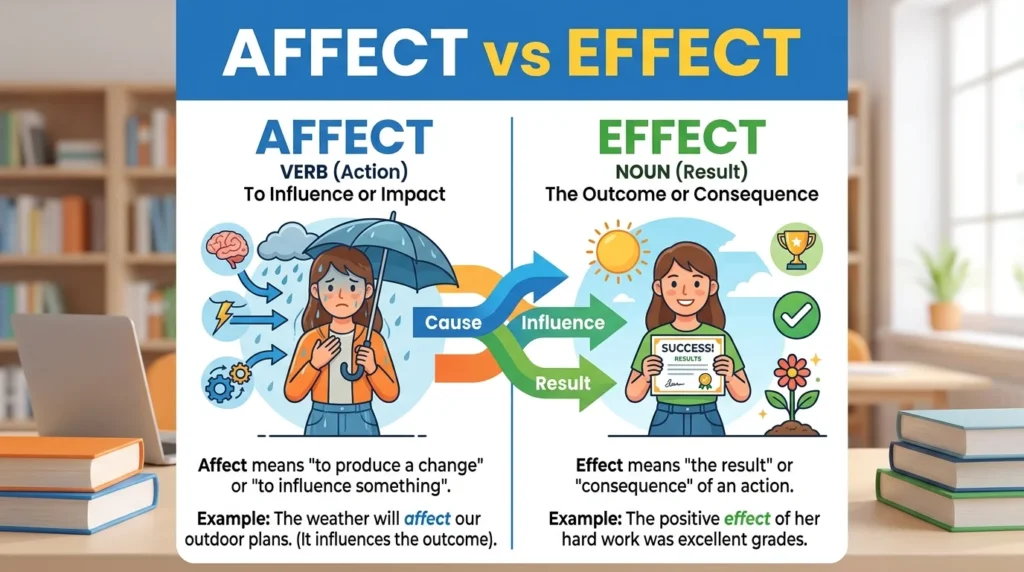
Many English learners confuse affect and effect because they sound similar and are closely related in meaning. However, they play different roles in a sentence and are usually used as different parts of speech. Understanding the difference will help you write and speak English more accurately.
In this guide, you’ll learn the meaning of affect and effect, their pronunciation, grammar, common mistakes, practical examples, comparison tables, quizzes, FAQs, and an easy memory trick to help you remember which word to use.
Understanding the Alter vs Altar meaning and difference can help prevent common vocabulary mistakes.
Quick Difference Table
| Word | Part of Speech | Meaning | Example | Common Usage |
| Affect | Verb | To influence or change something | Stress can affect your health. | Describing influence or impact |
| Effect | Noun | The result or outcome of something | The medicine had a positive effect. | Describing a result or consequence |
Read More: Altogether vs All Together
Meaning of Affect
Meaning
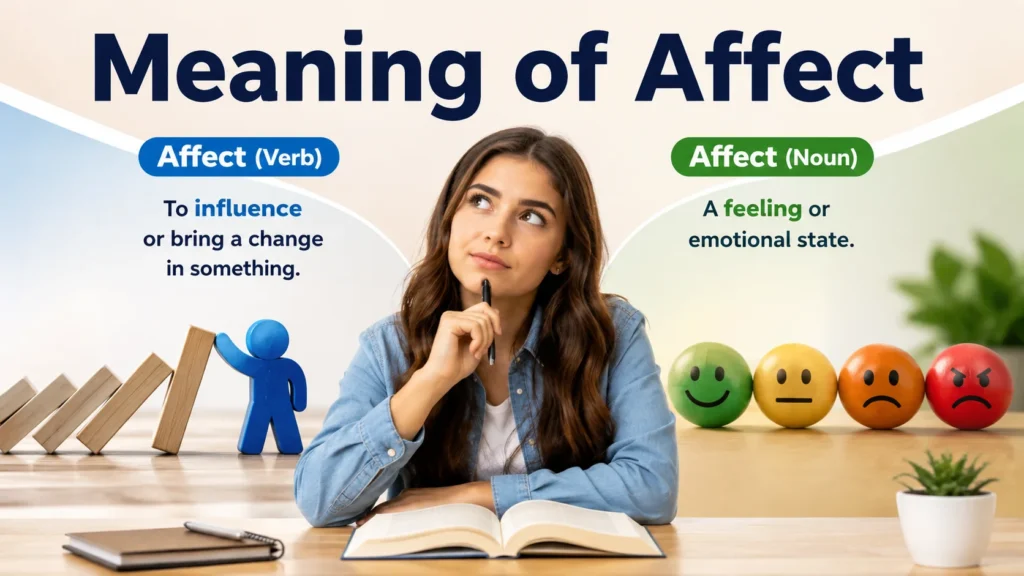
Affect is most commonly used as a verb. It means to influence, change, or have an impact on someone or something. It describes an action that causes a difference.
Pronunciation
| Feature | Details |
| IPA | /əˈfekt/ |
| American Pronunciation | uh-FEKT |
| British Pronunciation | uh-FEKT |
| Syllables | 2 |
| Word Stress | Second syllable |
Pronunciation Tips
- Say “uh” softly at the beginning.
- Stress the second syllable, “FEKT.”
- Keep the ending short and crisp.
- Practice by saying: “Affect, affect, affect.”
Function
Part of Speech
Verb
Grammar Role
Shows an action that influences another person, object, or situation.
Sentence Function
Explains what changes or influences something else.
Common Grammatical Patterns
- affect + noun
- affect + someone’s life
- affect + performance
- affect + decision
- affect + health
Example Sentences
- Lack of sleep can affect your mood.
- Rain may affect tomorrow’s baseball game.
- The news affected everyone in the office.
- Exercise positively affects your heart.
- High prices affect many families.
- Noise can affect your concentration.
- The teacher’s advice affected my confidence.
- Pollution affects wildlife every day.
- A healthy diet affects your energy level.
- His smile affected everyone around him.
When to Use
Use affect whenever you are talking about something that influences, changes, or impacts another thing.
Examples include:
- affect health
- affect behavior
- affect learning
- affect prices
- affect emotions
Common Mistakes
Many learners incorrectly use effect when they need a verb.
Incorrect:
- The weather will effect my plans.
Correct:
- The weather will affect my plans.
Remember that affect usually expresses the action of influencing something.
Read More: Alter vs Altar
Meaning of Effect
Meaning
Effect is most commonly used as a noun. It means the result, outcome, or consequence of an action or event.
Pronunciation
| Feature | Details |
| IPA | /ɪˈfekt/ |
| American Pronunciation | ih-FEKT |
| British Pronunciation | ih-FEKT |
| Syllables | 2 |
| Word Stress | Second syllable |
Pronunciation Tips
- Begin with a short “ih” sound.
- Stress the second syllable.
- Keep both syllables smooth.
- Practice by saying: “Effect, effect, effect.”
Function
Part of Speech
Noun
Grammar Role
Names the result of an action.
Sentence Function
Shows what happened because of something else.
Common Grammatical Patterns
- the effect of
- have an effect on
- positive effect
- negative effect
- long-term effect
Example Sentences
- The new policy had a positive effect.
- Exercise has a good effect on health.
- The medicine’s effect lasted all day.
- The storm had little effect on traffic.
- Education has a lasting effect on society.
- The movie created a powerful emotional effect.
- Climate change has serious effects worldwide.
- The treatment produced the desired effect.
- Her speech had a strong effect on the audience.
- Sunlight has a positive effect on many plants.
When to Use
Use effect when referring to the result or consequence of an action.
Examples include:
- positive effect
- side effect
- immediate effect
- long-term effect
- effect on health
Understanding the Alter vs Altar meaning and difference can help prevent common vocabulary mistakes.
Common Mistakes
Learners often write affect when they actually need a noun.
Incorrect:
- The medicine had a good affect.
Correct:
- The medicine had a good effect.
Remember that effect usually names the result.
Read More: Advice vs Advise
Side-by-Side Comparison
| Situation | Correct Word | Explanation | Example |
| Talking about influence | Affect | It is the action of changing something. | Poor weather can affect travel. |
| Talking about a result | Effect | It is the outcome of an action. | The effect was immediate. |
| Health discussions | Affect | Describes influence on health. | Smoking affects your lungs. |
| Medical outcome | Effect | Describes the result of treatment. | The drug’s effect lasted six hours. |
| School performance | Affect | Influence on grades. | Missing class affects learning. |
| Business results | Effect | The final outcome. | The campaign had a positive effect. |
| Emotional influence | Affect | Changes emotions. | Music affects emotions. |
| Scientific findings | Effect | The observed result. | Scientists measured the effect. |
| Environmental impact | Affect | Influence on nature. | Pollution affects rivers. |
| Final consequence | Effect | Describes what happened. | The effect surprised everyone. |
Practice Quiz
Fill in the Blanks
- Too much sugar can ______ your health.
- The medicine had an immediate ______.
- Stress may ______ your memory.
- The new law had little ______ on businesses.
- Bright lights can ______ your sleep.
- The teacher’s encouragement had a positive ______.
- Weather often ______ outdoor events.
- The speech had a lasting ______ on the audience.
- Poor communication can ______ teamwork.
- The training program had a noticeable ______.
Choose the Correct Word
- The noise will ______ my concentration.
- A. Affect
- B. Effect
- C. Affecting
- D. Effective
- The medicine had no ______.
- A. Affect
- B. Effect
- C. Affected
- D. Affects
- Exercise can ______ your mood.
- A. Effect
- B. Affect
- C. Effects
- D. Effective
- The rain had little ______ on traffic.
- A. Affect
- B. Affected
- C. Effect
- D. Affecting
- Pollution can ______ wildlife.
- A. Effect
- B. Affect
- C. Effects
- D. Effective
- The new rules had a positive ______.
- A. Affect
- B. Effect
- C. Affecting
- D. Affects
- His words deeply ______ me.
- A. Effect
- B. Affect
- C. Effective
- D. Effects
- The side ______ disappeared after two days.
- A. Affect
- B. Effect
- C. Affects
- D. Affecting
- Lack of exercise can ______ your fitness.
- A. Effect
- B. Affect
- C. Effective
- D. Effects
- The new software had a significant ______ on productivity.
- A. Affect
- B. Effect
- C. Affecting
- D. Affects
Answer Key
Fill in the Blanks
- affect, It means to influence your health.
- effect, It refers to the result of the medicine.
- affect, Stress influences memory.
- effect, The sentence refers to a result.
- affect, Bright lights influence sleep.
- effect, Encouragement produced a result.
- affects, The subject requires the third-person singular verb.
- effect, The audience experienced a result.
- affect, Poor communication influences teamwork.
- effect, The sentence describes the outcome.
Multiple Choice
- A, “Affect” is the correct verb.
- B, “Effect” is the noun meaning result.
- B, Exercise influences mood.
- C, The sentence needs a noun.
- B, Pollution influences wildlife.
- B, The sentence refers to a result.
- B, “Affected” would fit in the past tense, but among the options, “Affect” is the intended verb form.
- B, “Side effect” is a common expression.
- B, The verb “affect” means influence.
- B, Productivity experienced a result.
Final Thoughts
Although affect and effect look and sound alike, remembering their basic functions makes them much easier to use correctly. In most cases, affect is a verb that means to influence, while effect is a noun that means the result of that influence. A simple memory trick is to remember A for Action because affect is usually an action, and E for End Result because effect is usually the outcome. As you read, write, and practice English, pay attention to how these words appear in real sentences. Regular practice with examples will help you use both words naturally and confidently.
Frequently Asked Questions
What is the main difference between affect and effect?
Affect is usually a verb meaning “to influence,” while effect is usually a noun meaning “a result.”
Is affect always a verb?
No. In psychology, affect can also be a noun referring to emotional expression, but this use is uncommon.
Is effect always a noun?
Usually, yes. However, effect can also be a verb meaning “to bring about,” as in “effect change,” though this is more formal.
Which word is more common in everyday English?
Both are common, but affect is usually used as a verb and effect as a noun.
How do I remember affect vs effect?
Remember: Affect = Action, Effect = End Result.
Can I say “have an affect on”?
No. The correct phrase is have an effect on.
Can weather affect people?
Yes. Weather can influence health, mood, travel, and daily activities.
What is a side effect?
A side effect is an additional result, usually of a medicine or treatment, that may be unwanted.
Why do learners confuse affect and effect?
They have similar spelling, pronunciation, and related meanings.
Are affect and effect pronounced the same?
They are very similar, but the first vowel sound is slightly different.
Can affect and effect appear in the same sentence?
Yes. Example: “Lack of sleep can affect your performance, and the effect may last all day.”
Which word appears after “have an”?
The correct phrase is have an effect because a noun follows the article “an.”
When to Use Affect or Effect?
Use affect as a verb when you mean to influence or change something. Use effect as a noun when you mean the result or outcome of an action.
Examples:
- The weather can affect your mood.
- The new policy had a positive effect on productivity.
Is It “Effect Me” or “Affect Me”?
The correct phrase is “affect me.” Since you are talking about something influencing or changing you, you need the verb affect.
Correct: Loud noise can affect me.
Incorrect: Loud noise can effect me.The phrase “effect me” is only correct in the rare sense of effect meaning “to bring about” or “to cause,” which is uncommon in everyday English.
What Is the Trick to Remember Affect vs Effect?
A simple memory trick is:
- Affect = Action (Both start with A.) Use it as a verb.
- Effect = End Result (Both start with E.) Use it as a noun.
Remember this sentence:
Actions Affect, End Results are Effects.
This trick works for most everyday situations and helps you quickly choose the correct word.
What Does “Affect” Mean?
Affect means to influence, change, or have an impact on someone or something. It is most commonly used as a verb.
Examples:
- Lack of sleep can affect your concentration.
- Pollution affects the environment.
- Stress may affect your health.
In everyday English, affect almost always describes an action that causes a change or influence.

Caitlin Boylan is an experienced content writer, editor, educator, travel writer, and remote worker with more than 10 years of experience in English education and international communication. She is the founder and author of The Country Jumper, a travel blog dedicated to supporting solo travelers, especially women exploring life abroad. She is also the co-founder of Macro Magazine, a global online publication that shares diverse perspectives on worldwide topics that impact communities.
2 thoughts on “Affect vs Effect: Pronunciation, Meaning & Usage”