
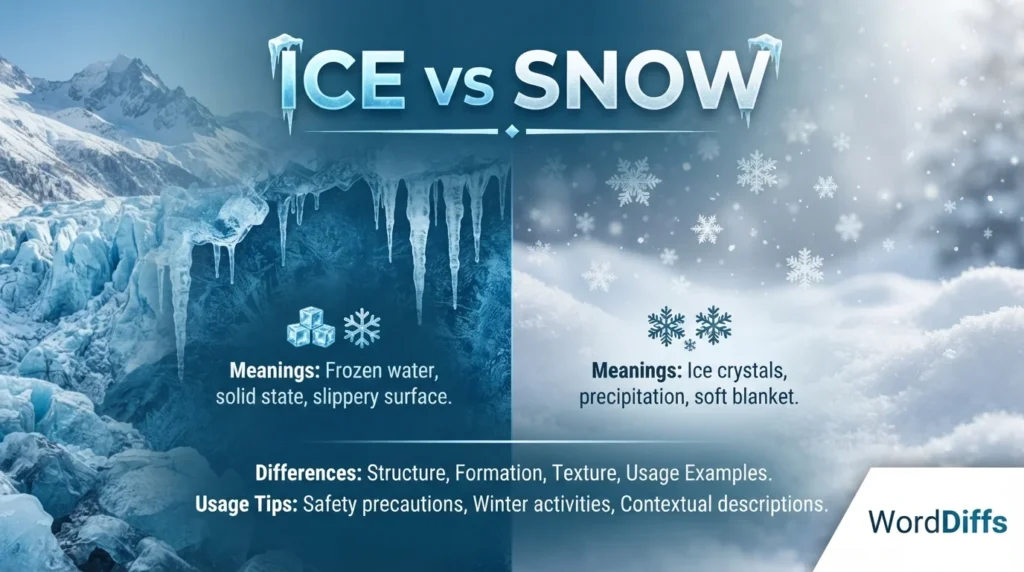
Ice and Snow are both related to frozen water, but they are not the same. Many English learners confuse these words because both appear in cold weather and winter situations. The main difference is that Ice is frozen water that becomes a solid surface or object, while Snow is frozen water that falls from clouds as soft flakes. This guide explains the meanings, pronunciation, grammar, examples, and correct usage of Ice vs Snow so you can use both words confidently in everyday English.
Quick Difference Table
| Word | Part of Speech | Meaning | Example | Common Usage |
| Ice | Noun, Verb | Frozen water that forms a hard solid | The lake is covered with ice. | Weather, drinks, surfaces, freezing |
| Snow | Noun, Verb | Frozen water crystals that fall from clouds | The snow covered the road. | Winter weather, snowfall, activities |
Meaning of Ice
Meaning
Ice means water that has frozen into a solid form. It is usually hard, cold, and clear or cloudy. Ice can form naturally on lakes, roads, and plants, or it can be made in a freezer for drinks and cooling.
Pronunciation
| Feature | Details |
| IPA | /aɪs/ |
| American Pronunciation | eyes |
| British Pronunciation | eyes |
| Syllables | 1 |
| Word Stress | Single syllable, fully stressed |
Pronunciation tips:
- Ice sounds like the word “eyes.”
- The vowel sound is a long “i” sound.
- Keep the ending sound sharp with an “s” sound.
- Do not pronounce it with two syllables.
Function
Ice is mainly a noun, but it can also be used as a verb.
- As a noun, it names frozen water.
- As a verb, it means to cover something with ice or add ice.
- It can appear with articles such as “the ice” or “some ice.”
- Common patterns include “ice on,” “ice in,” and “ice over.”
Example Sentences
- The children played carefully on the ice.
- I added some ice to my cold drink.
- The road was dangerous because of black ice.
- The lake turns into ice during very cold weather.
- She put ice on her injured ankle.
- The freezer makes fresh ice every day.
- The ice melted quickly under the warm sun.
- Farmers worried about ice damaging their crops.
- The glass was filled with ice and lemonade.
- The car windows were covered with ice this morning.
When to Use
Use Ice when you are talking about:
- Frozen water that is hard and solid.
- Ice cubes used in drinks.
- Frozen surfaces like roads or lakes.
- A thin frozen layer covering something.
- The process of becoming frozen.
Common Mistakes
A common mistake is using Ice for falling winter weather. Snow falls from clouds, but ice does not usually fall as soft flakes.
Incorrect: The ice was falling all night.
Correct: The snow was falling all night.
Remember that ice is a solid form of water, usually a hard surface or object.
Meaning of Snow
Meaning
Snow means frozen water crystals that form in clouds and fall to the ground as white flakes. It can cover roads, trees, and buildings during cold weather. Snow can also refer to the activity of snow falling.
Pronunciation
| Feature | Details |
| IPA | /snoʊ/ |
| American Pronunciation | snoh |
| British Pronunciation | snoh |
| Syllables | 1 |
| Word Stress | Single syllable, fully stressed |
Pronunciation tips:
- Snow begins with the “sn” sound.
- The vowel sound is a long “o” sound.
- The ending sounds like “oh.”
- Avoid adding an extra vowel before the word.
Function
Snow is mainly a noun, but it can also be used as a verb.
- As a noun, it describes frozen flakes falling from the sky.
- As a verb, it means for snow to fall.
- Common patterns include “snow falls,” “snow covers,” and “snow is falling.”
- It is often used with weather expressions.
Example Sentences
- The snow covered the mountains overnight.
- We built a snowman after the storm.
- The children enjoyed playing in the snow.
- Heavy snow delayed the morning flights.
- Snow usually falls during the coldest months.
- The weather report says it may snow tomorrow.
- Fresh snow made the park look beautiful.
- The snow melted when temperatures increased.
- They drove carefully because of the snow.
- The town received several inches of snow last week.
When to Use
Use Snow when you are talking about:
- Frozen flakes falling from the sky.
- Winter storms.
- Snow-covered landscapes.
- Snow activities like skiing or building snowmen.
- Weather conditions involving snowfall.
Common Mistakes
Many learners confuse Snow and Ice because both are forms of frozen water.
Incorrect: The snow on the road made it slippery.
Correct: The ice on the road made it slippery.
Snow is soft and made of flakes. Ice is hard and solid.
Side-by-Side Comparison
| Situation | Correct Word | Explanation | Example |
| Frozen drink cubes | Ice | Water frozen into solid pieces | Put some ice in my juice. |
| White flakes from clouds | Snow | Frozen crystals falling from the sky | Snow is falling outside. |
| Slippery road surface | Ice | A hard frozen layer creates danger | The ice made driving difficult. |
| Winter storm | Snow | Storms often produce snowfall | The snow blocked the roads. |
| Frozen lake | Ice | Water becomes a solid surface | The lake has thick ice. |
| Skiing activity | Snow | Skiing happens on snow-covered areas | We skied through fresh snow. |
| Freezer production | Ice | Machines create frozen water cubes | The freezer makes ice. |
| Mountain covering | Snow | Snow covers high areas in winter | The mountain has snow on top. |
Practice Quiz
Fill in the Blanks
- The children played in the fresh ______ after the storm.
- Please add some ______ to my lemonade.
- The road was slippery because of black ______.
- We watched the ______ fall from the sky.
- The lake was covered with thick ______.
- She put a bag of ______ on her injury.
- The weather forecast says it may ______ tonight.
- The freezer needs more time to make ______.
- The mountains looked beautiful with white ______.
- Drivers should be careful when there is ______ on the road.
Choose the Correct Word
- The glass contains cold water and ______.
A. snow
B. ice
C. both
D. neither - White flakes are falling from the sky. It is ______.
A. ice
B. snow
C. freeze
D. water - The lake became solid because of ______.
A. snow
B. ice
C. rain
D. cloud - Children built a snowman using ______.
A. ice
B. snow
C. water
D. frost - I need more ______ for my drink.
A. snow
B. ice
C. storm
D. cloud - The road became dangerous because of black ______.
A. snow
B. ice
C. rain
D. wind - The mountains were covered with fresh ______.
A. ice
B. snow
C. water
D. frost - The machine produces ______ cubes.
A. snow
B. ice
C. rain
D. clouds - We cannot see clearly during a heavy ______ storm.
A. ice
B. snow
C. water
D. frozen - The pond has a thin layer of ______ on top.
A. snow
B. ice
C. rain
D. cloud
Answer Key
- Ice. Ice is added to drinks to make them cold.
- Snow. Snow falls from clouds as frozen flakes.
- Ice. Water becomes ice when it freezes.
- Snow. Snow is soft enough to build snowmen.
- Ice. Ice cubes are used in beverages.
- Ice. Black ice is a slippery frozen road surface.
- Snow. Snow commonly covers mountains.
- Ice. Machines make ice cubes.
- Snow. Snowstorms involve falling snow.
- Ice. A pond surface freezes into ice.
Final Thoughts
Understanding Ice vs Snow becomes easier when you remember their basic difference. Ice is frozen water that forms a hard solid surface or object, while snow is frozen water that falls from clouds as flakes. Ice is common in drinks, roads, and frozen lakes. Snow is common in winter weather, storms, and outdoor activities. A simple memory trick is that ice is hard and snow is soft. When writing or speaking, think about whether you mean a solid frozen surface or falling winter flakes. This small difference will help you choose the correct word and communicate more clearly.
Frequently Asked Questions
What is the main difference between Ice and Snow?
Ice is hard frozen water, while snow is frozen water crystals that fall from clouds.
Are Ice and Snow the same thing?
No. Both come from frozen water, but they form differently and have different appearances.
Is Snow a type of Ice?
Yes, snow is a form of frozen water, but it is made of tiny ice crystals.
How do you pronounce Ice?
Ice is pronounced /aɪs/, like the word “eyes.”
How do you pronounce Snow?
Snow is pronounced /snoʊ/, with a long “o” sound.
Can Ice fall from the sky?
Small pieces of ice can fall during some weather conditions, but normal winter snowfall is snow.
Why do people confuse Ice and Snow?
People confuse them because both are connected to cold temperatures and frozen water.
Can Snow become Ice?
Yes. Snow can become ice when it melts and freezes again or becomes compressed.
Is Ice countable or uncountable?
Ice can be both. You can say “some ice” or “three pieces of ice.”
Is Snow countable or uncountable?
Snow is usually uncountable, but you can count snowfalls or snowstorms.
Which word should I use for winter weather?
Use snow for falling flakes and ice for frozen surfaces.
Can Ice and Snow be verbs?
Yes. Ice can mean to cover something with ice, and snow can describe snowfall.
What is black ice?
Black ice is a thin, nearly invisible layer of ice on roads or surfaces.

Caitlin Boylan is an experienced content writer, editor, educator, travel writer, and remote worker with more than 10 years of experience in English education and international communication. She is the founder and author of The Country Jumper, a travel blog dedicated to supporting solo travelers, especially women exploring life abroad. She is also the co-founder of Macro Magazine, a global online publication that shares diverse perspectives on worldwide topics that impact communities.