
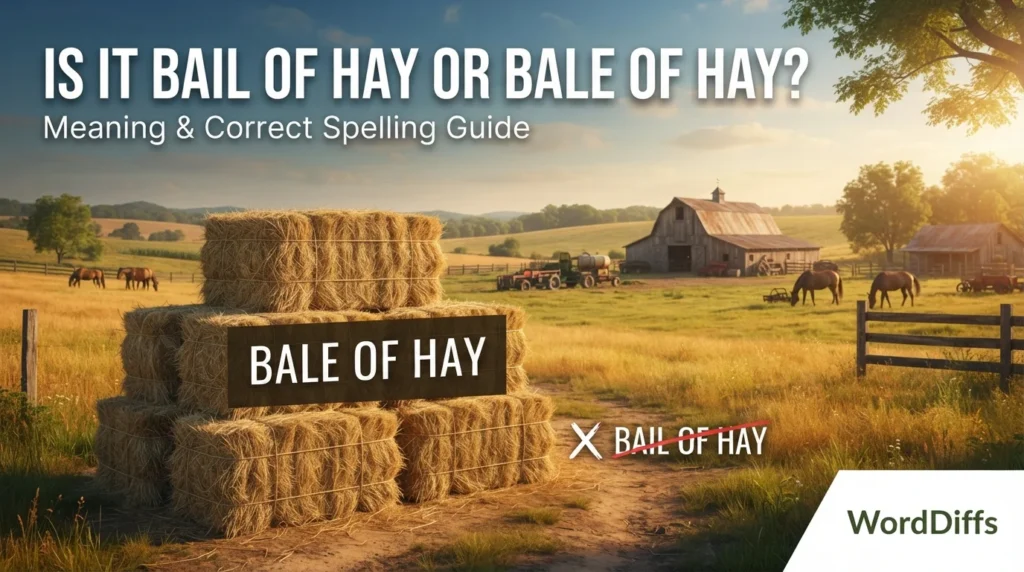
Have you ever wondered whether you should write bail of hay or bale of hay? This is a common spelling mistake because both bail and bale are real English words with completely different meanings. Since they sound exactly alike, many writers accidentally choose the wrong spelling, especially in informal writing or when typing quickly. Understanding the difference is important for clear communication, school assignments, professional documents, and everyday writing. In this guide, you’ll learn which spelling is correct, why the confusion happens, how to remember the right word, its pronunciation, origin, and plenty of practical examples that make the difference easy to understand.
Quick Facts Table
| Feature | Details |
| Correct Word | Bale of hay |
| Incorrect Word | Bail of hay (when referring to bundled hay) |
| Word Type | Noun |
| Meaning | A tightly packed bundle of hay or straw |
| Pronunciation | /beɪl/ (both words sound the same) |
| Common Error | Using bail instead of bale because they are homophones |
| Difficulty | Easy to Moderate |
What Does Bail of Hay or Bale of Hay Mean?
The phrase bale of hay refers to a large bundle of dried grass or straw that has been compressed and tied together for storage, transportation, or animal feed. Farmers commonly produce bales in fields after harvesting hay.
The phrase bail of hay is usually a spelling mistake. Although bail is a valid English word, it has completely different meanings that are unrelated to farming or hay.
Key Points
- Bale means a tightly packed bundle of hay, straw, cotton, or similar materials.
- Bail usually refers to legal release from custody, money paid for release, or removing water from a boat.
- Both words are pronounced the same, making them classic homophones.
- Context determines which spelling is correct.
Examples
- The farmer stacked every bale of hay in the barn.
- The horses ate one bale of hay each week.
- The judge granted bail to the defendant.
- They used a bucket to bail water out of the boat.
Is “Bail of Hay” Correct?
In almost every case, no.
When talking about agriculture, farming, livestock, or stored hay, bail of hay is an incorrect spelling. The mistake happens because people hear the pronunciation and spell the word the way it sounds instead of remembering its actual spelling.
Why It Is Incorrect
- Bail has legal and nautical meanings.
- It never means a bundle of hay.
- English contains many homophones that sound identical but have different spellings and meanings.
Common Situations Where People Make This Mistake
- Writing quickly
- Typing without spell check
- Learning English as a second language
- Hearing the phrase before seeing it written
- Confusing homophones
Incorrect Examples
- The tractor carried twenty bails of hay.
- We bought a bail of hay for the horses.
- Several bails were stacked beside the barn.
Each sentence should use bale instead.
What Is the Correct Spelling?
The correct phrase is bale of hay.
A bale is a compressed bundle that makes storage and transportation easier. Farmers create hay bales using specialized baling machines that compress and tie the hay.
Remember These Rules
- Use bale for hay, straw, cotton, paper, or recycled materials.
- Use bail for courts, prisons, legal matters, or removing water from boats.
- Never write “bail of hay” when discussing farming.
Correct Examples
- We loaded fifty bales of hay before sunset.
- Each bale weighed nearly 500 pounds.
- The cows needed another bale of hay during winter.
- The barn was filled with round hay bales.
Difference Between the Two Spellings
| Feature | Bail (Incorrect for Hay) | Bale (Correct) |
| Meaning | Legal release or removing water | Bundle of hay, straw, cotton, or similar material |
| Used in Farming | No | Yes |
| Used in Law | Yes | No |
| Refers to Bundles | No | Yes |
| Correct Phrase | Bail of hay ❌ | Bale of hay ✅ |
| Pronunciation | /beɪl/ | /beɪl/ |
Understanding the Difference
Although the pronunciation is identical, the meanings are completely different.
Think about the context:
- If you’re talking about a courtroom, use bail.
- If you’re talking about a farm, use bale.
Meaning of the Correct Word
A bale is a large, tightly compressed package of materials that are tied or wrapped together. While the phrase most commonly refers to hay, the word also applies to many other agricultural and industrial products.
A Bale Can Contain
- Hay
- Straw
- Cotton
- Wool
- Paper
- Cardboard
- Recyclable materials
Examples
- The workers moved cotton bales into the warehouse.
- Fresh hay bales covered the field.
- Each straw bale was wrapped in plastic.
- The recycling center compressed cardboard into large bales.
Pronunciation
IPA Pronunciation
- Bail: /beɪl/
- Bale: /beɪl/
Both words are pronounced exactly the same.
Syllable Breakdown
Bale
- Bale (1 syllable)
Bail
- Bail (1 syllable)
Pronunciation Tips
- The vowel sounds like the word day.
- Finish with a clear l sound.
- Since pronunciation cannot distinguish the words, rely on context and spelling.
Why Do People Make This Spelling Mistake?
English contains many homophones, and bail and bale are among the easiest to confuse.
Pronunciation Confusion
People naturally spell words based on how they sound. Since both words share identical pronunciation, many assume either spelling works.
Typing Mistakes
Fast typing often leads writers to choose the more familiar spelling without thinking about context.
Phonetic Spelling
Beginning writers frequently spell words exactly as they hear them, leading to bail instead of bale.
Similar-Looking Words
Both words contain four letters and differ by only one vowel.
Memory Errors
Many people remember hearing the phrase but cannot recall which spelling belongs to farming.
Regional Influence
In regions where farming vocabulary is less common, people may recognize bail from legal news more readily than bale, increasing the chance of confusion.
Origin and Etymology
The word bale comes from Middle English and Old French, ultimately tracing back to Germanic roots meaning a packed bundle or load. Over centuries, it became the standard English word for compressed packages of agricultural and commercial materials.
The word bail has a completely different history. It developed through Old French and Medieval Latin into English legal vocabulary, where it came to describe the temporary release of an accused person while awaiting trial. It also developed separate meanings related to scooping water from boats and certain structural supports.
Because the two words evolved from different linguistic origins but later came to share the same pronunciation, confusion between them has remained common in modern English.
How to Remember the Correct Spelling
Learning a simple memory trick can prevent this mistake permanently.
Memory Tricks
- Bale belongs in the barn. Both words contain the letter A.
- Hay is stored in a bale, not released on bail.
- Think of bale = barn = bundle.
- Think of bail = court = custody.
Quick Spelling Hacks
- If you’re talking about farming, choose bale.
- If you’re talking about judges or court, choose bail.
- Ask yourself whether the word means a bundle or legal release.
Examples in Sentences
| Incorrect Sentence | Correct Sentence |
| We bought a bail of hay yesterday. | We bought a bale of hay yesterday. |
| The horse ate an entire bail of hay. | The horse ate an entire bale of hay. |
| Several bails were stacked outside. | Several bales were stacked outside. |
| The tractor lifted a heavy bail. | The tractor lifted a heavy bale. |
| Every bail of hay was wrapped in plastic. | Every bale of hay was wrapped in plastic. |
| They stored the bails in the barn. | They stored the bales in the barn. |
| We counted thirty bails of hay. | We counted thirty bales of hay. |
| A wet bail is harder to move. | A wet bale is harder to move. |
| The farmer sold each bail for fifty dollars. | The farmer sold each bale for fifty dollars. |
| One bail of hay fed the cows for days. | One bale of hay fed the cows for days. |
| The truck delivered fresh bails. | The truck delivered fresh bales. |
| They covered every bail before the storm. | They covered every bale before the storm. |
| We rolled a round bail across the field. | We rolled a round bale across the field. |
| The sheep slept beside a bail of hay. | The sheep slept beside a bale of hay. |
| The workers loaded dozens of bails. | The workers loaded dozens of bales. |
Common Mistakes to Avoid
Even though bail and bale sound identical, they cannot be used interchangeably. Avoid these common errors to improve your writing accuracy.
- Writing “bail of hay” instead of “bale of hay.”
- Incorrect: The farmer bought a bail of hay.
- Correct: The farmer bought a bale of hay.
- Using “bail” for agricultural bundles.
- Remember that bale is always the correct word for bundles of hay, straw, cotton, or paper.
- Assuming pronunciation determines spelling.
- Since both words are pronounced /beɪl/, pronunciation alone cannot help you choose the correct spelling.
- Ignoring context.
- If the sentence is about farming, use bale.
- If it is about courts or legal release, use bail.
- Trusting autocorrect without reviewing the sentence.
- Spell checkers may not detect this mistake because both words are valid English words.
Similar Commonly Misspelled Words
| Incorrect or Confused Word | Correct Word | Difference |
| Bail | Bale | Legal release vs. bundle of hay |
| Sale | Sail | Selling vs. part of a boat |
| Brake | Break | Stop a vehicle vs. separate into pieces |
| Flour | Floor | Baking ingredient vs. surface of a room |
| Principal | Principle | School leader vs. rule or belief |
| Stationary | Stationery | Not moving vs. writing materials |
| Affect | Effect | Usually verb vs. usually noun |
| Loose | Lose | Not tight vs. fail to keep |
| Complement | Compliment | Complete vs. praise |
| Desert | Dessert | Dry land vs. sweet course |
Related Words
Synonyms
For bale:
- Bundle
- Pack
- Package
- Stack
- Roll
- Parcel
- Load
- Bundle of hay
Antonyms
There is no exact antonym for bale, but depending on context, these may be appropriate:
- Loose hay
- Scattered hay
- Unpacked material
- Unbundled material
Related Forms
| Word | Meaning |
| Bale | A compressed bundle |
| Baled | Compressed into bundles |
| Baling | The process of making bales |
| Hay bale | A bundle of dried grass |
| Straw bale | A compressed bundle of straw |
| Cotton bale | A compressed bundle of cotton |
| Bail | Legal release or to remove water |
| Bailed | Released or removed water |
| Bailing | The act of obtaining bail or removing water |
Grammar Tips
Using the correct spelling is only part of good grammar. These tips will help you use bale correctly in sentences.
- Use “bale” as a countable noun.
- Three bales of hay were delivered.
- Pluralize correctly.
- Singular: bale
- Plural: bales
- Use articles naturally.
- a bale of hay
- the bale
- several bales
- Keep subject and verb agreement correct.
- The bale is heavy.
- The bales are stacked outside.
- Choose words based on meaning, not pronunciation.
Writing Tips
These practical habits can help you avoid confusing bail and bale.
- Read your sentence after writing it.
- Think about the context before choosing the spelling.
- Learn common English homophones.
- Use a trusted dictionary when unsure.
- Proofread important emails and documents.
- Practice writing example sentences.
- Read books and articles that use farming vocabulary correctly.
- Remember that spell check cannot always catch real-word spelling mistakes.
Quick Spelling Checklist
| Checklist | Yes/No |
| Am I talking about hay or straw? | □ |
| If yes, did I write bale? | □ |
| Am I discussing courts or legal release? | □ |
| If yes, did I write bail? | □ |
| Did I proofread the sentence? | □ |
| Does the meaning match the spelling? | □ |
| Would the sentence still make sense if I replaced the word? | □ |
Key Takeaways
- Bale of hay is the correct phrase.
- Bail of hay is a spelling mistake.
- Bale means a compressed bundle of hay, straw, cotton, or similar material.
- Bail relates to legal release or removing water from a boat.
- Both words are homophones with identical pronunciation.
- Context is the easiest way to choose the correct spelling.
- A simple memory trick is “Bale belongs in the barn.”
- Careful proofreading helps prevent this common error.
Conclusion
Choosing between bail of hay and bale of hay becomes simple once you understand the meanings of the two words. Although they sound exactly alike, they serve completely different purposes in English. Bale refers to a tightly packed bundle of hay or other materials, while bail belongs to legal and nautical contexts. Because both spellings are legitimate English words, this mistake often slips past spell checkers, making careful proofreading especially important. By remembering that bale belongs in the barn and bail belongs in the courtroom, you can confidently use the correct spelling in school assignments, professional writing, and everyday communication. A little attention to context will help you avoid this common spelling mistake every time.
Frequently Asked Questions
Is “bail of hay” ever correct?
No. When referring to a bundle of hay, the correct phrase is always bale of hay. Although bail is a legitimate English word, it has meanings related to legal release, removing water from boats, or certain mechanical parts. It does not refer to agricultural bundles.
Why do people confuse bail and bale?
People confuse these words because they are perfect homophones. Both are pronounced /beɪl/, but they have different spellings and meanings. Many writers hear the phrase before seeing it written, causing them to choose the wrong spelling based solely on pronunciation.
What does “bale” mean?
A bale is a tightly compressed bundle of materials such as hay, straw, cotton, wool, paper, or cardboard. Bales make transportation and storage more efficient and are commonly used in agriculture and manufacturing industries.
What does “bail” mean?
Bail usually refers to money or security paid to obtain temporary release from custody while awaiting trial. It can also mean removing water from a boat or describe certain handles and mechanical components, depending on the context.
How do you pronounce bale?
Bale is pronounced /beɪl/. It has one syllable and rhymes with words such as mail, tail, rail, and sale. Its pronunciation is identical to that of bail, which is why spelling mistakes are so common.
How can I remember the correct spelling?
A helpful memory trick is “Bale belongs in the barn.” Since both bale and barn contain the letter A, it is easier to remember that agricultural bundles are always called bales, not bails.
Is “bale” used only for hay?
No. While bale of hay is the most familiar expression, bale also refers to compressed bundles of straw, cotton, wool, paper, cardboard, plastic, and other materials that are packed together for storage or transport.
Will spell check catch this mistake?
Not always. Since both bail and bale are correctly spelled English words, many spelling checkers cannot identify the error. Reviewing the sentence and considering its meaning is the best way to catch the mistake.
Is this mistake common in exams?
Yes. Homophone errors are common in school exams, English proficiency tests, and writing assignments. Teachers often expect students to distinguish between similar-sounding words based on meaning and context rather than pronunciation.
Which spelling should I use in professional writing?
Always use bale of hay when writing about farming, agriculture, livestock, or bundled materials. Correct word choice demonstrates attention to detail and improves the professionalism and accuracy of your writing.
Are bail and bale homophones?
Yes. Bail and bale are homophones because they share the same pronunciation but have different spellings and meanings. English contains many homophone pairs, making context essential for choosing the correct word.

Caitlin Boylan is an experienced content writer, editor, educator, travel writer, and remote worker with more than 10 years of experience in English education and international communication. She is the founder and author of The Country Jumper, a travel blog dedicated to supporting solo travelers, especially women exploring life abroad. She is also the co-founder of Macro Magazine, a global online publication that shares diverse perspectives on worldwide topics that impact communities.
1 thought on “Is It Bail of Hay or Bale of Hay? Meaning & Correct Spelling Guide”