
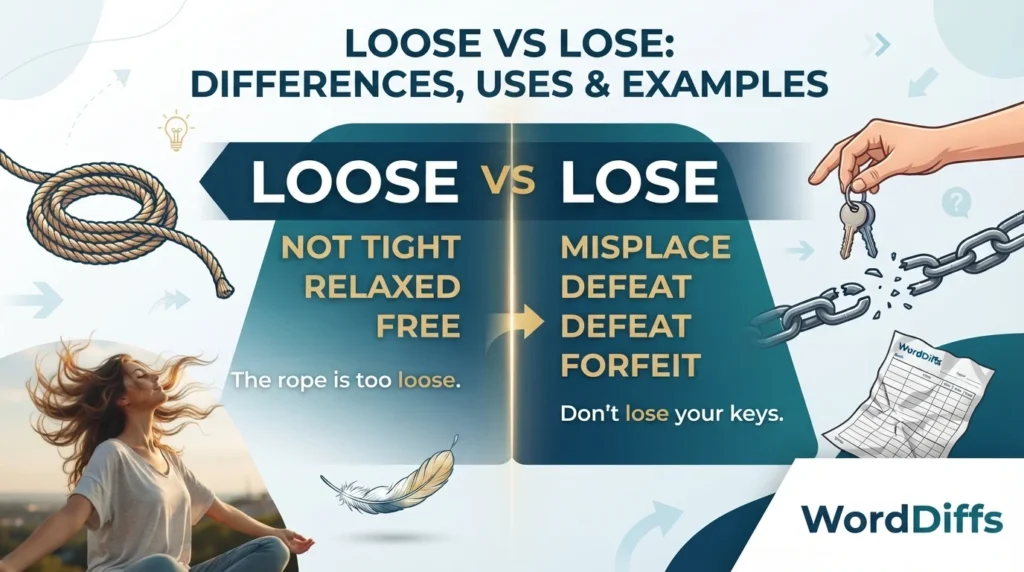
Many English learners confuse loose and lose because they look similar but have completely different meanings and pronunciations. Loose usually describes something that is not tight or something that has been released. Lose means to misplace something, fail to win, or no longer have something. This guide explains the difference between loose vs lose with simple meanings, pronunciation tips, examples, practice questions, and usage rules so you can choose the correct word confidently.
Quick Difference Table
| Word | Part of Speech | Meaning | Example | Common Usage |
| Loose | Adjective, Verb | Not tight, free, or released | My shirt is loose. | Clothing, objects, freedom |
| Lose | Verb | To misplace, fail, or no longer have | I do not want to lose my keys. | Possessions, games, opportunities |
Meaning of Loose
Meaning
Loose means something is not firmly attached, not tight, or has space to move. It can describe clothing, objects, rules, or situations. As a verb, loose means to release or set something free, although this use is less common.
Pronunciation
| Feature | Details |
| IPA | /luːs/ |
| American Pronunciation | loos |
| British Pronunciation | loos |
| Syllables | 1 |
| Word Stress | Entire word |
Pronunciation tips:
- Loose rhymes with words like “goose” and “moose.”
- The vowel sound is long, like the sound in “blue.”
- Do not pronounce it like “lose.”
Function
Loose is mainly an adjective.
It describes:
- Objects that are not tight.
- Things that are free or not fixed.
- Situations without strict control.
Common patterns:
- loose + noun
- be + loose
- become + loose
Example Sentences
- My shoes feel loose after I lost weight.
- The dog ran loose in the park.
- She wore a loose jacket during the cold evening.
- The screw became loose after years of use.
- The company has loose rules about working hours.
- I found a loose button on my shirt.
- The horse broke free and ran loose.
- His loose grip caused the phone to fall.
- The rope was loose and needed tightening.
- The child’s tooth became loose before falling out.
When to Use
Use loose when talking about something that is:
- Not tight.
- Not firmly attached.
- Free or uncontrolled.
- Relaxed or flexible.
Examples:
- loose clothes
- loose hair
- loose connection
- loose rules
Common Mistakes
A common mistake is writing lose when describing something that is not tight.
Incorrect: My pants are lose.
Correct: My pants are loose.
Remember: Loose has an extra “o” because it has extra space.
Meaning of Lose
Meaning
Lose means to no longer have something, fail to keep something, or not succeed in a competition. It can refer to objects, games, opportunities, feelings, or relationships.
Pronunciation
| Feature | Details |
| IPA | /luːz/ |
| American Pronunciation | looz |
| British Pronunciation | looz |
| Syllables | 1 |
| Word Stress | Entire word |
Pronunciation tips:
- Lose sounds like “looz.”
- The ending has a /z/ sound.
- It rhymes with “choose” and “news.”
- Do not confuse it with loose, which ends with an /s/ sound.
Function
Lose is a verb.
It shows:
- Losing possession of something.
- Failing in a contest.
- Becoming unable to keep something.
Common patterns:
- lose + object
- lose a game
- lose weight
- lose interest
- lose control
Example Sentences
- I do not want to lose my wallet.
- Our team may lose the final match.
- She hopes to lose weight through exercise.
- Do not lose your important documents.
- He started to lose confidence before the exam.
- They might lose their chance to apply.
- I often lose my glasses at home.
- The company could lose customers.
- We cannot afford to lose time.
- She was afraid she would lose her job.
When to Use
Use lose when you mean:
- Misplacing something.
- Failing to win.
- No longer having something.
- Reducing something, such as weight.
Examples:
- lose money
- lose a competition
- lose your phone
- lose interest
Common Mistakes
Many learners confuse lose with loose because they sound similar.
Incorrect: I don’t want to loose my keys.
Correct: I don’t want to lose my keys.
Memory trick: Lose has one “o” because you lose one “o” from loose.
Side-by-Side Comparison
| Situation | Correct Word | Explanation | Example |
| Clothing is too big | Loose | Describes something not tight | My sweater is loose. |
| Missing an item | Lose | Means misplace something | I might lose my phone. |
| A team fails | Lose | Means not win | They lose the game. |
| A rope is not tight | Loose | Means not firmly held | The rope is loose. |
| Losing weight | Lose | Means reduce something | She wants to lose weight. |
| A dog is free | Loose | Means not controlled | The dog is loose outside. |
Practice Quiz
Fill in the Blanks
- My jacket is too ______ after washing it.
- Be careful not to ______ your passport.
- The team may ______ the championship.
- The door handle feels ______.
- She wants to ______ five pounds.
- The bird flew ______ from its cage.
- I always worry that I will ______ my keys.
- His shoelaces are ______.
- They cannot afford to ______ the opportunity.
- The rules are too ______ for this competition.
Choose the Correct Word
- The shirt is too big and feels:
A. Lose
B. Loose
C. Loos
D. Losing - I do not want to _____ my wallet.
A. Loose
B. Lose
C. Loze
D. Loss - The player might _____ the match.
A. Lose
B. Loose
C. Loos
D. Loosing - The rope became _____.
A. Lose
B. Loss
C. Loose
D. Loze - She wants to _____ weight.
A. Loose
B. Lose
C. Loosed
D. Loosing - The dog was running _____ in the field.
A. Lose
B. Loose
C. Loss
D. Loze - Do not _____ your chance.
A. Loose
B. Lose
C. Losing
D. Loosed - My shoes are too _____.
A. Lose
B. Loose
C. Loss
D. Losed - They could _____ money this year.
A. Loose
B. Lose
C. Loos
D. Loosing - The connection is _____.
A. Lose
B. Loose
C. Loss
D. Losing
Answer Key
- B, Loose describes something that is not tight.
- B, Lose means to misplace something.
- A, Lose means fail to win.
- C, Loose describes something not firmly attached.
- B, Lose is used for reducing weight.
- B, Loose means free or uncontrolled.
- B, Lose means miss or fail to keep something.
- B, Loose describes shoes that are not tight.
- B, Lose means no longer have something.
- B, Loose describes a connection that is not secure.
Final Thoughts
The difference between loose vs lose becomes easier when you focus on meaning and spelling. Loose describes something free, relaxed, or not tight, while lose means to misplace, fail, or no longer have something. A simple memory trick is that loose has an extra “o” because it has extra space, while lose means something is gone. Pay attention to the context of your sentence, and you will quickly know which word fits. Practicing these words in everyday writing will help you avoid one of the most common English spelling mistakes.
Frequently Asked Questions
What is the difference between loose and lose?
Loose means not tight or free, while lose means to misplace, fail, or no longer have something.
How do you pronounce loose and lose?
Loose is pronounced /luːs/, while lose is pronounced /luːz/.
Is loose an adjective or a verb?
Loose is mainly an adjective, but it can also be used as a verb meaning to release.
Is lose always a verb?
Yes, lose is normally used as a verb.
Why do people confuse loose and lose?
They look similar and have similar pronunciations, but their meanings are different.
Is it correct to say I loose my keys?
No. The correct sentence is “I lose my keys.”
Is it correct to say my shirt is lose?
No. The correct sentence is “My shirt is loose.”
Does loose mean the opposite of tight?
Yes. Loose often means the opposite of tight.
Does lose mean fail?
Yes. Lose can mean fail to win a game or competition.
Can loose be used for animals?
Yes. A free or uncontrolled animal can be described as loose.
Which word is used for losing weight?
The correct word is lose, as in “lose weight.”
Does loose have an extra letter?
Yes. Loose has two “o” letters, while lose has one.
How can I remember loose vs lose?
Remember that loose has extra space with an extra “o,” while lose means something is gone.

Lauren Kafka is an experienced freelance writer, editor, English tutor, and writing coach with extensive expertise in education, journalism, publishing, and communications. She is the founder of Kafka Consulting LLC, where she provides private English tutoring, writing coaching, and educational consulting services for K-12 students, college students, graduate students, and adults.