
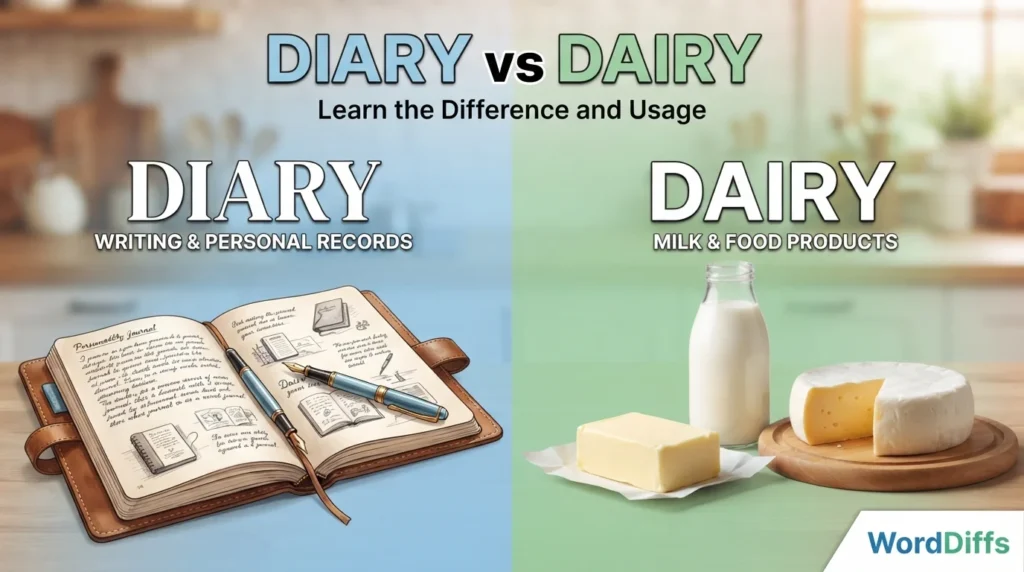
People often confuse Diary and Dairy because they look and sound similar. However, their meanings are completely different. A diary is a personal notebook used to record thoughts, experiences, or daily events. Dairy, on the other hand, relates to milk and foods made from milk, such as cheese, butter, and yogurt. Mixing up these words can cause spelling mistakes and misunderstandings in writing. This guide explains the meaning, pronunciation, grammar, correct usage, common mistakes, and practical examples of both words. By the end, you’ll know exactly when to use Diary and Dairy with confidence.
Quick Difference Table
| Word | Part of Speech | Meaning | Example | Common Usage |
| Diary | Noun | A personal book for recording thoughts or daily events | She writes in her diary every night. | Personal writing, journals, memories |
| Dairy | Adjective, Noun | Related to milk or foods made from milk, or a place where milk is produced | Milk is a dairy product. | Food, farming, nutrition |
Meaning of Diary

Meaning
A diary is a personal notebook or journal where someone writes about daily activities, feelings, experiences, plans, or memories. People often keep a diary to remember important events, express emotions, or track personal growth.
Unlike a notebook used for school or work, a diary usually contains personal and private information. Many people write in a diary every day, while others use it only for special occasions.
Pronunciation
| Feature | Details |
| IPA | /ˈdaɪəri/ |
| American Pronunciation | DYE-uh-ree |
| British Pronunciation | DYE-uh-ree |
| Syllables | 3 (di-a-ry) |
| Word Stress | First syllable (DYE) |
Pronunciation Tips
- Pronounce the first syllable like “dye.”
- The middle sound is a soft “uh.”
- Do not pronounce it as “dairy.”
- Say it slowly as DYE-uh-ree, then gradually increase your speed.
- Stress the first syllable more than the others.
Function
Part of Speech
Diary is a countable noun.
Grammar Role
It refers to a physical or digital book where personal thoughts or daily events are recorded.
Sentence Function
A diary usually functions as the subject or object of a sentence.
Examples:
- My diary is full of travel memories.
- She forgot her diary at home.
Common Grammatical Patterns
- keep a diary
- write in a diary
- read a diary
- personal diary
- travel diary
- diary entry
- daily diary
- maintain a diary
Their distinct sounds become easier to remember with Brake vs Break pronunciation guide and practical examples.
Example Sentences
- I write in my diary before going to bed every night.
- Her diary contains memories from her childhood.
- He bought a new diary for the upcoming year.
- My teacher encouraged us to keep a daily diary.
- She never lets anyone read her diary.
- I found an old diary while cleaning the attic.
- His travel diary describes every city he visited.
- Writing in a diary helps many people manage stress.
- The diary was filled with colorful sketches and notes.
- She started a gratitude diary to focus on positive experiences.
When to Use
Use diary when talking about:
- A personal journal
- Recording daily events
- Writing private thoughts
- Keeping memories
- Tracking goals or habits
- Writing about travel experiences
- Reflecting on personal growth
Examples:
- I keep a diary to remember important moments.
- She writes about her feelings in her diary.
- His travel diary became a bestselling book.
Common Mistakes
Mistake 1: Confusing “diary” with “dairy.”
❌ I bought a new dairy to write my thoughts.
✔ I bought a new diary to write my thoughts.
Mistake 2: Using diary for food-related topics.
❌ Cheese comes from diary products.
✔ Cheese comes from dairy products.
Mistake 3: Incorrect spelling
Many learners accidentally spell diary as dairy because the letters are very similar.
Memory Tip
Think of Diary as containing the word “day.” A diary is where you write about your day, making it easier to remember the correct spelling.
Meaning of Dairy
Meaning
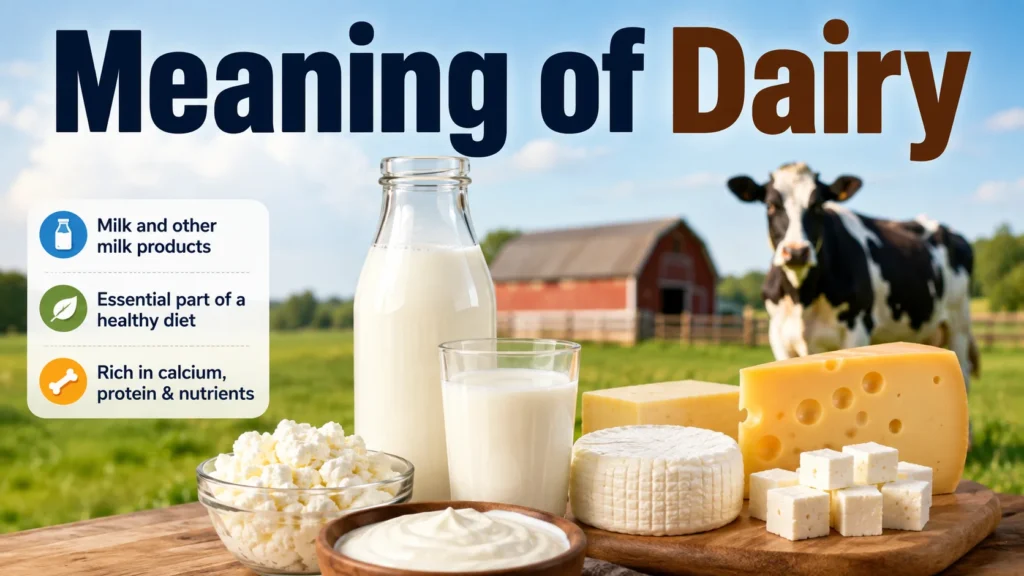
Dairy refers to milk and foods made from milk, such as cheese, butter, yogurt, cream, and ice cream. The word can also describe a farm or business that produces, processes, or sells milk and dairy products.
As an adjective, dairy describes anything related to milk or milk production.
Examples:
- Dairy products are rich in calcium.
- They own a dairy farm.
- She works in the dairy section of the supermarket.
Pronunciation
| Feature | Details |
| IPA | /ˈderi/ |
| American Pronunciation | DAIR-ee |
| British Pronunciation | DAIR-ee |
| Syllables | 2 (dair-y) |
| Word Stress | First syllable (DAIR) |
Pronunciation Tips
- Pronounce the first syllable like “air” with a d sound in front.
- The second syllable sounds like “ee.”
- Say DAIR-ee, not DYE-uh-ree.
- Notice that dairy has only two syllables, while diary has three.
- Stress the first syllable clearly.
Function
Part of Speech
Dairy can be both a noun and an adjective.
Grammar Role
As a noun, it refers to a place where milk is produced, processed, or sold.
As an adjective, it describes foods or businesses connected with milk.
Sentence Function
Dairy can function as:
- A noun: The dairy delivers fresh milk every morning.
- An adjective: She avoids dairy products because of lactose intolerance.
Common Grammatical Patterns
- dairy products
- dairy farm
- dairy cattle
- dairy industry
- dairy section
- dairy milk
- dairy business
- dairy company
Example Sentences
- Milk is one of the most common dairy products.
- The dairy farm has hundreds of healthy cows.
- She stopped eating dairy because of an allergy.
- We bought cheese from the local dairy shop.
- Butter is made from dairy ingredients.
- The supermarket has a large dairy section.
- Yogurt is a popular dairy food around the world.
- His family owns a successful dairy business.
- Fresh cream is another delicious dairy product.
- The dairy industry plays an important role in agriculture.
When to Use
Use dairy when talking about:
- Milk
- Cheese
- Butter
- Yogurt
- Cream
- Ice cream
- Dairy farms
- Milk production
- The dairy industry
- Foods made from milk
Examples:
- I drink dairy milk every morning.
- This recipe contains several dairy ingredients.
- They visited a dairy farm during the school trip.
Clear writing becomes simpler when you know the difference between Compare and Contrast and their specific purposes.
Common Mistakes
Mistake 1: Using “dairy” instead of “diary.”
❌ I wrote about my vacation in my dairy.
✔ I wrote about my vacation in my diary.
Mistake 2: Thinking dairy means a notebook.
❌ She keeps a dairy beside her bed.
✔ She keeps a diary beside her bed.
Mistake 3: Incorrect pronunciation
Many learners pronounce dairy the same as diary.
Remember:
- Diary = DYE-uh-ree (3 syllables)
- Dairy = DAIR-ee (2 syllables)
Memory Tip
Think of Dairy as containing “air.” Cows live outdoors in the fresh air and produce milk, making it easier to connect dairy with milk and dairy products.
Side-by-Side Comparison
| Situation | Correct Word | Explanation | Example |
| Writing about your personal thoughts | Diary | A diary is a personal journal for recording experiences. | She writes in her diary every evening. |
| Talking about milk | Dairy | Dairy refers to milk and milk-based foods. | Milk is a dairy product. |
| Recording daily memories | Diary | A diary is used to keep track of events and feelings. | His diary is full of travel stories. |
| Buying cheese | Dairy | Cheese is made from milk. | We bought fresh dairy products. |
| Keeping a private journal | Diary | A diary is usually personal and often private. | My diary is locked in a drawer. |
| Visiting a farm with cows | Dairy | A dairy farm raises cows for milk production. | The children toured a dairy farm. |
| Writing about your day | Diary | A diary stores daily experiences. | She wrote about school in her diary. |
| Shopping at a supermarket | Dairy | The dairy section contains milk products. | The butter is in the dairy aisle. |
| Reflecting on personal goals | Diary | A diary helps record progress and ideas. | He keeps a fitness diary. |
| Discussing the food industry | Dairy | Dairy describes the milk production industry. | The dairy industry supports many farmers. |
Practice Quiz
Fill in the Blanks
Choose Diary or Dairy to complete each sentence.
- She writes about her dreams in her ______ every night.
- Butter and cheese are ______ products.
- I received a beautiful ______ as a birthday gift.
- The children visited a ______ farm during their field trip.
- He forgot to pack his ______ before leaving for vacation.
- Yogurt is found in the ______ section of the grocery store.
- Keeping a ______ can improve your writing skills.
- Many people avoid ______ because of lactose intolerance.
- Her grandmother’s ______ contained stories from many years ago.
- Fresh milk comes from the ______ industry.
Choose the Correct Word
1. Which sentence is correct?
A. I wrote my homework in my dairy.
B. I wrote my homework in my diary.
C. I wrote my milk in my diary.
D. I wrote my cheese in my dairy.
2. Which word refers to milk products?
A. Diary
B. Dairy
C. Daily
D. Daring
3. Which sentence uses the correct spelling?
A. She keeps a dairy beside her bed.
B. He drinks diary every morning.
C. She keeps a diary beside her bed.
D. He wrote cheese in his diary.
4. Which sentence is correct?
A. Cheese is a diary product.
B. Cheese is a dairy product.
C. Cheese is a daily product.
D. Cheese is a diary entry.
5. What do people usually write in?
A. Dairy
B. Diary
C. Milk
D. Cheese
6. Which sentence is correct?
A. The dairy farm produces milk.
B. The diary farm produces milk.
C. The diary shop sells butter.
D. The diary industry makes yogurt.
7. Which word means a personal journal?
A. Dairy
B. Diary
C. Daily
D. Daring
8. Which sentence is correct?
A. She bought fresh diary products.
B. She bought fresh dairy products.
C. She bought fresh daily products.
D. She bought fresh diary entries.
9. Which word belongs in this sentence?
“I read my old ______ from high school.”
A. Dairy
B. Diary
C. Milk
D. Butter
10. Which sentence is correct?
A. Ice cream is a diary product.
B. Ice cream is a dairy product.
C. Ice cream is a diary notebook.
D. Ice cream is a diary memory.
Answer Key
| Question | Answer | Explanation |
| Fill in the Blank 1 | Diary | A diary is used for writing personal thoughts. |
| Fill in the Blank 2 | Dairy | Butter and cheese are made from milk. |
| Fill in the Blank 3 | Diary | A diary is a personal notebook. |
| Fill in the Blank 4 | Dairy | A dairy farm produces milk. |
| Fill in the Blank 5 | Diary | You pack a diary if you plan to write in it. |
| Fill in the Blank 6 | Dairy | Grocery stores have dairy sections for milk products. |
| Fill in the Blank 7 | Diary | A diary helps record ideas and experiences. |
| Fill in the Blank 8 | Dairy | Lactose intolerance is related to dairy foods. |
| Fill in the Blank 9 | Diary | Old personal writings are kept in a diary. |
| Fill in the Blank 10 | Dairy | The dairy industry produces milk and related foods. |
| Multiple Choice 1 | B | A diary is used for writing. |
| Multiple Choice 2 | B | Dairy refers to milk and milk products. |
| Multiple Choice 3 | C | “Diary” is the correct spelling for a personal journal. |
| Multiple Choice 4 | B | Cheese is made from milk, so it is a dairy product. |
| Multiple Choice 5 | B | People write in a diary. |
| Multiple Choice 6 | A | A dairy farm produces milk. |
| Multiple Choice 7 | B | A diary is a personal journal. |
| Multiple Choice 8 | B | Dairy products include milk, cheese, and yogurt. |
| Multiple Choice 9 | B | A diary contains personal memories and experiences. |
| Multiple Choice 10 | B | Ice cream is made from milk, making it a dairy product. |
Final Thoughts
Understanding the difference between Diary and Dairy is easier once you connect each word with its purpose. A diary is a personal journal where you write about your thoughts, experiences, or daily activities. Dairy relates to milk, foods made from milk, or the farming and production of milk. Although the words look similar, they have different meanings, spellings, pronunciations, and uses. A simple memory trick is to think of diary as containing day, reminding you that it is where you write about your day. Think of dairy as relating to cows, milk, cheese, butter, and yogurt. When writing, pause for a moment and consider whether you are talking about personal writing or milk products. With regular practice and careful proofreading, choosing the correct word will soon become second nature.
Frequently Asked Questions
[/faq_accordion]
What is the difference between diary and dairy?
A diary is a personal journal used for recording thoughts or daily events. Dairy refers to milk, foods made from milk, or the business of producing milk.
Is diary a noun?
Yes. Diary is a countable noun that refers to a book or digital journal where people record personal experiences or daily activities.
Is dairy a noun or an adjective?
Dairy can be both. As a noun, it refers to a place where milk is produced or sold. As an adjective, it describes foods or products made from milk.
Why do people confuse diary and dairy?
They have very similar spellings and are pronounced somewhat alike, but their meanings are completely different.
How do you pronounce diary?
In American English, diary is pronounced /ˈdaɪəri/, which sounds like DYE-uh-ree.
How do you pronounce dairy?
In American English, dairy is pronounced /ˈderi/, which sounds like DAIR-ee.
Can diary and dairy ever mean the same thing?
No. They have unrelated meanings and cannot be used interchangeably.
What are some examples of dairy products?
Common dairy products include milk, cheese, butter, yogurt, cream, ice cream, and cottage cheese.
Can I use “diary” to mean a notebook?
Sometimes, but only if the notebook is used to record personal thoughts, experiences, or daily events. A regular notebook for school or work is not usually called a diary.
What is a dairy farm?
A dairy farm is a farm where cows, goats, or other milk-producing animals are raised to produce milk and other dairy products.
How can I remember the difference between diary and dairy?
Remember this simple trick:
- Diary = Day = Writing about your day
- Dairy = Milk = Foods from milk
This association makes it much easier to choose the correct spelling.
Which word is more commonly confused in English?
Diary and Dairy are among the most commonly confused word pairs because they differ by only two letters while having completely different meanings.
[/faq_accordion]

Lauren Kafka is an experienced freelance writer, editor, English tutor, and writing coach with extensive expertise in education, journalism, publishing, and communications. She is the founder of Kafka Consulting LLC, where she provides private English tutoring, writing coaching, and educational consulting services for K-12 students, college students, graduate students, and adults.