
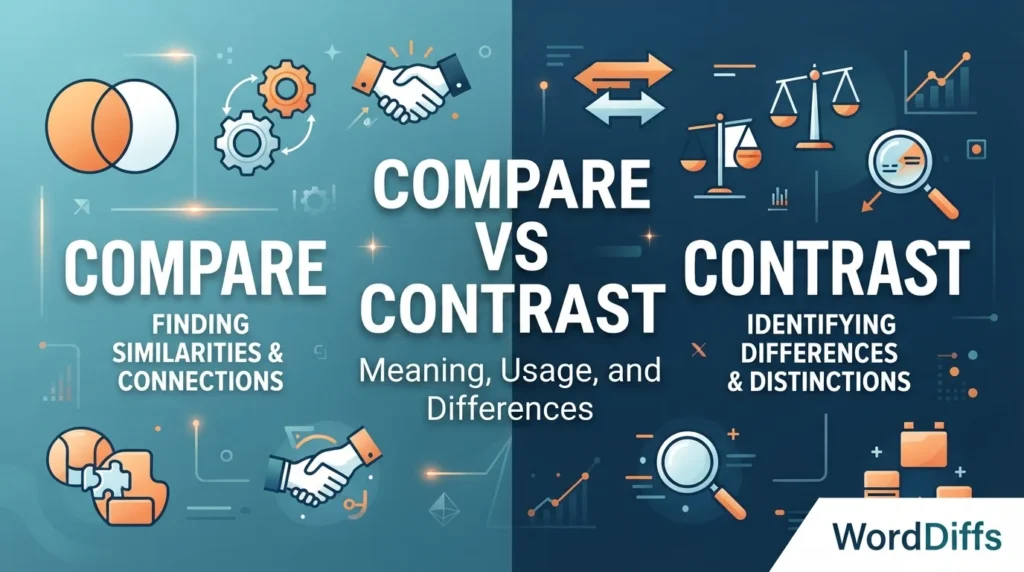
Many English learners confuse compare and contrast because both words are used when discussing two or more things. Although they are closely related, they are not interchangeable. Compare focuses on identifying similarities, while contrast emphasizes differences. Understanding when to use each word improves speaking, writing, and academic communication. In this guide, you’ll learn the meaning, pronunciation, grammar, examples, common mistakes, and practical usage of both words. You’ll also find comparison tables, quizzes, FAQs, and memory tips to help you confidently choose the correct word in any situation.
Clear examples of Droop vs Drop usage in sentences make their different meanings easier to recognize and remember.
Quick Difference Table
| Word | Part of Speech | Meaning | Example | Common Usage |
| Compare | Verb | To examine similarities and differences, often focusing on similarities | Let’s compare these two phones. | Comparing products, ideas, people, and results |
| Contrast | Verb, Noun | To show or examine differences | The report contrasts city life with country life. | Highlighting differences in writing, art, and analysis |
Meaning of Compare
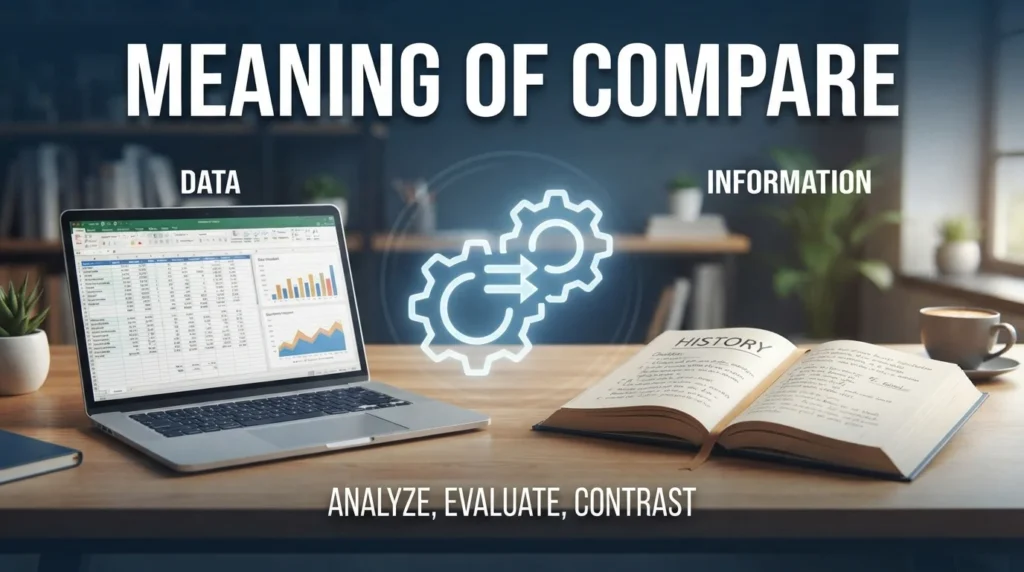
Meaning
Compare means to examine two or more people, objects, ideas, or situations to identify how they are alike and how they differ. In everyday English, the focus is often on finding similarities.
Pronunciation
| Feature | Details |
| IPA | /kəmˈper/ |
| American Pronunciation | kuhm-PAIR |
| British Pronunciation | kuhm-PAIR |
| Syllables | 2 |
| Word Stress | Second syllable |
Pronunciation Tips
- Stress the second syllable: per.
- The first syllable sounds like kuhm.
- Avoid saying COM-pare with stress on the first syllable.
Function
Part of Speech
Verb
Grammar Role
Shows the action of examining similarities or making evaluations.
Sentence Function
Acts as the main verb describing comparison.
Common Grammatical Patterns
- compare A and B
- compare A with B
- compare A to B
- compared with
- compared to
Example Sentences
- Please compare these two laptops before buying one.
- Teachers often compare students’ test scores.
- We compared our vacation photos yesterday.
- You should compare prices before shopping online.
- Scientists compare research findings carefully.
- My brother likes to compare cars by fuel economy.
- The article compares modern schools with older ones.
- We compared the weather in both cities.
- She compared the two paintings during class.
- It is difficult to compare these experiences fairly.
When to Use
Use compare when you want to:
- Find similarities between things.
- Evaluate products or services.
- Analyze people, ideas, or events.
- Discuss similarities and differences together.
- Make informed decisions.
Common Mistakes
- Using compare when only differences are discussed.
- Forgetting the correct prepositions like with or to.
- Assuming it always means finding differences only.
- Comparing things that are not logically related.
Meaning of Contrast
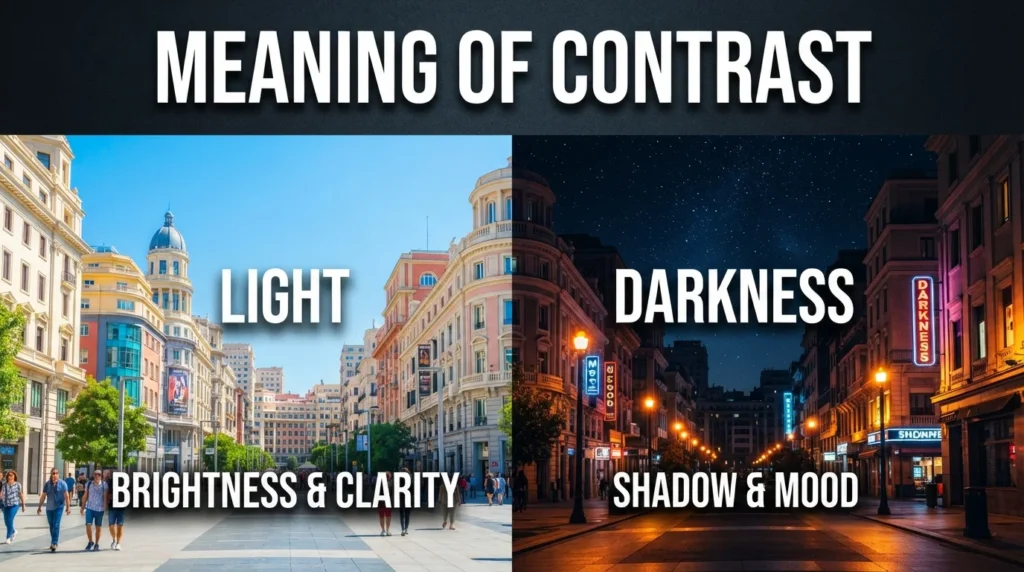
Meaning
Contrast means to examine or highlight the differences between two or more people, objects, ideas, or situations. It helps readers or listeners understand what makes things different.
Pronunciation
| Feature | Details |
| IPA | /kənˈtræst/ (verb), /ˈkɑːntræst/ (noun, American) |
| American Pronunciation | kuhn-TRAST (verb) |
| British Pronunciation | kuhn-TRAHST (verb) |
| Syllables | 2 |
| Word Stress | Second syllable (verb) |
Understanding Eligible vs Illegible meaning and differences can prevent confusion when choosing the correct word in formal English.
Pronunciation Tips
- Stress the second syllable when used as a verb.
- Keep the first syllable short.
- Practice saying contrast after compare to hear the difference.
Function
Part of Speech
Verb and noun
Grammar Role
Describes highlighting differences or refers to the difference itself.
Sentence Function
Functions as a verb in actions and as a noun when discussing differences.
Common Grammatical Patterns
- contrast A with B
- contrast between A and B
- in contrast
- by contrast
Example Sentences
- The teacher asked us to contrast the two stories.
- Her calm attitude contrasts with his excitement.
- The report contrasts rural and urban lifestyles.
- Dark colors contrast beautifully with white walls.
- The author contrasts hope and fear throughout the novel.
- We contrasted the old plan with the new one.
- The documentary contrasts different cultures respectfully.
- Bright flowers contrast against the green grass.
- The manager contrasted last year’s sales with this year’s results.
- Their personalities contrast in many ways.
When to Use
Use contrast when you want to:
- Focus mainly on differences.
- Highlight opposing ideas.
- Analyze literature or art.
- Explain distinctions.
- Improve descriptive writing.
Common Mistakes
- Using contrast when discussing similarities.
- Confusing the noun and verb forms.
- Forgetting to use with after the verb.
- Assuming contrast means comparison in general.
Side-by-Side Comparison
| Situation | Correct Word | Explanation | Example |
| Looking for similarities between two phones | Compare | Focus is on similarities | Compare these phones before buying. |
| Showing how two books differ | Contrast | Focus is on differences | Contrast the themes of both books. |
| Evaluating two job offers | Compare | Looking at benefits and features | Compare both job offers carefully. |
| Writing an essay about differences | Contrast | Academic writing often highlights differences | Contrast city life with country life. |
| Shopping online | Compare | Checking prices and features | Compare prices across websites. |
| Explaining opposite personalities | Contrast | Differences are emphasized | Their personalities contrast greatly. |
| Reviewing products | Compare | Overall evaluation | Compare both cameras before deciding. |
| Literary analysis | Contrast | Examining opposing ideas | Contrast the two main characters. |
Practice Quiz
Fill in the Blanks
- Please ________ these two smartphones before purchasing one.
- The essay will ________ traditional education with online learning.
- We should ________ the prices before making a decision.
- The artist used bright colors to ________ the dark background.
- Can you ________ your results with mine?
- The report ________ life in the city and the countryside.
- Scientists often ________ data from different experiments.
- His quiet personality ________ with his energetic brother.
- Let’s ________ the advantages of both plans.
- The teacher asked us to ________ the two historical events.
Choose the Correct Word
1. We need to ________ the two proposals.
A. Compare
B. Contrast
C. Comparing
D. Contrasted
2. The article ________ modern farming with traditional methods.
A. Compare
B. Contrasts
C. Compared
D. Comparing
3. Please ________ these prices before you buy.
A. Compare
B. Contrasting
C. Contrasted
D. Contrasts
4. Their personalities ________ sharply.
A. Compare
B. Contrasts
C. Contrast
D. Compared
5. The teacher asked us to ________ the similarities.
A. Contrast
B. Compare
C. Contrasted
D. Contrasting
6. This paragraph helps ________ the two opinions.
A. Compare
B. Contrasts
C. Contrast
D. Compare with
7. We should ________ both hotels before booking.
A. Compare
B. Contrasting
C. Contrasted
D. Contrasts
8. The movie ________ wealth and poverty.
A. Compare
B. Contrasts
C. Comparing
D. Compared
9. The chart allows readers to ________ sales figures.
A. Compare
B. Contrasting
C. Contrasts
D. Contrasted
10. The speaker wanted to ________ the two leadership styles.
A. Compare
B. Contrasted
C. Comparing
D. Contrasts
Answer Key
- Compare. You are evaluating two proposals.
- Contrasts. The sentence highlights differences.
- Compare. Comparing prices helps you choose.
- Contrast. The plural subject takes the base verb.
- Compare. Similarities require comparison.
- Contrast. The focus is on differences between opinions.
- Compare. Evaluating hotels involves comparison.
- Contrasts. The movie highlights opposing conditions.
- Compare. Readers examine similarities and differences.
- Compare. Leadership styles are being evaluated.
Final Thoughts
The difference between compare and contrast is simple once you remember their main focus. Compare is used when looking for similarities, although it may also include differences. Contrast is used when emphasizing differences. Choosing the correct word makes your writing clearer and more accurate, especially in academic essays, business reports, and everyday conversations. A simple memory trick is this: compare connects similar things, while contrast concentrates on differences. Whenever you’re unsure, ask yourself whether you’re mainly discussing what is alike or what is different. With regular practice, using these two words correctly will become natural.
Frequently Asked Questions
What is the main difference between compare and contrast?
Compare focuses on similarities, while contrast emphasizes differences.
Can compare include differences?
Yes. Comparing often includes both similarities and differences, but usually starts by identifying similarities.
Does contrast only discuss differences?
Yes. Contrast specifically highlights differences.
Are compare and contrast synonyms?
No. They are related but have different purposes.
Which word is common in academic writing?
Both are common, especially in essays that ask students to compare and contrast topics.
Is compare always followed by “with”?
No. It can be followed by with, to, or joined directly with and, depending on the context.
Can contrast be a noun?
Yes. For example, “The contrast between the two paintings is striking.”
How do I remember the difference?
Think of compare as connecting similarities and contrast as concentrating on differences.
Which word should I use when shopping?
Use compare because you evaluate products by looking at features, prices, and benefits.
Can I use compare in formal writing?
Yes. It is appropriate in academic, professional, and everyday writing.
Is contrast commonly used in literature?
Yes. Writers often contrast characters, themes, and settings to create stronger storytelling.
What are common mistakes learners make?
The most common mistake is using compare when discussing only differences or using contrast when talking about similarities.
Caitlin Boylan is an experienced content writer, editor, educator, travel writer, and remote worker with more than 10 years of experience in English education and international communication. She is the founder and author of The Country Jumper, a travel blog dedicated to supporting solo travelers, especially women exploring life abroad. She is also the co-founder of Macro Magazine, a global online publication that shares diverse perspectives on worldwide topics that impact communities.
1 thought on “Compare vs Contrast: Meaning, Usage, and Differences”