
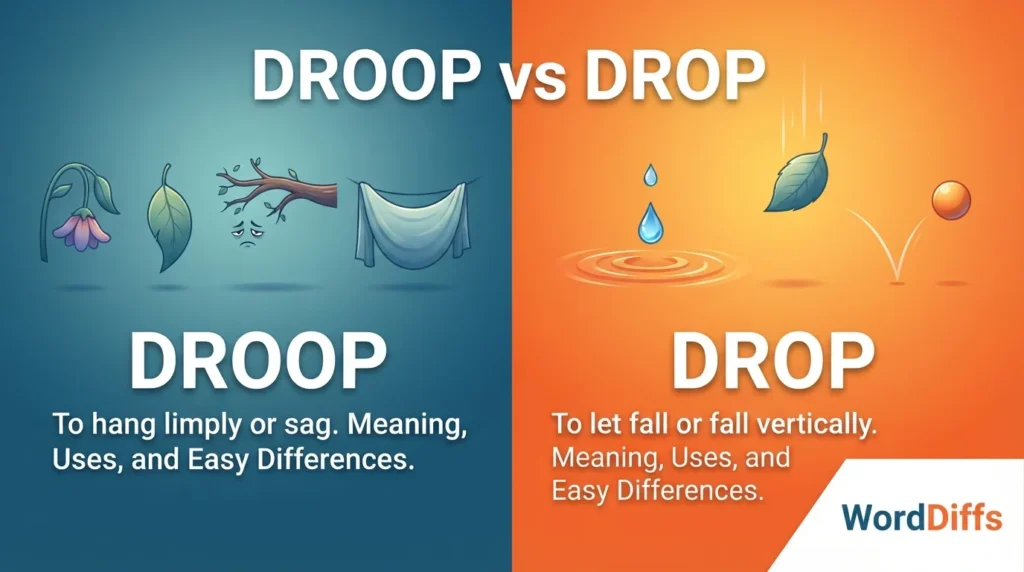
Many English learners confuse droop and drop because both can describe something moving downward. However, they have different meanings and are used in different situations. Droop usually describes something hanging or bending downward because it is weak, tired, or lacking support. Drop usually means to let something fall, to fall from a higher place, or to decrease.
In this guide, you’ll learn the meaning, pronunciation, grammar, examples, common mistakes, and correct usage of both words. By the end, you’ll know exactly when to use droop and when to use drop in everyday English.
Quick Difference Table
| Word | Part of Speech | Meaning | Example | Common Usage |
| Droop | Verb, Noun | To bend or hang downward because of weakness | The flowers began to droop. | Plants, shoulders, eyelids, mood |
| Drop | Verb, Noun | To fall or let something fall | She dropped her phone. | Objects, prices, temperatures, rain |
Meaning of Droop
Meaning
Droop means to bend, hang, or fall downward because something lacks strength, support, or energy. It often describes plants, body parts, or someone’s appearance when they are tired or sad.
Pronunciation
| Feature | Details |
| IPA | /druːp/ |
| American Pronunciation | droop |
| British Pronunciation | droop |
| Syllables | 1 |
| Word Stress | Droop |
Pronunciation Tips
- Rhymes with loop, group, and soup.
- The oo sounds like the oo in food.
- Say it with one smooth syllable.
Function
Part of Speech
- Verb
- Noun (less common)
Grammar Role
As a verb, it describes something bending or hanging downward.
Sentence Function
Usually acts as the main verb.
Common Grammatical Patterns
- droop slowly
- droop with age
- droop from lack of water
- droop because of heat
- drooping leaves
Example Sentences
- The flowers began to droop in the afternoon heat.
- His shoulders drooped after the long meeting.
- The tree branches drooped under the heavy snow.
- My eyelids started to droop during the movie.
- The old flag drooped without any wind.
- The plant will droop if you forget to water it.
- Her smile seemed to droop after hearing the news.
- The puppy’s ears drooped sadly.
- The fabric began to droop over the edge of the table.
- The sunflower drooped before the rain arrived.
When to Use
Use droop when something hangs downward because it is weak, tired, heavy, or unsupported.
Common situations include:
- Plants without enough water
- Tired eyes
- Hanging branches
- Slumped shoulders
- Sad expressions
Common Mistakes
- Do not use droop when you simply mean something falls.
- Remember that droop usually suggests a slow hanging motion.
- Avoid saying “the ball drooped.” A ball drops, not droops.
Meaning of Drop
Meaning
Drop means to fall, cause something to fall, decrease, or move downward from a higher position. It has many everyday uses in English.
Pronunciation
| Feature | Details |
| IPA | /drɑːp/ (US), /drɒp/ (UK) |
| American Pronunciation | drop |
| British Pronunciation | drop |
| Syllables | 1 |
| Word Stress | Drop |
Pronunciation Tips
- Rhymes with stop, top, and shop.
- Keep the vowel short.
- Pronounce the ending p clearly.
Function
Part of Speech
- Verb
- Noun
Grammar Role
As a verb, it describes falling or causing something to fall.
Sentence Function
Usually serves as the action verb.
Common Grammatical Patterns
- drop something
- drop by
- drop off
- drop down
- prices drop
- temperatures drop
Example Sentences
- She accidentally dropped her keys.
- The glass fell and dropped onto the floor.
- Please drop the package at my office.
- Temperatures will drop tonight.
- The leaves began to drop in autumn.
- His grades dropped last semester.
- Raindrops started to drop from the clouds.
- Don’t drop your phone.
- Sales dropped during the winter.
- The elevator dropped a few inches before stopping.
When to Use
Use drop when talking about:
- Something falling
- Letting something fall
- Delivering something
- A decrease in numbers or amounts
- Visiting briefly (“drop by”)
Common Mistakes
- Don’t replace drop with droop when something falls quickly.
- Remember that drop can describe decreases, while droop cannot.
- Avoid saying “prices drooped.” Prices drop.
Side-by-Side Comparison
| Situation | Correct Word | Explanation | Example |
| A flower hangs because it lacks water | Droop | It bends from weakness | The flower began to droop. |
| A cup falls from the table | Drop | It falls downward | The cup dropped. |
| Someone’s shoulders hang from sadness | Droop | Shows tiredness or emotion | His shoulders drooped. |
| Stock prices decrease | Drop | Means decline | Prices dropped today. |
| Tree branches bend under snow | Droop | Heavy weight causes hanging | The branches drooped. |
| You let your phone fall | Drop | You release it | I dropped my phone. |
| Eyelids become heavy | Droop | Due to tiredness | My eyelids drooped. |
| Rain falls from clouds | Drop | Falling movement | Rain began to drop. |
| A flag hangs without wind | Droop | Hangs loosely | The flag drooped. |
| Water falls from a bottle | Drop | Falls downward | Water dropped onto the floor. |
Practice Quiz
Fill in the Blanks
- The flowers began to ______ after two days without water.
- Please don’t ______ your laptop.
- His shoulders started to ______ after the long hike.
- The temperature will ______ tonight.
- The old curtain began to ______ in the middle.
- She accidentally ______ her wallet.
- My eyelids began to ______ during the lecture.
- Sales usually ______ after the holidays.
- The branches ______ because of the heavy fruit.
- Don’t ______ the glass on the floor.
Choose the Correct Word
1. The roses began to ____ in the heat.
A. Drop
B. Droop
C. Drive
D. Draw
2. Please don’t ____ your camera.
A. Droop
B. Drive
C. Drop
D. Dry
3. His shoulders ____ after hearing the bad news.
A. Drooped
B. Dropped
C. Drove
D. Drew
4. Prices may ____ this month.
A. Droop
B. Drop
C. Draw
D. Drift
5. The leaves began to ____ because they lacked water.
A. Drop
B. Drive
C. Droop
D. Draw
6. She accidentally ____ the plate.
A. Drooped
B. Dropped
C. Drew
D. Dried
7. My eyelids started to ____.
A. Drop
B. Droop
C. Draw
D. Dream
8. The company’s profits ____ last year.
A. Drooped
B. Drop
C. Dropped
D. Drooping
9. The heavy fruit made the branches ____.
A. Droop
B. Drop
C. Draw
D. Drift
10. Please ____ by my office tomorrow.
A. Droop
B. Drop
C. Draw
D. Dream
Answer Key
- Droop. Flowers bend because they lack water.
- Drop. It means to let something fall.
- Drooped. Shoulders hang because of sadness or tiredness.
- Drop. Prices decrease, they do not droop.
- Droop. Plants hang downward when weak.
- Dropped. The plate fell.
- Droop. Eyelids become heavy and hang.
- Dropped. Profits decreased.
- Droop. Heavy fruit causes branches to hang.
- Drop. “Drop by” means to visit briefly.
Final Thoughts
Although droop and drop both involve downward movement, they describe different actions. Droop refers to hanging or bending downward because of weakness, weight, or lack of support. Drop refers to falling, letting something fall, delivering something, or decreasing in amount or value.
An easy way to remember the difference is this: droop hangs, drop falls. If something slowly bends because it is weak or heavy, choose droop. If something falls or decreases, choose drop. Practicing these words in everyday sentences will help you use them naturally and confidently in both speaking and writing.
Frequently Asked Questions
What is the difference between droop and drop?
Droop means to hang or bend downward because of weakness, while drop means to fall or let something fall.
Can droop and drop be used interchangeably?
No. They describe different types of downward movement.
Is droop always about plants?
No. It can also describe shoulders, eyelids, ears, branches, flags, and facial expressions.
Can drop mean decrease?
Yes. It commonly refers to decreases in prices, temperatures, sales, or numbers.
Is drop a noun?
Yes. For example, “A drop of water.”
Is droop a noun?
Yes, but it is less common than the verb form.
How do you pronounce droop?
It is pronounced /druːp/ and rhymes with loop.
How do you pronounce drop?
In American English, it is /drɑːp/, and in British English, /drɒp/.
Which word describes tired eyelids?
Droop is the correct word.
Which word describes falling rain?
Drop is generally the correct choice.
Can prices droop?
No. Prices drop, not droop.
How can I remember the difference?
Think: Droop hangs because it is weak. Drop falls because it moves downward.

Josie Palmer is an experienced SEO Content Consultant, content strategist, and founder of JOT SEO, a consultancy focused on helping businesses improve their search visibility through effective SEO and content strategies. With more than 8 years of experience in SEO, content development, and digital marketing, she specializes in creating data-driven content strategies that help businesses grow online.
1 thought on “Droop vs Drop: Meaning, Uses, and Easy Differences”