
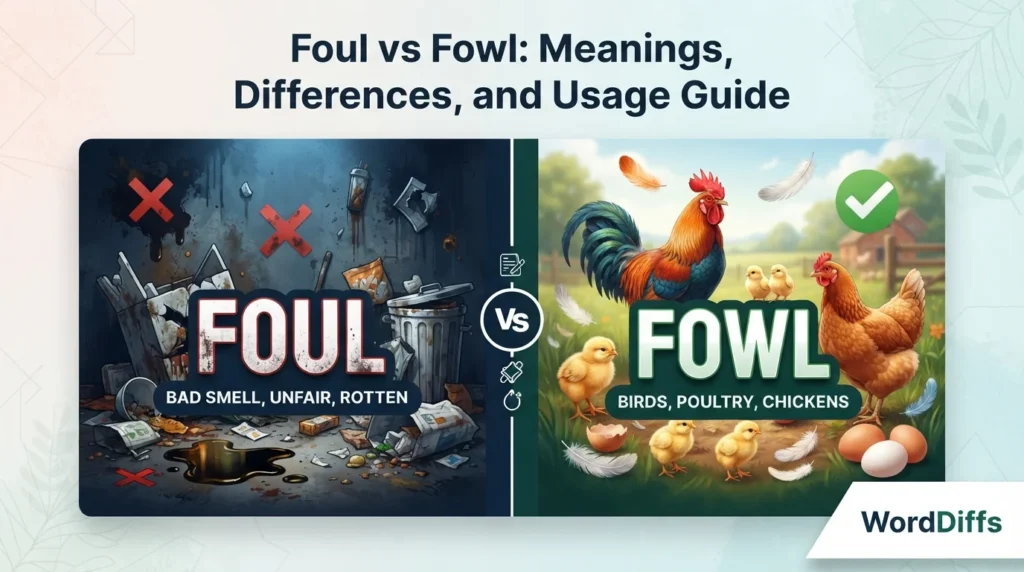
English learners often confuse foul vs fowl because the words sound almost identical but have completely different meanings. Foul usually describes something unpleasant, unfair, or against rules, while fowl refers to birds, especially domestic birds raised for food or eggs. This guide explains their meanings, pronunciation, grammar, differences, and correct usage with simple examples. By the end, you will know exactly when to use each word.
Quick Difference Table
| Word | Part of Speech | Meaning | Example | Common Usage |
| Foul | Adjective, verb, noun | Unpleasant, illegal, dirty, or against rules | The player committed a foul. | Sports, behavior, smells |
| Fowl | Noun | A bird, especially a chicken or similar bird | The farmer raised fowl. | Animals, farming, food |
Meaning of Foul
Meaning
Foul means something that is offensive, unpleasant, dirty, unfair, or not allowed by rules. It can describe smells, actions, language, weather, sports violations, or behavior.
Pronunciation
| Feature | Details |
| IPA | /faʊl/ |
| American Pronunciation | fowl |
| British Pronunciation | fowl |
| Syllables | One syllable |
| Word Stress | Entire word |
Pronunciation tips:
- Foul rhymes with “owl.”
- The vowel sound is like the sound in “out.”
- It is pronounced the same way as “fowl.”
Function
Foul can function as:
- An adjective describing something unpleasant or offensive.
- A verb meaning to break rules or make something dirty.
- A noun referring to a violation in sports.
Common patterns:
- foul smell
- foul language
- commit a foul
- foul up a plan
Example Sentences
- The garbage produced a foul smell after sitting outside all day.
- The basketball player received a foul during the game.
- She apologized for using foul language at dinner.
- The storm created foul weather conditions.
- The referee noticed the player’s foul move.
- The factory was accused of fouling the river.
- His foul attitude made teamwork difficult.
- The child accidentally fouled the clean water.
- The team lost because of too many fouls.
- The kitchen became foul after the food spoiled.
When to Use
Use foul when talking about:
- Bad smells or unpleasant things.
- Breaking rules in sports or competitions.
- Offensive behavior or language.
- Making something dirty or polluted.
Common Mistakes
A common mistake is using foul when talking about birds. Remember:
- Foul = bad, unfair, dirty, or against rules.
- Fowl = bird.
Meaning of Fowl
Meaning
Fowl is a noun that means a bird, especially a domesticated bird such as a chicken, turkey, duck, or goose. It is often used when discussing farming, hunting, or food.
Pronunciation
| Feature | Details |
| IPA | /faʊl/ |
| American Pronunciation | fowl |
| British Pronunciation | fowl |
| Syllables | One syllable |
| Word Stress | Entire word |
Pronunciation tips:
- Fowl has the same sound as “foul.”
- It rhymes with “howl” and “owl.”
- The spelling tells you the meaning, not the sound.
Function
Fowl functions as:
- A noun naming a type of bird.
Common patterns:
- domestic fowl
- wild fowl
- farm fowl
- water fowl
Example Sentences
- The farmer keeps fowl near the barn.
- Chickens are common types of domestic fowl.
- The hunter watched wild fowl near the lake.
- The market sells fresh fowl products.
- The farmer protected the young fowl from predators.
- Ducks and geese are examples of water fowl.
- The village depended on fowl for eggs and meat.
- The book explained different species of fowl.
- The children learned how to care for fowl.
- The farm displayed several types of fowl.
When to Use
Use fowl when discussing:
- Birds kept on farms.
- Birds used for food.
- Wild birds hunted for sport.
- Scientific or agricultural topics involving birds.
Common Mistakes
Many learners confuse fowl with foul because they sound identical. Always check the meaning:
- Talking about birds? Use fowl.
- Talking about something bad or illegal? Use foul.
Side-by-Side Comparison
| Situation | Correct Word | Explanation | Example |
| A bad smell | Foul | Describes something unpleasant | The room had a foul odor. |
| A farm bird | Fowl | Refers to a bird | The farmer raised fowl. |
| A sports violation | Foul | Means breaking rules | The referee called a foul. |
| Chickens and ducks | Fowl | Names birds | Ducks are a type of fowl. |
| Offensive words | Foul | Describes improper language | He used foul language. |
Practice Quiz
Fill in the Blanks
- The referee called a ______ during the match.
- The farmer raises ______ on his property.
- The trash created a ______ odor.
- Chickens are a type of domestic ______.
- The player received a penalty for a ______.
- The lake attracted wild ______.
- The spoiled food had a ______ smell.
- The farmer studied different types of ______.
- The coach warned players not to commit a ______.
- Ducks and geese are examples of ______.
Choose the Correct Word
- The referee stopped the game because of a:
A. Fowl
B. Foul
C. Foule
D. Fowle - The farmer owns several types of:
A. Foul
B. Fowl
C. Fouls
D. Fouling - The garbage produced a:
A. fowl smell
B. foul smell
C. fowl rule
D. foul bird - A chicken is a type of:
A. foul
B. fowl
C. fouled
D. foulness - The player broke the rules and committed a:
A. fowl
B. foul
C. bird
D. animal - Wild birds can also be called:
A. foul
B. fowl
C. foulers
D. fouls - Offensive speech may be described as:
A. foul language
B. fowl language
C. fowl words
D. bird language - The farm protects its:
A. foul
B. fowl
C. fouls
D. foulness - The smell from the garbage was:
A. fowl
B. foul
C. birdlike
D. feathered - The hunter searched for:
A. foul
B. fowl
C. fouling
D. foulness
Answer Key
- B, A foul is a rule violation in sports.
- B, Fowl refers to birds.
- B, Foul describes an unpleasant smell.
- B, A chicken is a type of fowl.
- B, A foul is a violation of rules.
- B, Fowl refers to birds.
- A, Foul describes offensive language.
- B, Farms keep fowl.
- B, Foul describes a bad smell.
- B, Hunters may search for wild fowl.
Final Thoughts
The difference between foul vs fowl is simple once you focus on meaning instead of pronunciation. Both words sound the same, but they belong to different categories. Foul describes something bad, unpleasant, unfair, or against rules. Fowl refers to birds such as chickens, ducks, and turkeys. A useful memory trick is that fowl has “owl” inside it, reminding you that it is a bird. When writing, always consider the context first. If you mean a problem, bad smell, or rule violation, choose foul. If you mean a bird, choose fowl.
Frequently Asked Questions
Are foul and fowl pronounced the same?
Yes. Both words are pronounced /faʊl/.
Is fowl a type of animal?
Yes. Fowl refers to birds, especially domestic birds.
What does foul mean in sports?
Foul means a violation of the rules during a game.
Can foul be used as a verb?
Yes. Foul can mean to make something dirty or polluted.
Is chicken a fowl?
Yes. A chicken is a common type of fowl.
Is foul an adjective?
Yes. It can describe something unpleasant or offensive.
Why do people confuse foul and fowl?
They are homophones, meaning they sound the same but have different meanings.
Can fowl describe wild birds?
Yes. Wild birds can also be called fowl.
Does foul always mean bad?
Usually, yes. It often describes something unpleasant or wrong.
What is a foul smell?
A foul smell is a very unpleasant or disgusting odor.
Is foul language correct usage?
Yes. Foul language means rude or offensive words.
How can I remember the difference between foul and fowl?
Remember that fowl contains “owl,” which is a bird.
Are foul and fowl interchangeable?
No. They have different meanings and cannot replace each other.

Caitlin Boylan is an experienced content writer, editor, educator, travel writer, and remote worker with more than 10 years of experience in English education and international communication. She is the founder and author of The Country Jumper, a travel blog dedicated to supporting solo travelers, especially women exploring life abroad. She is also the co-founder of Macro Magazine, a global online publication that shares diverse perspectives on worldwide topics that impact communities.
1 thought on “Foul vs Fowl: Meanings, Differences, and Usage Guide”