
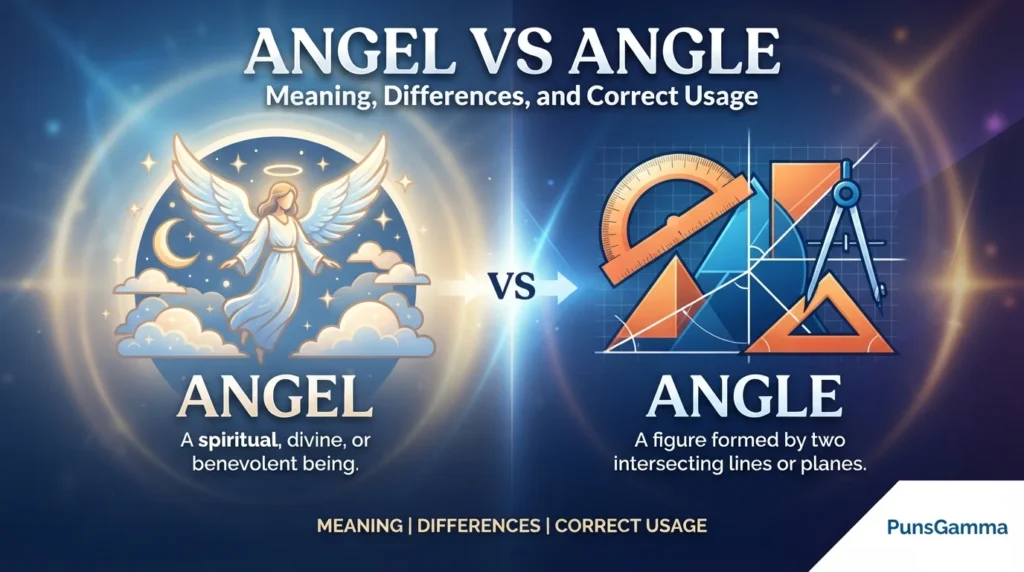
Many English learners confuse angel and angle because they look and sound similar. However, these two words have completely different meanings and are used in different situations. An angel usually refers to a spiritual being or a kind and caring person, while an angle refers to the space between two lines or a particular way of looking at something. Understanding the difference between these words will help you avoid common writing and speaking mistakes. In this guide, you’ll learn the meaning, pronunciation, grammar, usage, and real-life examples of angel and angle in simple American English, making it easy to remember when to use each word correctly.
Read More Differences Between Bale vs Bail
Quick Difference Table
| Word | Part of Speech | Meaning | Example | Common Usage |
| Angel | Noun | A spiritual being or a very kind person | The nurse was an angel during my recovery. | Religion, literature, compliments, everyday speech |
| Angle | Noun | The space formed where two lines meet or a point of view | Draw a right angle on the paper. | Math, geometry, photography, writing, discussions |
Also Learn The Meaning of Beside vs Besides
Meaning of Angel
Meaning
An angel is a noun that most commonly refers to a spiritual being found in many religions. Angels are often described as messengers, protectors, or guides. In everyday English, angel is also used to describe someone who is extremely kind, helpful, patient, or generous.
Unlike angle, which relates to geometry or viewpoints, angel refers to a person or supernatural being.
Pronunciation
| Feature | Details |
| IPA | /ˈeɪn.dʒəl/ |
| American Pronunciation | AYN-juhl |
| British Pronunciation | AYN-juhl |
| Syllables | 2 (an-gel) |
| Word Stress | First syllable |
Pronunciation Tips
- Pronounce the first syllable like the word “aim” without the m sound.
- The g makes a soft /dʒ/ sound, as in job or giant.
- The ending -el sounds like juhl, not gel.
- Stress the first syllable: AYN-juhl.
- Do not confuse the ending with the word angle, which ends with a clear gl sound.
Function
Part of Speech
Angel is a countable noun.
Grammar Role
It names a person, spiritual being, or someone admired for exceptional kindness.
Sentence Function
An angel can function as:
- The subject of a sentence
- The object of a verb
- The object of a preposition
- A subject complement after a linking verb
Understanding the Compare vs Contrast differences can make your writing clearer and more precise.
Common Grammatical Patterns
- an angel
- the angel
- guardian angel
- angel wings
- angel from heaven
- look like an angel
- be an angel
- my little angel
Example Sentences
- My grandmother believes an angel watches over our family.
- The little girl looked like an angel in her white dress.
- Thank you for helping me move. You’re an angel.
- The story tells of an angel delivering an important message.
- Our neighbor was an angel when she cared for our dog.
- The child smiled like a cheerful angel.
- Everyone called the volunteer an angel because she always helped others.
- The painting shows an angel with large white wings.
- He said his teacher was an angel for staying after school to help him.
- During the difficult time, my best friend was an absolute angel.
When to Use
Use angel when referring to:
- A spiritual or religious being
- Someone who is exceptionally kind or caring
- Literary or artistic descriptions
- Compliments for helpful people
- Figurative expressions about goodness or kindness
Correct Examples
- She was an angel during my illness.
- The church window shows an angel holding a trumpet.
- My aunt is an angel for always helping everyone.
Common Mistakes
1. Confusing angel with angle
❌ Draw an angel of 90 degrees.
✅ Draw an angle of 90 degrees.
A 90-degree measurement is an angle, not an angel.
2. Misspelling the Word
Some learners accidentally write:
- angel instead of angle
- angle instead of angel
Remember:
- Angel relates to kindness or spiritual beings.
- Angle relates to lines, corners, viewpoints, and geometry.
3. Using angel for Mathematical Ideas
❌ Measure the angel carefully.
✅ Measure the angle carefully.
Mathematics always uses angle.
4. Forgetting It Is a Countable Noun
Use articles correctly.
✅ An angel appeared.
✅ The angel smiled.
Not:
❌ Angel appeared.
5. Using angel Too Literally
In everyday English, calling someone an angel is usually a compliment rather than a religious statement.
Example:
- Thanks for bringing me dinner. You’re an angel.
Here, angel simply means “a very kind person,” not an actual heavenly being.
Here Is More Meaning Of Beside vs Besides
Meaning of Angle
Meaning
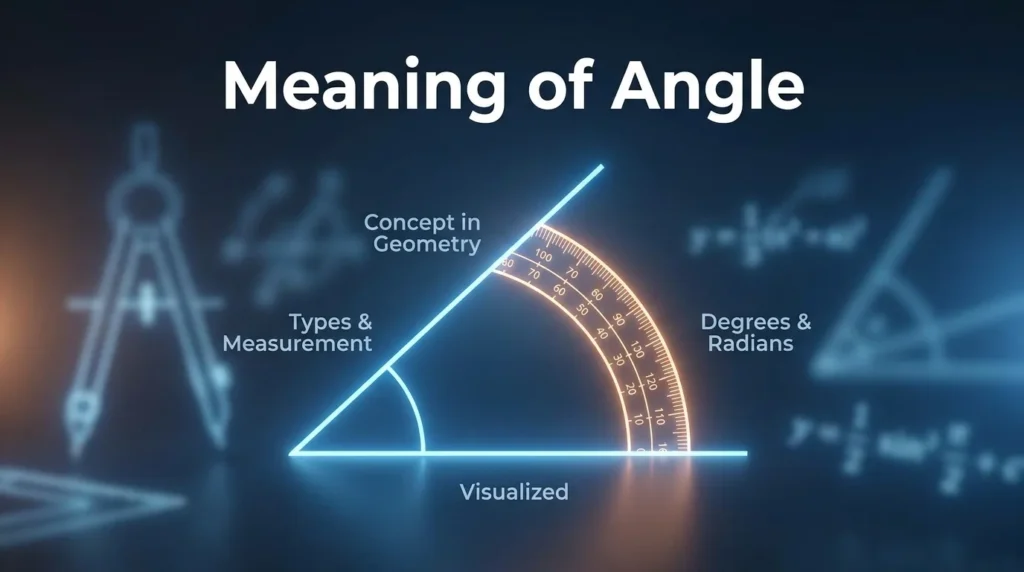
An angle is a noun that refers to the space formed where two lines or surfaces meet. It is commonly used in mathematics, geometry, engineering, architecture, and construction.
The word angle also has a figurative meaning. It can describe a particular way of thinking about, presenting, or analyzing something. For example, a journalist may choose a different angle for a news story, or a photographer may change the angle to capture a better picture.
Unlike angel, which refers to a spiritual being or a kind person, angle is about measurements, positions, perspectives, or viewpoints.
Pronunciation
| Feature | Details |
| IPA | /ˈæŋ.ɡəl/ |
| American Pronunciation | ANG-guhl |
| British Pronunciation | ANG-guhl |
| Syllables | 2 (an-gle) |
| Word Stress | First syllable |
Pronunciation Tips
- Say the first syllable like “ang” in anger.
- The g is a hard /ɡ/ sound, unlike the soft g in angel.
- The second syllable sounds like guhl.
- Stress the first syllable: ANG-guhl.
- Notice the ending -gle, which clearly distinguishes it from angel.
Function
Part of Speech
Angle is a countable noun.
Grammar Role
It names:
- A geometric measurement
- The direction from which something is viewed
- A particular perspective or approach to an idea or topic
Sentence Function
An angle can function as:
- The subject of a sentence
- The object of a verb
- The object of a preposition
- A complement after linking verbs
Common Grammatical Patterns
- a right angle
- an acute angle
- an obtuse angle
- camera angle
- viewing angle
- from a different angle
- look at something from another angle
- change the angle
Example Sentences
- Draw a right angle on the worksheet.
- The teacher explained how to measure each angle.
- This triangle has three different angles.
- The photographer changed the angle to improve the picture.
- Try looking at the problem from another angle.
- The security camera records every angle of the room.
- The roof was built at a steep angle.
- The reporter chose a fresh angle for the story.
- Bend your knees at a comfortable angle while exercising.
- The engineer checked the angle before installing the beam.
When to Use
Use angle when referring to:
- Geometry and mathematics
- Corners or measurements between lines
- Camera positions or photography
- Engineering or construction
- A viewpoint, perspective, or approach to a topic
Correct Examples
- Measure the angle with a protractor.
- The camera captured the mountain from a beautiful angle.
- Let’s discuss the issue from a different angle.
Common Mistakes
1. Confusing angle with angel
❌ My grandmother believes in guardian angles.
✅ My grandmother believes in guardian angels.
A guardian is an angel, not an angle.
2. Using angle for Kind People
❌ My nurse was an angle.
✅ My nurse was an angel.
Use angel when describing someone who is kind or helpful.
3. Mispronouncing the Hard G
Some learners pronounce angle like angel.
Remember:
- Angel has a soft g (/dʒ/), as in job.
- Angle has a hard g (/ɡ/), as in go.
4. Confusing the Figurative Meaning
An angle can also mean a point of view or approach.
Example:
- We need a new angle for this marketing campaign.
Here, angle does not refer to geometry. It means a fresh perspective or strategy.
5. Forgetting It Is a Countable Noun
Use articles correctly.
✅ An angle of 45 degrees.
✅ The angle is too sharp.
Not:
❌ Angle is 45 degrees.
Learn More Meaning of Cloth vs Clothe
Meaning of Angle
Meaning
An angle is a noun that refers to the space formed where two lines or surfaces meet. It is commonly used in mathematics, geometry, engineering, architecture, and construction.
The word angle also has a figurative meaning. It can describe a particular way of thinking about, presenting, or analyzing something. For example, a journalist may choose a different angle for a news story, or a photographer may change the angle to capture a better picture.
Unlike angel, which refers to a spiritual being or a kind person, angle is about measurements, positions, perspectives, or viewpoints.
Understanding the Device vs Devise differences helps prevent spelling errors and confusion between these commonly mixed-up words.
Pronunciation
| Feature | Details |
| IPA | /ˈæŋ.ɡəl/ |
| American Pronunciation | ANG-guhl |
| British Pronunciation | ANG-guhl |
| Syllables | 2 (an-gle) |
| Word Stress | First syllable |
Pronunciation Tips
- Say the first syllable like “ang” in anger.
- The g is a hard /ɡ/ sound, unlike the soft g in angel.
- The second syllable sounds like guhl.
- Stress the first syllable: ANG-guhl.
- Notice the ending -gle, which clearly distinguishes it from angel.
Function
Part of Speech
Angle is a countable noun.
Grammar Role
It names:
- A geometric measurement
- The direction from which something is viewed
- A particular perspective or approach to an idea or topic
Sentence Function
An angle can function as:
- The subject of a sentence
- The object of a verb
- The object of a preposition
- A complement after linking verbs
Common Grammatical Patterns
- a right angle
- an acute angle
- an obtuse angle
- camera angle
- viewing angle
- from a different angle
- look at something from another angle
- change the angle
Example Sentences
- Draw a right angle on the worksheet.
- The teacher explained how to measure each angle.
- This triangle has three different angles.
- The photographer changed the angle to improve the picture.
- Try looking at the problem from another angle.
- The security camera records every angle of the room.
- The roof was built at a steep angle.
- The reporter chose a fresh angle for the story.
- Bend your knees at a comfortable angle while exercising.
- The engineer checked the angle before installing the beam.
When to Use
Use angle when referring to:
- Geometry and mathematics
- Corners or measurements between lines
- Camera positions or photography
- Engineering or construction
- A viewpoint, perspective, or approach to a topic
Correct Examples
- Measure the angle with a protractor.
- The camera captured the mountain from a beautiful angle.
- Let’s discuss the issue from a different angle.
Common Mistakes
1. Confusing angle with angel
❌ My grandmother believes in guardian angles.
✅ My grandmother believes in guardian angels.
A guardian is an angel, not an angle.
2. Using angle for Kind People
❌ My nurse was an angle.
✅ My nurse was an angel.
Use angel when describing someone who is kind or helpful.
3. Mispronouncing the Hard G
Some learners pronounce angle like angel.
Remember:
- Angel has a soft g (/dʒ/), as in job.
- Angle has a hard g (/ɡ/), as in go.
4. Confusing the Figurative Meaning
An angle can also mean a point of view or approach.
Example:
- We need a new angle for this marketing campaign.
Here, angle does not refer to geometry. It means a fresh perspective or strategy.
5. Forgetting It Is a Countable Noun
Use articles correctly.
✅ An angle of 45 degrees.
✅ The angle is too sharp.
Not:
❌ Angle is 45 degrees.
Final Thoughts
Understanding the difference between angel and angle is easier once you connect each word with its meaning. An angel is a spiritual being or a kind, caring person, while an angle is the space between two lines or a particular way of looking at something. Although the two words are similar in spelling and pronunciation, they belong in completely different contexts. A simple memory trick is to remember that angel contains “el,” which can remind you of a heavenly being, while angle contains “gle,” which you can associate with geometry. Whenever you’re unsure, think about the context. If you’re talking about kindness or religion, choose angel. If you’re discussing math, photography, construction, or perspective, choose angle. Regular reading, writing, and practice will help you use both words accurately and confidently.
Frequently Asked Questions
What is the difference between angel and angle?
An angel is a spiritual being or a very kind person, while an angle is the space between two lines or a particular point of view.
Are angel and angle pronounced the same?
No. Angel has a soft g sound (/dʒ/), while angle has a hard g sound (/ɡ/).
Is angel a noun?
Yes. Angel is a countable noun that refers to a heavenly being or a kind person.
Is angle a noun?
Yes. Angle is a countable noun that refers to a geometric measurement or a perspective.
Can angel be used as a compliment?
Yes. Calling someone an angel means they are kind, caring, generous, or helpful.
When should I use angle instead of angel?
Use angle when talking about geometry, measurements, photography, architecture, engineering, or a particular viewpoint.
What is a memory trick for remembering angel and angle?
Think of angel as someone with wings and kindness, and angle as something measured with a protractor or viewed from a different perspective.
Can angle mean a point of view?
Yes. In everyday English, angle often means a particular approach or perspective on a topic.
Example: The journalist found a new angle for the story.
Why do learners confuse angel and angle?
The words have similar spellings and are pronounced similarly, but they have different meanings and different g sounds.
What is a common mistake with angel and angle?
A common mistake is writing angel when talking about geometry or writing angle when describing a kind person.
Which word is used in mathematics?
Angle is the correct word in mathematics because it refers to the measurement between two lines or surfaces.
Can angel refer to a real person?
Yes. In everyday English, angel is often used figuratively to describe someone who is exceptionally kind or helpful.

Caitlin Boylan is an experienced content writer, editor, educator, travel writer, and remote worker with more than 10 years of experience in English education and international communication. She is the founder and author of The Country Jumper, a travel blog dedicated to supporting solo travelers, especially women exploring life abroad. She is also the co-founder of Macro Magazine, a global online publication that shares diverse perspectives on worldwide topics that impact communities.