
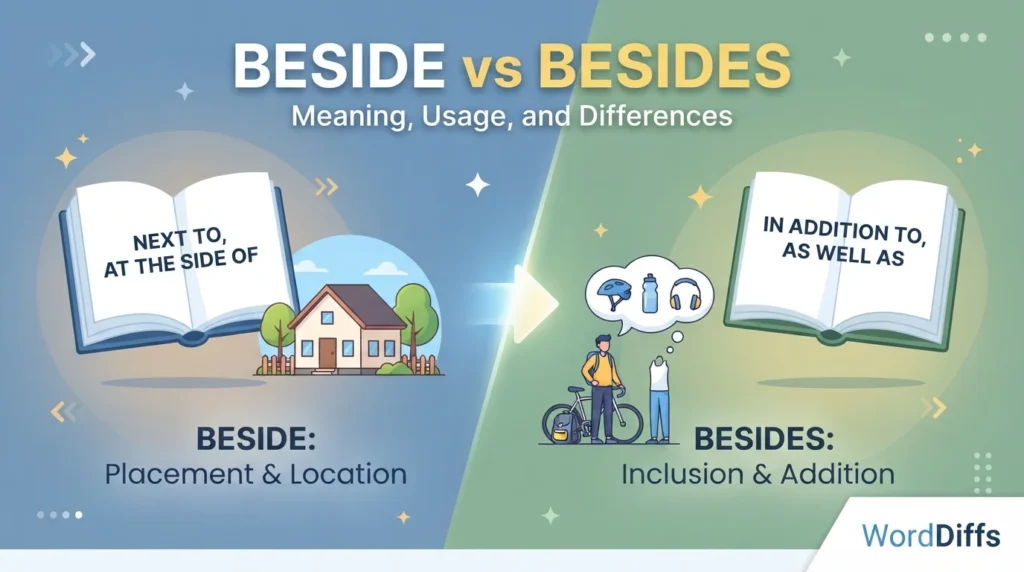
Many English learners confuse beside and besides because the words look almost identical and are closely related in spelling. However, they have different meanings and grammatical functions. Beside usually refers to physical position or location, while besides often means “in addition to” or “apart from.” Using the wrong word can change the meaning of a sentence and make your writing less clear.
In this guide, you’ll learn the meanings, pronunciation, grammar, correct usage, common mistakes, and plenty of everyday examples for both words. By the end, you’ll know exactly when to use beside and besides with confidence.
Understanding Cloth vs Clothe meaning and usage helps clarify these commonly confused words in everyday English.
Quick Difference Table
| Word | Part of Speech | Meaning | Example | Common Usage |
| Beside | Preposition | Next to or at the side of | The chair is beside the table. | Showing location |
| Besides | Preposition, Adverb | In addition to, apart from, also | Besides English, she speaks Spanish. | Adding information or exceptions |
Meaning of Beside
Meaning
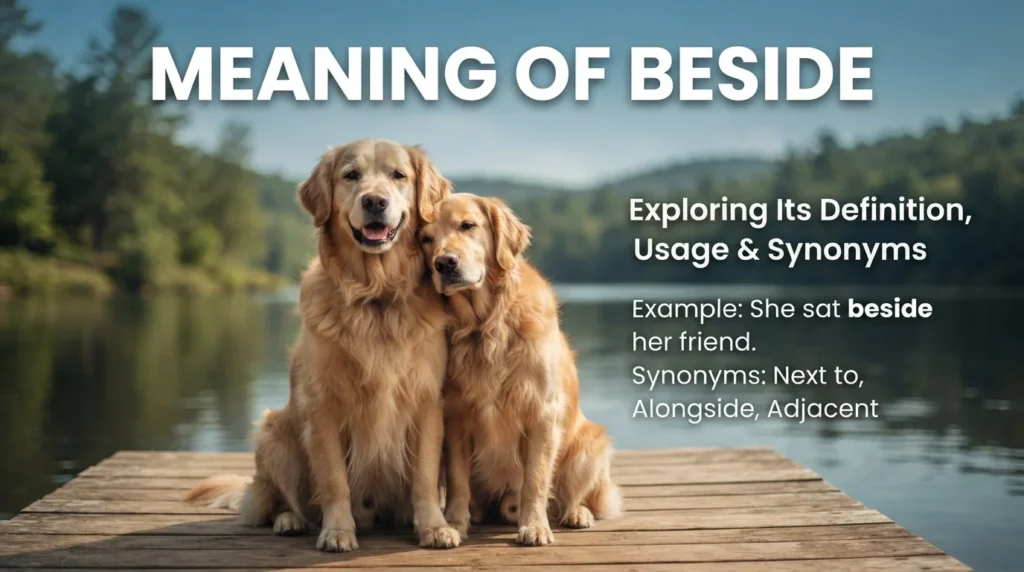
Beside is a preposition that means next to, at the side of, or close to someone or something. It describes the physical position of one person or object in relation to another.
Think of beside whenever you want to show that two things are located next to each other.
Examples:
- The backpack is beside the chair.
- She sat beside her brother.
- A small café stands beside the river.
Pronunciation
| Feature | Details |
| IPA | /bɪˈsaɪd/ |
| American Pronunciation | bih-SIDE |
| British Pronunciation | bih-SIDE |
| Syllables | 2 (be-side) |
| Word Stress | Second syllable (SIDE) |
Pronunciation Tips
- Pronounce it as bih-SIDE.
- Stress the second syllable.
- The ending sounds like the word side.
- Do not add an extra z sound at the end.
- Remember that beside ends with a clear d sound.
Function
Part of Speech
Beside is a preposition.
Grammar Role
It connects a noun or pronoun with another noun to show location or position.
Sentence Function
It tells readers where someone or something is located.
Common Grammatical Patterns
- beside + noun
- beside + pronoun
- beside + noun phrase
Examples:
- beside the door
- beside him
- beside my house
Example Sentences
- My bicycle is parked beside the garage.
- She placed her phone beside the laptop.
- The little boy stood beside his mother.
- We enjoyed lunch beside the lake.
- A beautiful garden grows beside the school.
- Please sit beside me during the meeting.
- The dog slept beside the fireplace all night.
- They built a hotel beside the beach.
- Keep your shoes beside the entrance.
- A tall tree stands beside our driveway.
When to Use
Use beside whenever you want to describe physical location or position.
Common situations include:
- Showing where people are sitting.
- Describing the location of objects.
- Giving directions.
- Explaining where buildings or landmarks are located.
- Talking about places in everyday conversation.
Examples:
- Stand beside the window.
- The restaurant is beside the bank.
- Leave your bag beside the desk.
- She walked beside her friend.
- The museum is beside the park.
Understanding Compare vs Contrast meaning and differences makes it easier to distinguish these related terms in academic writing.
Common Mistakes
1. Using “besides” when talking about location
❌ My car is besides the house.
✅ My car is beside the house.
Reason: The sentence describes position, not addition.
2. Thinking “beside” means “also”
❌ Beside English, he speaks French.
✅ Besides English, he speaks French.
Reason: “Also” requires besides, not beside.
3. Forgetting that “beside” is only a preposition
It must be followed by a noun or pronoun.
Correct:
- beside the river
- beside her
- beside the building
Incorrect:
- beside, I like coffee.
That sentence needs besides, not beside.
Meaning of Besides
Meaning
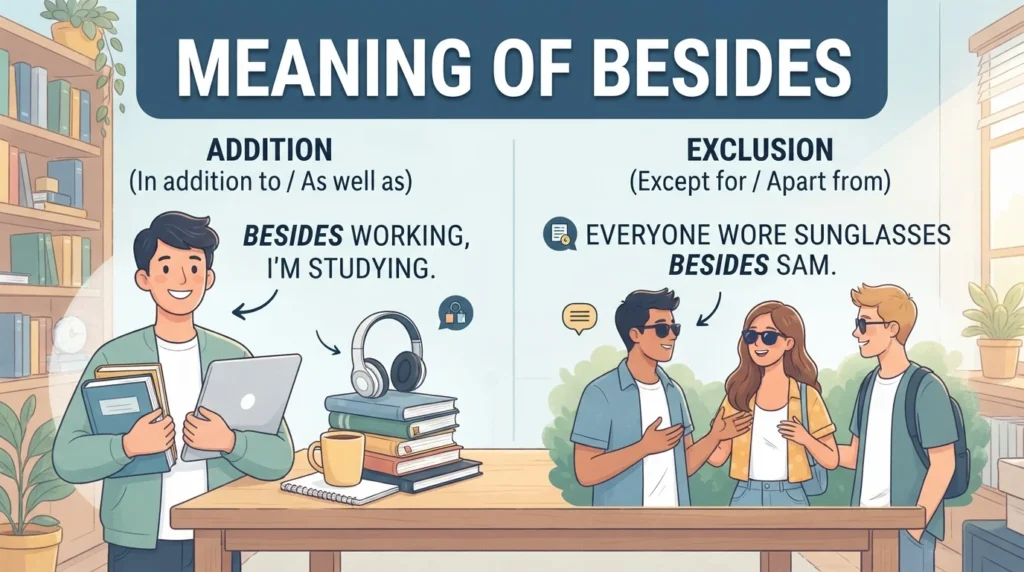
Besides is used as both a preposition and an adverb. It usually means in addition to, apart from, or also. It adds extra information or introduces another reason, person, or thing.
Unlike beside, which describes location, besides adds something to what has already been mentioned.
Examples:
- Besides math, she enjoys science.
- I don’t want to go. Besides, it’s raining.
- Besides my parents, my sister attended the event.
Pronunciation
| Feature | Details |
| IPA | /bɪˈsaɪdz/ |
| American Pronunciation | bih-SIDZ |
| British Pronunciation | bih-SIDZ |
| Syllables | 2 (be-sides) |
| Word Stress | Second syllable (SIDES) |
Pronunciation Tips
- Pronounce it as bih-SIDZ.
- Stress the second syllable.
- Notice the z sound at the end.
- Do not confuse it with beside, which ends with a d sound.
- Listening for the final z sound can help you distinguish the two words.
Function
Part of Speech
Besides can function as:
- A preposition
- An adverb
Grammar Role
As a preposition, it introduces an additional person, thing, or idea.
As an adverb, it adds another point or reason to support a statement.
Sentence Function
It helps expand information, provide extra details, or strengthen an argument.
Common Grammatical Patterns
- besides + noun
- besides + pronoun
- Besides, + complete sentence
Examples:
- besides coffee
- besides them
- Besides, we were already late.
Example Sentences
- Besides English, she can speak Japanese.
- I don’t need another jacket. Besides, my closet is already full.
- Besides homework, he completed his science project.
- Who besides Sarah is coming to dinner?
- Besides vegetables, the recipe includes fresh herbs.
- We had no choice. Besides, it was the safest option.
- Besides my brother, everyone arrived on time.
- Besides reading, she enjoys painting and gardening.
- There is nothing to worry about. Besides, everything is under control.
- Besides experience, employers often value good communication skills.
When to Use
Use besides when you want to express addition, extra information, or another reason.
Common situations include:
- Adding another item to a list.
- Giving an additional reason.
- Mentioning exceptions or additional people.
- Expanding an idea in conversation or writing.
- Connecting related thoughts.
Examples:
- Besides coffee, we bought tea.
- Besides my cousins, my neighbors attended the party.
- I don’t want to drive. Besides, the weather is terrible.
- Besides studying, make time to exercise.
- Besides this issue, everything else looks good.
Common Mistakes
1. Using “beside” to mean “in addition to”
❌ Beside French, she speaks German.
✅ Besides French, she speaks German.
Reason: The sentence adds another language, so besides is correct.
2. Using “besides” for physical location
❌ The lamp is besides the sofa.
✅ The lamp is beside the sofa.
Reason: Physical position requires beside.
3. Forgetting that “besides” can be an adverb
Correct:
- Besides, I have another meeting.
- Besides, we already agreed.
Incorrect:
- Beside, I have another meeting.
Reason: When introducing an additional point, only besides is correct.
Side-by-Side Comparison
| Situation | Correct Word | Explanation | Example |
| A chair is next to a desk. | Beside | Shows physical location. | The chair is beside the desk. |
| Adding another language someone speaks. | Besides | Means “in addition to.” | Besides English, she speaks Italian. |
| Walking next to a friend. | Beside | Indicates position. | I walked beside my friend. |
| Giving another reason. | Besides | Introduces an additional point. | I stayed home. Besides, it was raining. |
| A store is next to a bank. | Beside | Refers to location. | The store is beside the bank. |
| Mentioning extra people. | Besides | Means “apart from” or “in addition to.” | Who besides Alex can help? |
| Parking a car next to a building. | Beside | Describes where something is. | Park your car beside the building. |
| Adding another item to a shopping list. | Besides | Adds more information. | Besides milk, buy some eggs. |
| Standing next to someone. | Beside | Indicates physical proximity. | She stood beside her teacher. |
| Providing another supporting reason. | Besides | Functions as an adverb meaning “also.” | Besides, we had already made plans. |
Practice Quiz
Fill in the Blanks
Choose beside or besides to complete each sentence.
- Please place your backpack ________ the chair.
- ________ science, Mia enjoys studying history.
- The little girl stood ________ her father during the ceremony.
- I don’t want to leave early. ________, everyone is still having fun.
- The grocery store is ________ the pharmacy.
- Who ________ David wants to join the soccer team?
- We spread our picnic blanket ________ the river.
- ________ her excellent grades, she also volunteers on weekends.
- The keys are lying ________ the television remote.
- I have no other questions. ________, you’ve explained everything clearly.
Choose the Correct Word
1. The museum is _____ the city library.
A. beside
B. besides
C. beside’s
D. besided
2. _____ my parents, my grandparents attended the wedding.
A. Beside
B. Besides
C. Besided
D. Besiding
3. She sat _____ me throughout the concert.
A. besides
B. beside
C. beside’s
D. besided
4. I don’t need another notebook. _____, I already have three.
A. Beside
B. Besides
C. Besided
D. Besiding
5. The bicycle is parked _____ the fence.
A. beside
B. besides
C. beside’s
D. besided
6. _____ basketball, Ethan enjoys swimming.
A. Beside
B. Besides
C. Besided
D. Besiding
7. Please stand _____ your partner for the photo.
A. besides
B. beside
C. beside’s
D. besided
8. _____ this small mistake, your report is excellent.
A. Beside
B. Besides
C. Besided
D. Besiding
9. The dog slept _____ its owner.
A. beside
B. besides
C. beside’s
D. besided
10. I don’t think we should cancel. _____, the weather forecast looks good.
A. Beside
B. Besides
C. Besided
D. Besiding
Answer Key
Fill in the Blanks
- beside – It describes the location of the backpack.
- Besides – It adds another subject she enjoys.
- beside – It shows the girl’s position next to her father.
- Besides – It introduces an additional reason.
- beside – It indicates the store’s location.
- besides – It means “apart from David.”
- beside – It describes where the blanket was placed.
- Besides – It adds another achievement.
- beside – It shows where the keys are located.
- Besides – It introduces an additional supporting statement.
Multiple-Choice Answers
- A. beside – The sentence refers to physical location.
- B. Besides – It means “in addition to my parents.”
- B. beside – She sat next to the speaker.
- B. Besides – It introduces another reason.
- A. beside – It describes where the bicycle is parked.
- B. Besides – It adds another sport Ethan enjoys.
- B. beside – It refers to standing next to someone.
- B. Besides – It means “apart from this mistake.”
- A. beside – It describes physical position.
- B. Besides – It introduces an additional supporting reason.
Final Thoughts
Understanding the difference between beside and besides becomes much easier once you remember their primary functions. Beside is used only as a preposition to show that someone or something is next to another person or object. Besides, on the other hand, means in addition to, apart from, or also, and it can function as both a preposition and an adverb.
A simple memory trick is to think of the extra “s” in besides as standing for something extra. If you’re adding information or giving another reason, choose besides. If you’re talking about physical position or location, use beside.
When writing or speaking, pause for a moment and ask yourself whether you’re describing where something is or adding more information. That quick check will help you choose the correct word every time.
Frequently Asked Questions
Where Do We Use “Besides”?
We use besides mainly in two ways:
- To mean “in addition to” or “as well as” It introduces extra information or another thing. Examples:
- Besides English, she speaks Spanish and French.
- Besides his job, he runs a small business.
- What other hobbies do you have besides reading?
- To mean “except” or “apart from” It shows that something is excluded from a group. Examples:
- Besides John, everyone attended the meeting.
- I have no other choice besides this one.
What Is the Difference Between “Beside” and “Adjacent”?
Beside means next to or at the side of something or someone. It is commonly used for people and everyday situations.
Examples:
- She sat beside her friend.
- The lamp is beside the bed.
Adjacent also means next to or touching another thing, but it is more formal and often used for places, buildings, rooms, or areas.
Examples:
- Our office is adjacent to the parking lot.
- The two houses have adjacent gardens.
Key Difference:
- Beside = common, informal, often used for people or objects.
- Adjacent = formal, often used for locations or spaces that are next to each other.
What Is the Difference Between “Beside” and “Along”?
Beside means next to something or someone.
Examples:
- He is standing beside the car.
- The book is beside the computer.
Along means following the length or direction of something, such as a road, river, wall, or path.
Examples:
- We walked along the beach.
- There are trees along the road.
Key Difference:
- Beside focuses on a position next to something.
- Along focuses on movement or location following a line, path, or area.
Is It “Besides You” or “Beside You”?
Both are correct, but they have different meanings.
Beside you means next to you or at your side.
Examples:
- I will sit beside you during the movie.
- She stood beside you when you needed help.
Besides you means in addition to you or other than you.
Examples:
- Besides you, who else knows the answer?
- Nobody besides you can solve this problem.
Quick Tip:
- Use beside you when talking about physical position.
- Use besides you when adding or excluding information.
What is the main difference between beside and besides?
Beside means next to or at the side of, while besides means in addition to, apart from, or also.
Is beside a preposition?
Yes. Beside is always a preposition used to describe the physical position of someone or something.
Can besides be both a preposition and an adverb?
Yes. As a preposition, it means “in addition to.” As an adverb, it introduces another point or reason.
Can I use besides to describe location?
No. To describe physical location, use beside, not besides.
Correct: The lamp is beside the sofa.
Which word means “also”?
Besides can mean also or in addition.
Example: Besides, we have enough time to finish.
Why do learners confuse beside and besides?
They look and sound very similar, but they have different meanings and grammatical functions. The extra s in besides changes its meaning.
Is beside the same as “next to”?
Yes. In most situations, beside and next to have the same meaning.
Example:
- The car is beside the garage.
- The car is next to the garage.
Can a sentence start with Besides?
Yes. Besides commonly begins a sentence when introducing an additional reason or supporting idea.
Example: Besides, we had already booked the tickets.
What is a simple memory trick?
Remember:
- Beside = Side or next to.
- Besides = Something extra or also.
The extra s reminds you that more information is being added.
Are beside and besides pronounced the same?
No. They are very similar, but besides ends with a /z/ sound, while beside ends with a /d/ sound.
Can besides mean “except”?
In some contexts, yes. It can mean apart from or other than.
Example: Nobody besides Emma knew the answer.
Which word is more common in everyday English?
Both are common, but they are used in different situations. Beside is common when talking about location, while besides is common when adding information or giving another reason.

Josie Palmer is an experienced SEO Content Consultant, content strategist, and founder of JOT SEO, a consultancy focused on helping businesses improve their search visibility through effective SEO and content strategies. With more than 8 years of experience in SEO, content development, and digital marketing, she specializes in creating data-driven content strategies that help businesses grow online.
2 thoughts on “Beside vs Besides: Pronunciation, Meaning, Usage, and Differences”