
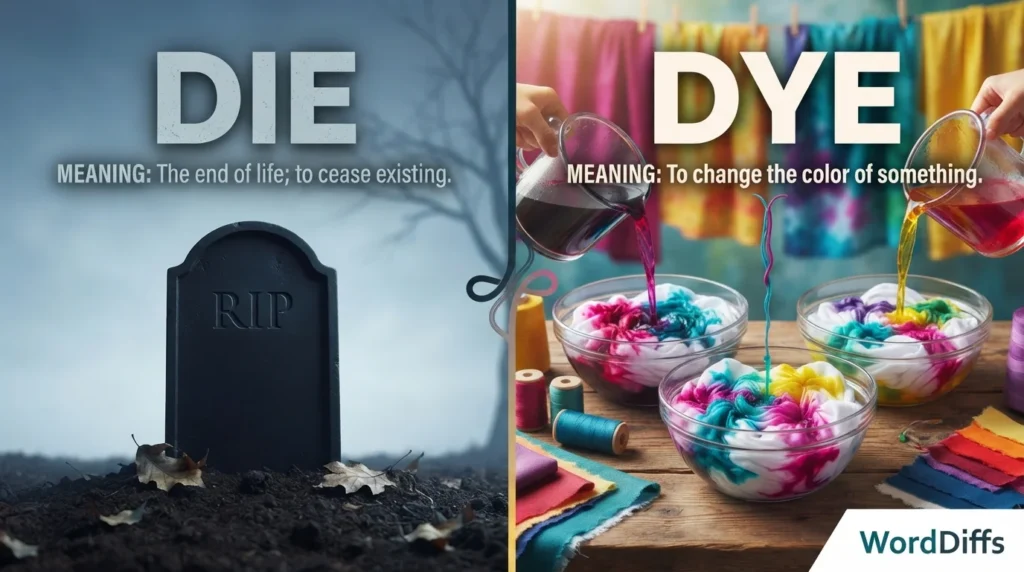
Many English learners confuse die and dye because they sound exactly the same but have completely different meanings. These words are homophones, which means they share the same pronunciation but differ in spelling and meaning. Die relates to death or stopping something from working, while dye refers to coloring hair, fabric, or other materials. Learning the difference helps you avoid embarrassing mistakes in writing and conversation. In this guide, you’ll discover clear meanings, pronunciation, grammar, practical examples, common mistakes, comparison tables, quizzes, FAQs, and memory tricks to help you use both words correctly every time.
Quick Difference Table
| Word | Part of Speech | Meaning | Example | Common Usage |
| Die | Verb | To stop living or stop functioning | The flowers will die without water. | Death, machines, batteries, plants |
| Dye | Verb, Noun | To color something; a coloring substance | She will dye her hair blue. | Hair, clothes, fabric, crafts |
Meaning of Die
Meaning
Die is a verb that means to stop living. It can also describe machines, batteries, engines, or devices that stop working. The word is commonly used for people, animals, plants, and equipment.
Pronunciation
| Feature | Details |
| IPA | /daɪ/ |
| American Pronunciation | “dye” |
| British Pronunciation | “dye” |
| Syllables | 1 |
| Word Stress | The only syllable is stressed |
Pronunciation Tips
- Rhymes with fly, cry, and sky.
- Say one clear syllable: dye.
- The pronunciation is identical to dye.
Function
Part of speech: Verb
Grammar role: Main verb
Sentence function: Shows that someone or something stops living or functioning.
Common grammatical patterns:
- die + of + illness
- die + from + cause
- die + in + place
- die out
- die down
Example Sentences
- Plants die without enough sunlight.
- My phone may die before we get home.
- Many fish die in polluted rivers.
- The old tree began to die slowly.
- Some traditions never die.
- The battery will die soon.
- Thousands of people die from preventable diseases every year.
- The fire began to die after the rain.
- Small businesses sometimes die during difficult economic times.
- We should help endangered animals before they die out.
When to Use
Use die when talking about:
- A person or animal stopping living.
- Plants no longer living.
- Batteries or machines stopping.
- Something gradually disappearing.
- Fires or sounds becoming weaker.
Common Mistakes
- Writing dye when talking about death.
- Using die when discussing hair color.
- Confusing the identical pronunciation.
- Forgetting that die has irregular forms: die, died, died, dying.
Meaning of Dye
Meaning
Dye is both a verb and a noun. As a verb, it means to change the color of something. As a noun, it refers to the coloring material itself.
Pronunciation
| Feature | Details |
| IPA | /daɪ/ |
| American Pronunciation | “dye” |
| British Pronunciation | “dye” |
| Syllables | 1 |
| Word Stress | The only syllable is stressed |
Pronunciation Tips
- Sounds exactly like die.
- Rhymes with high, buy, and sky.
- Listen carefully to the sentence because context determines the meaning.
Function
Part of speech:
- Verb
- Noun
Grammar role:
- Action verb
- Countable or uncountable noun depending on context
Sentence function:
Shows the action of coloring something or names the coloring substance.
Common grammatical patterns:
- dye + hair
- dye + fabric
- dye + clothes
- hair dye
- fabric dye
Example Sentences
- She plans to dye her hair black.
- We used natural plants to dye the cloth.
- He bought blue dye for the project.
- They dye shirts in bright colors.
- The artist used fabric dye on the cotton.
- I want to dye my old jacket green.
- She accidentally spilled red dye on the table.
- The factory dyes thousands of shirts every week.
- You should test the dye before coloring the fabric.
- My grandmother taught me how to dye wool naturally.
When to Use
Use dye when talking about:
- Coloring hair.
- Coloring fabric.
- Coloring clothes.
- Coloring crafts.
- Coloring materials.
Common Mistakes
- Writing die instead of dye when discussing colors.
- Forgetting that dye can be both a noun and a verb.
- Assuming pronunciation helps distinguish the words.
- Using the wrong spelling because both sound the same.
Side by Side Comparison
| Situation | Correct Word | Explanation | Example |
| A flower stops living | Die | Refers to death | The flower will die without water. |
| Coloring hair | Dye | Refers to changing color | She will dye her hair brown. |
| Battery loses power | Die | Means stop functioning | My battery may die today. |
| Coloring a shirt | Dye | Means apply color | They dye cotton shirts blue. |
| Animals stop living | Die | Refers to death | Many insects die during winter. |
| Buying coloring material | Dye | Refers to coloring substance | I bought fabric dye yesterday. |
| Fire becomes weaker | Die | Means fade away | The fire began to die. |
| Coloring wool | Dye | Means add color | They dye wool with natural plants. |
| Engine stops working | Die | Means stop functioning | The engine suddenly died. |
| Changing curtain color | Dye | Means recolor | We decided to dye the curtains green. |
Practice Quiz
Fill in the Blanks
- The flowers will ______ without water.
- She wants to ______ her hair red.
- My phone may ______ before dinner.
- We bought blue ______ for the fabric.
- Many fish ______ because of pollution.
- They decided to ______ the curtains.
- The campfire began to ______ after midnight.
- Natural plants can ______ cotton.
- Some traditions never ______.
- He used black ______ on the leather.
Choose the Correct Word
1. She wants to _____ her hair blonde.
A. Die
B. Dye
C. Died
D. Dying
2. My phone will _____ soon.
A. Dye
B. Dyed
C. Die
D. Dyeing
3. The leaves will _____ without water.
A. Die
B. Dye
C. Dyed
D. Dyeing
4. We bought green _____ for the fabric.
A. Die
B. Died
C. Dye
D. Dying
5. Birds can _____ during severe storms.
A. Dye
B. Die
C. Dyed
D. Dyeing
6. She used natural plants to _____ the cloth.
A. Die
B. Died
C. Dye
D. Dies
7. The battery may _____ overnight.
A. Dye
B. Die
C. Dyed
D. Dyeing
8. Hair _____ comes in many colors.
A. Die
B. Died
C. Dye
D. Dies
9. The engine suddenly _____.
A. Dye
B. Dyed
C. Died
D. Dyeing
10. They will _____ the curtains blue.
A. Die
B. Dye
C. Died
D. Dies
Answer Key
- Die. Flowers stop living without water.
- Dye. Hair is colored, not killed.
- Die. Phones stop working.
- Dye. Dye is the coloring material.
- Die. Birds stop living during storms.
- Dye. Cloth is colored.
- Die. Batteries stop functioning.
- Dye. Hair dye is the coloring product.
- Died. Past tense of die.
- Dye. Curtains are being colored.
Final Thoughts
Although die and dye sound exactly alike, they have completely different meanings. Die refers to someone or something stopping life or functioning, while dye means to color hair, fabric, clothing, or other materials. A simple memory trick is to remember that dye contains the letter Y, which can remind you of colorful yarn or colorful dyes used in crafts. If you’re talking about death, broken batteries, fading fires, or disappearing traditions, choose die. If you’re talking about adding color to hair, fabric, or clothing, choose dye. Paying attention to context is the easiest way to avoid mistakes and become a more confident English writer.
Frequently Asked Questions
What is the difference between die and dye?
Die means to stop living or functioning, while dye means to color something.
Why do die and dye sound the same?
They are homophones, meaning they have the same pronunciation but different meanings and spellings.
Is die a verb?
Yes. Die is mainly used as a verb.
Is dye a noun or a verb?
It can be both. It is a verb when coloring something and a noun when referring to the coloring substance.
Can I say “dye my hair”?
Yes. That is the correct expression.
Can batteries die?
Yes. We often say batteries die when they lose power.
What is the past tense of die?
The past tense is died.
What is the past tense of dye?
The past tense is dyed.
How can I remember the difference?
Think of dye as the word used for adding color, while die relates to death or stopping.
Are die and dye interchangeable?
No. They have completely different meanings.
Is dye used only for hair?
No. Dye is also used for fabric, clothing, leather, paper, and many other materials.
Can machines die?
Yes. In everyday English, people often say a machine or phone has died when it stops working.
