
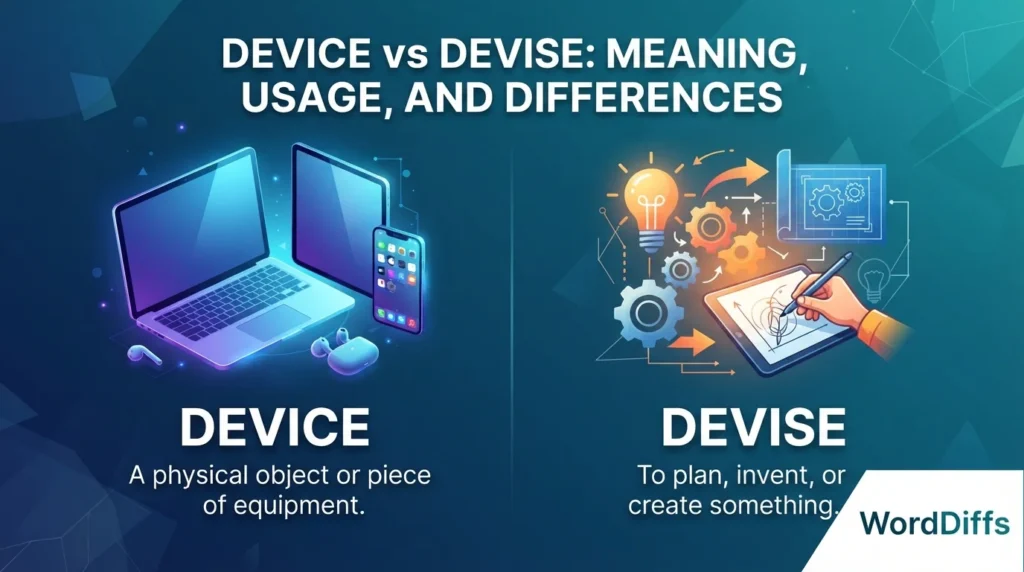
Many English learners confuse device and devise because they look and sound similar. However, they have completely different meanings and grammatical roles. Device is a noun that refers to an object, tool, or piece of equipment, while devise is a verb that means to create, invent, or plan something carefully.
Understanding the difference between these two words will help you write and speak more accurately. In this guide, you’ll learn the meaning, pronunciation, grammar, correct usage, common mistakes, and practical examples of both words. By the end, you’ll be able to choose the right word with confidence in everyday English.
Clear examples make Marry vs Merry usage in sentences easier to understand and remember.
Quick Difference Table
| Word | Part of Speech | Meaning | Example | Common Usage |
| Device | Noun | A tool, machine, or object made for a specific purpose | She bought a new device for reading e-books. | Technology, electronics, tools, medical equipment |
| Devise | Verb | To invent, create, or carefully plan something | The team devised a new marketing strategy. | Plans, ideas, solutions, methods |
Meaning of Device
Meaning
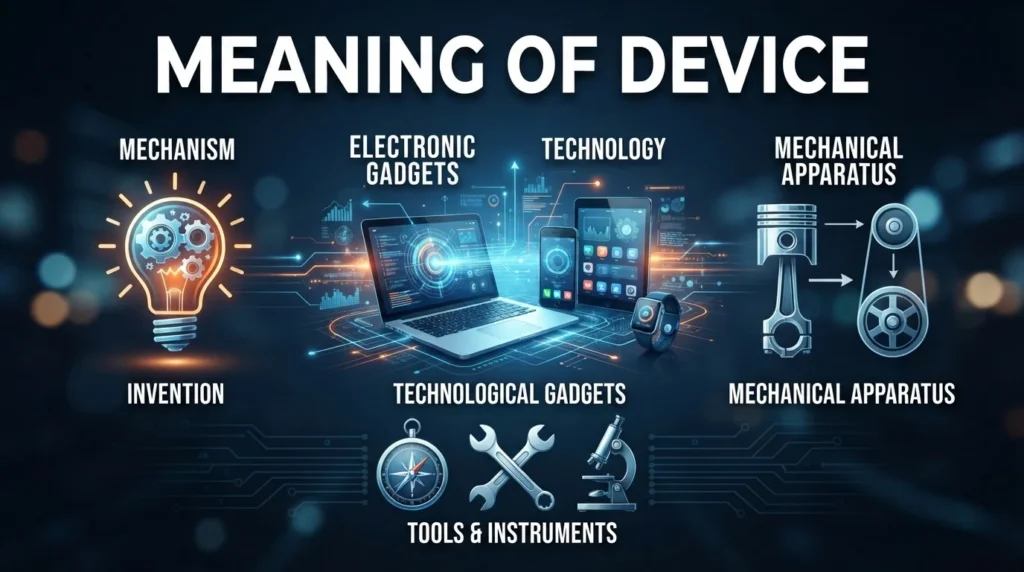
A device is a noun that refers to an object, machine, instrument, or piece of equipment designed to perform a particular task. It can describe everyday electronic products, household tools, medical instruments, or any object created for a specific purpose.
The word can also refer to a method or technique used to achieve a goal, especially in writing or problem-solving.
Pronunciation
| Feature | Details |
| IPA | /dɪˈvaɪs/ |
| American Pronunciation | dih-VICE |
| British Pronunciation | dih-VICE |
| Syllables | 2 (de-vice) |
| Word Stress | Second syllable |
Pronunciation Tips
- Pronounce it as dih-VICE.
- The second syllable receives the stress.
- The ending rhymes with ice, nice, and price.
- Avoid pronouncing it like devise, even though they look similar.
- Practice by saying: device, advice, price.
Function
Part of Speech
Device is a countable noun.
Grammar Role
It names a thing, object, or piece of equipment.
Sentence Function
It commonly functions as:
- The subject of a sentence
- The object of a verb
- The object of a preposition
- The complement after linking verbs
Common Grammatical Patterns
- a device
- the device
- electronic device
- digital device
- mobile device
- medical device
- safety device
- useful device
- use a device
- buy a device
Clear examples of Observation vs Observance in sentences make their distinct meanings easier to recognize in context.
Example Sentences
- I bought a new device to track my daily exercise.
- The doctor used a small device to check my heartbeat.
- This device helps people translate languages instantly.
- Please switch off every electronic device before boarding the plane.
- The engineer designed a device that saves electricity.
- My phone is my most frequently used device.
- Scientists tested the new medical device before releasing it.
- The security device prevented unauthorized entry.
- She carries a reading device instead of printed books.
- Every smart home device connects to the same wireless network.
When to Use
Use device whenever you are talking about:
- Electronic products such as phones, tablets, or laptops
- Machines and tools
- Medical equipment
- Safety equipment
- Instruments designed for a specific purpose
- A physical object that performs a particular function
Examples
- This device charges quickly.
- The laboratory purchased a new measuring device.
- Every student received a learning device.
- The emergency device activated automatically.
Common Mistakes
Mistake 1: Using “devise” when referring to an object
❌ I bought a new devise yesterday.
✅ I bought a new device yesterday.
Why?
Because device is a noun that names an object.
Mistake 2: Thinking every device is electronic
Many people believe a device must be electronic.
Incorrect idea:
- A device is always a phone or computer.
Correct idea:
- A device can also be mechanical, medical, scientific, or safety-related.
Mistake 3: Confusing spelling
Remember:
- Device ends with -ice.
- It names a thing.
Easy Memory Tip
Think of a device as something you can usually hold, use, or operate. If you’re talking about an object or tool, device is almost always the correct choice.
Meaning of Devise
Meaning
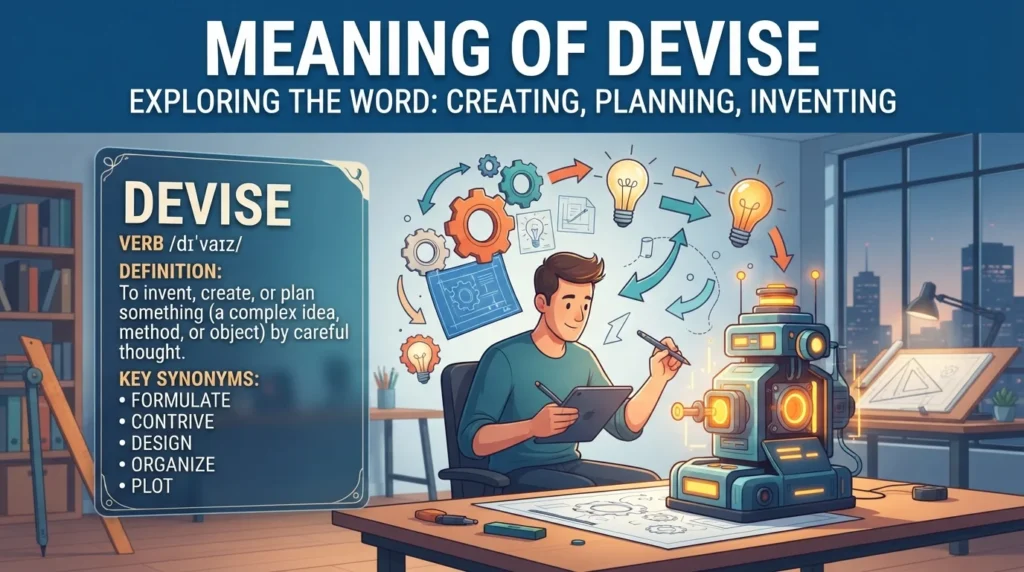
Devise is a verb that means to think of, invent, create, or carefully plan an idea, method, system, or solution. It refers to the process of using creativity or careful thought to develop something new or solve a problem.
Unlike device, which names an object, devise describes an action. You devise plans, strategies, solutions, games, rules, or inventions.
Pronunciation
| Feature | Details |
| IPA | /dɪˈvaɪz/ |
| American Pronunciation | dih-VIZE |
| British Pronunciation | dih-VIZE |
| Syllables | 2 (de-vise) |
| Word Stress | Second syllable |
Pronunciation Tips
- Pronounce it as dih-VIZE.
- Stress the second syllable.
- The ending rhymes with size, rise, and wise.
- Notice that device ends with an S sound, while devise ends with a Z sound.
- Practice saying them together: device, devise, device, devise.
Function
Part of Speech
Devise is a verb.
Grammar Role
It expresses the action of creating, inventing, planning, or developing something.
Sentence Function
It commonly functions as the main verb in a sentence.
Common Grammatical Patterns
- devise a plan
- devise a strategy
- devise a solution
- devise a method
- devise a system
- devise a way
- devise an approach
- devise new ideas
- carefully devise
- successfully devise
Example Sentences
- The engineers devised a safer bridge design.
- We need to devise a better plan for the project.
- She devised an easy way to organize her files.
- Scientists devised a new testing method.
- The coach devised a strategy to win the championship.
- They devised an emergency response plan before the event.
- Our teacher devised creative classroom activities.
- The company devised a solution to reduce waste.
- He devised a budget that helped his family save money.
- The researchers devised an experiment to test their theory.
When to Use
Use devise when you are talking about:
- Creating a plan
- Inventing an idea
- Developing a strategy
- Designing a method
- Solving a problem through careful thinking
- Coming up with something new
Examples
- We must devise a long-term strategy.
- She devised an effective study schedule.
- The team will devise a new marketing campaign.
- Scientists continue to devise better medical treatments.
Understanding Arc vs Ark meaning and differences helps clarify these commonly confused words in English.
Common Mistakes
Mistake 1: Using “device” as a verb
❌ We need to device a solution.
✅ We need to devise a solution.
Why?
Because devise is the verb meaning “to create or plan.”
Mistake 2: Thinking “devise” refers to a physical object
Incorrect idea:
- A devise is a machine.
Correct idea:
- Devise is never a noun in modern English. It is an action word meaning to invent or plan.
Mistake 3: Confusing pronunciation
Remember:
- Device ends with an S sound: dih-VICE.
- Devise ends with a Z sound: dih-VIZE.
Easy Memory Tip
If someone is thinking, creating, inventing, or planning, use devise. If someone is holding or using an object, use device.
Side-by-Side Comparison
| Situation | Correct Word | Explanation | Example |
| Buying a new smartphone | Device | A smartphone is a physical object. | I bought a new device yesterday. |
| Creating a business plan | Devise | You create or plan the strategy. | We need to devise a business plan. |
| Talking about a medical instrument | Device | It refers to equipment used for treatment or testing. | The hospital installed a new medical device. |
| Finding a solution to a problem | Devise | It means to think of or create a solution. | They devised an effective solution. |
| Using a tablet for reading | Device | A tablet is an electronic object. | This device stores thousands of books. |
| Planning a marketing campaign | Devise | Campaigns are carefully planned. | The team devised a creative campaign. |
| Referring to a safety alarm | Device | An alarm is a piece of equipment. | Every building has a fire safety device. |
| Inventing a new teaching method | Devise | Methods are developed through planning. | The teacher devised a new learning activity. |
| Talking about a GPS unit | Device | A GPS is a physical electronic tool. | The navigation device guided us home. |
| Creating a new game | Devise | Games can be invented or designed. | The children devised their own board game. |
Final Thoughts
Understanding the difference between device and devise becomes much easier once you remember their grammatical roles. Device is a noun that refers to a tool, machine, or object designed for a specific purpose. Devise is a verb that means to create, invent, or carefully plan an idea, method, or solution.
A simple memory trick is this: device ends with -ice and names a thing, while devise ends with -ise and describes an action. Whenever you’re talking about equipment, choose device. When you’re talking about planning or inventing something, choose devise. Practice using both words in your own sentences, and soon you’ll recognize the correct choice without hesitation.
Frequently Asked Questions
What is the difference between device and devise?
Device is a noun that refers to an object or piece of equipment, while devise is a verb meaning to invent, create, or carefully plan something.
Is device a noun or a verb?
Device is a noun. It names a thing, such as a phone, tablet, medical instrument, or other tool.
Is devise a noun?
No. Devise is a verb in modern English and means to create or plan something.
How do you pronounce device?
Device is pronounced /dɪˈvaɪs/, or dih-VICE, with stress on the second syllable.
How do you pronounce devise?
Devise is pronounced /dɪˈvaɪz/, or dih-VIZE, with stress on the second syllable.
Why do people confuse device and devise?
They have similar spellings and nearly identical pronunciation, but they belong to different parts of speech and have different meanings.
Can device and devise be used interchangeably?
No. Device refers to an object, while devise refers to the action of creating or planning.
What are some common examples of device?
Examples include a smartphone, laptop, calculator, medical monitor, smoke detector, and GPS unit.
What does devise mean in a sentence?
It means to create or plan something carefully, such as a strategy, solution, method, or system.
How can I remember the difference between device and devise?
Remember this simple trick: device = thing, devise = action. If you can hold it, it’s usually a device. If you’re creating or planning it, you devise it.
Which word is used with “plan”?
Use devise because you devise a plan, not a device.
Which word is used with “electronic”?
Use device because electronic products are physical objects.

Carter is an English language specialist, author, and senior editor with more than 20 years of experience in English grammar, writing, editing, and language education. Throughout his career, he has worked with educational organizations, digital publishers, and content teams to develop accurate, engaging, and learner-focused resources. His expertise includes English grammar, spelling, vocabulary, commonly confused words, proofreading, copy editing, academic writing, and SEO content strategy. Carter is passionate about helping learners and writers improve their communication skills through clear explanations, practical examples, and high-quality educational content.