
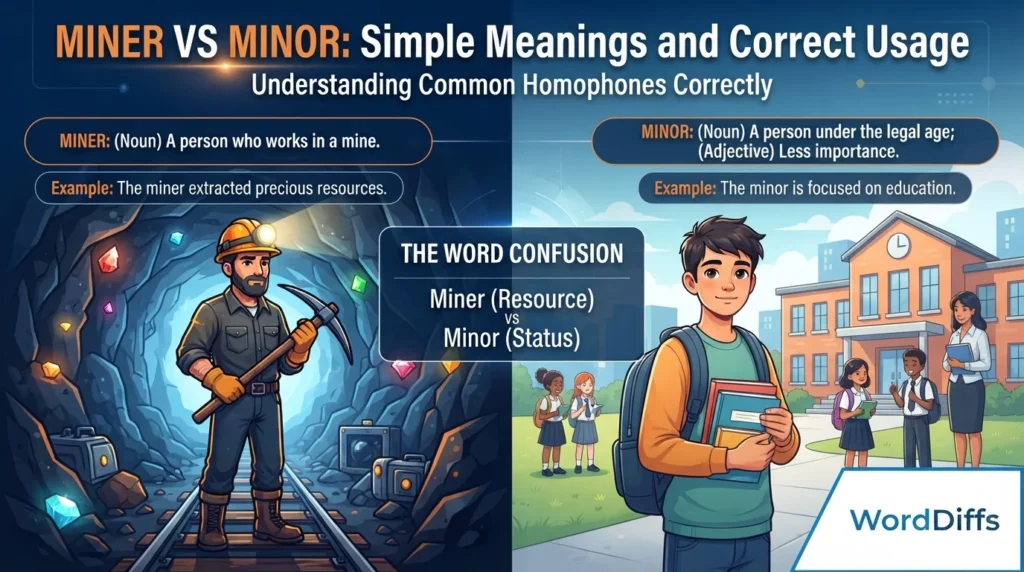
Many English learners confuse miner and minor because they sound exactly the same but have completely different meanings. These words are homophones, which means they share the same pronunciation but differ in spelling and definition. A miner is a person who works in a mine and extracts valuable materials such as coal, gold, or minerals. A minor usually refers to someone under the legal age of adulthood or something that is less important or smaller in degree. Learning the difference between these words will help you avoid common writing mistakes and improve your English. In this guide, you’ll discover their meanings, pronunciation, grammar, usage tips, example sentences, and common mistakes in simple American English.
Quick Difference Table
| Word | Part of Speech | Meaning | Example | Common Usage |
| Miner | Noun | A person who works in a mine | The miner found gold underground. | Mining, jobs, industries |
| Minor | Noun, Adjective | A person under 18 or something less important | She is still a minor. | Age, law, education, importance |
If similar sounding words often confuse you, Marry vs Merry clearly explains when each one belongs in everyday English.
Meaning of Miner
Meaning
A miner is a person whose job is to dig into the earth to extract valuable natural resources such as coal, gold, silver, copper, diamonds, or other minerals. The word is always used as a noun and refers to an occupation. Miners often work in underground tunnels or open-pit mines and play an important role in supplying raw materials used in construction, manufacturing, and energy production.
Pronunciation
| Feature | Details |
| IPA | /ˈmaɪ.nɚ/ (US), /ˈmaɪ.nə/ (UK) |
| American Pronunciation | MY-ner |
| British Pronunciation | MY-nuh |
| Syllables | 2 (min-er) |
| Word Stress | First syllable (MY) |
Pronunciation Tips
- Pronounce miner exactly like minor.
- The first syllable sounds like my.
- Stress the first syllable.
- The ending is soft: ner in American English.
- Practice saying: MY-ner.
Function
Part of Speech
Miner is a countable noun.
Grammar Role
It names a person who works in mining.
Sentence Function
It commonly serves as the subject or object of a sentence.
Common Grammatical Patterns
- a miner
- the miner
- skilled miner
- coal miner
- gold miner
- diamond miner
- miners work
- become a miner
Example Sentences
- The miner started work before sunrise.
- My grandfather was a coal miner for thirty years.
- The miner found a valuable piece of gold.
- Every miner wore a safety helmet underground.
- Rescue teams helped the trapped miners.
- A skilled miner understands how to work safely.
- The young miner received special safety training.
- The company hired another miner last month.
- The experienced miner taught new workers how to use the equipment.
- The miner returned home after a long shift.
When to Use
Use miner when talking about:
- A person who works in a mine.
- Jobs related to mining.
- Coal, gold, silver, copper, or diamond mining.
- Underground or surface mining activities.
- Workers who extract natural resources from the earth.
Examples
- The miner inspected the tunnel before starting work.
- Many miners wear protective equipment every day.
- A gold miner discovered a rich deposit.
Common Mistakes
Mistake 1: Using “minor” instead of “miner”
❌ My uncle is a minor in a coal mine.
✅ My uncle is a miner in a coal mine.
Mistake 2: Thinking “miner” means a young person
A miner has nothing to do with age. It always refers to a person who works in mining.
Mistake 3: Confusing the spelling
Although miner and minor sound the same, remember that miner contains mine, just like the place where a miner works.
Easy Memory Trick
Think of mine → miner. If the sentence is about digging for coal, gold, or other minerals, the correct word is miner.
Strengthen your English vocabulary by understanding the important meaning and usage differences in Metal vs Mettle.
Meaning of Minor
Meaning
Minor has two common meanings in English.
As an adjective, it describes something that is smaller, less important, less serious, or not major.
As a noun, it refers to a person who has not yet reached the legal age of adulthood, which is often 18 years old in many countries. The exact age may vary depending on local laws.
Because minor has more than one meaning, always use the surrounding words and context to understand its intended meaning.
Pronunciation
| Feature | Details |
| IPA | /ˈmaɪ.nɚ/ (US), /ˈmaɪ.nə/ (UK) |
| American Pronunciation | MY-ner |
| British Pronunciation | MY-nuh |
| Syllables | 2 (mi-nor) |
| Word Stress | First syllable (MY) |
Pronunciation Tips
- Minor is pronounced exactly like miner.
- Stress the first syllable: MY.
- The second syllable is soft and unstressed.
- Listen for the context because pronunciation will not tell you which word is meant.
- Practice saying: MY-ner.
Function
Part of Speech
Minor can be used as:
- An adjective
- A noun
Grammar Role
As an adjective, it modifies a noun.
As a noun, it refers to someone who is under the legal age of adulthood.
Sentence Function
It may describe a noun or act as the subject or object of a sentence.
Common Grammatical Patterns
- minor injury
- minor mistake
- minor problem
- minor changes
- a minor
- the minor
- still a minor
- considered a minor by law
Example Sentences
- She suffered only a minor injury during the game.
- The teacher corrected a minor spelling mistake.
- We made minor changes to the report.
- The delay caused only minor problems.
- He is still a minor, so his parents signed the form.
- Selling tobacco to a minor is against the law.
- The doctor said the cut was minor and would heal quickly.
- The meeting ended after discussing a few minor issues.
- As a minor, she needed permission to travel alone.
- The company experienced a minor drop in sales this month.
When to Use
Use minor when talking about:
- A person who is under the legal age of adulthood.
- Small or unimportant problems.
- Slight injuries or damage.
- Changes that are not significant.
- Legal, educational, or official situations involving age.
Examples
- The accident caused only minor damage.
- A minor cannot sign some legal documents without permission.
- We made a few minor improvements before publishing the article.
Common Mistakes
Mistake 1: Using “miner” when referring to age
❌ He is still a miner, so he cannot vote.
✅ He is still a minor, so he cannot vote.
Mistake 2: Using “minor” for someone who works in a mine
❌ The minor found gold underground.
✅ The miner found gold underground.
Mistake 3: Assuming “minor” always means a child
While minor often refers to someone under the legal age of adulthood, it can also describe something that is small, less important, or less serious.
Easy Memory Trick
Think of minor = mini. If something is small, less serious, or relates to someone under the legal age, minor is the correct word.
If homophones sometimes cause confusion, Meet vs Meat makes their meanings and usage much easier to remember.
Side-by-Side Comparison
| Situation | Correct Word | Explanation | Example |
| A person who digs for coal underground | Miner | A miner works in a mine. | The miner started his shift at dawn. |
| A person under the legal age of adulthood | Minor | A minor is not legally an adult. | The minor needed a parent’s signature. |
| Someone extracting gold from the earth | Miner | Refers to a mining worker. | The miner discovered a gold vein. |
| A small injury | Minor | Describes something not serious. | She suffered a minor cut. |
| Someone employed in a coal mine | Miner | Indicates a mining occupation. | The coal miner wore protective gear. |
| A small mistake in an essay | Minor | Means slight or unimportant. | It was only a minor grammar error. |
| A worker searching for diamonds | Miner | Refers to someone who mines valuable resources. | The diamond miner found a rare gem. |
| A slight change to a document | Minor | Means a small adjustment. | We made minor edits before publishing. |
| A person working underground | Miner | Refers to a mining profession. | Every miner carried a flashlight. |
| A legal discussion about age | Minor | Refers to a person below the legal age. | The court protected the rights of the minor. |
Practice Quiz
Fill in the Blanks
Choose miner or minor to complete each sentence.
- The _______ wore a helmet while working underground.
- She made only a _______ change to the presentation.
- The young _______ could not sign the contract alone.
- Every _______ received safety training before entering the mine.
- The accident resulted in _______ damage to the car.
- A gold _______ must follow strict safety rules.
- The doctor described the injury as _______.
- The _______ found a valuable piece of silver.
- Because he is a _______, he needs parental permission.
- The editor fixed a _______ punctuation error before publication.
Choose the Correct Word
1. My uncle has worked as a _____ for over twenty years.
A. minor
B. miner
C. minar
D. mine
2. The report contained only a _____ error.
A. miner
B. mining
C. minor
D. mined
3. A person under the age of 18 is usually called a _____.
A. miner
B. minor
C. mine
D. mining
4. The _____ discovered coal deep underground.
A. minor
B. mined
C. miner
D. mining
5. The doctor said it was a _____ injury.
A. miner
B. mine
C. minor
D. mined
6. Every _____ should wear protective equipment.
A. minor
B. miner
C. mine
D. minors
7. We made a few _____ improvements to the website.
A. miner
B. mined
C. minor
D. mine
8. The _____ spent hours searching for gold.
A. miner
B. minor
C. mine
D. mining
9. The law protects every _____.
A. miner
B. mine
C. minor
D. mined
10. The experienced _____ trained the new workers.
A. minor
B. mine
C. miner
D. mining
Answer Key
Fill in the Blanks
- miner – A person working underground is a miner.
- minor – The change is small, so minor is correct.
- minor – Someone under the legal age is a minor.
- miner – A mining worker is a miner.
- minor – The damage is slight, so use minor.
- miner – Someone extracting gold is a miner.
- minor – A slight injury is described as minor.
- miner – The person finding silver is a miner.
- minor – The sentence refers to legal age.
- minor – A punctuation error is a small mistake.
Multiple Choice Answers
- B. miner – It refers to someone whose job is mining.
- C. minor – The sentence describes a small error.
- B. minor – A person under the legal age is a minor.
- C. miner – The person extracting coal is a miner.
- C. minor – The injury is not serious.
- B. miner – Protective equipment is worn by mining workers.
- C. minor – The improvements are small.
- A. miner – A person searching for gold is a miner.
- C. minor – The law refers to someone under the legal age.
- C. miner – The experienced worker in a mine is a miner.
Small spelling differences can completely change your message, making Medal vs Meddle an excellent comparison to review.
Final Thoughts
Although miner and minor are pronounced the same, they have completely different meanings. A miner is a person who works in a mine and extracts natural resources such as coal, gold, or minerals. A minor is either a person who has not reached the legal age of adulthood or something that is small, less important, or less serious. Understanding the context of a sentence makes it easy to choose the correct word. A simple memory trick is to remember that miner contains the word mine, while minor can remind you of mini, meaning small. When writing or speaking, pause for a moment and think about whether you are referring to a mining worker, a young person, or something of lesser importance. With regular practice, using miner and minor correctly will become second nature.
Frequently Asked Questions
What is the difference between miner and minor?
A miner is a person who works in a mine, while a minor is someone under the legal age of adulthood or something that is less important or smaller in degree.
Are miner and minor pronounced the same?
Yes. They are homophones, meaning they have the same pronunciation but different spellings and meanings.
Is miner a noun?
Yes. Miner is always used as a noun because it refers to a person who works in mining.
Can minor be both a noun and an adjective?
Yes. As a noun, it means a person under the legal age of adulthood. As an adjective, it describes something that is less important, less serious, or smaller.
How can I remember the difference between miner and minor?
Think of mine → miner because a miner works in a mine. Think of mini → minor because minor often means small or less important.
Can a child be called a miner?
Only if the child actually works as a mining worker, which is illegal in many places. Normally, a young person is called a minor, not a miner.
Is a minor always under 18 years old?
In many countries, a minor is someone under 18. However, the exact legal age can vary depending on local laws.
Can minor describe injuries?
Yes. Minor commonly describes injuries, mistakes, problems, or changes that are small or not serious.
What are common collocations with miner?
Common collocations include coal miner, gold miner, diamond miner, experienced miner, mine worker, and skilled miner.
What are common collocations with minor?
Common collocations include minor injury, minor mistake, minor problem, minor change, minor issue, minor detail, and minor offense.
Why do English learners confuse miner and minor?
They are often confused because they sound exactly alike. The only way to distinguish them is by their spelling and the context of the sentence.
Can minor mean unimportant?
Yes. As an adjective, minor often means less important, slight, or not significant.

Lauren Kafka is an experienced freelance writer, editor, English tutor, and writing coach with extensive expertise in education, journalism, publishing, and communications. She is the founder of Kafka Consulting LLC, where she provides private English tutoring, writing coaching, and educational consulting services for K-12 students, college students, graduate students, and adults.