
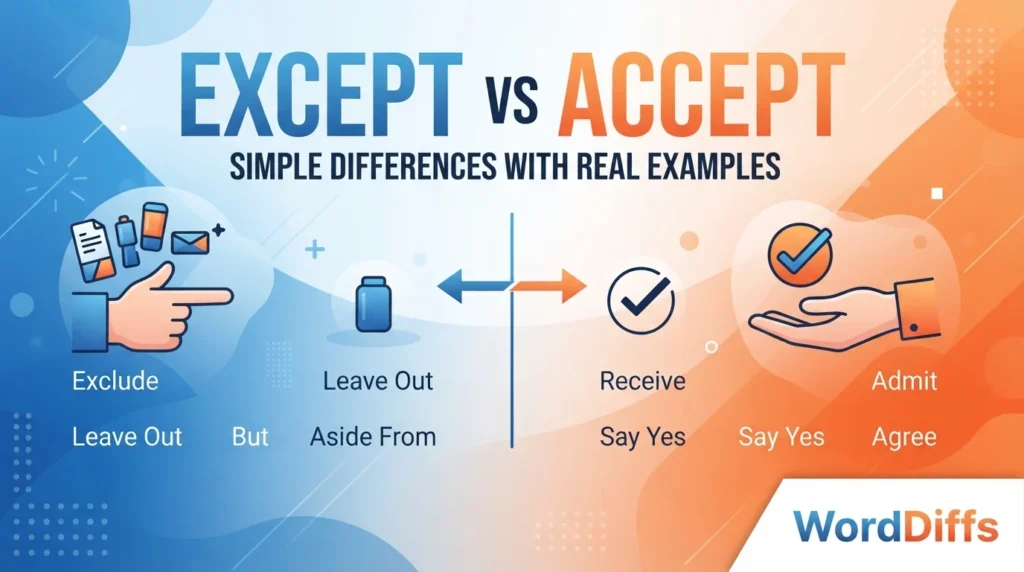
Many English learners confuse Except vs Accept because the two words sound similar but have completely different meanings and uses. Except is used when something is left out or excluded, while Accept means to receive, agree to, or recognize something as true or valid. Their spelling, pronunciation, and grammar roles are different, but the similarity in sound often causes mistakes in writing and speaking. In this guide, you will learn the exact difference between Except vs Accept, their meanings, pronunciation, sentence patterns, common mistakes, and practical examples that show how to use each word correctly in everyday English.
Quick Difference Table
| Word | Part of Speech | Meaning | Example | Common Usage |
| Except | Preposition, conjunction, verb | Not including someone or something | Everyone came except John. | Showing exclusion or an exception |
| Accept | Verb | To receive, agree to, or approve something | She accepted the invitation. | Receiving offers, ideas, situations, or responsibilities |
Meaning of Except
Meaning
Except means leaving someone or something out from a group, list, statement, or situation. It shows that there is an exception to what is being discussed.
When you use except, you are saying that everything or everyone is included, but one person, thing, or situation is different.
Examples:
- Everyone enjoyed the movie except Mike.
- The store is open every day except Sunday.
- I eat all vegetables except mushrooms.
In these sentences, except identifies what is not included.
Pronunciation
| Feature | Details |
| IPA | /ɪkˈsɛpt/ |
| American Pronunciation | ik-SEPT |
| British Pronunciation | ik-SEPT |
| Syllables | 2 syllables |
| Word Stress | Second syllable (SEPT) |
Pronunciation tips:
- The first sound is a short “ih” sound, not a strong “ee” sound.
- Stress the second syllable: ex-SEPT.
- The final “pt” sound is pronounced clearly.
- Do not pronounce it like “accept,” even though the words sound similar.
Function
Except can function mainly as a preposition and conjunction. In some cases, it can also be used as a verb.
Part of speech:
- Preposition: shows exclusion.
- Conjunction: connects two ideas and introduces an exception.
- Verb: means to exclude or leave out, though this use is less common.
Grammar role:
As a preposition, except usually comes before a noun or pronoun.
Examples:
- Everyone except Sarah attended the meeting.
- I have nothing except my old phone.
As a conjunction, it connects clauses.
Example:
- I would travel more, except I do not have enough vacation time.
Common grammatical patterns:
- Everyone + except + person/thing
- Everything + except + noun
- All + except + noun
- No one + except + person
- Clause + except + clause
Example Sentences
- Everyone in the class passed the test except David.
- I like all types of fruit except bananas.
- The restaurant serves breakfast every day except Monday.
- Nobody knew the answer except Maria.
- We invited everyone except our neighbors.
- The package included everything except the instruction manual.
- She works every weekend except during holidays.
- I would help you, except I am already busy.
- The park is open all year except during severe weather.
- He knows every street in the city except this one.
When to Use
Use except when you want to show that something or someone is excluded from a larger group.
Common situations where except is used:
- Listing things that are not included
- Explaining exceptions to rules
- Identifying one person or thing that is different from others
- Clarifying limits or restrictions
Examples:
- The office is closed every day except Friday.
- Everyone can join except children under ten.
A useful question to ask yourself is:
“Am I leaving something out?”
If the answer is yes, except is probably the correct word.
Common Mistakes
Many learners confuse except with accept because they sound almost identical.
Incorrect:
- I will accept everyone came to the party except John.
Correct:
- I will accept that everyone came to the party except John.
The first sentence uses accept incorrectly because the meaning is about agreeing with a fact, not excluding someone.
Another common mistake is writing except when you mean receiving something.
Incorrect:
- She excepted the job offer.
Correct:
- She accepted the job offer.
Remember:
- Except = exclude or leave out
- Accept = receive or agree
A simple memory trick:
Except has an “X” sound at the beginning, and X can remind you of something being crossed out or excluded.
Meaning of Accept
Meaning
Accept means to receive something willingly, agree to something, approve something, or recognize something as true. It is an action that shows agreement, approval, or willingness.
You use accept when someone receives an offer, invitation, responsibility, idea, apology, or situation.
Examples:
- She accepted the job offer.
- He accepted my apology.
- They accepted the new rules.
In these examples, accept shows that someone is willing to receive, approve, or agree with something.
Pronunciation
| Feature | Details |
| IPA | /əkˈsɛpt/ |
| American Pronunciation | uhk-SEPT |
| British Pronunciation | uhk-SEPT |
| Syllables | 2 syllables |
| Word Stress | Second syllable (SEPT) |
Pronunciation tips:
- The first syllable is weak and sounds like “uh.”
- Stress the second syllable: ac-SEPT.
- The ending sound is the same as except: “sept.”
- The main difference between accept and except is not the ending sound, but the first vowel sound and meaning.
Function
Accept is a verb. It describes an action where someone receives, agrees with, or approves something.
Part of speech:
- Verb: shows an action of receiving, agreeing, or recognizing.
Grammar role:
Accept usually takes an object because something is being received or approved.
Examples:
- She accepted the invitation.
- They accepted the challenge.
- I accepted his explanation.
Common grammatical patterns:
- Accept + noun
- She accepted the award.
- Accept + object + as + noun/adjective
- They accepted him as their leader.
- Accept + that + sentence
- I accept that mistakes happen.
- Accept + to + verb (less common, usually with offers or conditions)
- He accepted to join the team.
Example Sentences
- She accepted the gift from her friend with a smile.
- I accepted the invitation to the wedding.
- The company accepted my application for the position.
- He finally accepted that he needed more practice.
- They accepted the terms of the agreement.
- The teacher accepted my late assignment.
- We should accept people’s differences and opinions.
- She accepted responsibility for the mistake.
- The restaurant accepts credit cards and mobile payments.
- He accepted the award in front of a large audience.
When to Use
Use accept when you mean:
- Receive something offered to you
- Agree to an idea, suggestion, or request
- Approve something officially
- Admit or recognize a fact
- Take responsibility for something
Common situations:
Receiving something:
- She accepted the present.
Agreeing to something:
- He accepted the terms of the contract.
Recognizing reality:
- You need to accept that change takes time.
Taking responsibility:
- The manager accepted responsibility for the decision.
A useful question to ask yourself is:
“Am I receiving, agreeing, or approving something?”
If yes, accept is the correct word.
Common Mistakes
The most common mistake is using accept when the meaning is about excluding something.
Incorrect:
- Everyone came accept Tom.
Correct:
- Everyone came except Tom.
Another mistake is confusing accept with except in formal writing.
Incorrect:
- Please except my apology.
Correct:
- Please accept my apology.
Learners also sometimes confuse accept with agree. Although they are related, they are not always identical.
Example:
- I accept your apology.
(I receive or acknowledge your apology.) - I agree with your opinion.
(I share the same view.)
Remember:
- Accept = allow in, receive, approve
- Except = leave out, exclude
Side-by-Side Comparison
| Situation | Correct Word | Explanation | Example |
| Leaving one person out of a group | Except | Shows exclusion | Everyone attended except James. |
| Receiving an invitation | Accept | Shows willingness to receive | She accepted the invitation. |
| Saying something is not included | Except | Identifies an exception | All rooms are available except Room 5. |
| Agreeing to a proposal | Accept | Shows approval | The client accepted the proposal. |
| Excluding an item from a list | Except | Means not including | I like every color except green. |
| Recognizing a difficult truth | Accept | Means admitting something is true | He accepted the reality of the situation. |
| Talking about a rule with one exception | Except | Shows a special case | The gym is open daily except Sunday. |
| Receiving an award or gift | Accept | Means taking something offered | She accepted the award proudly. |
| Saying someone is not included | Except | Removes someone from a group | Everyone voted except Mark. |
| Agreeing to conditions | Accept | Means approving terms | They accepted the agreement. |
Practice Quiz
Fill in the Blanks
Complete each sentence with Except or Accept.
- Everyone was invited to the meeting ______ Sarah.
- She decided to ______ the job offer after careful consideration.
- I enjoy all sports ______ baseball.
- The company will not ______ applications after Friday.
- Nobody understood the instructions ______ the teacher.
- He was ready to ______ the award at the ceremony.
- The store sells everything ______ fresh seafood.
- We should learn to ______ constructive criticism.
- All students passed the exam ______ one student.
- She could not ______ the apology because she was still upset.
Choose the Correct Word
- Everyone attended the event ______ John.
A. Accept
B. Except
C. Accepted
D. Accepting - She decided to ______ the invitation.
A. Except
B. Excepted
C. Accept
D. Exception - I eat every vegetable ______ carrots.
A. Accept
B. Accepted
C. Except
D. Accepting - The manager will ______ the final proposal tomorrow.
A. Except
B. Accept
C. Excepting
D. Exception - Nobody knew the answer ______ Lisa.
A. Accept
B. Except
C. Accepted
D. Accepting - He learned to ______ his mistakes and improve.
A. Except
B. Accept
C. Excepted
D. Exception - The store is open every day ______ Sunday.
A. Accept
B. Except
C. Accepted
D. Accepting - They agreed to ______ the new rules.
A. Except
B. Accept
C. Excepted
D. Exception - Everyone received a certificate ______ Mark.
A. Accept
B. Except
C. Accepted
D. Accepting - She will ______ the award on behalf of her team.
A. Except
B. Accept
C. Excepting
D. Exception
Answer Key
- Except. It shows that John is not included in the group.
- Accept. It means receiving or agreeing to the invitation.
- Except. It shows that carrots are excluded from the list.
- Accept. It means approving or receiving the proposal.
- Except. It identifies Lisa as the only person included differently.
- Accept. It means recognizing and admitting mistakes.
- Except. It shows that Sunday is excluded from the schedule.
- Accept. It means agreeing to or approving the rules.
- Except. It shows that Mark was not included.
- Accept. It means receiving the award.
Final Thoughts
Understanding Except vs Accept becomes much easier when you focus on the meaning behind each word. Except is used when something is left out, removed, or treated as an exception. Accept is used when someone receives, agrees with, approves, or recognizes something. Although these words sound similar, they perform completely different jobs in English sentences.
A simple memory trick is to remember that except excludes. Both words begin with “ex” in some forms, but except is connected with excluding something. Accept means allowing something in or receiving it. Before writing, ask yourself whether you are leaving something out or taking something in. This quick check will help you choose the correct word and improve your everyday communication. Always consider the meaning first, because correct word choice makes your writing clearer and more professional.
Frequently Asked Questions
What is the main difference between Except and Accept?
Except means to leave something out or show an exception. Accept means to receive, agree to, or approve something.
Are Except and Accept pronounced the same?
No. They have similar endings, but their first sounds are different. Except is pronounced /ɪkˈsɛpt/, while Accept is pronounced /əkˈsɛpt/.
Why do people confuse Except and Accept?
People often confuse them because they look similar and have almost the same pronunciation. Their meanings, however, are completely different.
Is Except a verb or a preposition?
Except can be a preposition, conjunction, and sometimes a verb. It is most commonly used as a preposition to show exclusion.
Is Accept always a verb?
Yes. Accept is a verb that describes receiving, agreeing, approving, or recognizing something.
How can I remember the difference between Except and Accept?
Remember: Except excludes. If something is being left out, use except. If something is being received or approved, use accept.
Which word should I use for an invitation?
Use accept because you receive or agree to an invitation.
Example:
- She accepted the invitation.
Which word should I use when removing something from a list?
Use except because it shows that something is not included.
Example:
- Everyone came except Tom.
Can Accept mean “agree”?
Yes. Accept can mean agreeing to an idea, offer, condition, or situation.
Example:
- They accepted the new rules.
Can Except mean “receive”?
No. Except never means receive. Use accept when talking about receiving something.
What is the correct sentence: “I except your apology” or “I accept your apology”?
The correct sentence is:
- I accept your apology.
It means you receive or acknowledge the apology.
Is Except used in negative sentences?
Yes. Except can appear in negative sentences to show an exception.
Example:
- Nobody knew the answer except Maria.
What is the noun form of Accept?
Common noun forms include acceptance and acceptability.
Example:
- Her acceptance of the offer surprised everyone.
What is the noun form of Except?
The noun form related to except is usually exception.
Example:
- This rule has one exception.
Which word is more common in everyday English?
Both words are common, but they appear in different situations. Accept is common when discussing choices, offers, and agreements. Except is common when describing exceptions or exclusions.

Carter is an English language specialist, author, and senior editor with more than 20 years of experience in English grammar, writing, editing, and language education. Throughout his career, he has worked with educational organizations, digital publishers, and content teams to develop accurate, engaging, and learner-focused resources. His expertise includes English grammar, spelling, vocabulary, commonly confused words, proofreading, copy editing, academic writing, and SEO content strategy. Carter is passionate about helping learners and writers improve their communication skills through clear explanations, practical examples, and high-quality educational content.