
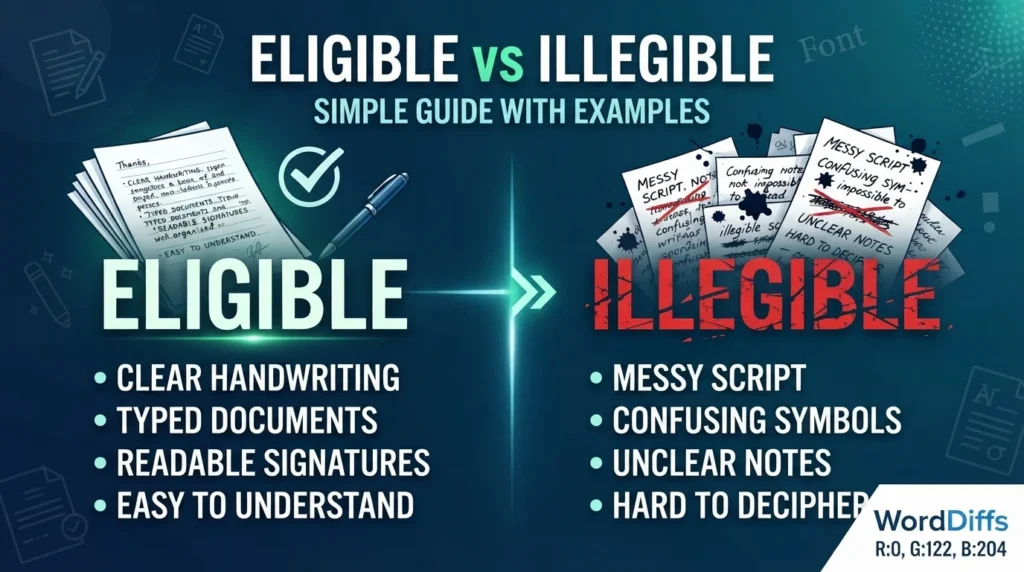
Understanding Eligible vs Illegible can be confusing because the two words look similar but have completely different meanings. Eligible describes someone or something that meets the necessary requirements for a benefit, opportunity, or action. Illegible describes writing, printing, or text that cannot be read clearly. People often confuse these words because they share similar letters and pronunciation patterns. In this guide, you will learn the difference between Eligible and Illegible, their meanings, correct usage, pronunciation, grammar roles, and real-life examples to help you use them confidently.
Quick Difference Table
| Word | Part of Speech | Meaning | Example | Common Usage |
| Eligible | Adjective | Meeting the requirements for something | She is eligible for the scholarship. | Rules, qualifications, opportunities |
| Illegible | Adjective | Impossible or difficult to read | His handwriting is illegible. | Writing, documents, text |
Meaning of Eligible
Meaning
Eligible means qualified or allowed to do something because a person, object, or situation meets specific conditions or requirements. When someone is eligible, they have the necessary qualities, age, experience, status, or qualifications needed for an opportunity.
For example, a student may be eligible for a scholarship if they meet the academic requirements. A customer may be eligible for a discount if they follow certain rules.
The word usually connects with ideas such as permission, qualification, selection, and approval.
Pronunciation
| Feature | Details |
| IPA | /ˈelɪdʒəbəl/ |
| American Pronunciation | EL-uh-juh-buhl |
| British Pronunciation | EL-ih-juh-buhl |
| Syllables | Four syllables: el-i-gi-ble |
| Word Stress | First syllable: EL-i-gi-ble |
Pronunciation tips:
- The first syllable sounds like “EL.”
- The middle sound is similar to “uh-juh.”
- The final part sounds like “buhl.”
- Do not pronounce it as “ee-li-ji-ble.” The first vowel sound is short.
- The stress stays on the first syllable.
Function
Eligible is an adjective. It describes whether a person, group, or thing meets certain conditions.
It commonly appears before nouns or after linking verbs.
Common grammatical patterns include:
- Eligible + for + noun
- She is eligible for financial aid.
- Eligible + to + verb
- He is eligible to apply for the position.
- Be + eligible
- They are eligible.
Sentence functions:
- Describes qualification:
- The employee is eligible for a promotion.
- Explains permission:
- Children over twelve are eligible to join.
- Shows approval status:
- Your account is eligible for the reward.
Example Sentences
- Maria is eligible for the company’s health insurance plan.
- Students who maintain high grades are eligible for the award.
- You must be eighteen years old to be eligible to vote.
- The customer is eligible for a free upgrade.
- Only registered members are eligible to enter the competition.
- Jake became eligible for the program after completing the training.
- She checked whether she was eligible for the government assistance.
- The athlete is eligible to compete in the national tournament.
- New employees are eligible for vacation benefits after six months.
- The applicant was eligible because he met all the required qualifications.
When to Use
Use eligible when you are talking about meeting requirements, having permission, or qualifying for something.
Common situations include:
- Scholarships and education
- Jobs and promotions
- Awards and competitions
- Discounts and rewards
- Voting and legal requirements
- Insurance and benefits
- Membership programs
Examples:
- You are eligible for a student discount.
- She is eligible to apply for the position.
A useful question to ask is:
“Does this person or thing meet the rules?”
If the answer is yes, eligible is likely the correct word.
Common Mistakes
Many learners confuse eligible with words related to general ability or preference.
Incorrect:
- He is eligible because he can run fast.
Correct:
- He is eligible because he meets the competition requirements.
Another common mistake is using eligible when something is simply available.
Incorrect:
- This product is eligible in the store.
Correct:
- This product is eligible for a discount.
Remember that eligible always involves requirements or conditions. It is not just about being possible or existing.
Meaning of Illegible
Meaning
Illegible means impossible or very difficult to read because the letters, numbers, or symbols are unclear. It is usually used for handwriting, printed text, signatures, labels, or documents.
For example, if someone writes quickly and their handwriting cannot be understood, it is illegible. If a faded document has unclear words, the text may also be illegible.
The word describes the quality of written information, not whether something is correct or incorrect.
Pronunciation
| Feature | Details |
| IPA | /ɪˈledʒəbəl/ |
| American Pronunciation | ih-LEJ-uh-buhl |
| British Pronunciation | ih-LEJ-uh-buhl |
| Syllables | Four syllables: il-leg-i-ble |
| Word Stress | Second syllable: il-LEG-i-ble |
Pronunciation tips:
- The first syllable sounds like “ih.”
- Stress falls on the second syllable, “LEG.”
- The ending sounds similar to eligible.
- The beginning “il-” means “not,” which helps connect it with the meaning.
- Say the word clearly as ih-LEJ-uh-buhl, not “eye-legible.”
Function
Illegible is an adjective. It describes text, handwriting, or symbols that cannot be understood visually.
Common grammatical patterns include:
- Illegible + noun
- The doctor wrote an illegible note.
- Be + illegible
- The signature is illegible.
- Too + adjective + to + verb
- The handwriting is too illegible to read.
Sentence functions:
- Describes unclear writing:
- His handwriting is illegible.
- Describes damaged text:
- The label became illegible after exposure to water.
- Explains reading difficulty:
- The document was illegible.
Example Sentences
- The teacher could not read the student’s illegible handwriting.
- The signature on the form was completely illegible.
- The old receipt became illegible because the ink faded.
- Please rewrite the address because it is illegible.
- The doctor’s handwriting was so illegible that the nurse asked for clarification.
- The scanned document was illegible due to poor image quality.
- The instructions were illegible because the paper was damaged.
- His quick notes became illegible after a few minutes.
- The name on the package was almost illegible.
- The employee submitted an illegible report that needed to be rewritten.
When to Use
Use illegible when something written or printed cannot be read clearly.
Common situations include:
- Messy handwriting
- Faded documents
- Blurry images
- Poor-quality scans
- Unclear labels
- Difficult-to-read signatures
Examples:
- The handwriting is illegible.
- The scanned copy is illegible.
A simple question can help:
“Can I read this clearly?”
If the answer is no, illegible is the correct word.
Common Mistakes
A common mistake is confusing illegible with incorrect.
Incorrect:
- The answer is illegible.
This means the answer cannot be read, not that it is wrong.
Correct:
- The answer is illegible because the handwriting is unclear.
Another mistake is using illegible for spoken communication.
Incorrect:
- His voice was illegible.
Correct:
- His handwriting was illegible.
- His voice was unclear.
Remember, illegible applies mainly to written words and symbols, not sounds or ideas.
Side-by-Side Comparison
| Situation | Correct Word | Explanation | Example |
| A student meets all requirements for a scholarship | Eligible | The student qualifies for the opportunity | Ali is eligible for the scholarship. |
| A form has handwriting that cannot be understood | Illegible | The writing is too unclear to read | The signature on the form is illegible. |
| A worker qualifies for a company benefit | Eligible | The worker meets the conditions | Employees are eligible for health benefits after one year. |
| A document has faded words | Illegible | The printed information cannot be read clearly | The old certificate became illegible over time. |
| A person meets the age requirement for a license | Eligible | The person has the required qualification | She is eligible to apply for a driving license. |
| A handwritten note is messy and unclear | Illegible | The writing cannot be easily understood | His doctor’s note was illegible. |
| A customer qualifies for a special offer | Eligible | The customer meets the rules for the offer | You are eligible for a discount. |
| A scanned file is blurry | Illegible | The text cannot be read because of poor quality | The uploaded copy was illegible. |
Practice Quiz
Fill in the Blanks
Complete each sentence with the correct word: eligible or illegible.
- Students with excellent grades may be __________ for the academic award.
- The handwritten address was so unclear that it became __________.
- You must complete the training before you are __________ for the promotion.
- The old newspaper article was __________ because the ink had faded.
- She is __________ to receive the employee discount after joining the program.
- The doctor’s handwriting was __________, so the pharmacist asked for clarification.
- Only members who meet the requirements are __________ to participate.
- The signature on the contract was almost __________.
- The athlete became __________ for the tournament after meeting the age requirement.
- The scanned document was __________ because the image quality was poor.
Choose the Correct Word
Select the correct answer.
- Maria meets all the requirements, so she is _____ for the scholarship.
A. Illegible
B. Eligible
C. Eligibility
D. Illegibly
- The handwritten instructions were _____ and nobody could understand them.
A. Eligible
B. Eligibility
C. Illegible
D. Eligiblely
- Employees who complete six months of service are _____ for paid leave.
A. Eligible
B. Illegible
C. Illegibly
D. Illegibility
- The faded label became _____ after years of use.
A. Eligible
B. Illegible
C. Eligibility
D. Eligiblely
- A person must meet the age requirement to be _____ for the competition.
A. Illegible
B. Eligible
C. Illegibility
D. Illegibly
- The teacher could not read the student’s _____ handwriting.
A. Eligible
B. Eligibility
C. Illegible
D. Eligiblely
- The customer is _____ for a free product because they followed the promotion rules.
A. Eligible
B. Illegible
C. Illegibly
D. Illegibility
- The old receipt was _____ because the printing had disappeared.
A. Eligible
B. Illegible
C. Eligibility
D. Eligiblely
- The applicant was considered _____ because all qualifications were completed.
A. Illegible
B. Eligible
C. Illegibility
D. Illegibly
- The name written on the package was _____, so the delivery company could not identify the owner.
A. Eligible
B. Eligibility
C. Illegible
D. Eligiblely
Answer Key
Fill in the Blanks Answers
- Eligible
The student qualifies for the award because they meet the required conditions. - Illegible
The handwriting cannot be read clearly. - Eligible
The person meets the requirements for promotion. - Illegible
The faded words are difficult or impossible to read. - Eligible
The person qualifies for the discount. - Illegible
The handwriting is unclear and cannot be understood. - Eligible
The members meet the conditions for participation. - Illegible
The signature cannot be read clearly. - Eligible
The athlete meets the rules for joining the tournament. - Illegible
The document cannot be read because of poor quality.
Multiple-Choice Answers
- B. Eligible
Eligible means meeting the requirements for an opportunity. - C. Illegible
Illegible describes writing that cannot be read. - A. Eligible
Employees qualify for benefits after meeting the condition. - B. Illegible
The faded label is difficult to read. - B. Eligible
Eligible refers to being qualified or allowed. - C. Illegible
The handwriting cannot be understood visually. - A. Eligible
The customer qualifies because they followed the rules. - B. Illegible
The missing printing makes the receipt unreadable. - B. Eligible
The applicant meets all necessary qualifications. - C. Illegible
The written name cannot be read clearly.
Final Thoughts
Eligible and Illegible may look similar, but they describe completely different ideas. Eligible means someone or something meets the necessary requirements for an opportunity, benefit, or activity. Illegible means written information cannot be read clearly because of poor handwriting, fading, or unclear printing.
A simple memory trick can help: Eligible starts with “E” for “Entry allowed,” meaning you qualify to enter or participate. Illegible starts with “Il,” meaning “not,” so it means not readable.
When writing, always check whether you are talking about qualifications or readability. If it involves rules and requirements, use eligible. If it involves unclear writing, use illegible.
Frequently Asked Questions
What is the main difference between eligible and illegible?
Eligible means qualified or allowed to do something. Illegible means impossible or difficult to read.
Are eligible and illegible pronounced the same way?
No. Eligible is pronounced with stress on the first syllable, while illegible has stress on the second syllable.
Can eligible describe a document?
Yes, but only when discussing qualification or approval. For example, a document can be eligible for approval.
Can illegible describe handwriting?
Yes. Illegible is commonly used for handwriting that cannot be read.
Is illegible the opposite of eligible?
No. They are not opposites. Eligible relates to qualification, while illegible relates to readability.
Why do people confuse eligible and illegible?
People confuse them because they look similar and both contain similar letter patterns.
What is an example of eligible?
“She is eligible for the scholarship because she meets all requirements.”
What is an example of illegible?
“The handwritten note was illegible because the letters were unclear.”
Does eligible mean selected?
Not always. Eligible means qualified, but a person may still need to be chosen.
Does illegible mean incorrect?
No. Illegible means unreadable, not wrong.
Can printed text be illegible?
Yes. Blurry, faded, or damaged printed text can be illegible.
Is eligible an adjective?
Yes. Eligible describes a person, object, or situation that meets certain requirements.
Is illegible an adjective?
Yes. Illegible describes writing or text that cannot be read clearly.
How can I remember the difference between eligible and illegible?
Remember: Eligible = allowed to enter. Illegible = impossible to read.
Which word should I use for unclear handwriting?
Use illegible because it describes writing that cannot be read.

Caitlin Boylan is an experienced content writer, editor, educator, travel writer, and remote worker with more than 10 years of experience in English education and international communication. She is the founder and author of The Country Jumper, a travel blog dedicated to supporting solo travelers, especially women exploring life abroad. She is also the co-founder of Macro Magazine, a global online publication that shares diverse perspectives on worldwide topics that impact communities.
1 thought on “Eligible vs Illegible: Simple Guide With Examples”