
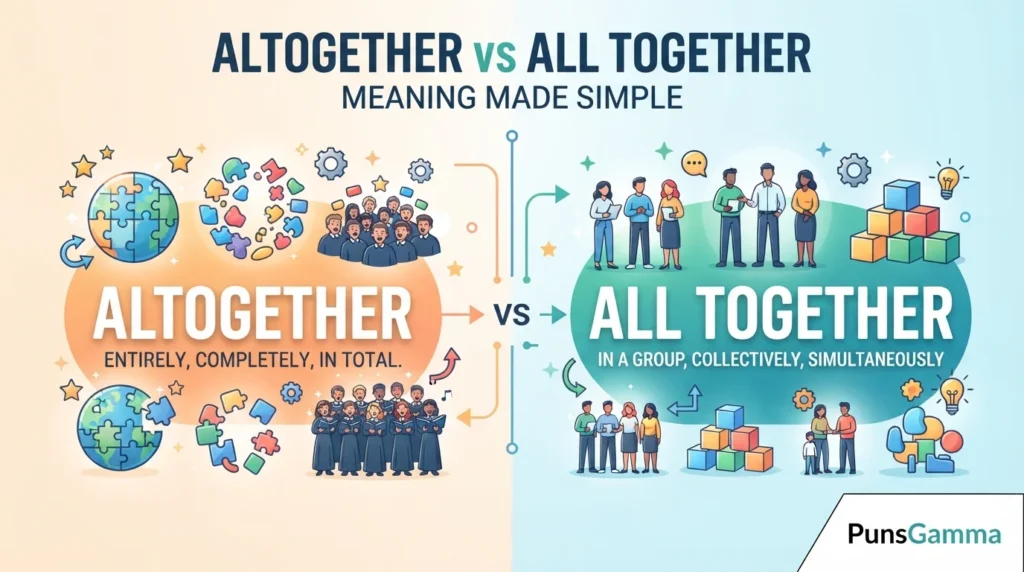
Many English learners confuse altogether and all together because they sound exactly the same when spoken. Although their pronunciation is identical, they have different meanings and are used in different situations. Using the wrong one can make your writing unclear or grammatically incorrect.
In this guide, you’ll learn the meaning of each term, how they function in a sentence, when to use them, common mistakes to avoid, and plenty of real-life examples. By the end, you’ll be able to confidently choose the correct word in everyday conversations, school assignments, emails, and professional writing.
Read More: Eligible vs Illegible
Quick Difference Table
| Word | Part of Speech | Meaning | Example | Common Usage |
| Altogether | Adverb | Completely or in total | We were altogether surprised. | Expressing completeness or a total amount |
| All Together | Phrase | Everyone or everything in one place or at the same time | The family ate all together. | Referring to people or things gathered as one group |
Meaning of Altogether
Pronunciation
| Feature | Details |
| IPA | /ˌɔːl.təˈɡeð.ɚ/ |
| American Pronunciation | awl-tuh-GETH-er |
| British Pronunciation | awl-tuh-GETH-uh |
| Syllables | al·to·geth·er (4 syllables) |
| Word Stress | Primary stress on GETH |
Pronunciation Tips
- Say all smoothly without pausing before the next syllable.
- Place the strongest emphasis on GETH.
- The ending sounds like er in American English and uh in many British accents.
- Do not separate it into three words when speaking.
- Remember that the pronunciation is the same as all together, so rely on the sentence’s meaning to choose the correct spelling.
Function
Part of Speech
Altogether is an adverb.
Grammar Role
It modifies verbs, adjectives, or other adverbs to express totality, completeness, or an overall result.
Sentence Function
It tells how completely something happens or gives a total amount.
Common Grammatical Patterns
- altogether + adjective
- altogether + verb
- not altogether + adjective
- altogether + different
- altogether + surprising
- altogether + impossible
- altogether + in total
Learning Cool vs Cold with practical examples helps prevent common mistakes when describing weather, objects, and sensations.
Example Sentences
- The movie was altogether better than I expected.
- We were altogether satisfied with the final results.
- Her explanation was altogether convincing.
- The project was altogether successful after months of planning.
- I found the experience altogether unforgettable.
- The new policy is altogether different from the old one.
- It is not altogether clear why the meeting was canceled.
- The restaurant was altogether too crowded during lunch.
- We spent altogether fifty dollars on groceries.
- His decision was altogether reasonable under the circumstances.
When to Use
Use altogether when you want to express:
- A complete or total amount.
- Something done entirely or fully.
- An overall judgment or opinion.
- A combined total.
- A degree of certainty or completeness.
Examples
- The vacation was altogether relaxing.
- There were altogether thirty guests at the event.
- The proposal is altogether practical.
- I am not altogether sure about the answer.
- The two situations are altogether different.
Understanding Angel vs Angle differences in meaning and usage helps prevent confusion between these commonly mixed-up English words.
Common Mistakes
Mistake 1: Using “all together” when you mean “completely.”
❌ The idea is all together wrong.
✅ The idea is altogether wrong.
Why?
Here, the meaning is “completely,” so altogether is correct.
Mistake 2: Confusing “altogether” with a group of people.
❌ The students stood altogether for the photo.
✅ The students stood all together for the photo.
Why?
This sentence describes everyone standing as one group, so the phrase all together is needed.
Mistake 3: Forgetting that “altogether” often means “in total.”
❌ We invited all together fifty people.
✅ We invited altogether fifty people.
Why?
The sentence refers to the total number of people invited.
Mistake 4: Separating the word unnecessarily.
❌ The solution is all together impossible.
✅ The solution is altogether impossible.
Why?
The meaning is “completely impossible,” so the single-word adverb is required.
Mistake 5: Relying only on pronunciation.
Both altogether and all together sound the same. Always determine whether the sentence means completely/in total or everyone/everything together before choosing the correct spelling.
Read More: Except vs Accept
Meaning of All Together
Pronunciation
| Feature | Details |
| IPA | /ˌɔːl təˈɡeð.ɚ/ |
| American Pronunciation | awl tuh-GETH-er |
| British Pronunciation | awl tuh-GETH-uh |
| Syllables | all + to·geth·er (spoken as 4 syllables) |
| Word Stress | Primary stress on GETH |
Pronunciation Tips
- All together is pronounced almost exactly like altogether.
- Stress the GETH syllable.
- Even though it is written as two words, say it naturally without a noticeable pause.
- Focus on the meaning of the sentence rather than the pronunciation when choosing the correct spelling.
- If you can replace it with everyone together or as a group, then all together is the correct choice.
Function
Part of Speech
All together is a phrase consisting of:
- All (determiner or pronoun)
- Together (adverb)
Grammar Role
The phrase refers to people, animals, or things being in one place or doing something at the same time.
Sentence Function
It describes a group acting collectively or being gathered in the same location.
Common Grammatical Patterns
- all together + verb
- be all together
- gather all together
- sing all together
- work all together
- live all together
- come all together
Example Sentences
- The children played all together in the backyard.
- We ate dinner all together every Sunday.
- The team stood all together before the match.
- Let’s sing all together at the concert.
- The classmates traveled all together on one bus.
- The family gathered all together for Thanksgiving.
- Please keep the documents all together in one folder.
- We finished the project all together as a team.
- The guests arrived all together just before sunset.
- The puppies slept all together in one basket.
When to Use
Use all together when referring to:
- Everyone being in the same place.
- A group doing something at the same time.
- People or things kept in one group.
- Collective actions.
- Objects gathered in one location.
Examples
- The students sat all together in the front row.
- We should solve the problem all together.
- Keep your receipts all together in an envelope.
- The choir performed all together on stage.
- The cousins stayed all together during the holiday.
Common Mistakes
Mistake 1: Using “altogether” when talking about a group.
❌ The family ate altogether.
✅ The family ate all together.
Why?
The sentence describes everyone eating as one group.
Mistake 2: Using “all together” to mean “completely.”
❌ The plan is all together unrealistic.
✅ The plan is altogether unrealistic.
Why?
Here, the meaning is “completely,” so the single-word adverb is correct.
Mistake 3: Confusing physical grouping with total amount.
❌ There were all together forty students.
✅ There were altogether forty students.
Why?
This sentence refers to the total number of students, not that they were gathered.
Mistake 4: Treating “all together” as a single word.
❌ Everyone worked altogether on the science project.
✅ Everyone worked all together on the science project.
Why?
The phrase describes the group working collectively.
Mistake 5: Ignoring the sentence’s meaning.
Since both expressions are pronounced the same way, don’t choose based on sound alone. Ask yourself:
- Does it mean completely or in total? Use altogether.
- Does it mean everyone together or as one group? Use all together
More Side By Side Comparison: Except vs Accept
Side-by-Side Comparison
| Situation | Correct Word | Explanation | Example |
| Talking about a total amount | Altogether | Means in total. | There were altogether 120 guests at the wedding. |
| Saying something is completely true | Altogether | Means entirely or completely. | Her explanation was altogether accurate. |
| Expressing an overall opinion | Altogether | Used to summarize or evaluate something. | The trip was altogether enjoyable. |
| Referring to everyone in one place | All Together | Means everyone is gathered as one group. | The students stood all together for the class photo. |
| Doing an activity as a group | All Together | Indicates a shared action. | Let’s sing all together before dinner. |
| Keeping things in one place | All Together | Refers to grouping objects. | Keep your papers all together in one folder. |
| Talking about family gatherings | All Together | Means family members are together. | We celebrated the holiday all together. |
| Describing something as completely different | Altogether | Means entirely different. | This solution is altogether different from the first one. |
| Referring to a combined total | Altogether | Adds up the whole amount. | We spent altogether $300 on the trip. |
| Describing teamwork | All Together | Means people work as one team. | The volunteers cleaned the park all together. |
Practice Quiz
Take More Practice Quiz: Expect vs Hope
Fill in the Blanks
Choose either altogether or all together to complete each sentence.
- We sang __________ before the ceremony began.
- The idea is __________ unrealistic.
- There were __________ sixty applicants for the position.
- Please keep your receipts __________ in one envelope.
- The children laughed __________ during the game.
- The movie was __________ more entertaining than I expected.
- We traveled __________ on the same train.
- I am not __________ convinced by his explanation.
- The cousins posed __________ for a family picture.
- We raised __________ $5,000 for charity.
Choose the Correct Word
1. Which sentence is correct?
A. The players stood altogether before the game.
B. The players stood all together before the game.
C. The players stood alltogether before the game.
D. The players stood all-to-gether before the game.
2. Which sentence correctly means “completely”?
A. The answer is all together correct.
B. The answer is altogether correct.
C. The answer is alltogether correct.
D. Both A and B.
3. Choose the correct sentence.
A. We spent all together fifty dollars.
B. We spent altogether fifty dollars.
C. We spent alltogether fifty dollars.
D. We spent all-to-gether fifty dollars.
4. Which sentence describes a group acting together?
A. The choir performed all together.
B. The choir performed altogether.
C. Both A and B.
D. Neither A nor B.
5. Which sentence is correct?
A. The two books are all together different.
B. The two books are altogether different.
C. The two books are alltogether different.
D. The two books are all-to-gether different.
6. Which sentence refers to everyone gathering?
A. We met all together after work.
B. We met altogether after work.
C. Both A and B.
D. Neither A nor B.
7. Which sentence uses the correct word?
A. It was altogether too expensive.
B. It was all together too expensive.
C. Both A and B.
D. Neither A nor B.
8. Choose the correct sentence.
A. Keep the tools all together in the garage.
B. Keep the tools altogether in the garage.
C. Both A and B.
D. Neither A nor B.
9. Which sentence correctly expresses a total?
A. There were all together ninety participants.
B. There were altogether ninety participants.
C. Both A and B.
D. Neither A nor B.
10. Which sentence is correct?
A. The entire project was altogether successful.
B. The entire project was all together successful.
C. Both A and B.
D. Neither A nor B.
Answer Key
Fill in the Blanks
- all together – It refers to everyone singing as a group.
- altogether – It means completely unrealistic.
- altogether – It indicates the total number of applicants.
- all together – The receipts are kept in one place.
- all together – The children laughed as one group.
- altogether – It means completely more entertaining.
- all together – Everyone traveled as a group.
- altogether – It means not completely convinced.
- all together – The cousins gathered for a photo.
- altogether – It refers to the total amount raised.
Multiple-Choice Answers
- B – All together refers to the players standing as one group.
- B – Altogether means completely.
- B – Altogether is used for a total amount.
- A – All together describes the choir performing as one group.
- B – Altogether means completely different.
- A – All together means everyone met as a group.
- A – Altogether means completely too expensive.
- A – All together means keeping the tools in one place.
- B – Altogether expresses the total number of participants.
- A – Altogether means completely successful.
Final Thoughts
Although altogether and all together sound the same, they have different meanings and should not be used interchangeably. Altogether is an adverb that means completely, entirely, or in total. In contrast, all together is a phrase that refers to people or things being in one place or acting as a group. The easiest way to choose the correct form is to think about the meaning of your sentence. If you can replace it with completely or in total, use altogether. If you can replace it with everyone together or as a group, use all together. With regular reading, writing, and practice, choosing between these commonly confused expressions will soon become natural.
Frequently Asked Questions
What is the difference between altogether and all together?
Altogether means completely, entirely, or in total, while all together means everyone or everything in one place or acting as a group.
Is altogether one word or two?
Altogether is always written as one word when it means completely or in total.
Is all together always written as two words?
Yes. All together is always written as two separate words because it is a phrase referring to a group of people or things.
Do altogether and all together sound the same?
Yes. They are homophones, meaning they have the same pronunciation but different spellings and meanings.
Can altogether mean “completely”?
Yes. One of the most common meanings of altogether is completely or entirely.
Example: The explanation was altogether convincing.
Can all together refer to objects as well as people?
Yes. It can describe both people and things that are gathered or kept in one place.
Example: Keep the receipts all together in a folder.
How can I remember the difference?
Use this simple memory trick:
- Altogether = completely or in total.
- All together = all as one group.
If you can replace the phrase with everyone together, choose all together.
Which expression is more common in formal writing?
Both are common in formal writing, but they are used in different contexts. Altogether often appears in reports and academic writing to express totality, while all together is used when discussing groups or collective actions.
Can I use altogether to describe people gathering?
No. When people gather in one place or do something as a group, use all together, not altogether.
Is “not altogether” a common expression?
Yes. Not altogether is a common expression that means not completely or not entirely.
Example: I’m not altogether sure that’s the best solution.
What are some common mistakes with altogether and all together?
The most common mistake is using all together when the sentence means completely or in total, or using altogether when referring to a group of people acting together.
Are altogether and all together interchangeable?
No. Although they sound identical, they have different meanings and grammatical functions, so they cannot be used interchangeably.

Lauren Kafka is an experienced freelance writer, editor, English tutor, and writing coach with extensive expertise in education, journalism, publishing, and communications. She is the founder of Kafka Consulting LLC, where she provides private English tutoring, writing coaching, and educational consulting services for K-12 students, college students, graduate students, and adults.
3 thoughts on “Altogether vs. All Together: Meaning, Usage & Key Differences”