
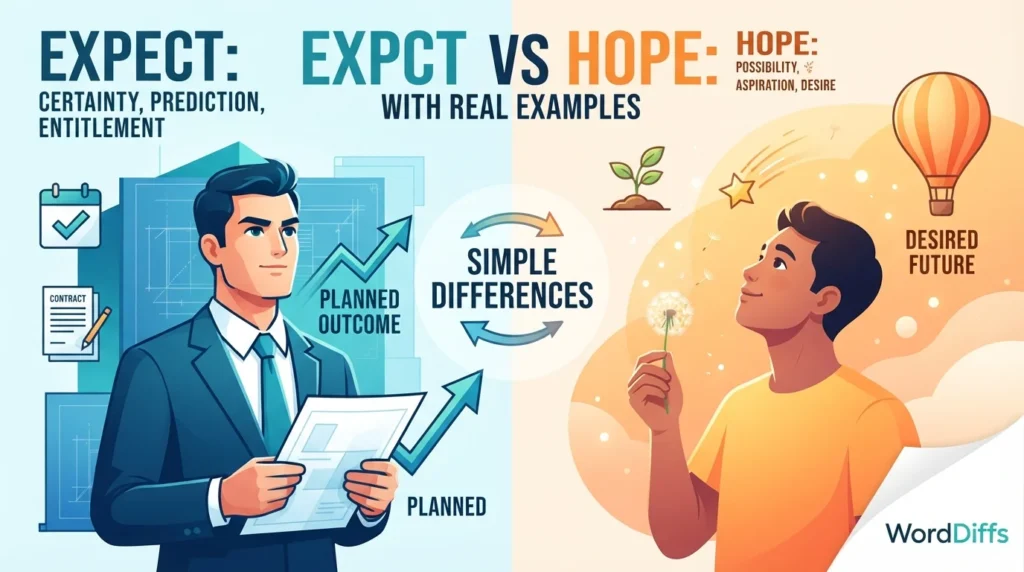
Understanding the difference between Expect vs Hope can improve your everyday English and help you express your thoughts more clearly. These two words are often confused because both can describe something that may happen in the future. However, they show different feelings and levels of certainty. Expect usually suggests that you believe something is likely to happen or you think it should happen. Hope expresses a wish or desire for something good to happen, even when you are not sure it will. In this guide, you will learn the meanings, pronunciation, grammar patterns, common mistakes, and real-life examples that show when to use each word correctly.
Quick Difference Table
| Word | Part of Speech | Meaning | Example | Common Usage |
| Expect | Verb | To believe something will happen or think something should happen | I expect the package to arrive tomorrow. | Predictions, plans, responsibilities, and likely events |
| Hope | Verb, Noun | To want something good to happen | I hope you have a great day. | Wishes, dreams, positive desires, and uncertain outcomes |
Meaning of Expect
Meaning
Expect means to believe that something will probably happen, or to think that someone should do something because it is required or reasonable. It is connected with a sense of prediction, preparation, or responsibility.
When you expect something, you usually have a reason for believing it. You may have information, experience, a schedule, or a rule that makes you think the event will happen.
Examples:
- The weather report says it will rain, so I expect bad weather tomorrow.
- The teacher expects students to complete their homework.
Unlike hope, expect does not mainly express a wish. It focuses on what you think is likely or what you believe should happen.
Pronunciation
| Feature | Details |
| IPA | /ɪkˈspekt/ |
| American Pronunciation | ik-SPEKT |
| British Pronunciation | ik-SPEKT |
| Syllables | 2 syllables: ex-pect |
| Word Stress | Second syllable: -pect |
Pronunciation tips:
- The first syllable sounds like “ik,” not “ex” with a strong E sound.
- The stress is placed on the second syllable: SPEKT.
- The final “ct” sound should be clear.
- Avoid saying “EX-pect” with equal stress on both syllables.
Function
Part of speech:
Expect is mainly used as a verb.
Grammar role:
It describes a belief, prediction, or requirement about a future action, event, or situation.
Sentence function:
It can show:
- A prediction about what will happen
- A belief that something is likely
- A requirement or standard someone should follow
Common grammatical patterns:
- Expect + noun
- I expect a response soon.
- Expect + to + verb
- She expects to finish the project today.
- Expect + person + to + verb
- They expect him to arrive early.
- Expect + that + sentence
- We expect that prices will increase.
Example Sentences
- I expect the meeting to finish before noon.
- She expects her package to arrive on Friday.
- We expect more customers during the holiday season.
- The manager expects employees to arrive on time.
- I expect you will enjoy this movie.
- They expect the new restaurant to become popular.
- He expects his team to win the competition.
- The doctor expects the patient to recover soon.
- My parents expect me to study hard.
- Experts expect technology to continue changing quickly.
When to Use
Use expect when you are talking about something you believe is likely to happen or something you think should happen.
Common situations include:
- Predictions:
- I expect the economy to improve next year.
- Plans and schedules:
- We expect the train to arrive at 8 p.m.
- Responsibilities:
- The company expects workers to follow safety rules.
- Normal results:
- You can expect better results with regular practice.
Use expect when there is a reason behind your belief. It often sounds more confident than hope.
Common Mistakes
Mistake 1: Using expect for simple wishes
Incorrect:
- I expect you have a wonderful birthday.
Correct:
- I hope you have a wonderful birthday.
Why:
A birthday wish is a desire, not a prediction.
Mistake 2: Confusing expect with want
Incorrect:
- I expect to buy a new phone because I like it.
Correct:
- I want to buy a new phone because I like it.
Why:
Expect means you believe something will happen, not simply that you desire it.
Mistake 3: Using expect when there is no evidence
Incorrect:
- I expect I will win the lottery.
Better:
- I hope I will win the lottery.
Why:
Winning the lottery is unlikely, so hope is more natural.
Mistake 4: Forgetting the grammar pattern
Incorrect:
- I expect him arrive soon.
Correct:
- I expect him to arrive soon.
Why:
When followed by a person and an action, use person + to + verb.
Meaning of Hope
Meaning
Hope means to want something good to happen or to believe that something positive may happen in the future. It expresses a wish, desire, or positive feeling about a possible outcome.
When you hope for something, you are not certain that it will happen. You simply want it to happen and believe it is possible.
Examples:
- I hope you feel better soon.
- She hopes to travel abroad next year.
Unlike expect, hope focuses on personal feelings and desires rather than a strong prediction or requirement.
Pronunciation
| Feature | Details |
| IPA | /hoʊp/ |
| American Pronunciation | HOHP |
| British Pronunciation | HOHP |
| Syllables | 1 syllable |
| Word Stress | The only syllable is stressed |
Pronunciation tips:
- The vowel sound is a long “o” sound, similar to the word “go.”
- Keep the final “p” sound clear.
- Do not add an extra vowel sound after the word.
- It is a single, strong syllable: HOPE.
Function
Part of speech:
Hope can be used as a verb and a noun.
Grammar role:
As a verb, it describes a desire or positive expectation about a future event. As a noun, it refers to a feeling of optimism or a belief that something good may happen.
Sentence function:
It can show:
- A wish for a future event
- A desire for a positive result
- Optimism during an uncertain situation
Common grammatical patterns:
- Hope + to + verb
- I hope to visit Japan someday.
- Hope + that + sentence
- She hopes that everything goes well.
- Hope + person + verb
- I hope you enjoy the event.
- Hope for + noun
- They hope for better opportunities.
- Hope (noun) + of + noun/verb-ing
- He has hope of finding a solution.
Example Sentences
- I hope you have a wonderful weekend.
- She hopes to start her own business someday.
- We hope the weather stays nice for the picnic.
- I hope my friend passes the exam.
- They hope to move into their new house soon.
- He hopes that his team wins the championship.
- I hope you understand my decision.
- The family hopes for a peaceful future.
- She hopes to learn a new language this year.
- We hope everything goes well during the event.
When to Use
Use hope when you are expressing a wish, desire, or positive feeling about something that may happen.
Common situations include:
- Wishes:
- I hope you have a safe trip.
- Dreams and goals:
- She hopes to become a doctor.
- Uncertain future events:
- I hope it does not rain tomorrow.
- Encouragement:
- I hope you feel better soon.
Use hope when the outcome is not guaranteed and you want something positive to happen.
Common Mistakes
Mistake 1: Using hope when talking about a strong prediction
Incorrect:
- I hope the train arrives at 9:00 because the schedule says it will.
Better:
- I expect the train arrives at 9:00 because the schedule says it will.
Why:
A scheduled event is something you predict, so expect is more suitable.
Mistake 2: Forgetting “to” before a verb
Incorrect:
- I hope visit London next year.
Correct:
- I hope to visit London next year.
Why:
When hope is followed by an action, use hope + to + verb.
Mistake 3: Using hope for requirements
Incorrect:
- The teacher hopes students submit their homework.
Better:
- The teacher expects students to submit their homework.
Why:
A requirement is an expectation, not a personal wish.
Mistake 4: Confusing hope with expect
Incorrect:
- I hope you will arrive on time because you promised.
Better:
- I expect you will arrive on time because you promised.
Why:
A promise creates a reasonable prediction, so expect is stronger.
Side-by-Side Comparison
| Situation | Correct Word | Explanation | Example |
| You believe a delivery will arrive tomorrow | Expect | You have information or a reason to believe it | I expect my order to arrive tomorrow. |
| You want your friend to enjoy their vacation | Hope | You are expressing a good wish | I hope you enjoy your vacation. |
| A manager talks about employee duties | Expect | It shows a requirement or standard | The manager expects everyone to be punctual. |
| Someone wants to achieve a dream | Hope | It expresses a personal goal or desire | She hopes to become a writer. |
| A weather forecast predicts rain | Expect | The prediction is based on evidence | We expect rain this evening. |
| Someone wishes for good health | Hope | It shows care and a positive desire | I hope you recover quickly. |
| A student believes they will pass after studying hard | Expect | There is a reason for the belief | I expect to pass the exam. |
| Someone wants to win a competition | Hope | The result is uncertain | I hope I win the competition. |
| A company requires workers to follow rules | Expect | It shows responsibility or obligation | The company expects employees to follow policies. |
| Someone wants a positive future result | Hope | It expresses optimism | We hope for a better future. |
Practice Quiz
Fill in the Blanks
Complete each sentence with expect or hope.
- I ______ you have a safe journey home.
- The teacher ______ students to complete their assignments on time.
- We ______ the package to arrive tomorrow because it has already shipped.
- She ______ to learn how to play the piano.
- I ______ everything goes well at your interview.
- The company ______ employees to follow workplace rules.
- They ______ the weather will improve before the outdoor event.
- He ______ to visit his grandparents during the summer.
- Experts ______ prices to increase next year.
- I ______ my favorite team wins the final match.
Choose the Correct Word
Choose the correct option.
- I ______ you enjoy your new job.
A. Expect
B. Hope
C. Expected
D. Expecting
- The manager ______ workers to arrive before 9 a.m.
A. Hopes
B. Hoped
C. Expects
D. Hoping
- We ______ the flight will leave on time because there are no delays.
A. Hope
B. Expect
C. Hoping
D. Hoped
- She ______ to become a successful artist.
A. Expects
B. Hope
C. Hopes
D. Expecting
- I ______ my order today because the tracking information says it is nearby.
A. Hope
B. Expect
C. Hoped
D. Hoping
- They ______ for peace after many years of conflict.
A. Expect
B. Hope
C. Expects
D. Expected
- The coach ______ players to practice every day.
A. Hopes
B. Expect
C. Expects
D. Hoping
- I ______ you understand why I made this choice.
A. Expect
B. Hope
C. Expected
D. Expecting
- Scientists ______ new discoveries in the future.
A. Expect
B. Hope
C. Hoping
D. Hoped
- She ______ her family can attend the celebration.
A. Expects
B. Expecting
C. Hope
D. Hopes
Answer Key
Fill in the Blanks Answers
- hope
Explanation: The sentence expresses a positive wish for someone’s safety, not a prediction. - expects
Explanation: The teacher has a responsibility or requirement for students. - expect
Explanation: The package arrival is predicted based on shipping information. - hopes
Explanation: Learning piano is a personal goal or desire. - hope
Explanation: The speaker wants a positive result but cannot guarantee it. - expects
Explanation: The company is describing a workplace requirement. - expect
Explanation: The weather improvement is a prediction about a possible event. - hopes
Explanation: Visiting grandparents is a personal wish or plan. - expect
Explanation: Experts make predictions based on knowledge and evidence. - hope
Explanation: Winning a match is uncertain, so the speaker expresses a wish.
Multiple Choice Answers
- B. Hope
Explanation: The speaker is expressing a friendly wish for someone’s happiness. - C. Expects
Explanation: A manager’s requirement for workers is an expectation. - B. Expect
Explanation: The flight schedule creates a reasonable prediction. - C. Hopes
Explanation: Becoming an artist is a personal dream or desire. - B. Expect
Explanation: Tracking information gives a reason to believe the order will arrive. - B. Hope
Explanation: Peace is something people desire, not something guaranteed. - C. Expects
Explanation: A coach’s instruction shows a responsibility or standard. - B. Hope
Explanation: The speaker wants understanding but cannot force it. - A. Expect
Explanation: Scientists make predictions about future possibilities. - D. Hopes
Explanation: Attending a celebration is a desired possibility.
Final Thoughts
The difference between expect and hope becomes easier when you focus on certainty and emotion. Expect is used when you believe something is likely to happen or when someone has a responsibility to do something. Hope is used when you want something good to happen, especially when the result is uncertain. A simple memory trick is: expect = prediction or requirement, hope = wish or desire. For example, you can expect a scheduled bus to arrive, but you hope it arrives on time. When writing or speaking English, think about whether you are making a prediction or expressing a wish. Choosing the right word will make your communication clearer and more natural.
Frequently Asked Questions
What is the main difference between expect and hope?
Expect means you believe something is likely to happen or should happen. Hope means you want something good to happen.
Can expect and hope be used for future events?
Yes, both can describe future events, but they show different meanings. Expect shows a prediction, while hope shows a desire.
Is expect stronger than hope?
Yes. Expect usually shows more confidence because it suggests you believe something will happen.
Is hope always about something positive?
Usually, yes. Hope commonly expresses a desire for a good or preferred result.
Can hope be used as a noun?
Yes. For example, “There is still hope for success.”
Can expect be used as a noun?
Yes, but it is less common. The noun form is usually expectation.
Do you say “I hope to” or “I hope for”?
Both are correct. Use “hope to” before an action and “hope for” before a thing or situation.
Examples:
- I hope to travel soon.
- I hope for good news.
Do you say “I expect to” or “I expect for”?
The correct form is usually expect to.
Example:
- I expect to finish the project tomorrow.
Can I say “I expect you have a good day”?
No, this sounds unnatural. Use:
- I hope you have a good day.
Can I say “I hope the meeting starts at 9”?
Yes, but if the schedule confirms the time, “I expect the meeting starts at 9” may be more suitable.
Why do learners confuse expect and hope?
They are confused because both words can talk about future events, but they express different levels of certainty and different emotions.
What is the pronunciation difference between expect and hope?
Expect has two syllables: ik-SPEKT.
Hope has one syllable: HOHP.
Which word should I use for dreams?
Use hope because dreams are wishes or goals.
Example:
- She hopes to become a doctor.
Which word should I use for rules and responsibilities?
Use expect.
Example:
- The company expects employees to be professional.
Can expect and hope appear in the same sentence?
Yes.
Example:
- I hope the weather improves, but I expect some rain tomorrow.

Josie Palmer is an experienced SEO Content Consultant, content strategist, and founder of JOT SEO, a consultancy focused on helping businesses improve their search visibility through effective SEO and content strategies. With more than 8 years of experience in SEO, content development, and digital marketing, she specializes in creating data-driven content strategies that help businesses grow online.