
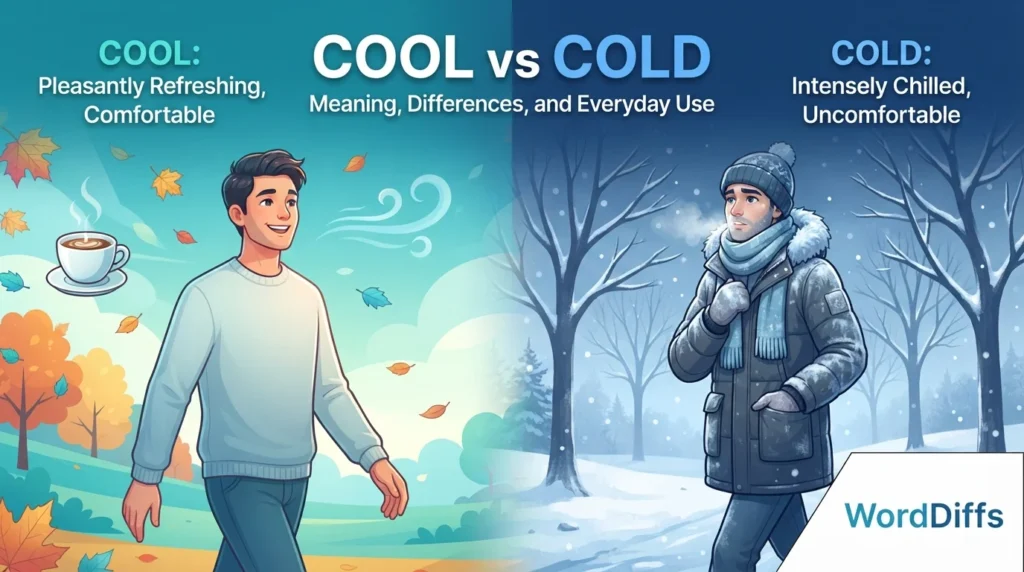
People often use cool and cold when talking about temperature, but these words are not always interchangeable. While both describe something that is not warm, they express different levels of temperature and can also have completely different meanings in everyday English. For example, cool can describe stylish people or calm behavior, while cold can describe weather, emotions, or illnesses. Understanding the difference helps you communicate more naturally and avoid common mistakes. In this guide, you’ll learn the meanings, pronunciation, grammar, correct usage, practical examples, and key differences between cool and cold through simple explanations and real-life situations.
Clear examples make Dew vs Due usage in sentences easier to understand and remember correctly.
Quick Difference Table
| Word | Part of Speech | Meaning | Example | Common Usage |
| Cool | Adjective, verb | Slightly cold, fashionable, calm | The evening is cool. | Weather, personality, style, temperature |
| Cold | Adjective, noun | Low in temperature, lacking warmth | The water is cold. | Weather, food, drinks, illness, emotions |
Meaning of Cool

Meaning
Cool describes something that is pleasantly or slightly cold rather than freezing. It can also describe someone or something fashionable, impressive, calm, or emotionally controlled.
Pronunciation
| Feature | Details |
| IPA | /kuːl/ |
| American Pronunciation | kool |
| British Pronunciation | kool |
| Syllables | 1 |
| Word Stress | COOL |
Pronunciation Tips
- Pronounce the long oo sound like the word school.
- End with a clear l sound.
- The word has only one syllable.
- Stretch the vowel slightly without adding another syllable.
Function
Part of Speech
- Adjective
- Verb (less common)
Grammar Role
As an adjective, cool describes nouns.
Examples
- a cool breeze
- cool weather
- a cool person
As a verb, cool means to become less hot or to make something less hot.
Examples
- Let the soup cool.
- Cool the cake before decorating it.
Sentence Function
- Describes temperature.
- Describes appearance or style.
- Describes behavior or emotions.
- Describes actions when used as a verb.
Common Grammatical Patterns
- cool + noun
- feel cool
- look cool
- stay cool
- cool down
- cool enough to
Example Sentences
- The morning air felt cool after the rain.
- She wore a cool blue jacket to school.
- Please let the cookies cool before eating them.
- We enjoyed a cool breeze by the lake.
- My brother thinks that skateboard is really cool.
- Try to stay cool during the interview.
- The room became cool after we opened the windows.
- I drank a cool glass of lemonade.
- The movie has a cool ending that surprised everyone.
- Keep the vegetables in a cool place.
When to Use
Use cool when talking about:
- Slightly low or comfortable temperatures.
- Pleasant weather.
- Drinks that are chilled but not icy.
- Fashionable or attractive people and things.
- Calm behavior during stressful situations.
- Lowering the temperature of something.
Examples:
- The evening is cool.
- That’s a cool idea.
- Stay cool under pressure.
- Let the pie cool before serving.
Common Mistakes
Mistake 1: Using cool instead of cold for freezing temperatures.
❌ The water is cool enough to make ice.
✅ The water is cold enough to make ice.
Mistake 2: Thinking cool only means fashionable.
Remember that cool often describes temperature as well.
Mistake 3: Saying “very cool” when describing freezing weather.
Use cold instead if the temperature is very low.
Meaning of Cold

Meaning
Cold describes something with a low temperature. It can also describe a person who seems unfriendly, emotions that lack warmth, or the common illness known as a cold.
Pronunciation
| Feature | Details |
| IPA | /koʊld/ |
| American Pronunciation | kold |
| British Pronunciation | kohld |
| Syllables | 1 |
| Word Stress | COLD |
Pronunciation Tips
- Pronounce the o as a long vowel.
- End with a clear ld sound.
- Do not add an extra vowel after the l.
- The word has one syllable with full stress.
Function
Part of Speech
- Adjective
- Noun
Grammar Role
As an adjective, cold describes nouns with a low temperature or a lack of warmth.
Examples
- cold weather
- cold water
- a cold room
- a cold smile
As a noun, cold usually refers to the common viral illness.
Examples
- I have a cold.
- She caught a cold last week.
Sentence Function
- Describes temperature.
- Describes emotions or behavior.
- Refers to an illness when used as a noun.
Common Grammatical Patterns
- cold + noun
- feel cold
- get cold
- catch a cold
- cold enough to
- too cold to
Context becomes clearer when comparing Expect and Hope with examples that show their meanings in practical situations.
Example Sentences
- The water is too cold for swimming.
- We stayed inside because the weather was cold.
- My hands became cold during the hike.
- Please wear a coat because it’s cold outside.
- She drank a cold glass of milk with breakfast.
- The soup turned cold before I finished eating.
- He caught a cold after walking in the rain.
- His cold expression made everyone uncomfortable.
- The classroom felt cold without the heater.
- They enjoyed cold ice cream on a hot afternoon.
When to Use
Use cold when talking about:
- Very low temperatures.
- Weather that requires warm clothing.
- Food or drinks served chilled.
- A person who seems emotionally distant or unfriendly.
- The common viral illness.
Examples:
- The lake is cold.
- It’s too cold to go outside.
- She has a cold.
- His reply sounded cold.
Common Mistakes
Mistake 1: Using cold when the temperature is only slightly low.
❌ The evening was cold and comfortable.
✅ The evening was cool and comfortable.
Mistake 2: Saying I have cold.
❌ I have cold.
✅ I have a cold.
Remember that the illness is a countable noun and usually needs the article a.
Mistake 3: Confusing cold with cool when describing fashionable things.
❌ That’s a cold jacket.
✅ That’s a cool jacket.
Side-by-Side Comparison
| Situation | Correct Word | Explanation | Example |
| Pleasant evening weather | Cool | Slightly cold and comfortable | The evening is cool. |
| Freezing winter day | Cold | Very low temperature | Today is cold. |
| Fashionable clothing | Cool | Stylish or attractive | That’s a cool outfit. |
| Ice water | Cold | Very low temperature | The water is cold. |
| Calm during pressure | Cool | Relaxed and composed | Stay cool during the test. |
| Unfriendly attitude | Cold | Emotionally distant | She gave me a cold look. |
| Letting food lose heat | Cool | Become less hot | Let the pizza cool first. |
| Talking about an illness | Cold | Common viral infection | He has a cold. |
Practice Quiz
Fill in the Blanks
Choose cool or cold to complete each sentence.
- The lemonade is nice and ________.
- It was so ________ outside that the lake froze.
- Please let the coffee ________ before drinking it.
- She always stays ________ during stressful situations.
- I caught a ________ after traveling in the rain.
- The mountain air felt pleasantly ________.
- The soup became ________ while we were talking.
- He gave me a ________ stare that made me nervous.
- Store the medicine in a ________ and dry place.
- The wind was so ________ that everyone wore gloves.
Choose the Correct Word
Choose the best answer for each question.
- The weather became ________ after the sun went down.
- A. cool
- B. cold
- C. coolerly
- D. coldly
- Please wait for the soup to ________ before eating it.
- A. cold
- B. cool
- C. cooler
- D. colded
- She has a ________ and needs to rest.
- A. cool
- B. cold
- C. cooler
- D. cooling
- That’s a really ________ skateboard.
- A. cold
- B. cooler
- C. cool
- D. coldest
- The milk should be kept ________ in the refrigerator.
- A. cool
- B. cold
- C. colder
- D. cooling
- Try to stay ________ during the interview.
- A. cold
- B. cool
- C. colder
- D. coldly
- The swimming pool was too ________ for the children.
- A. cool
- B. cooling
- C. cold
- D. coolest
- We enjoyed the ________ evening breeze.
- A. cold
- B. cool
- C. colder
- D. coldly
- He gave everyone a ________ response that sounded unfriendly.
- A. cool
- B. cooler
- C. cold
- D. cooling
- Let the cake ________ before adding the frosting.
- A. cold
- B. cooler
- C. cool
- D. colding
Answer Key
Fill in the Blanks
- cold – Lemonade is typically described as cold because it is served chilled.
- cold – Freezing temperatures require cold.
- cool – As a verb, cool means to become less hot.
- cool – Stay cool means remain calm under pressure.
- cold – The illness is called a cold.
- cool – Pleasant mountain air is usually cool, not freezing.
- cold – Soup that loses its heat becomes cold.
- cold – A cold stare means an unfriendly expression.
- cool – A cool, dry place is the standard expression.
- cold – Very chilly wind is described as cold.
Multiple Choice
- A. cool – Evening weather is often pleasantly cool.
- B. cool – Food cools before it is eaten.
- B. cold – The illness is called a cold.
- C. cool – Cool means stylish or impressive.
- B. cold – Refrigerators keep food cold.
- B. cool – The phrase stay cool means remain calm.
- C. cold – Water that is too chilly is cold.
- B. cool – A pleasant evening breeze is cool.
- C. cold – A cold response means emotionally distant.
- C. cool – Cakes should cool before frosting.
Final Thoughts
Understanding the difference between cool and cold will make your English sound more natural and accurate. Cool usually describes a pleasantly low temperature, something stylish, or someone who remains calm. Cold refers to a much lower temperature, emotional distance, or the common illness. An easy memory trick is that cool is comfortable, while cold is much colder and may require a jacket. Also remember that only cool commonly means fashionable or impressive. Practice using both words in everyday conversations, pay attention to the context, and read English regularly. With consistent practice, choosing between cool and cold will soon become automatic.
Frequently Asked Questions
What is the main difference between cool and cold?
Cool means slightly or pleasantly cold, while cold means a much lower temperature or can refer to an illness or an unfriendly attitude.
Can cool and cold describe temperature?
Yes. Both describe temperature, but cold indicates a lower temperature than cool.
Can cool mean fashionable?
Yes. Cool often means stylish, modern, or impressive.
Can cold describe a person’s behavior?
Yes. A cold person may seem unfriendly, distant, or lacking emotion.
Is “I have cold” correct?
No. The correct expression is I have a cold.
Can drinks be described as cool?
Yes. A drink can be cool, but beverages served from a refrigerator are more commonly described as cold.
Is cool always about temperature?
No. It can also mean calm, fashionable, or impressive.
Is cold always negative?
No. It simply describes low temperature, although it can also have negative meanings when describing emotions or behavior.
Which word is better for pleasant weather?
Cool is the better choice for weather that is slightly chilly but comfortable.
How can I remember the difference?
Think of cool as comfortable and pleasant, and cold as much colder or freezing.

Josie Palmer is an experienced SEO Content Consultant, content strategist, and founder of JOT SEO, a consultancy focused on helping businesses improve their search visibility through effective SEO and content strategies. With more than 8 years of experience in SEO, content development, and digital marketing, she specializes in creating data-driven content strategies that help businesses grow online.
1 thought on “Cool vs Cold: Meaning, Differences, and Everyday Use”