
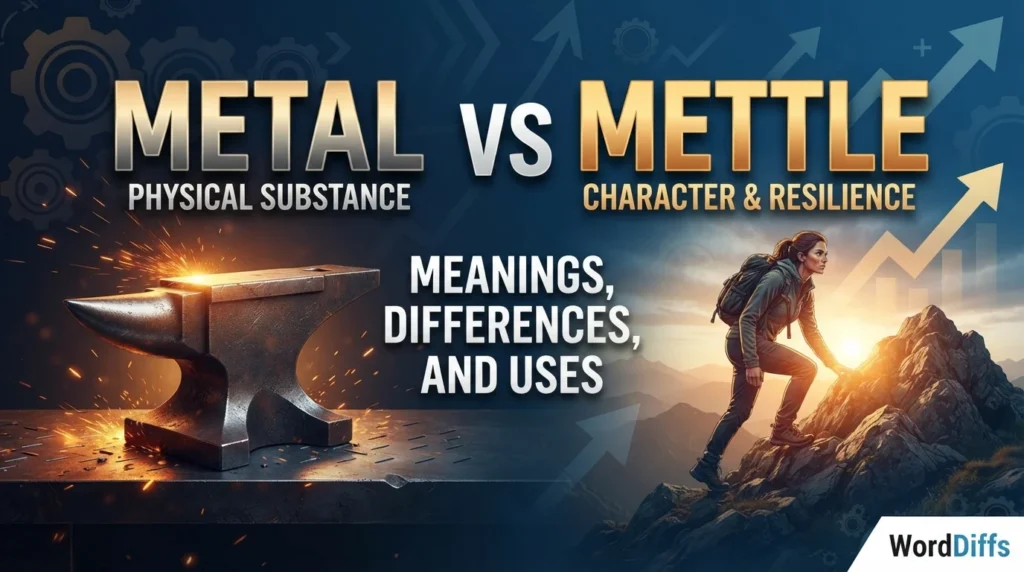
Many English learners confuse metal and mettle because they sound exactly alike but have completely different meanings. These words are examples of homophones, which are words with the same pronunciation but different spellings and meanings. Metal refers to a class of hard materials such as iron, gold, or aluminum, while mettle describes a person’s courage, determination, or strength of character. Learning the difference helps you avoid common writing mistakes and communicate more clearly. In this guide, you’ll discover the meanings, pronunciation, grammar, usage rules, examples, common mistakes, and practical tips that make it easy to choose the correct word every time.
Quick Difference Table
| Word | Part of Speech | Meaning | Example | Common Usage |
| Metal | Noun | A hard material like iron, steel, or gold | The bridge is made of metal. | Materials, construction, science, manufacturing |
| Mettle | Noun | Courage, determination, or inner strength | She proved her mettle during the crisis. | Character, bravery, perseverance, achievement |
If you’d like to explore another commonly confused pair of words, read our guide on Foul vs Fowl to understand their meanings, pronunciation, and correct usage in everyday English.
Meaning of Metal
Meaning
Metal is a noun that refers to a group of naturally occurring or manufactured materials that are usually hard, strong, and able to conduct heat and electricity. Metals are widely used in construction, transportation, engineering, electronics, jewelry, and everyday household items.
Common examples of metals include iron, steel, copper, aluminum, silver, and gold. Depending on the context, the word can refer to a specific metal or metals as a general category of materials.
Pronunciation
| Feature | Details |
| IPA | /ˈmɛtəl/ |
| American Pronunciation | MET-uhl |
| British Pronunciation | MET-uhl |
| Syllables | 2 |
| Word Stress | First syllable (MET) |
Pronunciation Tips
- Pronounce the first syllable as “met,” which rhymes with “pet.”
- The second syllable sounds like “uhl.”
- Stress the first syllable clearly.
- Do not pronounce it as “mee-tal.”
- Metal and mettle have identical pronunciation despite different spellings.
Function
Part of Speech
Metal functions as a countable or uncountable noun, depending on the context.
Examples:
- Gold is a precious metal.
- Several metals are used in modern electronics.
Grammar Role
It commonly acts as the subject, object, or complement in a sentence.
Examples:
- Metal conducts electricity.
- The sculpture is made from metal.
Sentence Function
The word names a physical substance or material.
Common Grammatical Patterns
- metal + noun
- metal pipe
- metal fence
- metal roof
- metal frame
- metal container
- made of metal
- precious metal
- heavy metal
- scrap metal
- sheet metal
Example Sentences
- The workers built the gate from strong metal.
- My grandfather keeps old metal tools in his garage.
- Gold is a valuable metal used in jewelry.
- The chair has a sturdy metal frame.
- We recycled the old metal cans after the picnic.
- This factory produces parts from lightweight metal.
- The artist created a beautiful metal sculpture.
- Copper is a metal that conducts electricity very well.
- The bicycle’s metal chain needs cleaning.
- The mechanic repaired the damaged metal panel.
When to Use
Use metal whenever you are talking about:
- Physical materials
- Construction and manufacturing
- Engineering
- Science
- Machinery
- Jewelry
- Tools
- Vehicles
- Household objects
- Recycling
Examples:
- The bridge is made of metal.
- Aluminum is a lightweight metal.
- The box has a metal handle.
Common Mistakes
Mistake 1: Confusing metal with mettle
❌ She showed great metal during the competition.
✅ She showed great mettle during the competition.
Reason: Courage and determination refer to mettle, not metal.
Mistake 2: Using metal for personality
❌ His metal impressed everyone.
✅ His mettle impressed everyone.
Reason: Personality traits require mettle.
Mistake 3: Incorrect spelling because both words sound alike
Many learners hear the pronunciation and write the wrong spelling.
Tip: If you’re talking about a physical material you can touch, the correct word is metal.
You may also like our Color vs Colour article, which explains why both spellings are correct and when to use each one depending on your audience.
Meaning of Mettle
Meaning
Mettle is a noun that means courage, determination, resilience, or strength of character, especially when someone faces a challenge or difficult situation. It describes a person’s inner qualities rather than a physical object.
Unlike metal, which refers to a material, mettle is used figuratively. When someone “shows their mettle,” they prove they are brave, capable, and able to handle pressure.
This word often appears in formal writing, literature, news reports, sports, business, and motivational contexts.
Pronunciation
| Feature | Details |
| IPA | /ˈmɛtəl/ |
| American Pronunciation | MET-uhl |
| British Pronunciation | MET-uhl |
| Syllables | 2 |
| Word Stress | First syllable (MET) |
Pronunciation Tips
- Mettle is pronounced exactly like metal.
- The first syllable rhymes with pet.
- Stress the first syllable.
- The ending sounds like uhl, not tell.
- Remember that although the pronunciation is the same, the meanings are completely different.
Function
Part of Speech
Mettle functions as a noun.
Grammar Role
It usually serves as the subject, object, or complement in a sentence.
Examples:
- Her mettle inspired the entire team.
- The competition tested everyone’s mettle.
Sentence Function
The word names a personal quality rather than a physical thing.
Common Grammatical Patterns
- show one’s mettle
- prove one’s mettle
- test someone’s mettle
- demonstrate mettle
- courage and mettle
- grit and mettle
- remarkable mettle
- true mettle
- inner mettle
- unwavering mettle
Example Sentences
- She showed remarkable mettle during the emergency.
- The difficult exam tested every student’s mettle.
- He proved his mettle by leading the team through the crisis.
- The young athlete displayed great mettle despite losing the first round.
- Starting a new business requires confidence and mettle.
- Her mettle helped her overcome every obstacle.
- The challenging hike revealed the group’s mettle.
- Good leaders inspire others through their mettle.
- The firefighter’s mettle earned everyone’s respect.
- Tough situations often reveal a person’s true mettle.
When to Use
Use mettle when talking about:
- Courage
- Determination
- Inner strength
- Perseverance
- Character
- Confidence under pressure
- Mental toughness
- Leadership
- Resilience
- Facing difficult situations
Examples:
- The interview really tested her mettle.
- He proved his mettle by never giving up.
- Their mettle helped them succeed during difficult times.
Common Mistakes
Mistake 1: Using metal instead of mettle
❌ She proved her metal in the competition.
✅ She proved her mettle in the competition.
Reason: The sentence describes courage, not a physical material.
Mistake 2: Thinking mettle refers to strength of the body
Some learners assume mettle means physical strength.
Correct: Mettle refers to mental and emotional strength, courage, and determination.
Mistake 3: Avoiding the word because it sounds old-fashioned
Although mettle is less common than metal, it is still widely used in books, journalism, sports commentary, business writing, and everyday expressions such as “test your mettle” and “prove your mettle.”
Side-by-Side Comparison
| Situation | Correct Word | Explanation | Example |
| Talking about iron, steel, or aluminum | Metal | Refers to a physical material | The ladder is made of metal. |
| Describing someone’s courage | Mettle | Refers to bravery or determination | She showed her mettle during the rescue. |
| Building a bridge | Metal | Construction materials are metals | Workers used metal beams for the bridge. |
| Facing a difficult challenge | Mettle | Describes inner strength | The marathon tested his mettle. |
| Making jewelry | Metal | Gold and silver are metals | This ring is made of precious metal. |
| Leading a team through a crisis | Mettle | Refers to leadership and resilience | The manager proved her mettle. |
| Recycling cans | Metal | Cans are made from metal | We separated the metal for recycling. |
| Overcoming failure | Mettle | Shows perseverance | His mettle helped him succeed after several setbacks. |
| Manufacturing machine parts | Metal | Refers to industrial materials | The factory shapes metal into gears. |
| Staying calm under pressure | Mettle | Describes emotional strength | Her mettle impressed everyone in the emergency. |
For another useful word comparison, explore our Arc vs Ark guide to discover when each word is appropriate and how to avoid common writing errors.
Practice Quiz
Fill in the Blanks
Choose either metal or mettle to complete each sentence.
- The engineer inspected the ______ bridge before it opened.
- Winning the championship proved the team’s ______.
- The old bucket was made of ______.
- Difficult times often reveal a person’s true ______.
- The artist shaped the ______ into a beautiful statue.
- The rescue mission tested the firefighters’ ______.
- This factory produces ______ parts for airplanes.
- She showed incredible ______ after losing the first match.
- The fence is built from strong ______.
- Every challenge is a chance to prove your ______.
Choose the Correct Word
1. The mechanic repaired the damaged ______ panel.
A. mettle
B. metal
C. metel
D. mettall
2. The difficult interview really tested her ______.
A. metal
B. medal
C. mettle
D. metel
3. Gold is a valuable ______.
A. mettle
B. medal
C. metal
D. meddle
4. The captain showed great ______ during the storm.
A. metal
B. mettle
C. medal
D. meter
5. The sculpture is made of recycled ______.
A. mettle
B. metal
C. medal
D. meddle
6. Which sentence is correct?
A. She proved her metal during the race.
B. She proved her mettle during the race.
C. She proved her medal during the race.
D. She proved her meter during the race.
7. Aluminum is a lightweight ______.
A. metal
B. mettle
C. medal
D. meddle
8. His ______ helped him stay calm under pressure.
A. medal
B. metal
C. mettle
D. meter
9. We recycled the old ______ cans.
A. mettle
B. metal
C. medal
D. meddle
10. The competition allowed every participant to prove their ______.
A. metal
B. medal
C. mettle
D. meter
Answer Key
Fill in the Blanks
- metal, A bridge is made from a physical material.
- mettle, The sentence refers to courage and determination.
- metal, A bucket is a physical object made from a material.
- mettle, Difficult situations reveal a person’s character.
- metal, A statue is formed from a physical material.
- mettle, Rescue missions test bravery and resilience.
- metal, Airplane parts are made from metal.
- mettle, The sentence describes perseverance after a setback.
- metal, A fence is constructed from a material.
- mettle, The phrase “prove your mettle” is a common English expression.
Multiple-Choice Answers
- B. metal
The panel is a physical object made of metal. - C. mettle
An interview tests confidence, courage, and determination. - C. metal
Gold is a type of metal. - B. mettle
Courage during a storm is described as mettle. - B. metal
Sculptures can be made from recycled metal. - B. She proved her mettle during the race.
“Mettle” means courage and perseverance. - A. metal
Aluminum is a lightweight metal. - C. mettle
Remaining calm under pressure demonstrates mettle. - B. metal
Cans are commonly made from metal. - C. mettle
People prove their mettle by overcoming challenges.
Final Thoughts
Although metal and mettle are pronounced the same, they have entirely different meanings. Metal refers to a physical material such as iron, steel, copper, or gold, while mettle refers to a person’s courage, determination, and inner strength. A simple way to remember the difference is this: if you can touch it, it is probably metal. If it describes someone’s character or bravery, it is mettle. Paying attention to the context will help you choose the correct word every time. As you read, write, and practice English, you’ll become more confident in distinguishing these homophones and using each one naturally and accurately.
Frequently Asked Questions
What is the difference between metal and mettle?
Metal is a physical material, while mettle means courage, determination, or strength of character.
Are metal and mettle pronounced the same?
Yes. They are perfect homophones and are both pronounced /ˈmɛtəl/.
Is mettle a noun?
Yes. Mettle is a noun that refers to a person’s courage or resilience.
Is metal a noun?
Yes. Metal is a noun that refers to a class of hard materials such as iron, copper, aluminum, and gold.
What does “prove your mettle” mean?
It means to demonstrate your courage, ability, or determination when facing a difficult challenge.
Can I use metal to describe someone’s personality?
No. Use mettle when talking about someone’s character, bravery, or determination.
Can mettle refer to physical strength?
Not usually. Mettle refers to mental and emotional strength rather than physical power.
What are some examples of metals?
Common examples include iron, steel, aluminum, copper, silver, gold, zinc, and nickel.
Why do people confuse metal and mettle?
They sound exactly alike but have different spellings and meanings, making them easy to confuse in writing.
Is mettle commonly used today?
Yes. It is still common in journalism, sports, business, literature, and everyday expressions such as “test your mettle” and “show your mettle.”
How can I remember the difference?
Remember this simple trick:
- Metal = a material you can touch.
- Mettle = the courage you cannot touch but can clearly see through a person’s actions.
Are metal and mettle interchangeable?
No. They have completely different meanings and should never be substituted for one another.

Josie Palmer is an experienced SEO Content Consultant, content strategist, and founder of JOT SEO, a consultancy focused on helping businesses improve their search visibility through effective SEO and content strategies. With more than 8 years of experience in SEO, content development, and digital marketing, she specializes in creating data-driven content strategies that help businesses grow online.