
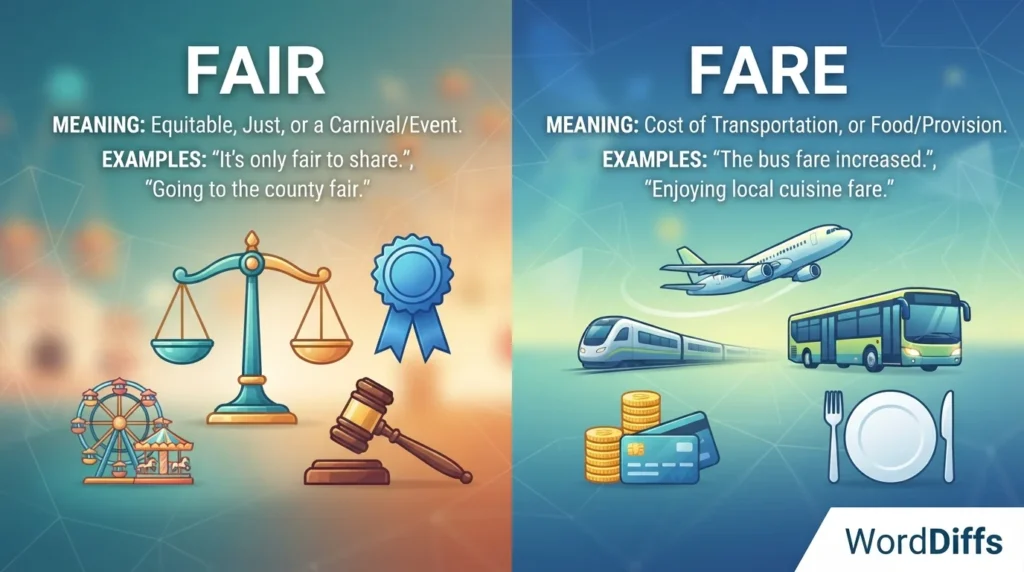
Understanding the difference between Fair vs Fare can be confusing because these two words sound the same but have completely different meanings. Fair usually describes something that is reasonable, equal, or pleasing, while fare commonly refers to the price paid for transportation or the food available in a particular place. Many English learners mix them up because they are homophones, meaning they have identical pronunciation but different spellings and meanings. In this guide, you will learn the definitions, pronunciation, grammar roles, examples, common mistakes, and practical ways to use fair and fare correctly in everyday American English.
Quick Difference Table
| Word | Part of Speech | Meaning | Example | Common Usage |
| Fair | Adjective, noun, adverb | Equal, reasonable, acceptable, or a public event | The teacher gave everyone a fair chance. | Rules, judgments, appearance, events |
| Fare | Noun, verb | Transportation cost or food offered at a place | The bus fare increased this year. | Travel, tickets, meals, performance |
Meaning of Fair
Meaning
Fair means something that is just, equal, reasonable, or free from unfair advantage. It is often used when people talk about equal treatment, honest decisions, or situations where everyone has the same opportunity.
The word can also describe something as attractive or pleasant, especially when talking about appearance, weather, or conditions. As a noun, fair can refer to a public event where people gather to enjoy games, food, entertainment, or displays.
Examples:
- A fair decision treats everyone equally.
- A fair competition gives each participant the same opportunity.
- A county fair may include rides, games, and food stands.
Pronunciation
| Feature | Details |
| IPA | /fer/ |
| American Pronunciation | fair |
| British Pronunciation | fair |
| Syllables | 1 syllable |
| Word Stress | Single stressed syllable |
Pronunciation Tips
- Fair sounds like the words fare and pair.
- The vowel sound is similar to the sound in “air.”
- Keep the pronunciation short with one clear syllable.
- Do not pronounce it as two separate sounds.
Function
Fair can function as different parts of speech depending on the sentence.
Part of speech:
- Adjective: describes something that is reasonable, equal, or acceptable.
- Noun: refers to a public event or exhibition.
- Adverb: means in a proper or fair way in some formal expressions.
Grammar role:
As an adjective, fair usually comes before a noun or after linking verbs.
Examples:
- a fair price
- a fair rule
- The decision was fair.
As a noun, it usually refers to an event.
Example:
- We visited the county fair.
As an adverb, it appears in expressions such as:
- play fair
Common grammatical patterns:
- fair + noun
Example: fair treatment - be + fair
Example: The result is fair. - play + fair
Example: Everyone should play fair. - go to + fair
Example: They went to the science fair.
Example Sentences
- The teacher gave every student a fair opportunity to answer the question.
- We agreed that the judge made a fair decision.
- The company offers fair wages to its employees.
- Everyone deserves fair treatment at work.
- The weather was fair and comfortable during our trip.
- She won first place at the local science fair.
- Please be fair when you decide who gets the last piece of cake.
- The referee tried to make a fair call during the game.
- They visited the county fair during the summer vacation.
- A fair agreement helped both sides solve the problem.
When to Use
Use fair when you are talking about:
- Equal treatment between people
- Honest decisions or judgments
- Reasonable prices, rules, or conditions
- Public events such as fairs or exhibitions
- Acceptable weather or conditions
Common situations include:
- “That is a fair price.”
- “The teacher was fair to all students.”
- “We are going to the book fair.”
Common Mistakes
A common mistake is using fair when talking about transportation costs.
Incorrect:
- The train fair is expensive.
Correct:
- The train fare is expensive.
Another mistake is confusing fair with physical appearance.
Example:
- She has fair hair.
Here, fair means light-colored, not equal or reasonable.
Remember that fair is connected with ideas of equality, honesty, and acceptable conditions.
Meaning of Fare
Meaning
Fare has two main meanings in English.
First, fare refers to the amount of money someone pays for transportation, such as a bus, taxi, train, or airplane ride.
Examples:
- The taxi fare was expensive.
- I paid my subway fare before entering the station.
Second, fare can refer to food or meals, especially when describing the type or quality of food served somewhere.
Examples:
- The restaurant serves traditional Italian fare.
- The hotel offers simple breakfast fare.
As a verb, fare means to perform, progress, or do in a particular situation. This use is more formal.
Example:
- The team fared well in the competition.
Pronunciation
| Feature | Details |
| IPA | /fer/ |
| American Pronunciation | fare |
| British Pronunciation | fare |
| Syllables | 1 syllable |
| Word Stress | Single stressed syllable |
Pronunciation Tips
- Fare has the same pronunciation as fair.
- The sound is the same as “air” in words like “care” and “share.”
- Focus on the spelling to understand the meaning because pronunciation will not help you.
- Remember that fare contains the idea of payment, food, or performance.
Function
Fare is mainly used as a noun, but it can also be used as a verb.
Part of speech:
- Noun: the cost of transportation or a type of food.
- Verb: to perform or progress.
Grammar role:
As a noun, fare usually appears after words connected to travel.
Examples:
- bus fare
- taxi fare
- airline fare
It can also describe food.
Examples:
- local fare
- traditional fare
As a verb, it is usually followed by an adverb or phrase describing performance.
Examples:
- fare well
- fare poorly
Common grammatical patterns:
- pay + fare
Example: I paid the bus fare. - transportation + fare
Example: The train fare increased. - fare + well/poorly
Example: She fared well on the exam.
Example Sentences
- The bus fare increased because fuel prices went up.
- I paid my taxi fare before leaving the airport.
- The airline fare was cheaper when I booked early.
- She saved money by comparing train fares online.
- The restaurant offers delicious local fare from the region.
- The festival included traditional fare from many cultures.
- The small café serves simple but tasty breakfast fare.
- The new employee fared well during the first month at work.
- The team did not fare as expected in the championship.
- Travelers should check the fare before choosing a transportation service.
When to Use
Use fare when you are talking about:
- The price of transportation
- Money paid for a ride
- Food served in a restaurant or event
- How someone or something performs in a situation
Common situations include:
- “What is the bus fare?”
- “The flight fare is too expensive.”
- “The restaurant serves seafood fare.”
- “How did you fare in the interview?”
Common Mistakes
A frequent mistake is using fare when the meaning is about fairness or equality.
Incorrect:
- The teacher gave every student a fare chance.
Correct:
- The teacher gave every student a fair chance.
Another common mistake is confusing fare with other travel words.
Incorrect:
- I bought my bus fair yesterday.
Correct:
- I bought my bus fare yesterday.
Remember that fare is connected with payment, food, or performance. If you are talking about equal treatment or justice, use fair.
Side-by-Side Comparison
| Situation | Correct Word | Explanation | Example |
| Talking about equal treatment | Fair | Means reasonable or equal | The manager made a fair decision. |
| Talking about transportation cost | Fare | Means the price of a ride | The train fare increased this month. |
| Describing a public event | Fair | Means an exhibition or festival | We visited the county fair. |
| Talking about restaurant food | Fare | Means a type of food served | The restaurant serves Italian fare. |
| Describing a person’s performance | Fare | Means to do or perform | She fared well on the test. |
| Talking about a reasonable price | Fair | Means acceptable or not too expensive | The store offers a fair price. |
| Discussing a bus ticket cost | Fare | Means travel payment | The bus fare is $2.50. |
| Describing honest rules | Fair | Means just and unbiased | The competition had fair rules. |
| Talking about light appearance | Fair | Means light-colored | He has fair skin and blond hair. |
| Talking about a food festival | Fair and Fare | Fair is the event, fare is the food | The fair featured local fare. |
Practice Quiz
Fill in the Blanks
Complete each sentence with fair or fare.
- The judge made a ______ decision after hearing both sides.
- How much is the bus ______ to downtown?
- The school held a science ______ last Friday.
- The restaurant serves traditional Mexican ______.
- Everyone deserves a ______ chance to succeed.
- The airline ______ was higher during the holiday season.
- She wondered how she would ______ during her first week at the new job.
- The teacher created ______ rules for the classroom.
- We enjoyed the food and entertainment at the county ______.
- The taxi ______ from the airport was expensive.
Choose the Correct Word
1. Which word completes the sentence correctly?
The company provides ______ opportunities for all employees.
A. Fare
B. Fair
C. Fear
D. Fire
2. Which word refers to the cost of a train ride?
A. Fair
B. Fare
C. Fear
D. Farm
3. Choose the correct word:
We visited the summer ______ and enjoyed the rides.
A. Fare
B. Fair
C. Fear
D. Fares
4. Which sentence uses the correct word?
A. The bus fair was expensive.
B. The bus fare was expensive.
C. The bus fair was crowded with passengers.
D. The bus fare decision was equal.
5. The restaurant offers fresh seafood ______.
A. Fair
B. Fare
C. Fear
D. Fire
6. Which sentence is correct?
A. The referee made a fare decision.
B. The referee made a fair decision.
C. The referee made a fare call.
D. The referee made a fear decision.
7. She ______ well during the interview.
A. Fair
B. Fare
C. Fared
D. Fairs
8. Which word describes something equal and reasonable?
A. Fare
B. Fair
C. Fire
D. Far
9. The flight ______ dropped after the holiday season ended.
A. Fair
B. Fare
C. Fear
D. Fairly
10. The children enjoyed games and food at the county ______.
A. Fare
B. Fair
C. Fear
D. Far
Answer Key
- Fair: Fair means equal, reasonable, or unbiased, so it correctly describes opportunities.
- Fare: Fare refers to the amount of money paid for transportation.
- Fair: A fair can be a public event with rides, games, and activities.
- Fare: A bus fare is the cost of traveling by bus.
- Fare: Fare can describe a type of food served at a restaurant.
- Fair: A referee makes a fair decision when it is honest and unbiased.
- Fared: Fared is the past tense of the verb fare, meaning performed or progressed.
- Fair: Fair describes something that is equal or reasonable.
- Fare: Flight fare refers to the price of an airline ticket.
- Fair: A county fair is a public event with entertainment and activities.
Final Thoughts
Understanding fair vs fare becomes easier when you connect each word with its main idea. Fair relates to equality, honesty, reasonable treatment, and public events. Fare relates to transportation costs, food, and performance. Although both words sound exactly the same, their meanings and spellings are different.
A simple memory trick is to remember that fare has an “e” for expenses, such as the money you pay for a bus, taxi, or airplane ride. Fair is connected with being equal and just. When writing, always think about the meaning first, not the sound. Choosing the correct word will make your English clearer and more accurate.
Frequently Asked Questions
What is the main difference between fair and fare?
Fair means equal, reasonable, or a public event, while fare usually means transportation cost, food, or performance.
Are fair and fare pronounced the same?
Yes. Both words are pronounced /fer/ in American English.
Are fair and fare homophones?
Yes. They are homophones because they have the same pronunciation but different meanings and spellings.
How do you remember the difference between fair and fare?
Remember that fare is connected with expenses, such as bus fare or train fare. Fair relates to equality or justice.
Is fair an adjective or a noun?
Fair is commonly an adjective, but it can also be a noun when referring to an event.
Is fare only used for transportation?
No. Fare can also describe food served at a restaurant or event, and it can be a verb meaning to perform or progress.
Which is correct: bus fair or bus fare?
The correct phrase is bus fare because it refers to the cost of riding a bus.
Which is correct: fair price or fare price?
The correct phrase is fair price because it means a reasonable or acceptable price.
Can fair describe a person’s appearance?
Yes. Fair can describe light-colored skin, hair, or features.
What does fare mean as a verb?
As a verb, fare means to perform, succeed, or progress in a situation.
Is the food at a festival called fair or fare?
The event is a fair, but the food served there can be called fare.
Why do people confuse fair and fare?
People confuse them because they sound identical when spoken.
Is “play fair” correct?
Yes. “Play fair” means to follow rules and behave honestly.
Is “pay fair” correct?
Usually no. The correct phrase depends on the meaning. You might say “pay the fare” for transportation or “pay a fair price” for a reasonable amount.

Lauren Kafka is an experienced freelance writer, editor, English tutor, and writing coach with extensive expertise in education, journalism, publishing, and communications. She is the founder of Kafka Consulting LLC, where she provides private English tutoring, writing coaching, and educational consulting services for K-12 students, college students, graduate students, and adults.
2 thoughts on “Fair vs Fare: Simple Differences, Meanings, and Examples”