
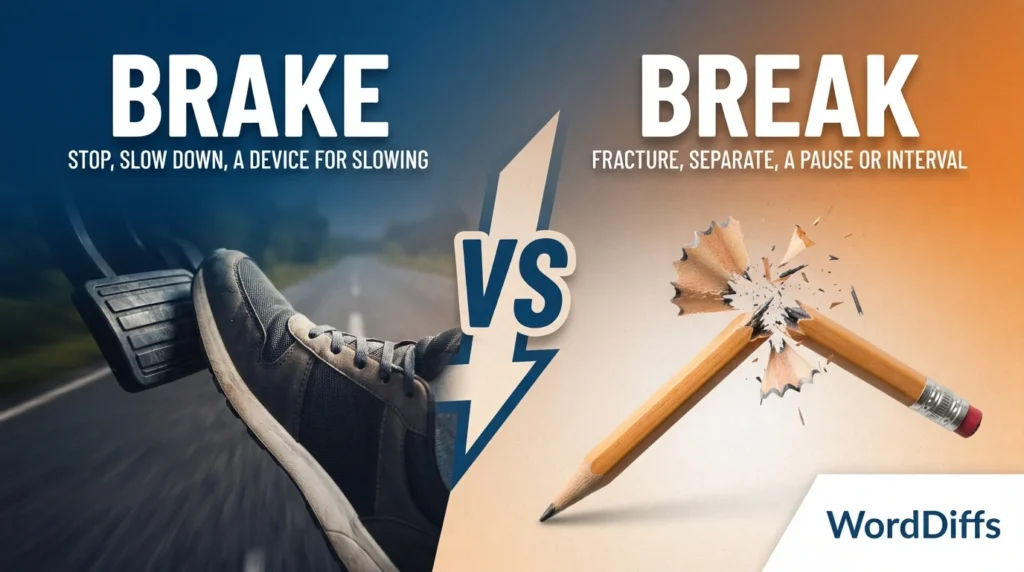
Many English learners confuse brake and break because they sound exactly alike but have completely different meanings. These words are homophones, which means they share the same pronunciation but differ in spelling and meaning. Brake usually refers to slowing or stopping movement, while break means to separate something into pieces, interrupt something, or take a rest. Learning the difference is important for writing and speaking accurately. In this guide, you’ll discover the meaning, pronunciation, grammar, usage, common mistakes, and real-life examples of both words so you can confidently choose the correct one in every situation.
Clear explanations of Cell vs Sel pronunciation and correct usage make these similar-looking terms easier to remember.
Quick Difference Table
| Word | Part of Speech | Meaning | Example | Common Usage |
| Brake | Noun, Verb | A device or action used to slow or stop movement | Please press the brake before turning. | Driving, cycling, machinery |
| Break | Noun, Verb | To separate into pieces, interrupt, or pause | Be careful not to break the glass. | Objects, work, school, sports, relationships |
Meaning of Brake
Meaning
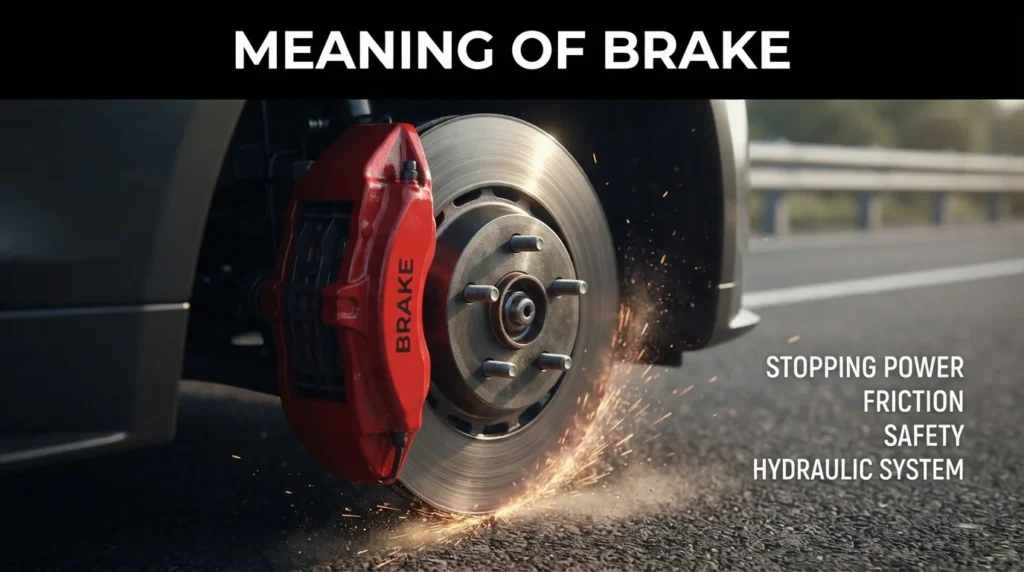
The word brake refers to a device or mechanism that slows down or stops a moving vehicle or machine. As a verb, it means to reduce speed or stop by using brakes. It is most commonly associated with cars, bicycles, motorcycles, trains, and other vehicles.
Unlike break, brake is specifically connected with controlling movement rather than damaging or interrupting something.
Pronunciation
| Feature | Details |
| IPA | /breɪk/ |
| American Pronunciation | brayk |
| British Pronunciation | brayk |
| Syllables | 1 |
| Word Stress | BRAKE |
Pronunciation Tips
- Brake rhymes with make, take, and cake.
- The ai sound is pronounced like the letter A.
- It has only one syllable.
- The pronunciation is identical to break, so context determines the meaning.
- Practice saying: brake pedal, brake suddenly, and apply the brake.
Function
Part of Speech
- Noun
- Verb
Grammar Role
As a noun, brake names a device used to slow or stop movement.
As a verb, brake describes the action of slowing down by using that device.
Sentence Function
- Subject: The brake needs repair.
- Object: He checked the brake.
- Verb: She braked quickly.
Common Grammatical Patterns
- apply the brake
- hit the brakes
- slam on the brakes
- brake suddenly
- brake gently
- brake before turning
- brake for pedestrians
- brake to avoid an accident
Example Sentences
- Always press the brake before shifting into park.
- The driver hit the brake when the light turned red.
- My bicycle brake needs to be adjusted.
- She braked quickly to avoid hitting a dog.
- The mechanic replaced the worn brake pads.
- You should brake gently on wet roads.
- The bus driver applied the brake at the stop.
- He forgot to set the parking brake.
- Good brakes help keep drivers safe.
- The train began to brake as it entered the station.
When to Use
Use brake when talking about slowing down or stopping movement.
Common situations include:
- Driving a car
- Riding a bicycle
- Operating machinery
- Road safety
- Vehicle maintenance
- Transportation instructions
Examples:
- Apply the brake before getting out.
- The cyclist used the rear brake.
- The driver braked to avoid a collision.
- Check your brakes regularly for safety.
Common Mistakes
Many learners accidentally write break when they mean brake because both words sound the same.
Incorrect: Please break the car before the turn.
Correct: Please brake the car before the turn.
Another mistake is forgetting that brake relates only to stopping or slowing movement.
Incorrect: I need a coffee brake.
Correct: I need a coffee break.
A simple memory trick is:
- Brake = Vehicle
- Break = Damage or Pause
Remember that whenever the topic involves driving, stopping, slowing down, or vehicle safety, brake is almost always the correct choice.
Writers can improve accuracy by learning Device vs Devise with clear examples in practical sentences.
Meaning of Break
Meaning
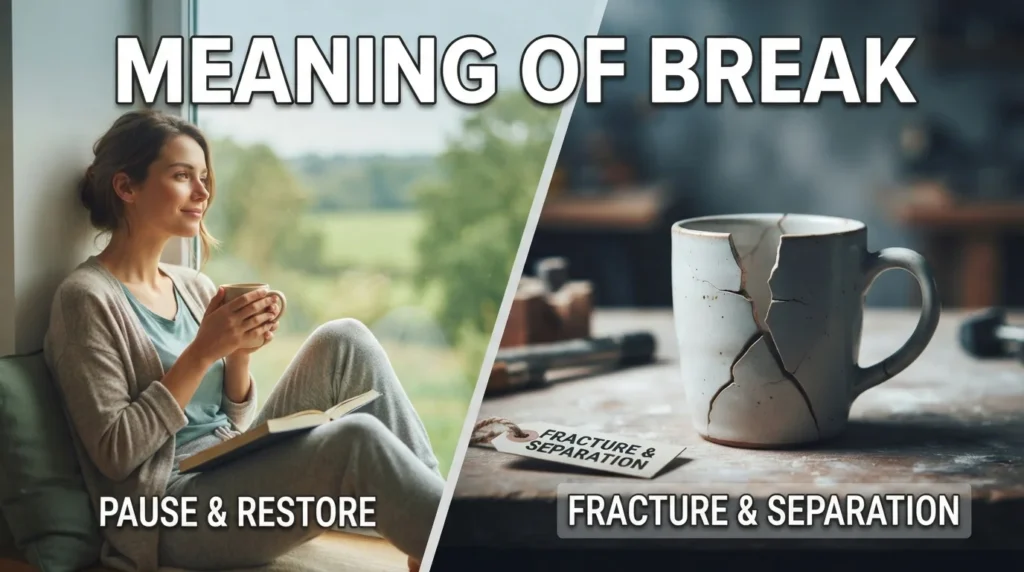
The word break has several meanings, making it one of the most commonly used words in English. As a verb, it usually means to separate something into pieces by force, either accidentally or intentionally. It can also mean to interrupt an activity, stop a pattern, violate a rule, or take a rest. As a noun, break refers to a pause, a gap, or a period of rest.
Unlike brake, which is related to slowing or stopping movement, break is used in many everyday situations involving damage, interruptions, pauses, and changes.
Pronunciation
| Feature | Details |
| IPA | /breɪk/ |
| American Pronunciation | brayk |
| British Pronunciation | brayk |
| Syllables | 1 |
| Word Stress | BREAK |
Pronunciation Tips
- Break rhymes with cake, make, and take.
- The vowel sound is the long A sound.
- It contains only one syllable.
- It is pronounced exactly like brake, so the meaning depends on the sentence.
- Practice saying phrases like take a break, break the glass, and break the rules.
Function
Part of Speech
- Verb
- Noun
Grammar Role
As a verb, break expresses an action such as damaging, interrupting, or ending something.
As a noun, it refers to a pause, rest, opening, or interruption.
Sentence Function
- Subject: The break was relaxing.
- Object: We enjoyed our break.
- Verb: Don’t break the vase.
Common Grammatical Patterns
- break a window
- break a promise
- break the law
- break the news
- break a record
- break into pieces
- take a break
- coffee break
- lunch break
- break away
Example Sentences
- Be careful not to break the glass.
- We usually take a short break after lunch.
- She accidentally broke her favorite mug.
- Don’t break your promise to your friends.
- The workers enjoyed a fifteen-minute break.
- Strong winds can break tree branches.
- He hopes to break the school running record.
- Please don’t break the classroom rules.
- They decided to break the bad habit together.
- The children took a break before finishing their homework.
When to Use
Use break when referring to:
- Damaging or separating something
- Taking a rest or pause
- Interrupting an activity
- Violating rules or promises
- Setting or surpassing records
- Ending habits, patterns, or silence
Examples:
- Don’t break the plate.
- Let’s take a break after this lesson.
- He broke the speed record.
- Never break the law.
Common Mistakes
Since break and brake sound the same, learners often confuse their spellings.
Incorrect: Press the break before the stop sign.
Correct: Press the brake before the stop sign.
Another common mistake is using brake when talking about pauses.
Incorrect: Let’s take a brake.
Correct: Let’s take a break.
Keep this memory trick in mind:
- Break = Damage, Pause, or Interrupt
- Brake = Stop a Vehicle
If the sentence is about resting, breaking an object, ending something, or interrupting an activity, break is the correct word.
Side-by-Side Comparison
| Situation | Correct Word | Explanation | Example |
| Stopping a car | Brake | Refers to slowing down or stopping a vehicle. | Press the brake before the intersection. |
| Damaging a glass | Break | Means to separate something into pieces. | Don’t break the glass. |
| Taking a rest at work | Break | Refers to a short period of rest. | We took a coffee break. |
| Riding a bicycle downhill | Brake | Means to slow the bicycle safely. | Use the rear brake on steep hills. |
| Breaking a promise | Break | Means to fail to keep a promise. | Never break your word. |
| Avoiding an accident | Brake | Means to stop or reduce speed. | She hit the brake immediately. |
| School recess | Break | Means a pause between classes. | The students went outside during break. |
| Parking a vehicle | Brake | Refers to the parking brake. | Always set the parking brake. |
| Snapping a pencil | Break | Means to damage an object. | He accidentally broke the pencil. |
| Emergency driving | Brake | Means to stop quickly for safety. | The driver braked to avoid a deer. |
Practice Quiz
Fill in the Blanks
Choose either brake or break to complete each sentence.
- Please press the ______ before the car starts rolling.
- Let’s take a short ______ before continuing the meeting.
- Be careful not to ______ your phone.
- The cyclist used the front ______ while going downhill.
- Don’t ______ the classroom rules.
- The driver had to ______ suddenly when a child crossed the street.
- We stopped for a lunch ______ during our road trip.
- The mechanic checked all four ______ before the race.
- If you drop the vase, it might ______.
- She always applies the parking ______ before leaving the car.
Choose the Correct Word
1. Which word correctly completes the sentence?
The driver slammed on the ______.
A. break
B. brake
C. brakee
D. breake
2. Which sentence is correct?
A. I need a five-minute brake.
B. Please brake the glass carefully.
C. Let’s take a short break.
D. The break pedal is broken.
3. Which word means to damage something?
A. Brake
B. Break
C. Both
D. Neither
4. Which sentence uses the correct word?
A. Always break before a sharp turn.
B. The bike’s break is loose.
C. Apply the brake gently.
D. Take a brake after lunch.
5. Which word refers to a rest period?
A. Brake
B. Break
C. Both
D. Neither
6. Which sentence is correct?
A. He broke the speed limit sign.
B. He braked the coffee.
C. We brake for ten minutes.
D. She put the break on the bicycle.
7. Which word belongs in this sentence?
Please don’t ______ the window.
A. brake
B. break
C. breake
D. brak
8. Which sentence is correct?
A. The parking break is engaged.
B. The parking brake is engaged.
C. The parking breake is engaged.
D. The parking brak is engaged.
9. Which word fits best?
The children enjoyed their afternoon ______.
A. brake
B. break
C. brakee
D. breake
10. Which sentence is correct?
A. The driver braked just in time.
B. The driver breaked just in time.
C. The driver break just in time.
D. The driver brake just in time.
Answer Key
Fill in the Blanks
- brake
Explanation: A brake is used to slow down or stop a vehicle. - break
Explanation: A break is a short period of rest. - break
Explanation: Break means to damage or separate something into pieces. - brake
Explanation: A bicycle uses a brake to reduce speed or stop. - break
Explanation: We say break the rules, meaning to violate them. - brake
Explanation: To stop a moving vehicle, you brake. - break
Explanation: A lunch break is a pause during the day. - brakes
Explanation: Vehicles have brakes, the devices used for stopping. - break
Explanation: A vase can break if it falls. - brake
Explanation: A parking brake keeps a vehicle from moving when parked.
Choose the Correct Word
- B. brake
Explanation: The phrase slam on the brake(s) refers to stopping a vehicle quickly. - C. Let’s take a short break.
Explanation: A break means a pause or rest. - B. Break
Explanation: Break means to damage, separate, or interrupt something. - C. Apply the brake gently.
Explanation: Brake is the correct word when referring to stopping a vehicle. - B. Break
Explanation: A break is a rest period. - A. He broke the speed limit sign.
Explanation: Broke is the past tense of break, meaning damaged. - B. break
Explanation: Windows can break, not brake. - B. The parking brake is engaged.
Explanation: The correct term is parking brake. - B. break
Explanation: Children enjoy a break between activities. - A. The driver braked just in time.
Explanation: Braked is the past tense of brake, meaning slowed or stopped the vehicle.
Final Thoughts
Understanding the difference between brake and break is easier once you connect each word with its purpose. Brake is related to stopping or slowing a moving vehicle, while break refers to damaging something, taking a pause, interrupting an activity, or ending a pattern. Although they sound exactly the same, their meanings are completely different.
An easy memory trick is to think of brake whenever you’re driving or riding a bike, and break whenever something is damaged or you need a rest. The more you read, write, and practice these words in everyday situations, the more naturally you’ll choose the correct spelling. With regular practice, confusing brake and break will soon become a thing of the past.
Frequently Asked Questions
What is the difference between brake and break?
Brake refers to slowing or stopping a vehicle, while break means to damage something, pause an activity, or interrupt a process.
Are brake and break pronounced the same?
Yes. Both words are pronounced /breɪk/, making them homophones.
Is brake a noun or a verb?
Brake can be both a noun and a verb. As a noun, it is a stopping device. As a verb, it means to slow or stop using that device.
Is break a noun or a verb?
Yes. Break is both a noun and a verb. It can mean a pause, or the action of damaging or interrupting something.
How do I remember the difference between brake and break?
Remember this simple trick:
- Brake = Stop a vehicle
- Break = Damage or take a rest
Which word is used for a coffee break?
The correct word is break, because it refers to a short period of rest.
Which word is used when driving a car?
Use brake when talking about slowing down or stopping a vehicle.
What is the past tense of brake?
The past tense of brake is braked.
Example: She braked suddenly to avoid an accident.
What is the past tense of break?
The past tense of break is broke.
Example: He broke his phone yesterday.
Why do people confuse brake and break?
People confuse them because they have the same pronunciation but different spellings and meanings.
Can break mean a pause?
Yes. Break commonly means a pause from work, school, or another activity.
Example: Let’s take a ten-minute break.
Can brake be used outside driving?
Yes, although it is most commonly used for vehicles, brake can also refer to slowing or stopping machines, trains, elevators, or similar equipment.

Carter is an English language specialist, author, and senior editor with more than 20 years of experience in English grammar, writing, editing, and language education. Throughout his career, he has worked with educational organizations, digital publishers, and content teams to develop accurate, engaging, and learner-focused resources. His expertise includes English grammar, spelling, vocabulary, commonly confused words, proofreading, copy editing, academic writing, and SEO content strategy. Carter is passionate about helping learners and writers improve their communication skills through clear explanations, practical examples, and high-quality educational content.
2 thoughts on “Brake vs Break: Pronunciation & Master Their Meanings and Usage”