
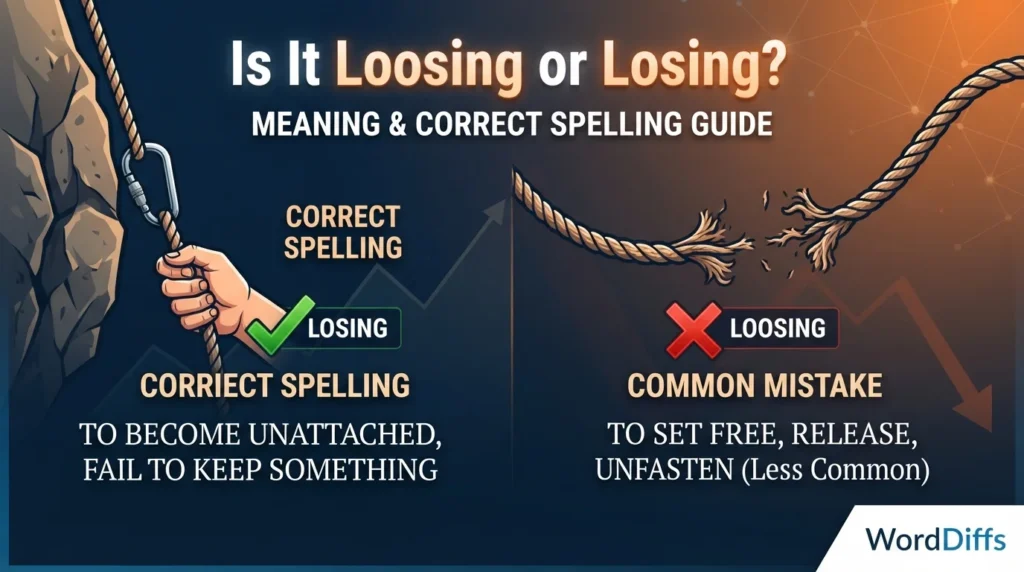
Many English learners and even native speakers wonder whether loosing or losing is the correct spelling. The confusion happens because both words exist in English, but they have completely different meanings. In everyday writing, people often type loosing when they actually mean losing, creating one of the most common spelling mistakes in English. Understanding the difference can improve your writing, help you avoid embarrassing errors, and make your communication clearer. In this guide, you’ll learn the meanings of both words, why they are confused, how to remember the correct spelling, proper pronunciation, real-life examples, and practical tips for using the right word every time.
Knowing Brake vs Break spelling and pronunciation can improve accuracy when writing or speaking English.
Quick Facts Table
| Feature | Details |
| Correct Word (for most situations) | Losing |
| Incorrect Word (when meaning “to fail to keep or win”) | Loosing |
| Word Type | Verb (present participle of lose) |
| Meaning | Failing to keep, win, find, or retain something |
| Pronunciation | /ˈluːzɪŋ/ |
| Common Error | Adding an unnecessary extra o |
| Difficulty | Easy to Moderate |
What Does Loosing or Losing Mean?
Although people often compare loosing and losing, the two words are not interchangeable. One is commonly used in everyday English, while the other has a much more limited meaning.
Losing
Losing is the present participle and gerund of the verb lose. It means failing to keep, win, achieve, or possess something.
Examples include:
- She is losing her patience.
- Our team keeps losing close matches.
- He is losing weight after exercising regularly.
- I’m afraid of losing my wallet.
Common meanings of losing include:
- Failing to win
- Misplacing something
- Becoming deprived of something
- Gradually decreasing
- Missing an opportunity
Loosing
Loosing is also a real English word, but it comes from the verb loose, meaning to release, untie, or set free.
Examples include:
- The sailor was loosing the ropes.
- The archer was loosing an arrow.
- They were loosing the dogs into the field.
Because this meaning is uncommon in modern everyday English, many people accidentally write loosing when they actually mean losing.
Is “Loosing” Correct?
The answer depends on what you mean.
If you want to express failing to win, failing to keep something, or misplacing something, then loosing is incorrect.
For example:
- ❌ I am loosing my keys.
- ✅ I am losing my keys.
People mistakenly use loosing because:
- It looks similar to lose.
- They assume adding -ing requires doubling the vowel.
- They rely on pronunciation instead of spelling.
- Fast typing leads to an extra o.
However, loosing is perfectly correct when it means releasing or setting free.
Correct examples:
- The knight was loosing his horse from the stable.
- The hunter was loosing an arrow.
What Is the Correct Spelling?
If your meaning is not winning, misplacing something, becoming less, or failing to keep something, the correct spelling is losing.
Remember this important rule:
Lose → Losing
Not:
Lose → Loosing
Examples:
- ✅ She is losing confidence.
- ✅ They are losing money.
- ✅ We are losing time.
- ✅ The company is losing customers.
Quick reminders:
- Lose becomes losing.
- Do not add another o.
- Think of losing as the everyday spelling used in conversations, exams, emails, and professional writing.
Knowing the correct spelling of Cell vs Sel helps avoid errors when writing this commonly confused word.
Difference Between the Two Spellings
| Feature | Loosing | Losing |
| Correct for “fail to win” | ❌ No | ✅ Yes |
| Correct English word | ✅ Yes | ✅ Yes |
| Main Meaning | Releasing or setting free | Failing to keep, win, or retain |
| Everyday Usage | Rare | Very common |
| Used in sports | ❌ No | ✅ Yes |
| Used for misplaced objects | ❌ No | ✅ Yes |
| Common learner mistake | Frequently misused | Correct choice |
Key Difference
Use losing when talking about:
- Games
- Competitions
- Money
- Weight
- Time
- Keys
- Patience
- Opportunities
Use loosing only when talking about:
- Releasing something
- Untying something
- Letting something go
- Shooting arrows (traditional usage)
Meaning of the Correct Word
The correct spelling for almost all everyday situations is losing.
It can describe many situations, including:
- Not winning a competition
- Misplacing belongings
- Becoming smaller in amount
- Gradually disappearing
- Giving up something unintentionally
Examples:
- Our team is losing the championship.
- She’s losing interest in the project.
- I’m losing sleep because of stress.
- The phone is losing battery quickly.
Other common uses include:
- Losing hope
- Losing focus
- Losing confidence
- Losing control
- Losing balance
- Losing momentum
- Losing sight
- Losing track of time
Real examples can demonstrate the Advice vs Advise meaning and usage in natural English sentences.
Pronunciation
IPA Pronunciation
Losing: /ˈluːzɪŋ/
The s is pronounced like a z sound.
Syllable Breakdown
los-ing
Two syllables:
- LOO
- zing
Pronunciation Tips
- Say lose first.
- Add ing without changing the spelling.
- The middle sound is z, not s.
- Do not pronounce an extra vowel because there isn’t one.
Practice:
- lose
- losing
- losing confidence
- losing the game
Why Do People Make This Spelling Mistake?
The confusion between loosing and losing happens for several reasons.
Pronunciation Confusion
Many learners hear the long oo sound and assume the spelling should contain two consecutive o letters.
Typing Mistakes
When typing quickly, it is easy to insert an extra o, especially because the fingers naturally repeat nearby keys.
Phonetic Spelling
People often spell words according to how they sound rather than following standard spelling rules.
Similar-Looking Words
English contains many words ending in -ing, leading writers to incorrectly assume that lose changes to loose before adding -ing.
Memory Errors
Some people confuse:
- lose
- loose
- losing
- loosing
because they look visually similar.
Regional Influence
Non-native speakers may rely on pronunciation patterns from their first language, making it harder to distinguish between similar English spellings.
Origin and Etymology
The verb lose comes from the Old English word losian, meaning to perish, be destroyed, or fail to keep. Over centuries, its meaning expanded to include failing to win, misplacing possessions, and becoming deprived of something.
The word loose comes from Old Norse and Old English roots meaning free, untied, or not fastened. From this developed the verb to loose, meaning to release or set free.
Although the words share similar spellings and pronunciations, they evolved from different historical meanings. That is why losing and loosing remain separate words with distinct uses today.
How to Remember the Correct Spelling
A few simple memory tricks can help you avoid this mistake.
Memory Trick 1
Lose becomes losing, not loosing.
If the base word is lose, simply add -ing.
Memory Trick 2
Think of this sentence:
When I’m losing, I don’t gain an extra o.
Memory Trick 3
Remember that loose means not tight.
Since loosing comes from loose, it refers to releasing something, not failing to win.
Memory Trick 4
Ask yourself:
“Am I talking about failing to keep something?”
If yes, write losing.
Quick Spelling Hacks
- Start with lose.
- Add -ing.
- Never insert another o.
- Double-check before sending emails or assignments.
Examples in Sentences
| Incorrect Sentence | Correct Sentence |
| I am loosing my phone again. | I am losing my phone again. |
| She keeps loosing her glasses. | She keeps losing her glasses. |
| We are loosing the match. | We are losing the match. |
| They are loosing money every month. | They are losing money every month. |
| He is loosing confidence. | He is losing confidence. |
| I’m loosing interest in the movie. | I’m losing interest in the movie. |
| The company is loosing customers. | The company is losing customers. |
| She is loosing weight steadily. | She is losing weight steadily. |
| We are loosing valuable time. | We are losing valuable time. |
| He was loosing his wallet every week. | He was losing his wallet every week. |
| Our team keeps loosing. | Our team keeps losing. |
| You are loosing focus during class. | You are losing focus during class. |
| They are loosing patience with the delays. | They are losing patience with the delays. |
| I hate loosing arguments. | I hate losing arguments. |
| We are loosing opportunities by waiting. | We are losing opportunities by waiting. |
Common Mistakes to Avoid
Even though losing is the correct spelling in most situations, many writers continue to confuse it with loosing. Avoid these common mistakes.
- Using loosing instead of losing when talking about failure
- ❌ We are loosing the game.
- ✅ We are losing the game.
- Confusing lose with loose
- Lose means to fail to keep or win.
- Loose means not tight.
- Adding an unnecessary extra “o”
- The verb lose changes directly to losing.
- It does not become loosing.
- Assuming pronunciation determines spelling
- English spelling often differs from pronunciation. Always remember the base word is lose.
- Using loosing in formal writing
- Unless you truly mean “releasing” or “setting free,” use losing.
Similar Commonly Misspelled Words
| Incorrect | Correct | Meaning |
| Loosing | Losing | Failing to keep or win |
| Looseing | Losing | Incorrect spelling |
| Loose | Lose | Different words with different meanings |
| Recieve | Receive | To get something |
| Definately | Definitely | Certainly |
| Seperate | Separate | To divide |
| Occured | Occurred | Happened |
| Untill | Until | Up to a certain time |
| Grammer | Grammar | Rules of language |
| Writting | Writing | The act of writing |
Related Words
Synonyms
Depending on context, losing may be similar to:
- Misplacing
- Forfeiting
- Surrendering
- Missing
- Sacrificing
- Dropping
- Wasting
- Falling behind
Antonyms
Some opposite words include:
- Winning
- Finding
- Keeping
- Retaining
- Gaining
- Recovering
- Securing
- Preserving
Related Forms
| Word | Part of Speech | Meaning |
| Lose | Verb | To fail to keep or win |
| Losing | Verb (present participle/gerund) | Currently failing to keep or win |
| Lost | Adjective/Verb | No longer possessed or past tense of lose |
| Loss | Noun | The act or result of losing |
| Loser | Noun | Someone who loses |
| Loose | Adjective | Not tight |
| Loosen | Verb | To make less tight |
| Loosing | Verb | Releasing or setting free |
Grammar Tips
Using losing correctly also means understanding how it functions in a sentence.
- Losing is the -ing form of the verb lose.
- It can be part of a continuous tense.
- She is losing confidence.
- It can function as a gerund.
- Losing isn’t the end.
- It often appears after helping verbs.
- They were losing badly.
- Do not replace losing with loosing unless you mean “releasing.”
Writing Tips
Improve your spelling accuracy with these practical habits.
- Proofread words ending in -ing before submitting your work.
- Remember that lose and losing have only one o.
- Read your sentence aloud and check its meaning.
- Use spell-check, but do not rely on it completely.
- Learn commonly confused word pairs such as:
- Lose vs Loose
- Affect vs Effect
- Accept vs Except
- Build vocabulary by reading professionally edited books and articles.
- Practice writing sentences using lose, losing, lost, and loss together.
Quick Spelling Checklist
| Question | Yes/No |
| Am I talking about failing to keep or win something? | ✅ Use losing |
| Am I talking about releasing or setting something free? | ✅ Use loosing |
| Did I accidentally add an extra o? | Check carefully |
| Is the base word lose? | Then write losing |
| Does the sentence discuss games, money, time, or keys? | Use losing |
| Have I proofread the word? | Always |
Key Takeaways
- Losing is the correct spelling when you mean failing to keep, win, or retain something.
- Loosing is a real word but means releasing or setting free.
- The confusion usually comes from the similar spellings of lose and loose.
- Remember: Lose → Losing, not Loosing.
- Context is the easiest way to choose the correct word.
- Careful proofreading helps eliminate this common spelling mistake.
Conclusion
The difference between loosing and losing is simple once you understand their meanings. Losing is the correct spelling for everyday situations involving failure to win, misplacing something, or no longer having something. Loosing, on the other hand, is a legitimate but much less common word that means releasing, untieing, or setting something free. Because these words look alike, many writers accidentally choose the wrong one. By remembering that lose changes directly to losing, you can avoid one of the most common English spelling mistakes. Whether you are writing emails, academic assignments, business reports, or social media posts, using the correct spelling will make your writing clearer, more professional, and more accurate.
Frequently Asked Questions
Is losing or loosing the correct spelling?
Losing is the correct spelling when you mean failing to keep, win, or retain something. Loosing is also a real English word, but it means releasing or setting something free. In everyday writing, most people should use losing.
Why do people spell losing as loosing?
Many people confuse the words because they sound similar and because lose and loose are visually alike. Others mistakenly think adding -ing requires another o, which is not correct.
Is loosing ever correct?
Yes. Loosing is correct when it means releasing, untying, or setting something free. For example, an archer may be loosing an arrow, or someone may be loosing the ropes from a boat.
What is the easiest way to remember the correct spelling?
Remember the simple rule: Lose becomes losing. If your sentence is about not winning or not keeping something, never add an extra o.
How is losing pronounced?
Losing is pronounced /ˈluːzɪŋ/. It has two syllables: LOO-zing. The letter s sounds like z in pronunciation.
Is losing a verb or a noun?
Losing is the present participle and gerund form of the verb lose. It can function as part of a verb phrase or as a noun-like gerund, depending on the sentence.
Is losing acceptable in academic writing?
Yes. Losing is completely correct in academic, professional, and formal writing whenever it matches the intended meaning. Using loosing incorrectly can reduce the quality and credibility of your writing.
What is the difference between lose and loose?
Lose is a verb meaning to fail to keep or win. Loose is usually an adjective meaning not tight. Although they are similar in spelling, they have different meanings and pronunciations.
Are loss and losing related?
Yes. Both words come from the verb lose. Loss is a noun referring to the result of losing, while losing is the present participle or gerund of the verb.
Will using loosing instead of losing affect exam scores?
It can. Many teachers and examiners treat loosing as a spelling error when losing is intended. Using the correct spelling demonstrates strong language skills and careful proofreading.
How can I stop making this spelling mistake?
Practice writing lose, losing, lost, and loss together. Read carefully before submitting your work, and remember that the correct everyday spelling contains only one o after the initial l.

Carter is an English language specialist, author, and senior editor with more than 20 years of experience in English grammar, writing, editing, and language education. Throughout his career, he has worked with educational organizations, digital publishers, and content teams to develop accurate, engaging, and learner-focused resources. His expertise includes English grammar, spelling, vocabulary, commonly confused words, proofreading, copy editing, academic writing, and SEO content strategy. Carter is passionate about helping learners and writers improve their communication skills through clear explanations, practical examples, and high-quality educational content.