
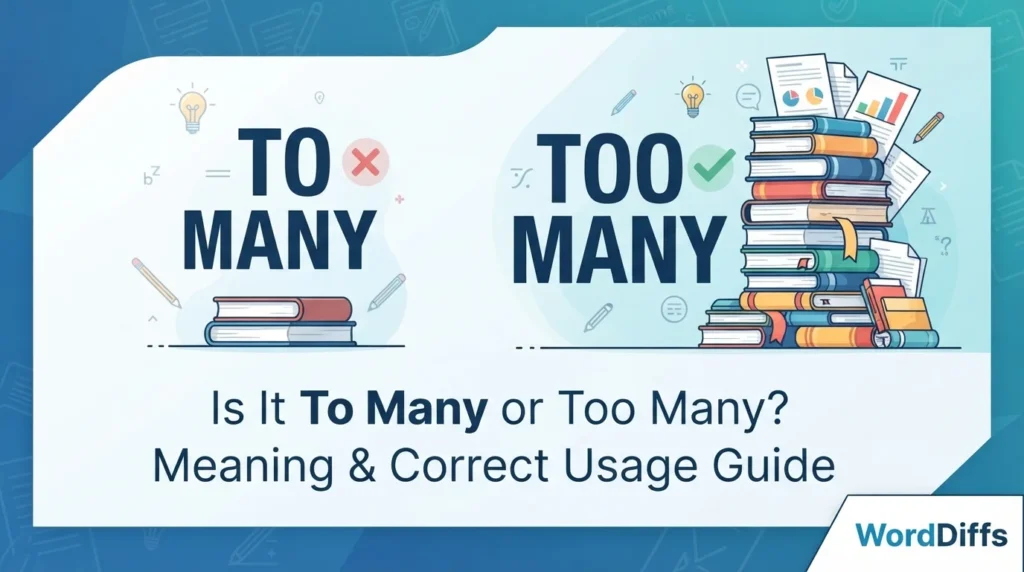
Have you ever wondered whether you should write to many or too many? This is one of the most common English writing mistakes because the words to and too sound exactly alike but have different meanings and grammatical functions. As a result, many learners and even native speakers accidentally use the wrong form in emails, school assignments, social media posts, and professional writing. In this guide, you’ll learn the correct spelling, the meaning of each expression, their pronunciation, why the mistake happens, simple memory tricks, and plenty of practical examples so you can use too many confidently every time.
Quick Facts Table
| Feature | Details |
| Correct Expression | Too many |
| Incorrect Expression | To many (when meaning “an excessive number”) |
| Word Type | Adverb (too) + Determiner (many) |
| Meaning | More than is needed, wanted, or acceptable |
| Pronunciation | /tuː ˈmɛni/ |
| Common Error | Confusing to with too because they sound alike |
| Difficulty | Easy to Moderate |
What Does To Many or Too Many Mean?
The expression too many means an excessive number of people or things. It is used when the quantity is greater than what is desired, acceptable, or necessary.
The phrase to many is not generally correct when expressing excess. However, it can occasionally appear in a sentence where to functions as a preposition before the adjective or pronoun many, such as in literary or uncommon constructions. In everyday English, when you mean “more than enough,” the correct expression is always too many.
Key Points
- Too many expresses excess.
- Too means more than enough or excessively.
- Many refers to a large number of countable nouns.
- To is usually a preposition or part of an infinitive, not a word showing excess.
Examples
- There are too many cars on the road today.
- She bought too many books.
- We invited too many guests.
- The recipe uses too many ingredients.
Is “To Many” Correct?
In most situations, to many is incorrect when you want to express that there is an excessive number of something.
People often write to many because the words to and too are pronounced the same. This makes it a common homophone error rather than a spelling error.
Why Is It Incorrect?
- To does not mean “more than enough.”
- The meaning of excess belongs to too.
- Replacing too with to changes the grammar and makes the sentence incorrect.
Incorrect Examples
- There are to many mistakes in this report.
- We have to many meetings today.
- She owns to many shoes.
Correct Versions
- There are too many mistakes in this report.
- We have too many meetings today.
- She owns too many shoes.
What Is the Correct Spelling?
The correct expression is too many whenever you are talking about an excessive number of countable items.
Remember that too has several meanings, one of which is more than enough. When it comes before many, it always indicates excess.
Rules to Remember
- Write too many with two “o”s in too.
- Use it only with countable nouns.
- Replace it with “an excessive number of” to check whether it fits.
Examples
- There are too many emails in my inbox.
- The teacher assigned too many homework tasks.
- We planted too many flowers.
- He asked too many questions.
Difference Between the Two Spellings
| Feature | To Many | Too Many |
| Correct for excess? | No | Yes |
| Meaning | Usually incorrect in this context | More than enough |
| Grammar | Preposition + adjective/pronoun | Adverb + determiner |
| Common Usage | Rare and context-dependent | Everyday English |
| Example | There are to many books. ✗ | There are too many books. ✓ |
Understanding the Difference
The difference comes down to the word too.
- Too means excessively or more than enough.
- To usually indicates direction, destination, or forms part of an infinitive.
Compare these examples:
- I walked to school.
- There were too many students in the classroom.
Although they sound identical, they serve completely different grammatical purposes.
Meaning of the Correct Expression
The phrase too many describes a number that exceeds what is appropriate, expected, or manageable.
It is used with countable nouns, including people, books, cars, apples, emails, and questions.
Common Situations
You can use too many when talking about:
- People
- Animals
- Books
- Cars
- Problems
- Mistakes
- Emails
- Meetings
- Toys
- Questions
Examples
- There were too many people at the concert.
- The child has too many toys.
- Our team made too many errors.
- She received too many notifications.
Pronunciation
IPA Pronunciation
Too many
/tuː ˈmɛni/
Syllable Breakdown
- Too → too
- Many → man-y
Pronounced together:
too MAN-ee
Pronunciation Tips
- Stretch the vowel in too.
- Stress the first syllable of many.
- Remember that pronunciation does not reveal the spelling because to and too sound the same.
- Focus on the meaning instead of the sound when writing.
Why Do People Make This Spelling Mistake?
Several factors contribute to the confusion between to many and too many.
Pronunciation Confusion
Both to and too are pronounced the same in normal speech, making them easy to confuse.
Typing Mistakes
Many writers type quickly and accidentally choose the shorter word to without proofreading.
Phonetic Spelling
People often spell words based on what they hear rather than their grammatical function.
Similar-Looking Words
The words differ by only one letter, making the mistake difficult to notice during editing.
Memory Errors
Some learners remember that to is extremely common and mistakenly use it in every similar expression.
Regional Influence
In many English-speaking regions, to and too are pronounced identically, offering no spoken clue about which spelling is correct.
Origin and Etymology
The word too comes from Old English tō, which originally carried the sense of “in addition” or “beyond.” Over time, it developed the meaning of more than enough or excessively, which is the meaning used in the phrase too many today.
The word many comes from Old English manig, meaning “numerous” or “a large number.”
Meanwhile, to developed as a preposition indicating direction, movement, purpose, or relationship. Although to and too share historical roots and identical pronunciation in modern English, their meanings gradually separated, giving each word a distinct grammatical role.
How to Remember the Correct Spelling
Learning a few simple memory tricks can help you avoid this common mistake.
Memory Tricks
- Too has two Os, and excess means “extra.”
- Think of the second O as representing something extra.
- If you can replace the phrase with an excessive number of, use too many.
- If the sentence talks about quantity being more than necessary, choose too.
Mnemonics
- Two Os mean something extra.
- Too = Extra.
- Too many = More than enough.
Quick Tips
- Ask yourself, “Do I mean an excessive amount?”
- If yes, write too many.
- Never use to many to express excess.
Examples in Sentences
| Incorrect Sentence | Correct Sentence |
| There are to many people here. | There are too many people here. |
| She has to many clothes. | She has too many clothes. |
| We bought to many apples. | We bought too many apples. |
| He asked to many questions. | He asked too many questions. |
| They made to many mistakes. | They made too many mistakes. |
| I received to many emails today. | I received too many emails today. |
| There were to many visitors yesterday. | There were too many visitors yesterday. |
| The recipe has to many ingredients. | The recipe has too many ingredients. |
| She watches to many videos. | She watches too many videos. |
| We invited to many guests. | We invited too many guests. |
| There are to many books on the shelf. | There are too many books on the shelf. |
| He owns to many cars. | He owns too many cars. |
| The project has to many problems. | The project has too many problems. |
| They planted to many trees in one area. | They planted too many trees in one area. |
| You packed to many bags for the trip. | You packed too many bags for the trip. |
Common Mistakes to Avoid
Many learners confuse too many with similar expressions because several English words have similar pronunciation or related meanings. Avoid these common mistakes to write more accurately.
- Using to many instead of too many
- Incorrect: There are to many errors.
- Correct: There are too many errors.
- Using too much with countable nouns
- Incorrect: There are too much books.
- Correct: There are too many books.
- Using too many with uncountable nouns
- Incorrect: There is too many water.
- Correct: There is too much water.
- Confusing to, too, and two
- To is a preposition or part of an infinitive.
- Too means excessively or also.
- Two is the number 2.
- Forgetting subject-verb agreement
- Correct: There are too many people.
- Correct: There is too much traffic.
Similar Commonly Misspelled Words
| Incorrect | Correct | Reason |
| To much | Too much | Too means excessively. |
| To many | Too many | Too expresses excess. |
| Your | You’re | Possessive vs. contraction. |
| Its | It’s | Possessive vs. contraction. |
| Their | They’re | Possessive adjective vs. contraction. |
| Loose | Lose | Different meanings and spellings. |
| Then | Than | Time vs. comparison. |
| Affect | Effect | Verb vs. noun in most cases. |
| Accept | Except | Receive vs. excluding. |
| Principal | Principle | Person vs. rule or belief. |
Related Words
Synonyms
Depending on the context, too many can be replaced with:
- Excessive
- Numerous
- Overabundant
- More than enough
- Countless (informal in some contexts)
- An excessive number of
Antonyms
- Few
- A few
- Not enough
- Too few
- Limited
- Scarce
Related Forms
| Expression | Meaning |
| Too much | Excessive amount of uncountable nouns |
| Too few | Fewer than needed |
| Many | A large number |
| Much | A large amount |
| Enough | Sufficient quantity |
| So many | A very large number, not necessarily excessive |
Grammar Tips
Using too many correctly becomes easier when you understand a few simple grammar rules.
- Use too many only with countable nouns.
- Too many students
- Too many emails
- Use too much with uncountable nouns.
- Too much sugar
- Too much information
- Use many only with plural countable nouns.
- Do not replace too with to when expressing excess.
- Proofread homophones carefully, especially in formal writing.
Writing Tips
These practical tips will help you avoid this spelling mistake.
- Read your sentence aloud, then check the spelling separately.
- Ask yourself whether you mean more than enough.
- Replace too many with an excessive number of. If the sentence still makes sense, your choice is correct.
- Use grammar-checking software as a second review, not your only review.
- Build the habit of proofreading common homophones before submitting assignments or emails.
- Practice writing complete sentences with too many until it becomes automatic.
Quick Spelling Checklist
| Checklist | Yes/No |
| Am I describing an excessive number? | ✓ |
| Is the noun countable? | ✓ |
| Did I write too with two “o”s? | ✓ |
| Did I accidentally type to many? | ✓ |
| Does the sentence sound natural after replacing it with “an excessive number of”? | ✓ |
| Have I proofread the sentence? | ✓ |
Key Takeaways
- Too many is the correct expression when referring to an excessive number of countable nouns.
- To many is usually incorrect in this context.
- Remember that too has two “o”s because it represents something extra.
- Use too much for uncountable nouns.
- Proofreading helps catch homophone errors that spell checkers sometimes miss.
- Learning the function of each word is more effective than memorizing isolated spellings.
- Frequent reading and writing reinforce the correct usage naturally.
Conclusion
Understanding the difference between to many and too many is a simple but important step toward writing accurate English. Although both words sound the same, they perform different grammatical functions. Whenever you want to express that there is an excessive number of people or things, too many is the correct choice. In contrast, to many is generally incorrect in that context because to is a preposition rather than an adverb showing excess. By remembering that too contains two “o”s to represent something extra, practicing with real examples, and proofreading your writing carefully, you can avoid this common mistake. With regular practice, choosing too many will become natural in academic, professional, and everyday communication.
Frequently Asked Questions
Is too many the correct spelling?
Yes. Too many is the correct expression when you mean an excessive number of countable people or things. The word too means “more than enough,” while many refers to plural countable nouns.
Why is to many usually incorrect?
To many is usually incorrect because to is a preposition and does not express excess. When you mean “more than enough,” English requires the adverb too, making too many the correct expression.
What does too many mean?
Too many means that the number of people or things exceeds what is needed, wanted, or acceptable. It indicates excess and is always followed by a plural countable noun.
How do you pronounce too many?
It is pronounced /tuː ˈmɛni/. Although to and too sound identical in standard English, they have different meanings and spellings, which is why writers often confuse them.
When should I use too many?
Use too many before plural countable nouns whenever you want to express excess. For example, too many books, too many questions, and too many mistakes are all correct.
What is the difference between too many and too much?
Too many is used with countable nouns, while too much is used with uncountable nouns. For example, say too many chairs but too much furniture.
Is too many acceptable in formal writing?
Yes. Too many is completely appropriate in academic writing, business communication, journalism, and everyday English whenever it accurately expresses an excessive quantity.
How can I remember the correct spelling?
A useful memory trick is to remember that too has two “o”s, representing something extra. Since too many means more than enough, the extra letter helps you remember the correct spelling.
Why do people confuse to and too?
People confuse them because they are homophones. They sound the same in spoken English, but they have different meanings, spellings, and grammatical functions.
Is this mistake common in English exams?
Yes. Confusing to, too, and two is one of the most common homophone mistakes in school tests, competitive exams, and English proficiency assessments. Careful proofreading can help prevent this error.
Can grammar checkers always detect this mistake?
Not always. Some grammar tools recognize the error, but others may miss it depending on the sentence. Understanding the grammar rule yourself is the most reliable way to avoid mistakes.

Lauren Kafka is an experienced freelance writer, editor, English tutor, and writing coach with extensive expertise in education, journalism, publishing, and communications. She is the founder of Kafka Consulting LLC, where she provides private English tutoring, writing coaching, and educational consulting services for K-12 students, college students, graduate students, and adults.