
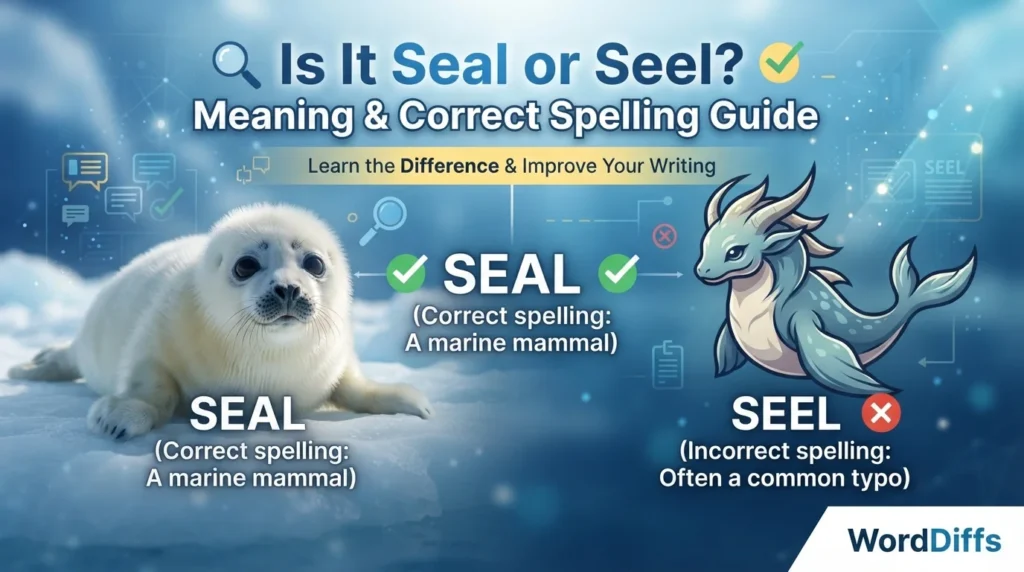
Have you ever wondered whether Seal or Seel is the correct spelling? This confusion is common because both words look possible at first glance, but they do not have the same status or meaning in modern English. Most people encounter seal in everyday reading and writing, while seel is a rare historical word that appears mainly in old literature or specialized discussions. In this guide, you will learn which spelling is appropriate for modern English, what each word means, how to pronounce them, why people confuse them, and how to remember the correct choice. By the end, you will be able to use the right spelling with confidence.
Quick Facts Table
| Feature | Details |
| Correct Word | Seal (for almost all modern uses) |
| Rare Word | Seel |
| Word Type | Noun and verb |
| Meaning | Seal: an animal, a stamp, or to close securely. Seel: an old verb meaning to close or sew a bird’s eyelids. |
| Pronunciation | /siːl/ |
| Common Error | Assuming seel is a modern alternative spelling of seal. |
| Difficulty | Easy to Moderate |
What Does Seal or Seel Mean?
The phrase Seal or Seel compares two words that are spelled differently but sound exactly alike. Although they share the same pronunciation, they have different meanings and very different levels of usage.
Seal
The word seal is a common English word with several meanings.
It can refer to:
- A marine mammal.
- A device or mark showing authenticity.
- Something that closes a container tightly.
- The act of closing or securing something.
Examples:
- The seal swam gracefully through the icy water.
- Please seal the envelope before mailing it.
- The document carries the official company seal.
Seel
The word seel is an archaic verb. It means to close or sew shut the eyes of a hunting bird, especially a falcon, to keep it calm before a hunt.
Today, this word is almost never used outside historical writing, dictionaries, or literature.
Examples:
- Falconers once seel birds before training them.
- The ancient text describes how the bird was seel’d.
Is “Seel” Correct?
The answer depends on the context.
If you mean:
- closing an envelope,
- protecting a surface,
- an official stamp,
- a marine animal,
then seel is not correct.
However, seel is a legitimate English word in historical English. It is simply not the correct spelling for the modern meanings associated with seal.
People often write seel because:
- both words sound identical,
- spell-check may not explain the difference,
- they rely on pronunciation instead of spelling,
- they have seen the rare word in literature.
Examples:
❌ Please seel the package.
✅ Please seal the package.
❌ We saw a seel at the zoo.
✅ We saw a seal at the zoo.
What Is the Correct Spelling?
For nearly every situation in modern English, the correct spelling is seal.
Use seal when talking about:
- closing something securely,
- official approval,
- waterproofing,
- preserving freshness,
- marine mammals.
Examples:
- Seal the jar tightly.
- The king’s seal appeared on the letter.
- Workers sealed the cracks in the wall.
- A seal rested on the beach.
Use seel only when discussing historical falconry or quoting older literature.
Difference Between the Two Spellings
| Feature | Seel | Seal |
| Modern Usage | Very rare | Very common |
| Dictionary Status | Archaic word | Standard English word |
| Part of Speech | Verb | Noun and verb |
| Main Meaning | To close a bird’s eyelids | To close securely, official mark, marine animal |
| Everyday Writing | Not recommended | Correct |
| Common in Schools | No | Yes |
| Professional Writing | Almost never | Frequently used |
Understanding the Difference
Although both words are real English words, they belong to different periods and contexts.
- Seal is part of everyday vocabulary.
- Seel survives mainly in historical references.
- Replacing seal with seel changes the meaning and creates an error in modern writing.
Meaning of the Correct Word
The correct spelling for everyday English is seal.
As a noun, seal has several meanings.
It may refer to:
- a sea mammal,
- an official stamp,
- a symbol of authority,
- a fastening that prevents leakage.
Examples:
- The seal balanced on a rock.
- The certificate bears the university seal.
- The bottle has a safety seal.
As a verb, seal means:
- to close securely,
- to fasten tightly,
- to make airtight,
- to confirm officially.
Examples:
- Seal the box with strong tape.
- The agreement was sealed with signatures.
- Workers sealed the roof against rain.
Pronunciation
IPA Pronunciation
Both words are pronounced:
/siːl/
Syllable Breakdown
Seal
Single syllable:
Seal
Seel
Single syllable:
Seel
Pronunciation Tips
- Say the long ee sound as in see.
- Finish with a clear l sound.
- Remember that pronunciation alone does not tell you which spelling is correct.
- Always rely on the meaning and context.
Why Do People Make This Spelling Mistake?
Several factors contribute to the confusion between seal and seel.
Pronunciation Confusion
Both words sound exactly the same, making them perfect homophones.
Typing Mistakes
Fast typing can lead to choosing the wrong vowel combination.
Phonetic Spelling
Some writers spell words exactly as they hear them, resulting in seel instead of seal.
Similar-Looking Words
English contains many words ending in -eel, such as:
- eel
- peel
- wheel
These patterns can influence spelling choices.
Memory Errors
People may remember the pronunciation but forget the correct letter combination.
Regional Influence
Because pronunciation remains nearly identical across most English accents, speech provides very little clue about the correct spelling.
Origin and Etymology
Seal
The modern word seal comes from Old English seolh when referring to the marine animal. Its verb sense, meaning “to close securely,” developed from Old French and Latin roots connected with stamps, signs, and official marks.
Over centuries, the word expanded to include meanings related to security, authentication, preservation, and closure.
Seel
The word seel comes from Old French ciller, meaning “to sew shut the eyelids.” It entered Middle English during the period when falconry was a popular sport among European nobility.
As falconry declined in everyday life, the word gradually disappeared from common usage, remaining mostly in historical texts and literary works.
How to Remember the Correct Spelling
You can avoid this mistake with a few simple memory tricks.
Memory Trick 1
Think:
SEAL closes things.
The letter A can remind you of airtight.
Memory Trick 2
Remember the phrase:
Seal the envelope.
You have probably seen this expression many times.
Memory Trick 3
Associate seal with the familiar sea animal.
If you picture the animal, you’ll naturally remember the correct spelling.
Memory Trick 4
Remember that seel belongs to history, not everyday English.
Whenever you are writing for school, work, or daily communication, seal is almost certainly the correct choice.
Examples in Sentences
| Incorrect Sentence | Correct Sentence |
| Please seel the envelope. | Please seal the envelope. |
| They seel every package carefully. | They seal every package carefully. |
| The bottle was not seel properly. | The bottle was not sealed properly. |
| We watched a seel at the aquarium. | We watched a seal at the aquarium. |
| The lawyer placed the official seel on the document. | The lawyer placed the official seal on the document. |
| The workers will seel the roof tomorrow. | The workers will seal the roof tomorrow. |
| Make sure you seel the bag tightly. | Make sure you seal the bag tightly. |
| The broken pipe needs to be seel. | The broken pipe needs to be sealed. |
| The company added a security seel. | The company added a security seal. |
| The jar will stay fresh if you seel it. | The jar will stay fresh if you seal it. |
| We found a baby seel on the shore. | We found a baby seal on the shore. |
| The mechanic seel the engine joint. | The mechanic sealed the engine joint. |
| They forgot to seel the container. | They forgot to seal the container. |
| Every official letter needs a seel. | Every official letter needs a seal. |
| The agreement was finally seel yesterday. | The agreement was finally sealed yesterday. |
Common Mistakes to Avoid
Many spelling mistakes happen because people rely on pronunciation instead of checking the meaning of a word. Avoid these common errors when using seal and seel.
- Using seel instead of seal in everyday writing.
- Incorrect: Please seel the package.
- Correct: Please seal the package.
- Assuming both spellings are interchangeable.
- They are not interchangeable. Seal is the standard modern spelling for almost every common situation.
- Using seel for the marine animal.
- Incorrect: A seel was resting on the beach.
- Correct: A seal was resting on the beach.
- Using seel for official documents.
- Incorrect: The certificate has the royal seel.
- Correct: The certificate has the royal seal.
- Ignoring the historical meaning of seel.
- If you encounter seel in classic literature, remember that it refers to an old falconry practice, not to sealing objects.
Similar Commonly Misspelled Words
| Incorrect or Confused Word | Correct Word | Explanation |
| Seel | Seal | Seal is correct for modern English. |
| Recieve | Receive | “I” comes before “E” after “C.” |
| Definately | Definitely | The correct spelling includes -nite-. |
| Occured | Occurred | Double r is required. |
| Seperate | Separate | The correct spelling contains -par-. |
| Grammer | Grammar | Grammar is the correct spelling. |
| Untill | Until | Only one l is needed. |
| Begining | Beginning | Double n is required. |
| Enviroment | Environment | Include the second n. |
| Writting | Writing | Remove the extra t. |
Related Words
Synonyms
When seal means “close securely”:
- Close
- Secure
- Fasten
- Lock
- Shut
- Tighten
When seal means an official mark:
- Stamp
- Emblem
- Certification
- Authentication
- Insignia
Antonyms
Depending on the meaning of seal, possible antonyms include:
- Open
- Unseal
- Unlock
- Loosen
- Unfasten
- Expose
Related Forms
| Word | Part of Speech | Meaning |
| Seal | Noun | Marine animal or official mark |
| Seal | Verb | To close securely |
| Sealed | Adjective/Verb | Closed or secured |
| Sealing | Noun/Gerund | The act of closing securely |
| Unseal | Verb | To open something previously sealed |
| Sealant | Noun | Material used to seal gaps |
Grammar Tips
Using seal correctly is easier when you understand its grammatical role.
- Seal functions as both a noun and a verb.
- As a noun:
- The official seal was stamped on the document.
- As a verb:
- Please seal the envelope.
- Use sealed as the past tense and past participle.
- Use sealing for ongoing actions.
- Avoid replacing seal with seel unless discussing historical falconry.
Writing Tips
Follow these practical tips to improve your spelling accuracy.
- Think about the meaning before choosing the spelling.
- Remember that seal is correct for modern English.
- If you see seel, check whether the text is historical or literary.
- Read your writing aloud and then proofread the spelling separately.
- Use a reliable dictionary when uncertain.
- Learn words by context rather than pronunciation alone.
- Keep a personal list of commonly confused spellings.
- Use spell-check as a helper, not as your only proofreader.
Quick Spelling Checklist
| Checklist Item | Yes |
| Did I mean to close or secure something? | ✓ Use seal |
| Did I mean the marine mammal? | ✓ Use seal |
| Did I mean an official stamp? | ✓ Use seal |
| Am I writing modern English? | ✓ Use seal |
| Am I discussing historical falconry? | ✓ Seel may be appropriate |
| Did I proofread the final spelling? | ✓ Always check |
Key Takeaways
- Seal is the correct spelling for almost all modern English writing.
- Seel is a real but archaic English word.
- Both words are pronounced /siːl/.
- Seal can be both a noun and a verb.
- Seel mainly appears in historical texts about falconry.
- Always choose the spelling based on the intended meaning.
- Context is more reliable than pronunciation when selecting the correct spelling.
Conclusion
Although seal and seel sound exactly alike, they are not used in the same way. Seal is the standard modern English word for closing something securely, referring to a marine mammal, or indicating an official mark. In contrast, seel is an archaic verb that survives mainly in historical writing about falconry and is rarely used in everyday communication. Remembering this distinction will help you avoid a common spelling mistake and write with greater confidence. Whenever you are writing emails, reports, assignments, articles, or professional documents, seal is almost always the correct choice. If you ever come across seel, consider the context carefully, as it is usually found only in older literature or specialized historical discussions.
Frequently Asked Questions
Is seal or seel the correct spelling?
For modern English, seal is the correct spelling. It refers to closing something securely, an official stamp, or a marine animal. Seel is an archaic verb used mainly in historical discussions about falconry and is not appropriate for everyday writing.
Is seel a real English word?
Yes. Seel is a genuine English word, but it is archaic. It originally referred to sewing or closing the eyelids of a falcon before training. Today, it is rarely used outside historical or literary contexts.
Why do seal and seel sound the same?
English contains many homophones, which are words that share the same pronunciation but have different spellings and meanings. Seal and seel are pronounced /siːl/, making pronunciation alone an unreliable guide to correct spelling.
How do I remember the correct spelling?
Associate seal with familiar phrases like seal the envelope or seal the container. You can also think of the sea animal called a seal. Since these are common everyday uses, the spelling becomes easier to remember.
Can I use seel in formal writing?
Only if you are writing about historical falconry, medieval customs, or quoting old literature. In business, academic, legal, or everyday writing, seal is the correct and expected spelling.
Is seal a noun or a verb?
It is both. As a noun, it can refer to a marine mammal or an official stamp. As a verb, it means to close, secure, or fasten something so that it cannot easily be opened.
What is the past tense of seal?
The past tense and past participle are sealed. For example, The technician sealed the package before shipping it. This form is used in both spoken and written English.
Why do people mistakenly write seel?
Most mistakes happen because both words sound identical. Some writers rely on pronunciation instead of remembering the correct spelling, while others assume seel is simply an alternative version of seal.
Is this spelling difference important in exams?
Yes. Standardized tests, school assignments, and professional writing expect the correct modern spelling. Using seel instead of seal in ordinary contexts is generally marked as a spelling error.
Does spell-check always catch this mistake?
Not necessarily. Since seel is a legitimate dictionary word, some spell-check tools may not flag it. This is why proofreading for meaning and context is just as important as checking spelling.
Should I learn archaic spellings like seel?
It can be helpful if you enjoy literature, history, or linguistics. However, for everyday communication, your priority should be mastering the correct modern spelling, seal, because it is the form you will use most often.
[/faq_accordion]

Josie Palmer is an experienced SEO Content Consultant, content strategist, and founder of JOT SEO, a consultancy focused on helping businesses improve their search visibility through effective SEO and content strategies. With more than 8 years of experience in SEO, content development, and digital marketing, she specializes in creating data-driven content strategies that help businesses grow online.