
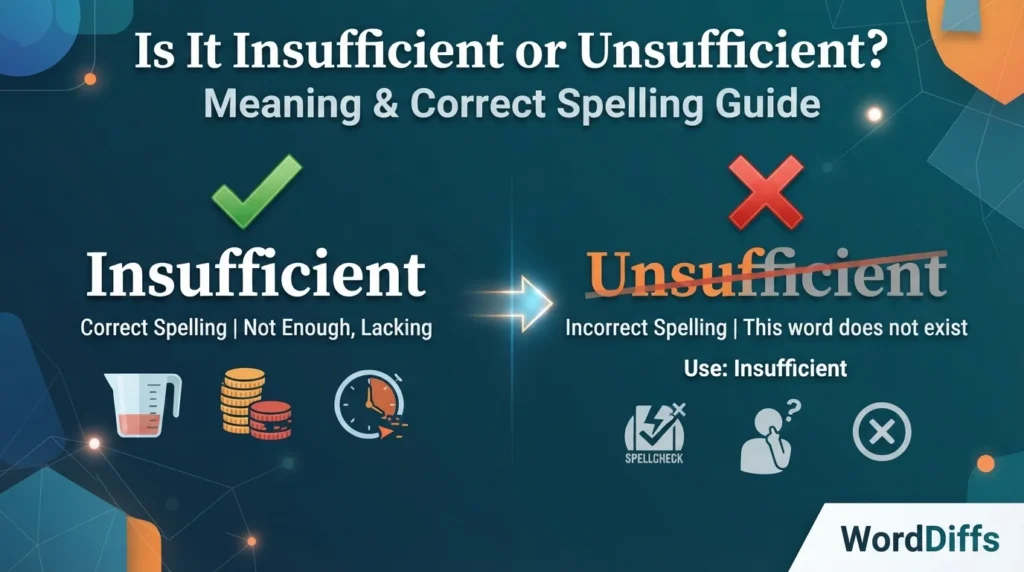
Learning the correct spelling of English words can be challenging, especially when two similar-looking forms appear to mean the same thing. One common question is whether Insufficient or Unsufficient is correct. While both may seem logical at first glance, only one is accepted in standard English. The confusion often comes from the prefixes in- and un-, which both express negation in different contexts. In this guide, you’ll discover which spelling is correct, what it means, why the mistake happens, how to remember the right form, and how to use it confidently in everyday writing, academic work, and professional communication.
Quick Facts Table
| Feature | Details |
| Correct Word | Insufficient |
| Incorrect Word | Unsufficient |
| Word Type | Adjective |
| Meaning | Not enough; inadequate to meet a need or requirement |
| Pronunciation | in-suh-FISH-uhnt (/ˌɪn.səˈfɪʃ.ənt/) |
| Common Error | Replacing the prefix in- with un- |
| Difficulty | Moderate |
What Does Insufficient or Unsufficient Mean?
When people search for Insufficient or Unsufficient, they are usually trying to determine which spelling is correct.
The correct English word is insufficient. It describes something that is not enough, inadequate, or unable to meet a required standard or amount.
The form unsufficient is considered a nonstandard spelling and is not accepted in modern dictionaries or formal English.
Insufficient is commonly used in:
- Academic writing
- Business communication
- Banking
- Legal documents
- Everyday conversations
Examples
- The evidence was insufficient to prove the claim.
- There was insufficient time to complete the project.
- The funds were insufficient for the purchase.
Is “Unsufficient” Correct?
No. Unsufficient is not the standard English spelling.
Although the prefix un- often creates opposites, it does not work with every adjective. The adjective sufficient historically forms its negative with the prefix in-, resulting in insufficient.
Because both prefixes can indicate negation, many learners naturally assume that unsufficient should exist. However, modern English recognizes only insufficient.
Why People Write “Unsufficient”
People commonly use unsufficient because:
- They know many words beginning with un-, such as unhappy, unsafe, and unclear.
- They apply the spelling pattern to sufficient.
- They write based on pronunciation instead of dictionary spelling.
- They have seen the incorrect form online or in informal writing.
Incorrect Examples
- ✗ The money is unsufficient.
- ✗ His explanation was unsufficient.
- ✗ We had unsufficient resources.
Each sentence should use insufficient instead.
What Is the Correct Spelling?
The correct spelling is insufficient.
It begins with the prefix in-, followed by sufficient.
Remember This Rule
- Correct: insufficient
- Incorrect: unsufficient
Why “Insufficient” Is Correct
The prefix in- is the historically established negative prefix attached to sufficient.
English contains many words that use in-, im-, il-, or ir- depending on pronunciation and historical development.
Examples include:
- inaccurate
- incomplete
- inadequate
- incorrect
- insincere
Likewise:
- ✓ insufficient funds
- ✓ insufficient evidence
- ✓ insufficient information
- ✓ insufficient experience
Difference Between the Two Spellings
| Feature | Unsufficient | Insufficient |
| Standard English | ❌ No | ✅ Yes |
| Found in Modern Dictionaries | ❌ No | ✅ Yes |
| Accepted in Academic Writing | ❌ No | ✅ Yes |
| Used in Professional Writing | ❌ No | ✅ Yes |
| Meaning | Intended to mean “not enough,” but nonstandard | Not enough; inadequate |
| Recommended for Exams | ❌ Never | ✅ Always |
| Grammar Status | Incorrect spelling | Correct spelling |
Explanation
Although unsufficient may appear understandable, it is considered a spelling mistake in modern English. Writers should always replace it with insufficient to ensure clarity and correctness.
Meaning of the Correct Word
Insufficient means not enough in quantity, quality, strength, or degree to satisfy a requirement.
It can describe money, evidence, time, resources, skills, information, effort, or any other amount that fails to meet a particular need.
Common Uses
- Insufficient money
- Insufficient evidence
- Insufficient experience
- Insufficient preparation
- Insufficient data
- Insufficient support
- Insufficient resources
- Insufficient sleep
Example Sentences
- The company had insufficient staff during the holiday season.
- There was insufficient evidence to continue the investigation.
- Her preparation was insufficient for such a difficult exam.
- The rainfall was insufficient for healthy crop growth.
- The report contained insufficient information.
Pronunciation
IPA Pronunciation
Insufficient
/ˌɪn.səˈfɪʃ.ənt/
Syllable Breakdown
in • suf • fi • cient
Four syllables:
- in
- suf
- fi
- cient
The primary stress falls on FISH.
Pronunciation Tips
- Say in, not un.
- Stress the third syllable.
- Pronounce -cient as shuhnt.
- Practice slowly before increasing speed.
Example:
- The evidence was insufficient.
Why Do People Make This Spelling Mistake?
Several factors contribute to the confusion between insufficient and unsufficient.
Pronunciation Confusion
Both prefixes express negation, so learners often expect either one to be acceptable.
Typing Mistakes
Fast typing may lead writers to choose un- because it appears more frequently in everyday English.
Phonetic Spelling
Many people spell words according to how they think they sound rather than checking a dictionary.
Similar-Looking Words
English contains many adjectives beginning with un-, including:
- unhappy
- unfair
- unsafe
- uncertain
- unusual
This pattern encourages people to assume unsufficient follows the same rule.
Memory Errors
Some learners simply forget which negative prefix belongs with sufficient.
Regional Influence
In some informal speech or online discussions, people occasionally write unsufficient. However, this does not make it correct in standard English.
Origin and Etymology
The word insufficient comes from the Latin adjective insufficiens, meaning “not enough” or “failing to provide adequately.”
The development followed this path:
- Latin sufficere, meaning “to provide enough.”
- Latin insufficiens, meaning “not sufficient.”
- Old French influenced the form.
- Middle English adopted insufficient.
- Modern English retained the traditional spelling.
Because the word entered English through Latin and French influences, the prefix in- remained part of its standard spelling.
How to Remember the Correct Spelling
Learning a simple memory trick can prevent this mistake.
Memory Trick 1
Think:
IN = Inadequate, Incomplete, Insufficient
These words all begin with in-.
Memory Trick 2
Associate the phrase:
Insufficient funds
This common banking phrase always uses insufficient, never unsufficient.
Memory Trick 3
Remember this sentence:
“If something isn’t enough, it is insufficient.”
Quick Spelling Hacks
- Never write unsufficient.
- Think of insufficient information.
- Connect insufficient with inadequate.
- Practice writing the word several times.
- Read professional texts where the correct spelling appears naturally.
Examples in Sentences
| Incorrect Sentence | Correct Sentence |
| The evidence was unsufficient. | The evidence was insufficient. |
| We had unsufficient money for the trip. | We had insufficient money for the trip. |
| His explanation seemed unsufficient. | His explanation seemed insufficient. |
| The supplies were unsufficient. | The supplies were insufficient. |
| She has unsufficient experience. | She has insufficient experience. |
| There is unsufficient data for analysis. | There is insufficient data for analysis. |
| The report contained unsufficient details. | The report contained insufficient details. |
| Their efforts were unsufficient. | Their efforts were insufficient. |
| We received unsufficient support. | We received insufficient support. |
| The team had unsufficient training. | The team had insufficient training. |
| The budget was unsufficient. | The budget was insufficient. |
| Our food supply became unsufficient. | Our food supply became insufficient. |
| The teacher said the answer was unsufficient. | The teacher said the answer was insufficient. |
| They found unsufficient evidence. | They found insufficient evidence. |
| There was unsufficient time to finish. | There was insufficient time to finish. |
Common Mistakes to Avoid
When using insufficient, avoid these frequent spelling and usage errors.
- Writing unsufficient instead of insufficient.
This is the most common mistake. Always use insufficient in standard English. - Confusing “insufficient” with “insufficiency.”
Insufficient is an adjective, while insufficiency is a noun.- Correct: The evidence was insufficient.
- Correct: The insufficiency of evidence delayed the case.
- Using “insufficient” when “few” or “little” is more natural.
Depending on the sentence, another word may sound more natural.- Formal: There was insufficient water.
- Informal: There wasn’t enough water.
- Misspelling the middle of the word.
Common incorrect forms include:- insuficient
- insufficent
- insufficiant
- insuffishent
- Forgetting the double “f”.
Remember that insufficient contains ff.
Similar Commonly Misspelled Words
| Incorrect Spelling | Correct Spelling | Meaning |
| Unsufficient | Insufficient | Not enough |
| Definately | Definitely | Certainly |
| Recieve | Receive | To get |
| Seperate | Separate | To divide |
| Occured | Occurred | Happened |
| Grammer | Grammar | Rules of language |
| Untill | Until | Up to a certain time |
| Neccessary | Necessary | Required |
| Publically | Publicly | In a public manner |
| Begining | Beginning | The start |
Related Words
Synonyms
These words have meanings similar to insufficient, although their usage may vary by context.
- Inadequate
- Limited
- Deficient
- Scant
- Meager
- Sparse
- Lacking
- Incomplete
- Unsatisfactory
- Inacceptable (in limited contexts, though “unacceptable” is more common for quality)
Antonyms
Words with the opposite meaning include:
- Sufficient
- Adequate
- Enough
- Ample
- Abundant
- Plentiful
- Complete
- Satisfactory
- Generous
- Adequate
Related Forms
| Word | Part of Speech | Meaning |
| Sufficient | Adjective | Enough to meet a need |
| Insufficient | Adjective | Not enough |
| Sufficiency | Noun | The state of being enough |
| Insufficiency | Noun | The state of not being enough |
| Sufficiently | Adverb | To an adequate degree |
| Insufficiently | Adverb | Not adequately |
Grammar Tips
Understanding how insufficient functions in grammar helps you write more accurately.
- Insufficient is an adjective.
- It usually appears after linking verbs such as is, was, seems, and became.
- It can also come before a noun.
- It often describes quantity, quality, evidence, time, money, or resources.
- It is commonly followed by to + verb.
- It may also be followed by for + noun.
Examples
- The evidence is insufficient.
- We had insufficient food.
- The budget was insufficient to complete the project.
- There was insufficient information for a decision.
Writing Tips
Follow these practical tips to avoid spelling mistakes.
- Learn the complete spelling rather than sounding it out.
- Remember that the word starts with in-, not un-.
- Read professional writing regularly.
- Use your spell checker, but do not rely on it completely.
- Keep a personal list of commonly confused words.
- Practice writing the word in complete sentences.
- Proofread slowly before submitting important documents.
- When unsure, consult a reliable dictionary.
Quick Spelling Checklist
| Checklist | Yes |
| Did you write insufficient? | ✅ |
| Did you avoid unsufficient? | ✅ |
| Did you include both f letters? | ✅ |
| Did you spell -cient correctly? | ✅ |
| Did you use it as an adjective? | ✅ |
| Did you proofread the sentence? | ✅ |
Key Takeaways
- Insufficient is the only correct spelling in modern English.
- Unsufficient is a nonstandard and incorrect spelling.
- Insufficient means not enough or inadequate.
- The word comes from Latin and has always used the prefix in-.
- Remember the common phrase insufficient funds to reinforce the correct spelling.
- Double-check spelling in exams, business writing, and professional communication.
- Reading and writing the word regularly helps build long-term spelling accuracy.
Conclusion
The choice between Insufficient or Unsufficient is simple once you understand the spelling rule. Insufficient is the only correct form recognized in modern English dictionaries, grammar guides, and professional writing. Although unsufficient may seem reasonable because many English adjectives begin with un-, it is not accepted as standard English. By learning the word’s history, pronunciation, and common usage, you can avoid this mistake with confidence. Remember the familiar expression insufficient funds, practice the correct spelling regularly, and proofread your work carefully. Whether you are writing an essay, email, report, or examination answer, using insufficient correctly will make your English clearer, more accurate, and more professional.
Frequently Asked Questions
Is insufficient or unsufficient the correct spelling?
Insufficient is the correct spelling. It is the standard English adjective meaning “not enough” or “inadequate.” Unsufficient is not accepted in modern English and should be avoided in academic, professional, and everyday writing.
What does insufficient mean?
Insufficient means that something is not enough to satisfy a requirement or achieve a purpose. It can refer to money, time, evidence, resources, information, experience, or any quantity that falls below what is needed.
Why do people write unsufficient?
Many people assume the negative form of sufficient should begin with un-, since English has many words like unhappy and unsafe. However, the correct historical prefix is in-, making insufficient the accepted spelling.
How do you pronounce insufficient?
The IPA pronunciation is /ˌɪn.səˈfɪʃ.ənt/. It has four syllables: in, suf, fi, cient, with the main stress on the third syllable. Saying it slowly helps reinforce the correct pronunciation and spelling.
Is unsufficient found in dictionaries?
Modern English dictionaries do not recognize unsufficient as the standard spelling. Reputable dictionaries list insufficient as the correct word, while unsufficient is treated as a spelling error or a historical rarity.
Can I use unsufficient in formal writing?
No. Formal writing requires standard English spelling. Always replace unsufficient with insufficient in essays, reports, business emails, legal documents, and professional communication to maintain credibility and accuracy.
Is insufficient an adjective?
Yes. Insufficient is an adjective that describes something as not enough or inadequate. It commonly modifies nouns such as evidence, funds, time, resources, and information.
What is a simple way to remember the correct spelling?
Think of the common phrase insufficient funds, which appears in banking and financial contexts. Seeing and using this phrase regularly makes it easier to remember that the correct prefix is in-, not un-.
Is insufficient commonly used in exams?
Yes. Insufficient appears frequently in school exams, competitive tests, academic writing, and reading comprehension passages. Using the correct spelling demonstrates good vocabulary and strong language skills.
What are some examples of insufficient in a sentence?
Examples include: The evidence was insufficient to prove the claim. We had insufficient time to finish the assignment. The company had insufficient resources to expand the project. Each sentence shows that something was not enough.
How can I stop misspelling insufficient?
Practice writing the word several times, read it in books and articles, and remember that it begins with in-. Proofreading your work and using trusted dictionaries can also help prevent repeated spelling mistakes.

Caitlin Boylan is an experienced content writer, editor, educator, travel writer, and remote worker with more than 10 years of experience in English education and international communication. She is the founder and author of The Country Jumper, a travel blog dedicated to supporting solo travelers, especially women exploring life abroad. She is also the co-founder of Macro Magazine, a global online publication that shares diverse perspectives on worldwide topics that impact communities.
1 thought on “Is It Insufficient or Unsufficient? Meaning & Correct Spelling Guide”