
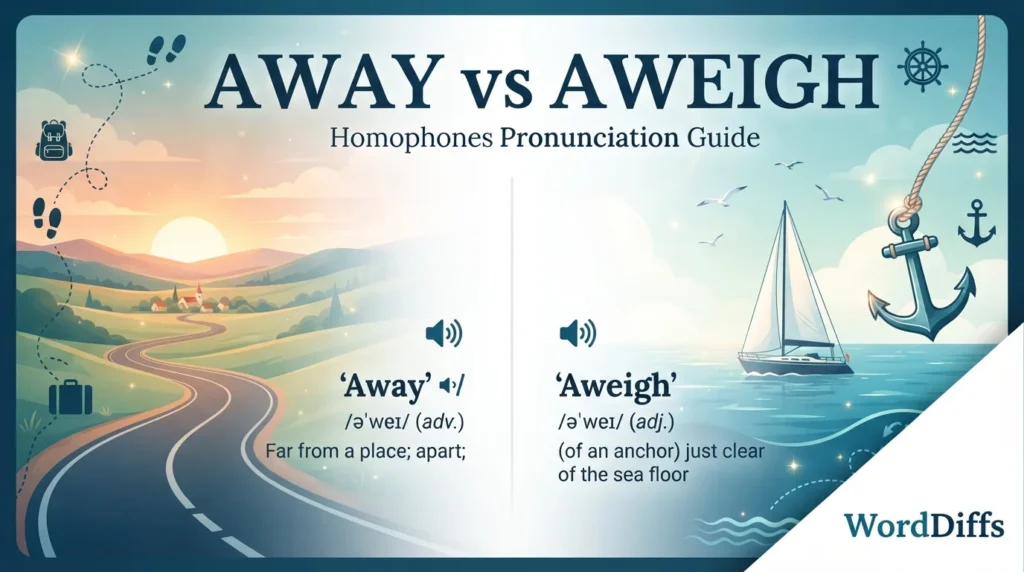
English homophones often challenge learners because two different words can sound the same while having completely different meanings and spellings. Away and aweigh are a perfect example. Although they are pronounced alike in most varieties of English, they belong to different contexts. One is a common everyday word used in daily conversations, while the other is a specialized nautical term that many learners encounter only in books, history, or maritime discussions.
Choosing the correct spelling is important because using the wrong word can confuse readers and change the meaning of a sentence. Good pronunciation also helps listeners understand your intended meaning, even when two words sound identical.
In this guide, you will learn the pronunciation, meanings, grammar, origins, common uses, collocations, example sentences, grammar differences, pronunciation comparison, quizzes, memory tricks, common expressions, and practical learning tips to master Away vs Aweigh with confidence.
A quick comparison of Altar vs Alter can make their different meanings and everyday uses easier to recognize.
Quick Difference Table
| Word | Part of Speech | Meaning | Pronunciation (IPA) | Usage | Example |
| Away | Adverb, adjective | To another place, absent, or at a distance | /əˈweɪ/ | Everyday English | She walked away. |
| Aweigh | Adjective, interjection | An anchor lifted clear of the seabed | /əˈweɪ/ | Nautical English | The anchor is aweigh. |
Away
Pronunciation
IPA: /əˈweɪ/
Simple pronunciation: uh-WAY
Audio-style spelling: uh-WAY
Homophone status: Away sounds exactly like aweigh in standard English.
British pronunciation: /əˈweɪ/
American pronunciation: /əˈweɪ/
There is virtually no pronunciation difference between British and American English.
Understanding Insufficient or Unsufficient can help you identify the correct word and avoid common spelling mistakes.
Meaning
Away means at a distance, to another place, not present, or continuously.
It is one of the most common words in English and appears in everyday conversations, stories, news articles, and academic writing.
Common meanings include:
- Moving from one place to another.
- Being absent.
- Remaining at a distance.
- Continuing an action.
Part of Speech
Away is primarily an adverb.
Sometimes it functions as an adjective in expressions like “the away team.”
It usually modifies verbs by describing movement or location.
Origin
Away comes from Old English onweg, meaning “on one’s way” or “from this place.” Over centuries, it became the modern English word away, keeping its original idea of movement or distance.
Knowing when to use Color vs Colour can improve your writing across American and British English contexts.
Common Uses
Away appears in many situations.
- Daily conversations
- Travel
- Sports
- Education
- Literature
- News reports
- Business writing
- Storytelling
Common Collocations
- go away
- walk away
- run away
- move away
- throw away
- stay away
- drive away
- fly away
- pass away
- give away
- fade away
- take away
- far away
- away from home
- away game
Example Sentences
- Please go away for a few minutes.
- She walked away without saying goodbye.
- The children ran away from the loud noise.
- My grandparents live far away.
- He threw away the old newspaper.
- We stayed away because of the storm.
- The birds flew away at sunrise.
- She moved away after graduation.
- Put your phone away during class.
- The pain slowly faded away.
- They drove away before sunset.
- Keep dangerous chemicals away from children.
- Our neighbors are away on vacation.
- He looked away during the scary movie.
- The snow melted away by noon.
Aweigh
Pronunciation
IPA: /əˈweɪ/
Simple pronunciation: uh-WAY
Audio-style spelling: uh-WAY
Homophone status: Aweigh is pronounced exactly like away.
British pronunciation: /əˈweɪ/
American pronunciation: /əˈweɪ/
The pronunciation remains the same across major English varieties.
Meaning
Aweigh is a nautical term.
It means that an anchor has been lifted completely off the seabed and no longer holds the ship in place.
The word is rarely used outside maritime contexts.
If you often mix up these homophones, Alter vs Altar provides useful guidance for using each word correctly.
Part of Speech
Aweigh is usually used as an adjective.
It can also appear as an interjection or part of traditional sailing commands.
Origin
Aweigh comes from Middle English maritime language. It developed from expressions used by sailors to indicate that an anchor was no longer touching the sea floor and the ship was ready to move.
Common Uses
The word appears in:
- Maritime communication
- Naval operations
- Sailing manuals
- Historical writing
- Sea adventure novels
- Nautical training
- Traditional sea songs
Common Collocations
- anchor aweigh
- anchors aweigh
- weigh anchor
- anchor is aweigh
- ship is aweigh
- cable aweigh
- fully aweigh
- aweigh and underway
- aweigh at dawn
- anchor came aweigh
- report aweigh
- vessel aweigh
- anchor now aweigh
- stand by until aweigh
- once aweigh
Example Sentences
- The captain announced that the anchor was aweigh.
- Once the anchor was aweigh, the ship departed.
- The sailors confirmed the anchor was fully aweigh.
- Our vessel became aweigh before sunrise.
- The crew celebrated when the anchor came aweigh.
- The ship remained still until the anchor was aweigh.
- The officer reported that everything was aweigh.
- The anchor was finally aweigh after several attempts.
- The harbor pilot waited until the vessel was aweigh.
- The ship sailed immediately after becoming aweigh.
- They checked the chain before declaring the anchor aweigh.
- The captain ordered everyone to prepare once the anchor was aweigh.
- The old sailing manual explained when an anchor is aweigh.
- The crew shouted happily as the anchor became aweigh.
- The voyage officially began after the anchor was aweigh.
Pronunciation Comparison
Both away and aweigh are considered perfect homophones in modern English.
They share the IPA pronunciation /əˈweɪ/ in both British and American English. Native speakers generally cannot distinguish between the two words through pronunciation alone. Instead, listeners understand which word is intended from the surrounding context.
Regional accents may slightly affect the vowel quality or stress, but these changes affect both words equally rather than creating a distinction between them.
English learners often confuse these words because they sound identical while having unrelated meanings. Since away is extremely common and aweigh is mostly limited to maritime language, learners frequently misspell aweigh as away when discussing ships or anchors.
Grammar Differences
| Word | Part of Speech | Meaning | Function | Sentence Position | Verb Forms (If Applicable) | Plural Forms (If Applicable) |
| Away | Adverb, adjective | At a distance or elsewhere | Modifies verbs or nouns | Usually after verbs | Not applicable | Not applicable |
| Aweigh | Adjective, interjection | Anchor lifted from the seabed | Describes anchor status | Usually after linking verbs | Not applicable | Not applicable |
Side-by-Side Examples
| Away | Aweigh |
| She walked away quietly. | The anchor was aweigh before dawn. |
| Put your books away. | The captain confirmed the anchor was aweigh. |
| They moved away last year. | The ship became aweigh at sunrise. |
| Please stay away from the fire. | The crew waited until the anchor was aweigh. |
| He looked away quickly. | The vessel departed once the anchor was aweigh. |
| Throw away the empty bottle. | The sailors announced the anchor was aweigh. |
| The birds flew away. | The harbor master heard the anchor was aweigh. |
| Keep your phone away. | The ship was officially aweigh. |
| She drifted away in thought. | The cable tightened as the anchor became aweigh. |
| They drove away smiling. | The voyage started after the anchor was aweigh. |
Homophones Comparison Table
| Word | Pronunciation | Meaning | Part of Speech | Usage | Example |
| Away | /əˈweɪ/ (uh-WAY) | At a distance, elsewhere, absent, or moving from a place | Adverb, adjective | Everyday English | They walked away after the meeting. |
| Aweigh | /əˈweɪ/ (uh-WAY) | Having an anchor lifted clear of the seabed | Adjective, interjection | Maritime and naval English | The captain announced the anchor was aweigh. |
Memory Tricks
Remembering Away
- Think of away as meaning “not here.”
- If someone goes somewhere else, they go away.
- You will see away in everyday conversations.
Remembering Aweigh
- Notice that aweigh contains the word weigh.
- Sailors weigh anchor, meaning they lift it from the seabed.
- Associate aweigh with ships, anchors, and the sea.
Visual Memory Trick
Imagine a family leaving home. They are going away.
Now imagine a ship lifting its anchor before sailing. The anchor is aweigh.
Common Mistakes
| Incorrect Sentence | Correct Sentence | Explanation |
| The anchor is away. | The anchor is aweigh. | Use aweigh for anchors. |
| The ship became away. | The ship became aweigh. | Maritime context requires aweigh. |
| We are aweigh on vacation. | We are away on vacation. | Everyday travel uses away. |
| Please stay aweigh from the edge. | Please stay away from the edge. | Away means at a distance. |
| She threw the box aweigh. | She threw the box away. | Away indicates movement. |
| They moved aweigh last month. | They moved away last month. | Ordinary movement uses away. |
| Keep the children aweigh from traffic. | Keep the children away from traffic. | Safety expressions use away. |
| My parents are aweigh today. | My parents are away today. | Away means absent. |
| The birds flew aweigh. | The birds flew away. | Natural movement uses away. |
| He looked aweigh. | He looked away. | Looking in another direction uses away. |
| We put the toys aweigh. | We put the toys away. | Storing something uses away. |
| The anchor went away. | The anchor went aweigh. | Correct nautical terminology is aweigh. |
| The sailors shouted away. | The sailors shouted, “Anchor aweigh!” | Maritime announcement requires aweigh. |
| They drifted aweigh from each other. | They drifted away from each other. | General separation uses away. |
| She stayed aweigh from school. | She stayed away from school. | Absence uses away. |
Fill in the Blank Quiz
- Please put your shoes ________.
- The captain confirmed the anchor was ________.
- We stayed ________ because it was raining.
- The ship sailed once the anchor became ________.
- The children ran ________ laughing.
- The anchor was fully ________ before departure.
- My grandparents live far ________.
- The crew waited until the anchor was ________.
- Throw ________ the broken glass carefully.
- She looked ________ during the surprise.
- The vessel was finally ________.
- Keep pets ________ from the road.
- The sailors celebrated when the anchor came ________.
- He moved ________ after college.
- The ship could leave because the anchor was ________.
- Please stay ________ from danger.
- The birds flew ________ together.
- The officer reported the anchor was ________.
- She packed everything ________ neatly.
- The voyage began once the anchor was ________.
Answer Key
- away
- aweigh
- away
- aweigh
- away
- aweigh
- away
- aweigh
- away
- away
- aweigh
- away
- aweigh
- away
- aweigh
- away
- away
- aweigh
- away
- aweigh
Choose the Correct Word Quiz
1. The family went ____ for the weekend.
A. Away
B. Aweigh
C. Both
D. Neither
Correct Answer: A
Explanation: Travel uses away.
2. The anchor was finally ____.
A. Away
B. Aweigh
C. Both
D. Neither
Correct Answer: B
Explanation: Nautical terminology requires aweigh.
3. Please stay ____ from the fire.
A. Aweigh
B. Away
C. Both
D. Neither
Correct Answer: B
Explanation: Distance from something is expressed with away.
4. The ship left after the anchor was ____.
A. Away
B. Aweigh
C. Both
D. Neither
Correct Answer: B
Explanation: Anchors become aweigh.
5. She looked ____ quickly.
A. Away
B. Aweigh
C. Both
D. Neither
Correct Answer: A
Explanation: Looking in another direction uses away.
6. The crew announced the anchor was ____.
A. Away
B. Aweigh
C. Both
D. Neither
Correct Answer: B
Explanation: Maritime language uses aweigh.
7. Put your books ____.
A. Away
B. Aweigh
C. Both
D. Neither
Correct Answer: A
Explanation: Putting something in its place means away.
8. They moved ____ last year.
A. Away
B. Aweigh
C. Both
D. Neither
Correct Answer: A
Explanation: Relocation uses away.
9. The anchor came ____ before sunrise.
A. Away
B. Aweigh
C. Both
D. Neither
Correct Answer: B
Explanation: The correct nautical term is aweigh.
10. Keep chemicals ____ from children.
A. Away
B. Aweigh
C. Both
D. Neither
Correct Answer: A
Explanation: Safety instructions use away.
11. The vessel became ____.
A. Away
B. Aweigh
C. Both
D. Neither
Correct Answer: B
12. The birds flew ____.
A. Away
B. Aweigh
C. Both
D. Neither
Correct Answer: A
13. We threw the old clothes ____.
A. Away
B. Aweigh
C. Both
D. Neither
Correct Answer: A
14. The captain waited until the anchor was ____.
A. Away
B. Aweigh
C. Both
D. Neither
Correct Answer: B
15. My parents are ____ this week.
A. Away
B. Aweigh
C. Both
D. Neither
Correct Answer: A
Common Expressions
Away
Idioms and Fixed Expressions
Go away
Please go away until the meeting is over.
Far away
Their village is far away from the city.
Throw away
Never throw away useful documents.
Put away
Please put away your toys before dinner.
Stay away
Stay away from dangerous animals.
Give away
She decided to give away her old books.
Fade away
The music slowly faded away.
Run away
The frightened rabbit ran away.
Aweigh
Nautical Expressions
Anchor aweigh
The crew shouted, “Anchor aweigh!” as the journey began.
Anchors aweigh
The naval band played “Anchors Aweigh.”
Weigh anchor
The captain ordered the sailors to weigh anchor.
Once aweigh
Once aweigh, the ship headed toward open water.
Fully aweigh
The vessel could depart because the anchor was fully aweigh.
Frequently Asked Questions
What is the difference between away and aweigh?
Away is an everyday English word meaning elsewhere, absent, or at a distance. Aweigh is a specialized nautical word meaning an anchor has been lifted from the seabed. Although they sound identical, their meanings, spellings, and contexts are completely different.
Are away and aweigh pronounced the same?
Yes. In standard British and American English, both are pronounced /əˈweɪ/. Native speakers usually identify the intended word through context rather than pronunciation.
Why do people confuse these homophones?
People confuse them because they sound exactly alike. Most English learners encounter away frequently but rarely see aweigh, making the unusual spelling easier to forget.
Is aweigh commonly used?
No. It is mainly used in maritime, naval, sailing, and historical contexts. Most everyday English conversations never require it.
Can away be an adjective?
Yes. Although it is primarily an adverb, away can also function as an adjective, as in the away team or an away match.
Is aweigh a verb?
No. Aweigh is not a verb. It is generally used as an adjective describing the condition of an anchor after it has been lifted.
How can I remember the difference?
Associate away with everyday movement and aweigh with the phrase weigh anchor. The shared spelling with weigh is an excellent memory aid.
Which word is more common?
Away is one of the most common English adverbs. Aweigh is relatively rare and mostly appears in maritime writing.
Are these perfect homophones?
Yes. In standard English, they are considered perfect homophones because they have identical pronunciation but different spellings and meanings.
Should I use aweigh outside sailing?
Generally no. Unless you are discussing ships, anchors, or nautical topics, away is almost always the correct choice.
Tips to Remember the Difference
- Read stories containing both words.
- Practice saying the pair aloud several times.
- Write five sentences with away every day.
- Write five nautical sentences using aweigh.
- Learn common collocations instead of isolated words.
- Create flashcards with pictures.
- Read maritime articles to become familiar with aweigh.
- Compare the spellings side by side.
- Build vocabulary through regular reading.
- Review example sentences weekly.
Summary
Away and aweigh are classic English homophones that share the pronunciation /əˈweɪ/ but differ completely in meaning and usage. Away is an everyday adverb and adjective that describes movement, distance, absence, or location. It appears in daily conversation, writing, literature, and formal communication. In contrast, aweigh is a specialized nautical adjective used when an anchor has been lifted clear of the seabed, allowing a ship to depart.
Understanding their grammatical roles helps you choose the correct word in context. Although pronunciation cannot distinguish them, surrounding words usually make the intended meaning clear. Remember that away belongs to ordinary English, while aweigh belongs to maritime language. A simple memory trick is to connect aweigh with the phrase weigh anchor.
By practicing pronunciation, reading authentic examples, completing quizzes, and writing your own sentences, you will confidently recognize and use both words correctly. Mastering Away vs Aweigh improves spelling accuracy, strengthens vocabulary, and builds greater confidence in both spoken and written English.

Caitlin Boylan is an experienced content writer, editor, educator, travel writer, and remote worker with more than 10 years of experience in English education and international communication. She is the founder and author of The Country Jumper, a travel blog dedicated to supporting solo travelers, especially women exploring life abroad. She is also the co-founder of Macro Magazine, a global online publication that shares diverse perspectives on worldwide topics that impact communities.