
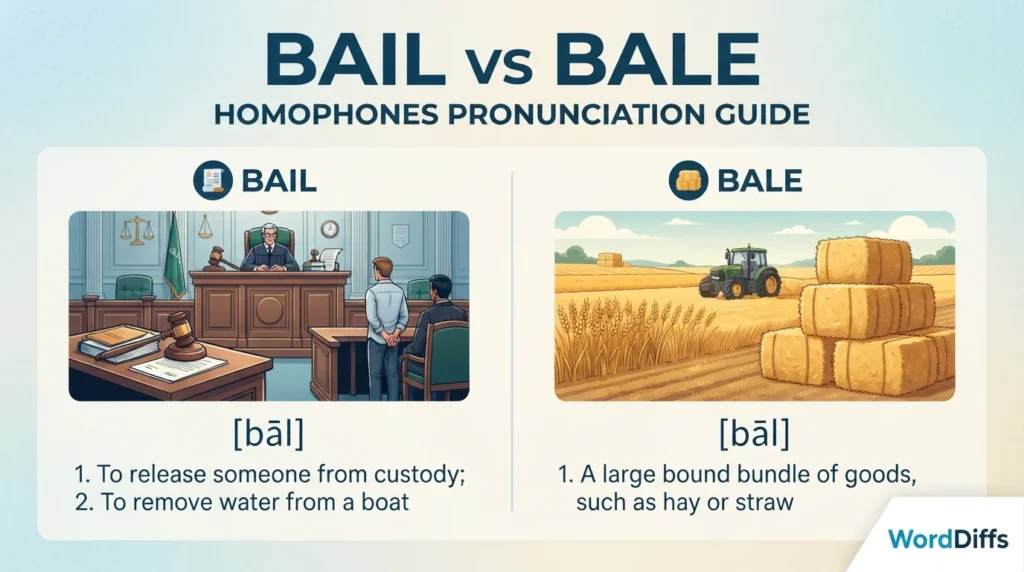
English homophones often challenge learners because two or more words share the same pronunciation but have different spellings and meanings. Bail and Bale are excellent examples of this. Although they sound alike in everyday speech, they refer to completely different ideas. Choosing the wrong spelling can change the meaning of a sentence, especially in legal, agricultural, or everyday contexts.
Correct spelling is important for clear communication in writing, while accurate pronunciation helps listeners understand your intended meaning from context. Since both words are pronounced the same in most varieties of English, learners must rely on vocabulary knowledge rather than pronunciation alone.
In this comprehensive guide, you will learn the pronunciation, meanings, grammar, origins, common uses, collocations, and real-life examples of Bail and Bale. You’ll also discover pronunciation comparisons, grammar differences, and practical examples to help you confidently distinguish these commonly confused English homophones.
Quick Difference Table
| Word | Part of Speech | Meaning | Pronunciation (IPA) | Usage | Example |
| Bail | Noun, Verb | Money paid to secure temporary release from custody, or to remove water or help someone escape | /beɪl/ | Legal, boating, informal | She was released on bail. |
| Bale | Noun, Verb | A tightly packed bundle of materials such as hay, cotton, or paper | /beɪl/ | Farming, shipping, manufacturing | The farmer loaded a bale of hay. |
Bail
Pronunciation
The word bail is pronounced:
- IPA: /beɪl/
- Simple pronunciation: BAYL
- Audio-style spelling: bayl
British English: /beɪl/
American English: /beɪl/
The pronunciation is identical in British and American English. It sounds exactly the same as bale, making them perfect homophones.
Meaning
Bail has several related meanings depending on the context.
As a noun, it usually refers to money or security paid to allow someone accused of a crime to leave jail until their court hearing.
As a verb, it can mean:
- To release someone after bail has been paid.
- To remove water from a boat.
- To leave a difficult situation, especially informally.
- To help someone out of trouble.
In everyday English, the informal meaning “to leave suddenly” is especially common.
Part of Speech
Bail functions as both a noun and a verb.
As a noun, it names legal security or financial guarantee.
As a verb, it describes the action of securing release, removing water, or leaving a situation.
Examples:
- They couldn’t afford the bail.
- His family bailed him out.
- We had to bail the boat after the storm.
- She decided to bail on the meeting.
Origin
The word bail comes from Old French baillier, meaning “to deliver, hand over, or take charge of.” It ultimately traces back to the Latin bajulare, meaning “to bear a burden.”
Its legal meaning developed during medieval English law, where a person or payment guaranteed an accused individual’s appearance in court.
Over time, additional meanings such as “bail out a boat” and the informal “leave suddenly” evolved naturally in English.
Common Uses
Everyday usage
- Bail on plans
- Bail someone out
- Bail water from a canoe
Formal usage
- Bail hearing
- Bail conditions
- Bail application
- Bail bond
Legal usage
- Grant bail
- Deny bail
- Set bail
- Post bail
Informal usage
- Bail early
- Bail out of a project
- Bail on friends
Common Collocations
- post bail
- grant bail
- deny bail
- set bail
- pay bail
- bail hearing
- bail bond
- bail conditions
- bail application
- bail out
- bail someone out
- bail water
- bail from prison
- released on bail
- jump bail
Example Sentences
- The judge granted bail after reviewing the evidence.
- His parents paid the bail immediately.
- She remained in jail because she could not afford bail.
- The lawyer requested lower bail during the hearing.
- The court denied bail due to safety concerns.
- We had to bail water from the small fishing boat.
- The heavy rain forced us to bail the canoe several times.
- He decided to bail on the road trip at the last minute.
- Don’t bail just because the project is difficult.
- Her friends bailed her out when she lost her wallet.
- I appreciate you for bailing me out of that awkward situation.
- The officer explained the bail process carefully.
- She was released on bail until her next court appearance.
- They hired a company to arrange the bail bond.
- Please don’t bail before the presentation begins.
Bale
Pronunciation
The word bale is pronounced:
- IPA: /beɪl/
- Simple pronunciation: BAYL
- Audio-style spelling: bayl
British English: /beɪl/
American English: /beɪl/
Its pronunciation is identical to bail, making these words perfect homophones.
Meaning
A bale is a tightly compressed bundle of materials that is tied or wrapped for storage or transport.
Common materials include:
- Hay
- Straw
- Cotton
- Paper
- Wool
- Recycled cardboard
As a verb, bale means to pack something into large bundles.
Part of Speech
Bale functions as both a noun and a verb.
As a noun, it refers to a bundle.
As a verb, it describes the action of bundling materials together.
Examples:
- The truck carried a bale of cotton.
- Workers baled the hay before sunset.
Origin
The word bale comes from Old English beal and Old Norse bali, referring to a bundle or package.
Its meaning has remained remarkably stable for centuries and is closely associated with farming, agriculture, and transportation.
Modern industries also use the term for compressed recyclable materials.
Common Uses
Agriculture
- Bale of hay
- Bale of straw
- Bale of cotton
Manufacturing
- Bale paper
- Bale plastic
- Bale cardboard
Shipping
- Cotton bale
- Wool bale
- Paper bale
Industrial recycling
- Bale recyclable waste
- Bale scrap paper
Common Collocations
- bale of hay
- bale of straw
- bale of cotton
- bale of paper
- bale of wool
- large bale
- heavy bale
- square bale
- round bale
- hay bale
- cotton bale
- bale machine
- bale wire
- bale materials
- bale recyclables
Example Sentences
- The farmer stacked every bale neatly in the barn.
- We counted fifty bales of hay after harvest.
- A large bale of cotton arrived at the factory.
- The workers loaded each bale onto the truck.
- The horse ate from a fresh bale of hay.
- The recycling center compressed cardboard into a bale.
- They wrapped each bale with strong wire.
- The machine can bale hundreds of kilograms every hour.
- Volunteers helped bale the harvested straw.
- Every bale was labeled before shipping.
- The warehouse stored dozens of paper bales.
- A wet bale is much heavier than a dry one.
- The farmer inspected each bale carefully.
- The workers baled the hay before the rain arrived.
- The tractor carried a massive bale across the field.
Pronunciation Comparison
Both bail and bale are considered perfect homophones because they are pronounced exactly the same in standard English.
| Feature | Bail | Bale |
| IPA | /beɪl/ | /beɪl/ |
| British English | Same | Same |
| American English | Same | Same |
| Stress | One syllable | One syllable |
There is generally no pronunciation difference between the two words in standard British or American English. Regional accents may slightly change the vowel quality, but both words change together, so they remain homophones.
Learners confuse these words because pronunciation offers no clue about spelling. Instead, understanding the sentence’s meaning is the key to choosing the correct word.
Grammar Differences
| Word | Part of Speech | Meaning | Function | Sentence Position | Verb Forms (If Applicable) | Plural Forms (If Applicable) |
| Bail | Noun, Verb | Legal release, remove water, leave | Subject, object, verb | Anywhere appropriate | bail, bails, bailed, bailing | bails (noun) |
| Bale | Noun, Verb | Bundle, package materials | Subject, object, verb | Anywhere appropriate | bale, bales, baled, baling | bales |
Side-by-Side Examples
| Bail | Bale |
| She was released on bail. | The horse ate from a bale of hay. |
| The lawyer requested lower bail. | A bale of cotton weighed hundreds of kilograms. |
| He couldn’t afford the bail amount. | The farmer loaded another bale onto the trailer. |
| Please don’t bail on our plans. | Every bale was tied securely. |
| We had to bail the boat after the storm. | The machine can bale paper quickly. |
| They posted bail that afternoon. | Workers stacked each bale neatly. |
| The judge denied bail. | The barn was full of bales. |
| My friend bailed me out financially. | We bought a fresh bale of straw. |
| She almost bailed before the interview. | The truck carried twenty bales. |
| He remained free on bail. | The recycling plant produced one large bale. |
| They discussed the bail conditions. | A round bale rolled down the hill. |
| The family arranged the bail bond. | Each bale had an identification tag. |
| Don’t bail when things become difficult. | The workers baled the harvested hay. |
| The officer explained the bail procedure. | The cotton bales were exported overseas. |
| She promised not to jump bail. | The old barn stored hundreds of bales. |
| He bailed water from the canoe. | The warehouse received another bale today. |
| We may bail if the weather worsens. | A single bale supplied feed for several days. |
| The defendant appeared after being granted bail. | The farmer inspected every bale before transport. |
| They finally paid the required bail. | The machine continued to bale cardboard. |
| Nobody expected him to bail at the last minute. | The dry bale was easy to move. |
Homophones Comparison Table
| Word | Pronunciation | Meaning | Part of Speech | Usage | Example |
| Bail | /beɪl/ | Money for temporary release, remove water, leave suddenly | Noun, Verb | Legal, boating, informal speech | They posted bail before the trial. |
| Bale | /beɪl/ | A compressed bundle of materials, or to bundle materials | Noun, Verb | Farming, shipping, recycling | The farmer lifted a bale of hay. |
Memory Tricks
Remembering the difference between bail and bale becomes much easier when you associate each word with a visual image and its most common meaning.
Bail
- Bail = Jail
- Both words end with -ail.
- Think: Bail helps someone leave jail.
- Bail Out
- Imagine scooping water out of a leaking boat.
- The action is bailing water.
- Bail on Someone
- Remember that bail can also mean leaving or quitting unexpectedly.
- Example: He bailed on the party.
Bale
- Bale = Bundle
- Both words begin with B.
- Think: Bale means a big bundle.
- Picture a farmer lifting a huge bale of hay into a barn.
- Imagine a recycling center compressing cardboard into a large bale.
Practical Learning Methods
- Read legal news to see bail used naturally.
- Read farming or agriculture articles to find bale in context.
- Write five sentences using each word every day.
- Practice saying both words aloud while remembering their different meanings.
- Create flashcards with pictures instead of definitions.
Common Mistakes
| Incorrect Sentence | Correct Sentence | Explanation |
| The farmer stacked the bail of hay. | The farmer stacked the bale of hay. | Hay comes in bales, not bail. |
| She was released on bale. | She was released on bail. | Legal release uses bail. |
| We bought a cotton bail. | We bought a cotton bale. | Cotton is packed into bales. |
| He couldn’t pay his bale. | He couldn’t pay his bail. | Courts require bail, not bale. |
| Please don’t bale on us. | Please don’t bail on us. | Leaving unexpectedly is bail. |
| We had to bale the boat. | We had to bail the boat. | Removing water is bail. |
| They loaded ten bails of straw. | They loaded ten bales of straw. | Straw is stored in bales. |
| The judge denied bale. | The judge denied bail. | Legal term is bail. |
| He jumped bale after release. | He jumped bail after release. | The expression is “jump bail.” |
| The workers bailed the hay. | The workers baled the hay. | Bundling hay uses the verb bale. |
| A huge bail rolled across the field. | A huge bale rolled across the field. | Fields contain hay bales. |
| They wrapped the bail with wire. | They wrapped the bale with wire. | Bundles are bales. |
| She stayed in prison without bale. | She stayed in prison without bail. | Legal security is bail. |
| The machine bailed cardboard. | The machine baled cardboard. | Compressing materials means bale. |
| The lawyer discussed the bale amount. | The lawyer discussed the bail amount. | Courts set bail amounts. |
Fill in the Blank Quiz
Choose bail or bale to complete each sentence.
- The judge granted ______ before the trial.
- The farmer lifted a ______ of hay.
- Please don’t ______ on our plans.
- The workers loaded every ______ onto the truck.
- She couldn’t afford the ______.
- We had to ______ water from the canoe.
- A cotton ______ arrived at the warehouse.
- The recycling center can ______ cardboard quickly.
- He was released on ______.
- The horse ate from a fresh ______.
- They posted ______ that afternoon.
- Each ______ was tied securely.
- Don’t ______ at the last minute.
- The machine produced one large paper ______.
- The lawyer requested lower ______.
- Volunteers helped ______ the harvested straw.
- The officer explained the ______ process.
- The barn contained hundreds of ______.
- They refused to ______ on the project.
- The truck carried twenty ______ of hay.
Answer Key
- bail
- bale
- bail
- bale
- bail
- bail
- bale
- bale
- bail
- bale
- bail
- bale
- bail
- bale
- bail
- bale
- bail
- bales
- bail
- bales
Choose the Correct Word Quiz
1. The judge set the ______ at $10,000.
A. bale
B. bail
C. bell
D. ball
Correct Answer: B. bail
Explanation: Courts set bail, not bale.
2. The horse ate a ______ of hay.
A. bail
B. bell
C. bale
D. ball
Correct Answer: C. bale
Explanation: Hay is stored in bales.
3. Please don’t ______ on the meeting.
A. bale
B. bail
C. bell
D. ball
Correct Answer: B. bail
Explanation: “Bail on” means to leave or cancel.
4. The recycling plant compressed paper into a ______.
A. bale
B. bail
C. bell
D. bill
Correct Answer: A. bale
Explanation: Bundles of paper are bales.
5. She was released on ______.
A. bale
B. bell
C. bail
D. bill
Correct Answer: C. bail
Explanation: The legal term is bail.
6. The workers stacked every ______ carefully.
A. bail
B. bale
C. bill
D. bell
Correct Answer: B. bale
Explanation: Farmers stack bales.
7. We had to ______ water from the boat.
A. bale
B. bail
C. bill
D. bell
Correct Answer: B. bail
Explanation: Removing water is to bail.
8. The farmer sold each ______ of cotton.
A. bail
B. bale
C. bill
D. bell
Correct Answer: B. bale
Explanation: Cotton is packed into bales.
9. His family paid the ______ immediately.
A. bale
B. bell
C. bail
D. ball
Correct Answer: C. bail
Explanation: Money paid for temporary release is bail.
10. The machine can ______ straw automatically.
A. bail
B. bale
C. bell
D. bill
Correct Answer: B. bale
Explanation: Machines bale straw.
11. Don’t ______ before we finish the project.
A. bale
B. bail
C. bill
D. bell
Correct Answer: B. bail
Explanation: “Bail” means to leave unexpectedly.
12. The warehouse stored dozens of paper ______.
A. bails
B. bales
C. bells
D. balls
Correct Answer: B. bales
Explanation: Paper bundles are called bales.
13. The court denied ______.
A. bale
B. bail
C. bell
D. bill
Correct Answer: B. bail
Explanation: Courts deny or grant bail.
14. They wrapped the ______ with strong wire.
A. bail
B. bale
C. bill
D. bell
Correct Answer: B. bale
Explanation: Bundles are wrapped with wire.
15. He promised not to jump ______.
A. bale
B. bail
C. bill
D. bell
Correct Answer: B. bail
Explanation: The fixed legal expression is jump bail.
Common Expressions
Bail
Idioms and Fixed Expressions
Bail out
Meaning: To help someone financially or rescue them from a difficult situation.
Example: Her parents bailed her out after she lost her job.
Bail on someone
Meaning: To leave unexpectedly or fail to keep a commitment.
Example: He bailed on us just before dinner.
Jump bail
Meaning: To fail to appear in court after being released.
Example: The suspect jumped bail and disappeared.
Post bail
Meaning: To pay the required amount for temporary release.
Example: The family posted bail that evening.
Out on bail
Meaning: Released from jail while waiting for trial.
Example: The defendant remained out on bail for several months.
Bale
Common Phrases
Bale of hay
Example: We stored a fresh bale of hay in the barn.
Bale of cotton
Example: The factory received another bale of cotton.
Round bale
Example: The tractor moved a round bale across the field.
Square bale
Example: Square bales are easier to stack neatly.
Bale recyclables
Example: Workers bale recyclables before transporting them.
Frequently Asked Questions
What is the difference between bail and bale?
Bail usually refers to money or security used for temporary release from custody, or the action of removing water from a boat or leaving unexpectedly. Bale refers to a tightly packed bundle of materials such as hay, cotton, paper, or straw. Although they sound identical, their meanings and uses are completely different.
Are bail and bale pronounced the same?
Yes. Both words are pronounced /beɪl/ in standard British and American English. They are perfect homophones, so pronunciation alone does not tell you which spelling is correct. You must rely on the sentence’s meaning and context.
Why do people confuse these homophones?
People confuse them because they share the same pronunciation but have different spellings and meanings. Learners often choose the spelling based on sound instead of understanding the context. Practicing with examples helps prevent this mistake.
How can I remember the difference?
Remember that bail relates to jail because both words end in -ail. Think of bale as a big bundle, since both words begin with B. Visual associations make these words much easier to remember.
Can bail be both a noun and a verb?
Yes. As a noun, it refers to legal security or money. As a verb, it means to release someone after bail is paid, remove water from a boat, or leave a situation unexpectedly.
Can bale be used as a verb?
Yes. Bale means to compress or bundle materials such as hay, straw, cotton, cardboard, or paper into tightly packed bundles.
Is “bail on someone” informal?
Yes. This is an informal expression meaning to cancel plans or leave unexpectedly. It is very common in everyday spoken English.
Is bale only used in farming?
No. While bale is common in agriculture, it is also widely used in recycling, shipping, manufacturing, and warehousing for compressed bundles of various materials.
Which word appears more often in legal English?
Bail is a fundamental legal term. It frequently appears in court proceedings, police reports, legal documents, and news stories involving criminal justice.
How can I master these homophones?
Practice reading, writing, speaking, and listening using both words in different contexts. Building vocabulary and reviewing real-life examples will help you recognize the correct spelling automatically.
Tips to Remember the Difference
- Associate bail with jail because both end in -ail.
- Associate bale with a bundle of hay or cotton.
- Read legal articles to reinforce the meaning of bail.
- Read agricultural and environmental articles to reinforce bale.
- Create flashcards with pictures instead of translations.
- Write ten original sentences using each word.
- Read your sentences aloud.
- Practice dictation exercises.
- Learn common collocations rather than isolated words.
- Review mistakes regularly until choosing the correct spelling becomes automatic.
Summary
Bail and bale are perfect English homophones because they share the pronunciation /beɪl/ in both British and American English. Despite sounding identical, they have entirely different meanings and uses. Bail is primarily associated with legal contexts, referring to money or security for temporary release from custody. It can also mean removing water from a boat or leaving a situation unexpectedly. Bale, on the other hand, refers to a tightly packed bundle of materials such as hay, straw, cotton, paper, or cardboard, and as a verb, it means to create such bundles.
Understanding their grammar, origins, common collocations, and typical contexts makes choosing the correct spelling much easier. Memory tricks such as linking bail with jail and bale with bundle can help learners avoid confusion. Regular reading, writing, pronunciation practice, and sentence creation are effective ways to reinforce the difference. By focusing on context instead of pronunciation, you’ll use bail and bale accurately and confidently in both spoken and written English.

Carter is an English language specialist, author, and senior editor with more than 20 years of experience in English grammar, writing, editing, and language education. Throughout his career, he has worked with educational organizations, digital publishers, and content teams to develop accurate, engaging, and learner-focused resources. His expertise includes English grammar, spelling, vocabulary, commonly confused words, proofreading, copy editing, academic writing, and SEO content strategy. Carter is passionate about helping learners and writers improve their communication skills through clear explanations, practical examples, and high-quality educational content.