
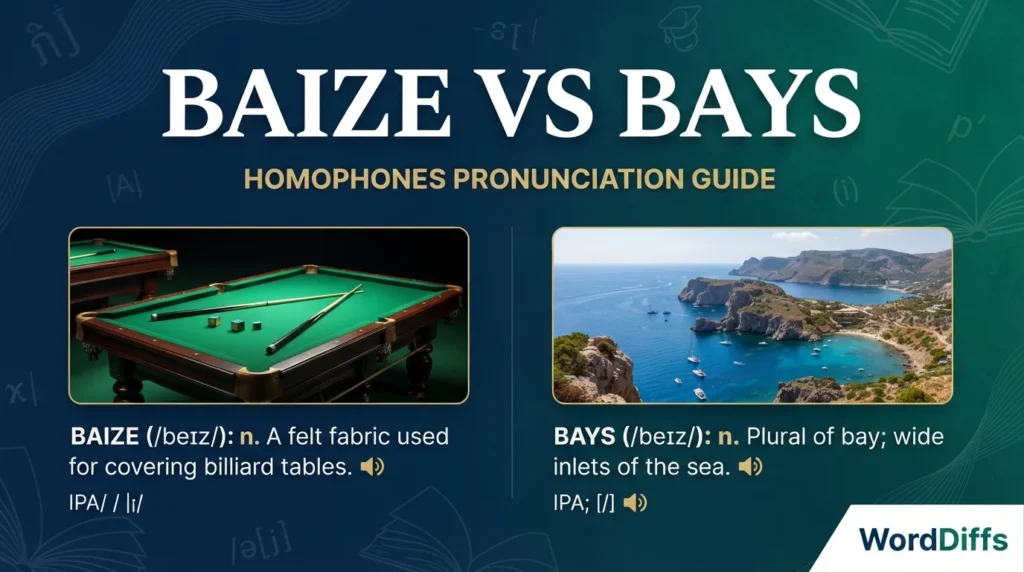
English homophones often confuse learners because they sound alike but have different spellings and meanings. Baize and bays are excellent examples of this challenge. Although they are pronounced the same in most varieties of English, they refer to completely different things. Choosing the wrong spelling can change the meaning of a sentence and create confusion for readers or listeners.
Learning the correct spelling, pronunciation, and usage of homophones helps improve writing accuracy, speaking confidence, and reading comprehension. It also makes communication clearer in academic, professional, and everyday situations.
In this guide, you will learn the meanings of baize and bays, their pronunciation in British and American English, grammar, origins, common collocations, example sentences, pronunciation comparisons, and practical usage tips. By the end, you will be able to recognize each word quickly and use it correctly in different contexts.
Quick Difference Table
| Word | Part of Speech | Meaning | Pronunciation (IPA) | Usage | Example |
| Baize | Noun | A coarse woolen cloth, usually green, used to cover tables and other surfaces | /beɪz/ | Refers to a type of fabric | The billiard table was covered with green baize. |
| Bays | Noun (plural) | More than one bay, such as a body of water, horse color, storage area, or tree | /beɪz/ | Refers to multiple bays | The ship sailed past several bays. |
Baize
Pronunciation
The word baize is pronounced /beɪz/.
Simple pronunciation: Bayz
Audio-style spelling: BAYZ
Both baize and bays are pronounced exactly the same in standard English, making them perfect homophones.
British pronunciation: /beɪz/
American pronunciation: /beɪz/
There is virtually no difference between British and American pronunciation for this word.
Meaning
Baize is a type of thick, coarse woolen fabric. It is most commonly green and is traditionally used to cover billiard tables, card tables, desks, and other surfaces to protect them and reduce noise.
In everyday English, the word is relatively uncommon, but it frequently appears in books, historical writing, interior decoration, and discussions of games such as billiards and snooker.
Part of Speech
Baize is a noun.
It names a material or fabric rather than an action or quality.
Examples:
- The baize felt smooth.
- Green baize covered the table.
- They replaced the worn baize.
Origin
The word baize comes from Middle English and is believed to have originated from the French word baie, referring to a coarse woolen cloth. It entered English several centuries ago and became associated with table coverings, particularly for gaming and office furniture.
Today, the term remains common in historical descriptions and traditional indoor games.
Common Uses
People commonly use baize when discussing:
- Billiard tables
- Snooker tables
- Card tables
- Antique furniture
- Writing desks
- Library tables
- Historical interiors
- Protective cloth coverings
- Traditional game rooms
- Museum displays
Common Collocations
Some common collocations include:
- green baize
- baize cloth
- baize covering
- baize table
- baize surface
- baize top
- baize lining
- worn baize
- thick baize
- replace the baize
- smooth baize
- billiard baize
- snooker baize
- fine baize
- protective baize
Example Sentences
- The old billiard table was covered with green baize.
- They replaced the worn baize before the tournament.
- Dust settled gently on the faded baize.
- The museum displayed a nineteenth-century desk covered in baize.
- Fresh baize gave the table a professional appearance.
- The craftsman carefully stretched the baize across the surface.
- The card table featured dark green baize.
- The soft baize reduced the sound of rolling balls.
- Antique dealers admired the original baize.
- The damaged baize was restored by specialists.
- The library desk still had its traditional baize covering.
- He brushed chalk dust from the baize.
- High-quality baize improves playing conditions.
- The furniture maker selected durable baize.
- New baize completely transformed the old table.
Bays
Pronunciation
The word bays is pronounced /beɪz/.
Simple pronunciation: Bayz
Audio-style spelling: BAYZ
Like baize, bays has exactly the same pronunciation in standard English.
British pronunciation: /beɪz/
American pronunciation: /beɪz/
There is no meaningful pronunciation difference between British and American English.
Meaning
Bays is the plural form of bay. Depending on context, it may refer to:
- Coastal inlets of the sea
- Parking or loading spaces
- Sections within buildings
- Bay-colored horses
- Bay trees
The intended meaning depends entirely on the surrounding sentence.
Part of Speech
Bays is a plural noun.
It refers to more than one bay.
Examples:
- Several bays lined the coast.
- The warehouse has four loading bays.
- The stable houses two bay horses, so visitors admired the beautiful bays.
Origin
The word bay comes from Old French baie, meaning an inlet or opening. Over time, English expanded the word’s meanings to include architectural sections, parking spaces, horse coloring, and certain trees. Bays simply represents the regular plural form.
Common Uses
People commonly use bays when discussing:
- Geography
- Coastlines
- Harbors
- Loading docks
- Parking facilities
- Warehouses
- Airports
- Horse breeding
- Architecture
- Landscaping
Common Collocations
Common collocations include:
- sheltered bays
- coastal bays
- beautiful bays
- loading bays
- parking bays
- docking bays
- repair bays
- service bays
- engine bays
- cargo bays
- scenic bays
- shallow bays
- several bays
- nearby bays
- spacious bays
Example Sentences
- The coastline features many beautiful bays.
- Workers unloaded trucks at the loading bays.
- Tourists visited several quiet bays during their trip.
- The marina overlooks two sheltered bays.
- The airport added new parking bays.
- Mechanics worked inside the repair bays.
- Small boats rested in the calm bays.
- The nature reserve protects several coastal bays.
- Cargo ships occupied all the docking bays.
- The stable contained three handsome bays.
- Emergency vehicles parked in designated bays.
- The photographer captured sunrise over the bays.
- New service bays improved efficiency.
- The hiking trail connected several hidden bays.
- Engineers inspected the aircraft maintenance bays.
Pronunciation Comparison
Both baize and bays are perfect homophones in standard English.
They are pronounced /beɪz/ in both British and American English. Native speakers generally cannot distinguish between the words through pronunciation alone.
Regional accents may slightly change the vowel quality, but both words change together, so they continue to sound identical.
English learners often confuse these words because they rely on sound rather than spelling. Since pronunciation offers no clue, understanding the sentence’s context is the only reliable way to choose the correct spelling.
Grammar Differences
| Word | Part of Speech | Meaning | Function | Sentence Position | Verb Forms (If Applicable) | Plural Forms (If Applicable) |
| Baize | Noun | Woolen cloth used as a covering | Names a material | Subject, object, complement | Not applicable | Usually treated as an uncountable noun |
| Bays | Plural noun | More than one bay | Names multiple places, spaces, horses, or trees | Subject, object | Not applicable | Plural of bay |
Side-by-Side Examples
| Baize | Bays |
| The baize needs cleaning. | The bays were full of boats. |
| Fresh baize improved the table. | We explored three bays yesterday. |
| The green baize looked new. | The parking bays were occupied. |
| He repaired the torn baize. | Delivery trucks waited at the loading bays. |
| The baize reduced noise. | Calm bays attract sailors. |
| Antique baize is valuable. | The hotel overlooks beautiful bays. |
| The craftsman measured the baize carefully. | Aircraft filled the maintenance bays. |
| They selected premium baize. | The hikers photographed hidden bays. |
| The old baize faded over time. | Repair bays remained open all day. |
| Green baize covered every table. | Fishing boats entered the sheltered bays. |
Homophones Comparison Table
| Word | Pronunciation | Meaning | Part of Speech | Usage | Example |
| Baize | /beɪz/ (BAYZ) | A coarse woolen cloth, often green, used to cover tables | Noun | Refers to a specific type of fabric | The old card table was covered with green baize. |
| Bays | /beɪz/ (BAYZ) | The plural of bay, referring to coastal inlets, parking spaces, building sections, horses, or trees | Plural noun | Refers to more than one bay | Several bays along the coast attract tourists. |
Memory Tricks
Remembering the difference between baize and bays becomes much easier with a few simple techniques.
- Baize contains the letter z, which can remind you of the soft, fuzzy texture of the cloth.
- Think of a billiard table covered with green baize.
- Bays ends in s, reminding you that it usually refers to more than one bay.
- Picture several beautiful bays along a coastline to connect the spelling with the plural form.
- Associate baize with indoor objects and bays with outdoor places or multiple spaces.
- Read and write each word in different example sentences to reinforce the correct spelling.
- Create flashcards showing a green table for baize and a coastline with several inlets for bays.
Common Mistakes
| Incorrect Sentence | Correct Sentence | Explanation |
| The billiard table has green bays. | The billiard table has green baize. | A table covering is baize, not bays. |
| We visited three baize. | We visited three bays. | Coastal inlets are bays. |
| The parking baize were full. | The parking bays were full. | Parking spaces are called bays. |
| The old bays looked worn on the table. | The old baize looked worn on the table. | Fabric is baize. |
| Green bays covered the desk. | Green baize covered the desk. | Desk coverings use baize. |
| The museum replaced the bays on the card table. | The museum replaced the baize on the card table. | The cloth is baize. |
| Several baize lined the coast. | Several bays lined the coast. | Coastlines have bays. |
| The repair baize were occupied. | The repair bays were occupied. | Repair areas are bays. |
| The craftsman stretched the bays across the table. | The craftsman stretched the baize across the table. | Fabric is baize. |
| Boats entered the sheltered baize. | Boats entered the sheltered bays. | Boats enter bays. |
| The snooker bays looked new. | The snooker baize looked new. | Snooker tables use baize. |
| Fresh bays improved the billiard table. | Fresh baize improved the billiard table. | Table cloth is baize. |
| The loading baize were empty. | The loading bays were empty. | Loading areas are bays. |
| He cleaned the bays on the card table. | He cleaned the baize on the card table. | Cloth is baize. |
| The coastline has many beautiful baize. | The coastline has many beautiful bays. | Geographic inlets are bays. |
Fill in the Blank Quiz
- The billiard table was covered with green ________.
- We explored several beautiful ________ during our vacation.
- The old ________ needed replacing.
- Trucks waited at the loading ________.
- The museum preserved the original green ________.
- The fishing boats entered the sheltered ________.
- The craftsman stretched the ________ tightly.
- The airport added new parking ________.
- The worn ________ was replaced before the match.
- Tourists photographed the scenic ________.
- The card table featured fine ________.
- Mechanics worked in the service ________.
- The library desk still had green ________.
- The coastline contains many small ________.
- New ________ improved the appearance of the snooker table.
- Cargo trucks occupied every loading ________.
- The antique ________ was carefully restored.
- Sailors anchored in quiet ________.
- Dust covered the old ________.
- The repair ________ remained open overnight.
Answer Key
- baize
- bays
- baize
- bays
- baize
- bays
- baize
- bays
- baize
- bays
- baize
- bays
- baize
- bays
- baize
- bays
- baize
- bays
- baize
- bays
Choose the Correct Word Quiz
1. The billiard table was covered with green ________.
A. baize
B. bays
C. base
D. bass
Answer: A
Explanation: The cloth covering is called baize.
2. We visited several beautiful ________.
A. baize
B. bays
C. base
D. baits
Answer: B
Explanation: Coastal inlets are bays.
3. The card table needed new ________.
A. bays
B. baize
C. base
D. bays
Answer: B
Explanation: Tables are covered with baize.
4. Trucks entered the loading ________.
A. baize
B. bays
C. base
D. bass
Answer: B
Explanation: Loading areas are bays.
5. The antique desk still had its original ________.
A. baize
B. bays
C. base
D. bayes
Answer: A
Explanation: A desk covering is baize.
6. Sailors anchored in quiet ________.
A. baize
B. bays
C. base
D. bass
Answer: B
Explanation: Boats anchor in bays.
7. The green ________ looked brand new.
A. bays
B. baize
C. base
D. baits
Answer: B
Explanation: Fabric covering is baize.
8. The airport expanded its parking ________.
A. baize
B. bays
C. base
D. bass
Answer: B
Explanation: Parking spaces are bays.
9. The worn ________ was carefully replaced.
A. baize
B. bays
C. base
D. baits
Answer: A
Explanation: The cloth is baize.
10. The coastline has many sheltered ________.
A. baize
B. bays
C. base
D. bass
Answer: B
Explanation: Coastal inlets are bays.
11. The craftsman installed fresh ________.
A. baize
B. bays
C. base
D. bass
Answer: A
Explanation: Table fabric is baize.
12. Mechanics worked in the repair ________.
A. baize
B. bays
C. base
D. bass
Answer: B
Explanation: Repair sections are bays.
13. The snooker table had premium ________.
A. baize
B. bays
C. base
D. bass
Answer: A
Explanation: Snooker tables are covered with baize.
14. Tourists explored hidden ________.
A. baize
B. bays
C. base
D. bass
Answer: B
Explanation: Coastal inlets are bays.
15. Dust settled on the old ________.
A. baize
B. bays
C. base
D. bass
Answer: A
Explanation: The fabric covering is baize.
Common Expressions
Baize
Common Expressions
Although baize appears in relatively few idioms, it is commonly found in fixed phrases.
- green baize table
- The committee gathered around the green baize table.
- covered with baize
- The writing desk was covered with baize.
- baize-covered table
- They restored the antique baize-covered table.
- replace the baize
- The club decided to replace the baize before the competition.
Bays
Common Expressions
Bays appears in many everyday and technical expressions.
- loading bays
- Delivery trucks occupied the loading bays.
- parking bays
- Visitors used the marked parking bays.
- repair bays
- Mechanics worked inside the repair bays.
- coastal bays
- The region is famous for its beautiful coastal bays.
- sheltered bays
- Sailors preferred sheltered bays during storms.
Frequently Asked Questions
What is the difference between baize and bays?
Baize is a noun referring to a thick woolen cloth used to cover tables, especially billiard and card tables. Bays is the plural form of bay, meaning more than one coastal inlet, parking space, building section, bay-colored horse, or bay tree. Although they sound identical, their meanings and uses are completely different.
Are baize and bays pronounced the same?
Yes. In both British and American English, they are pronounced /beɪz/. They are considered perfect homophones because they have the same pronunciation but different spellings and meanings.
Why do people confuse these homophones?
People often rely on pronunciation when spelling words. Since baize and bays sound exactly alike, learners may choose the wrong spelling if they are unfamiliar with the context or the meaning of each word.
Is baize a common English word?
Compared with bays, baize is relatively uncommon. It is mainly used when discussing billiards, snooker, antique furniture, card tables, libraries, museums, and traditional interiors.
Can bays have more than one meaning?
Yes. Bays can refer to coastal inlets, loading spaces, parking spaces, architectural sections, bay-colored horses, or bay trees. The surrounding sentence makes the intended meaning clear.
How can I remember the difference?
Associate baize with a green billiard table and bays with several coastal inlets or parking spaces. Visual memory is often the easiest way to distinguish these homophones.
Is baize countable?
It is generally treated as an uncountable noun when referring to the fabric itself. However, it may occasionally be used in a countable sense when referring to different kinds of baize in specialist contexts.
Is bays always plural?
Yes. Bays is the regular plural of bay. The singular form is bay.
Are these words interchangeable?
No. Despite identical pronunciation, they cannot replace each other because they have unrelated meanings.
Why is context important?
Since pronunciation cannot distinguish baize from bays, readers and listeners depend entirely on context to determine which word is intended.
Tips to Remember the Difference
- Read books and articles containing homophones to become familiar with their meanings.
- Practice writing both words in original sentences.
- Say each word aloud while visualizing its meaning.
- Create flashcards with pictures of a billiard table and coastal bays.
- Review example sentences regularly.
- Learn words in context instead of memorizing isolated definitions.
- Practice short dictation exercises with homophones.
- Build your vocabulary by grouping similar sounding words together.
- Ask yourself whether the sentence refers to fabric or multiple bays before choosing the spelling.
- Revisit challenging homophones frequently to reinforce long-term memory.
Summary
Understanding the difference between baize and bays is essential because they are perfect homophones that sound identical but have completely different meanings. Baize refers to a thick woolen cloth traditionally used to cover billiard tables, card tables, desks, and similar surfaces. Bays is the plural of bay, which can describe coastal inlets, parking spaces, loading areas, architectural sections, bay-colored horses, or bay trees.
Both words share the pronunciation /beɪz/ in British and American English, so context is the only reliable way to determine the correct spelling. Learning their meanings, grammatical roles, common collocations, and example sentences will help you avoid common mistakes in writing and speaking.
Using visual memory techniques, practicing with quizzes, reading authentic English texts, and creating your own example sentences are effective ways to master these homophones. With regular practice, you will confidently recognize when to use baize and when bays is the appropriate choice, improving both your vocabulary and overall English communication skills.

Caitlin Boylan is an experienced content writer, editor, educator, travel writer, and remote worker with more than 10 years of experience in English education and international communication. She is the founder and author of The Country Jumper, a travel blog dedicated to supporting solo travelers, especially women exploring life abroad. She is also the co-founder of Macro Magazine, a global online publication that shares diverse perspectives on worldwide topics that impact communities.