
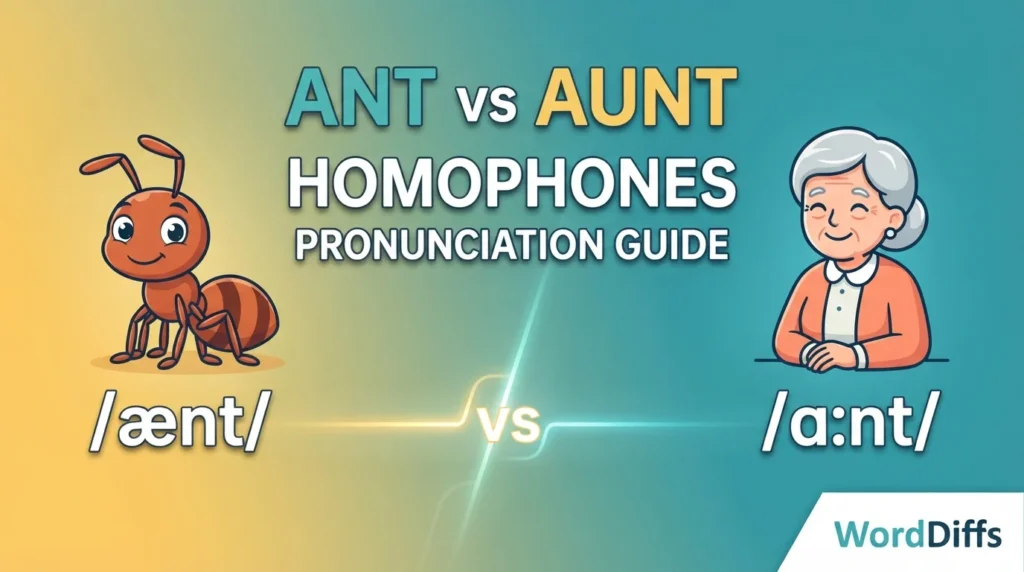
English homophones often confuse learners because two different words can sound almost identical while having completely different meanings and spellings. Ant and Aunt are a classic example. Depending on the speaker’s accent, these words may sound exactly alike or slightly different. Using the wrong spelling can change the meaning of a sentence completely, especially in writing. Understanding their pronunciation, grammar, and usage helps learners communicate more accurately in both spoken and written English.
In this guide, you will learn the pronunciation of Ant and Aunt, their meanings, parts of speech, origins, common uses, collocations, grammar, and plenty of practical examples. You will also discover why English speakers pronounce these words differently in various regions and how to remember the correct spelling. Whether you are a beginner or an advanced English learner, this guide will help you confidently distinguish between these commonly confused homophones.
Quick Difference Table
| Word | Part of Speech | Meaning | Pronunciation (IPA) | Usage | Example |
| Ant | Noun | A small social insect | UK: /ænt/, US: /ænt/ | Refers to an insect | An ant carried a crumb. |
| Aunt | Noun | The sister of one’s parent or the wife of an uncle | UK: /ɑːnt/ or /ænt/, US: /ænt/ or /ɑnt/ | Refers to a family member | My aunt baked a cake. |
Ant
Pronunciation
The word ant is pronounced /ænt/ in both American and most British English.
Simple pronunciation: ant
Audio-style spelling: ANT
In many English accents, ant sounds exactly the same as aunt, making them true homophones. However, in some British accents, aunt is pronounced differently with a broader vowel sound.
British pronunciation: /ænt/
American pronunciation: /ænt/
Meaning
An ant is a small insect that lives in organized colonies. Ants are known for working together to build nests, gather food, and protect their colony. They are found almost everywhere in the world and are famous for their strength and teamwork.
In everyday conversation, ant always refers to the insect.
Part of Speech
Ant is a countable noun.
It functions as the subject, object, or complement of a sentence.
Examples:
- The ant climbed the wall.
- I watched an ant carry food.
- That tiny insect is an ant.
Origin
The word ant comes from Old English ǣmete, which gradually evolved into the modern English form. It has Germanic roots and has referred to the same insect for hundreds of years.
Common Uses
People commonly use ant when discussing:
- Nature
- Gardens
- Science
- Biology
- Children’s books
- Insect behavior
- Teamwork
- Pest control
- Outdoor activities
- Wildlife education
Common Collocations
- ant colony
- ant hill
- ant nest
- worker ant
- queen ant
- flying ant
- tiny ant
- black ant
- red ant
- army ant
- ant trail
- ant bite
- ant population
- ant species
- giant ant
Example Sentences
- An ant carried a piece of bread across the sidewalk.
- The little ant disappeared into its nest.
- Every ant has a specific job inside the colony.
- I watched an ant climb a tall blade of grass.
- A black ant crawled across my notebook.
- The children observed an ant through a magnifying glass.
- Scientists studied the behavior of the ant colony.
- One ant found food and quickly attracted the others.
- The ant worked tirelessly throughout the day.
- We accidentally stepped on an ant hill.
- The ant carried something much larger than itself.
- A tiny ant wandered across the picnic blanket.
- The teacher explained how an ant communicates with other ants.
- An ant can lift many times its own weight.
- I brushed the ant off my sleeve before it bit me.
Aunt
Pronunciation
The pronunciation of aunt varies depending on the speaker’s accent.
Common IPA pronunciations:
- American English: /ænt/ or /ɑnt/
- British English: /ɑːnt/ or /ænt/
Simple pronunciation: ant or ahnt
Audio-style spelling: ANT or AHNT
In many parts of North America, aunt sounds exactly like ant. In much of southern England and several Commonwealth countries, speakers often pronounce aunt with a longer “ah” vowel.
Meaning
An aunt is the sister of your mother or father, or the wife of your uncle. The word refers to a close family relationship.
People may also use aunt as a respectful title for an older family friend or family acquaintance in some cultures.
Part of Speech
Aunt is a countable noun.
It usually names a person within a family.
Examples:
- My aunt lives nearby.
- We visited our aunt last weekend.
- Her favorite relative is her aunt.
Origin
The word aunt entered English from Old French ante, which came from the Latin word amita, meaning “father’s sister.” Over time, the spelling remained stable while pronunciation developed differently across English-speaking regions.
Common Uses
The word aunt commonly appears in:
- Family conversations
- Personal stories
- Genealogy
- Children’s books
- Invitations
- Family celebrations
- School writing
- Everyday conversation
- Holiday gatherings
- Cultural traditions
Common Collocations
- favorite aunt
- loving aunt
- dear aunt
- aunt and uncle
- maternal aunt
- paternal aunt
- great-aunt
- aunt Mary
- aunt Sarah
- visiting my aunt
- beloved aunt
- rich aunt
- elderly aunt
- caring aunt
- proud aunt
Example Sentences
- My aunt makes delicious homemade bread.
- We visited our aunt during the summer holiday.
- Her aunt taught her how to knit.
- My aunt lives near the beach.
- Everyone enjoys spending time with their cheerful aunt.
- My aunt gave me a thoughtful birthday present.
- We called our aunt to wish her a happy birthday.
- My aunt enjoys gardening every weekend.
- Their aunt works as a history teacher.
- I stayed with my aunt while attending college.
- My aunt shared many interesting childhood stories.
- Our aunt invited the whole family to dinner.
- My aunt adopted a playful puppy.
- We thanked our aunt for her kindness.
- My aunt always remembers everyone’s birthday.
Pronunciation Comparison
Although Ant and Aunt are commonly treated as homophones, their pronunciation depends on regional English accents.
In American English, many speakers pronounce both words as /ænt/, making them perfect homophones. However, some Americans pronounce aunt as /ɑnt/, creating a noticeable distinction.
In British English, pronunciation varies even more. Many southern British speakers say aunt as /ɑːnt/ while ant remains /ænt/. In northern England and some other regions, both words may be pronounced alike.
These regional differences explain why some learners hear no distinction while others clearly notice different vowel sounds. Despite pronunciation differences, the spellings and meanings are always different.
Grammar Differences
| Word | Part of Speech | Meaning | Function | Sentence Position | Verb Forms (If Applicable) | Plural Forms (If Applicable) |
| Ant | Noun | A small insect | Subject or object | Anywhere a noun is used | Not applicable | ants |
| Aunt | Noun | A parent’s sister or an uncle’s wife | Subject or object | Anywhere a noun is used | Not applicable | aunts |
Side-by-Side Examples
| Ant | Aunt |
| An ant crossed the table. | My aunt crossed the street to greet us. |
| The ant carried a leaf. | My aunt carried the groceries home. |
| An ant found sugar quickly. | My aunt found an old family photo. |
| Every ant followed the trail. | Every aunt attended the reunion. |
| The ant entered its nest. | My aunt entered the library quietly. |
| A tiny ant crawled on the wall. | My aunt painted the wall yesterday. |
| The ant searched for food. | My aunt searched for my lost keys. |
| An ant climbed the tree. | My aunt climbed the hill with us. |
| The ant escaped the rain. | My aunt escaped the traffic by leaving early. |
| I observed an ant carefully. | I thanked my aunt sincerely. |
Homophones Comparison Table
| Word | Pronunciation | Meaning | Part of Speech | Usage | Example |
| Ant | UK: /ænt/, US: /ænt/ | A small social insect | Noun | Biology, nature, everyday conversation | The ant carried a seed. |
| Aunt | UK: /ɑːnt/ or /ænt/, US: /ænt/ or /ɑnt/ | The sister of a parent or the wife of an uncle | Noun | Family relationships | My aunt lives in London. |
Memory Tricks
Remembering the difference between Ant and Aunt becomes much easier with a few simple techniques.
- Ant = Animal. Both words start with the letter A, making it easy to connect ant with a tiny animal.
- Aunt = Family. The letters “au” can remind you of “adult”, helping you associate aunt with an adult family member.
- Picture a tiny insect for ant and a smiling relative for aunt.
- Create flashcards with pictures instead of only words.
- Practice writing both words in short sentences every day.
- Read children’s books and simple stories that contain both words.
- Listen to speakers from different English-speaking countries to notice pronunciation differences.
Common Mistakes
| Incorrect Sentence | Correct Sentence | Explanation |
| My ant visited yesterday. | My aunt visited yesterday. | A family member is an aunt. |
| An aunt crawled across the table. | An ant crawled across the table. | An insect is an ant. |
| My ant baked cookies. | My aunt baked cookies. | Refers to a relative. |
| I saw an aunt in the garden. | I saw an ant in the garden. | The insect is an ant. |
| The aunt carried food to its nest. | The ant carried food to its nest. | Insects build nests. |
| My ant called me last night. | My aunt called me last night. | Use aunt for family. |
| An aunt bit my foot. | An ant bit my foot. | Ants can bite. |
| We visited our favorite ant. | We visited our favorite aunt. | Relative, not insect. |
| Every aunt followed the food trail. | Every ant followed the food trail. | Ants follow scent trails. |
| My ant is a doctor. | My aunt is a doctor. | Profession belongs to a person. |
| I stepped on an aunt hill. | I stepped on an ant hill. | It is an ant hill. |
| The aunt colony was enormous. | The ant colony was enormous. | Colonies belong to ants. |
| My ant knitted me a sweater. | My aunt knitted me a sweater. | A family member knits. |
| The aunt searched for sugar. | The ant searched for sugar. | Ants search for food. |
| My little ant invited us to dinner. | My little aunt invited us to dinner. | The person is an aunt. |
Fill in the Blank Quiz
Choose ant or aunt to complete each sentence.
- My ______ bought me a birthday gift.
- A tiny ______ crawled across the floor.
- We visited our ______ during the holidays.
- The ______ carried a leaf.
- My ______ teaches science.
- I found an ______ near the picnic basket.
- Our ______ made delicious soup.
- Every ______ worked together in the colony.
- My ______ lives next door.
- The ______ disappeared into its nest.
- My ______ loves gardening.
- We watched an ______ climb a tree.
- My ______ called this morning.
- The ______ followed a food trail.
- Their ______ is visiting this weekend.
- The ______ carried a crumb.
- My ______ enjoys painting.
- We observed an ______ with a magnifying glass.
- My ______ baked fresh bread.
- The ______ entered the ant hill.
Answer Key
- aunt
- ant
- aunt
- ant
- aunt
- ant
- aunt
- ant
- aunt
- ant
- aunt
- ant
- aunt
- ant
- aunt
- ant
- aunt
- ant
- aunt
- ant
Choose the Correct Word Quiz
1. My ______ gave me a birthday card.
A. ant
B. aunt
C. both
D. neither
Answer: B
Explanation: A family member is an aunt.
2. The ______ climbed the tree.
A. aunt
B. ant
C. both
D. neither
Answer: B
Explanation: Only an insect can climb as described.
3. We stayed with our ______.
A. aunt
B. ant
C. both
D. neither
Answer: A
Explanation: You stay with a relative.
4. The ______ carried food home.
A. aunt
B. ant
C. both
D. neither
Answer: B
Explanation: Ants carry food to their nest.
5. My ______ works in a hospital.
A. ant
B. aunt
C. both
D. neither
Answer: B
Explanation: Refers to a person.
6. I watched an ______ crawl on the wall.
A. aunt
B. ant
C. both
D. neither
Answer: B
7. Our ______ invited everyone for dinner.
A. ant
B. aunt
C. both
D. neither
Answer: B
8. The ______ entered its colony.
A. aunt
B. ant
C. both
D. neither
Answer: B
9. My ______ enjoys reading novels.
A. ant
B. aunt
C. both
D. neither
Answer: B
10. The ______ found a piece of candy.
A. aunt
B. ant
C. both
D. neither
Answer: B
11. My ______ is my mother’s sister.
A. ant
B. aunt
C. both
D. neither
Answer: B
12. The ______ marched in a line.
A. aunt
B. ant
C. both
D. neither
Answer: B
13. My ______ knitted a blanket.
A. ant
B. aunt
C. both
D. neither
Answer: B
14. The ______ lived inside the hill.
A. aunt
B. ant
C. both
D. neither
Answer: B
15. We thanked our ______ for dinner.
A. ant
B. aunt
C. both
D. neither
Answer: B
Common Expressions
Ant
Common Expressions
Busy as an ant
Meaning: Extremely hardworking.
Example: She was as busy as an ant preparing for the event.
Ant colony
Meaning: A community of ants living together.
Example: We discovered an ant colony beneath the rock.
Ant trail
Meaning: A line of ants following a scent path.
Example: The children followed the ant trail through the garden.
Ant hill
Meaning: A mound built by ants.
Example: Do not disturb the ant hill.
Aunt
Common Expressions
Dear Aunt
A respectful way to address an aunt.
Example: Dear Aunt Susan, thank you for your thoughtful gift.
Aunt and Uncle
A common expression referring to extended family.
Example: My aunt and uncle visited last weekend.
Favorite Aunt
Used affectionately.
Example: She is everyone’s favorite aunt because she tells wonderful stories.
Great-Aunt
The sister of one of your grandparents.
Example: My great-aunt celebrated her ninetieth birthday.
Frequently Asked Questions
What is the difference between ant and aunt?
An ant is a small insect that lives in colonies, while an aunt is the sister of one of your parents or the wife of your uncle. Although they may sound alike in many accents, they have completely different meanings and spellings.
Are ant and aunt pronounced the same?
In many American accents they are pronounced the same, making them true homophones. In several British accents, aunt is pronounced with a longer vowel sound, while ant keeps the short vowel.
Why do people confuse these words?
People mainly confuse them because they often sound identical in conversation. Without context, listeners may not know which word is intended until they see the spelling.
Is ant always a noun?
Yes. Ant is always used as a noun referring to the insect.
Is aunt always a noun?
Yes. Aunt is also always a noun and refers to a family relationship.
Which spelling should I use for the insect?
Always write ant when talking about the insect.
Which spelling refers to a family member?
Use aunt whenever you mean your parent’s sister or your uncle’s wife.
Do British and American speakers pronounce aunt differently?
Yes. Many British speakers say /ɑːnt/, while many Americans say /ænt/, though regional variations exist in both countries.
How can I remember the difference?
Associate ant with insects and nature, and aunt with family members. Visual memory works especially well.
Are these common beginner mistakes?
Yes. English learners frequently confuse these words because pronunciation can be nearly identical.
Tips to Remember the Difference
- Read children’s stories that use both words.
- Keep a vocabulary notebook with example sentences.
- Practice saying the words aloud in British and American pronunciation.
- Write five original sentences using each word every day.
- Label pictures of insects and family members with the correct word.
- Review common collocations regularly.
- Test yourself with quizzes and flashcards.
- Listen to native speakers from different regions.
- Use the words in conversation whenever possible.
- Proofread carefully before submitting written work.
Summary
Although Ant and Aunt may sound alike in many English accents, they refer to completely different things. Ant is a noun that names a small social insect known for living in colonies and working cooperatively. Aunt is also a noun, but it refers to a family member, specifically the sister of one of your parents or the wife of your uncle. Their pronunciation varies by region, with many American speakers pronouncing them identically, while many British speakers distinguish aunt with a broader vowel sound.
Learning their meanings, grammar, common collocations, and typical contexts makes choosing the correct spelling much easier. Memory tricks such as linking ant with animal and aunt with family can help reinforce the difference. Regular reading, writing, pronunciation practice, and sentence creation are excellent ways to master these homophones. By understanding how context determines meaning, you can confidently use Ant and Aunt correctly in both spoken and written English.

1 thought on “Ant vs Aunt: Meaning and Pronunciation Guide”