
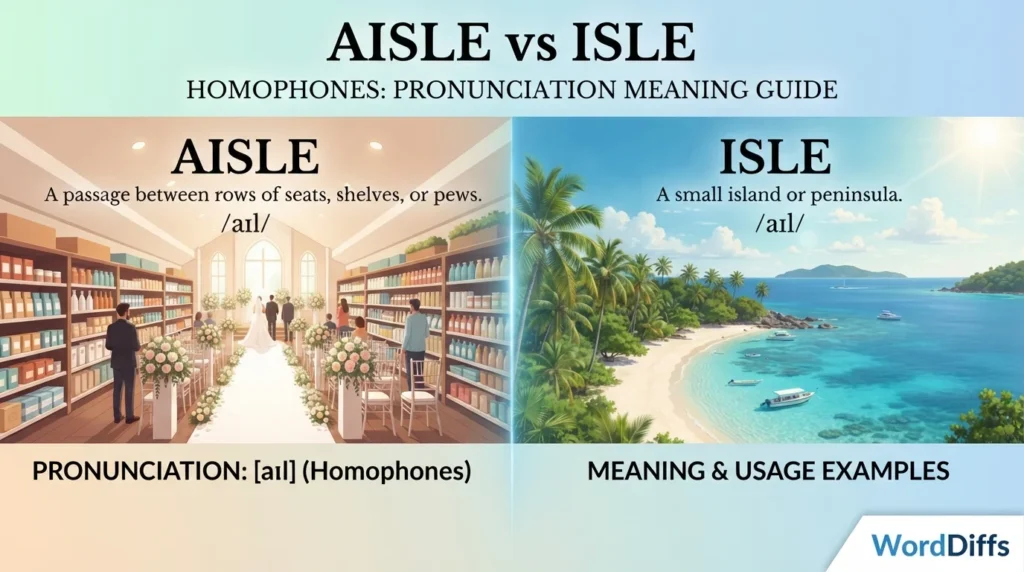
English learners often find Aisle and Isle confusing because they sound exactly the same but have completely different meanings and spellings. These words are perfect homophones, meaning they share the same pronunciation while referring to different things. Choosing the wrong spelling can change the meaning of a sentence and create confusion in both writing and reading. Although native speakers usually understand the intended meaning from context, accurate word choice is essential in academic writing, professional communication, and everyday English.
Pronunciation also plays an important role in understanding homophones. Since Aisle and Isle are pronounced alike, learners must rely on context rather than sound to determine which word is correct. In this guide, you will learn the pronunciation, meanings, grammar, origins, common collocations, usage tips, comparison tables, and plenty of original examples to help you confidently distinguish between Aisle and Isle in any situation.
Quick Difference Table
| Word | Part of Speech | Meaning | Pronunciation (IPA) | Usage | Example |
| Aisle | Noun | A passage between rows of seats, shelves, or pews | /aɪl/ | Buildings, stores, churches, airplanes | We walked down the grocery aisle. |
| Isle | Noun | A small island or a poetic word for island | /aɪl/ | Geography, literature, travel | They visited a peaceful isle. |
Aisle
Pronunciation
IPA: /aɪl/
Simple pronunciation: Sounds like “ile.”
Audio-style spelling: eye-l
Does it sound the same as Isle?
Yes. Aisle and Isle are perfect homophones in modern English.
British pronunciation: /aɪl/
American pronunciation: /aɪl/
The pronunciation is virtually identical in both British and American English.
Meaning
An aisle is a passage or walkway between rows of seats, shelves, desks, or other objects. It allows people to move from one place to another inside a building or vehicle.
In everyday life, you often hear this word in supermarkets, churches, theaters, airplanes, buses, and wedding ceremonies.
Part of Speech
Grammar category: Noun
Function:
An aisle names a place or passage.
It often follows articles such as the, an, or this.
Examples:
- The aisle was crowded.
- Walk down the center aisle.
- She stood in the wedding aisle.
Origin
The word aisle entered English through Old French aile, meaning “wing.” It originally referred to the side section or wing of a church. Over time, its meaning expanded to include the passageways found in churches, stores, theaters, airplanes, and many other places.
Although its spelling looks unusual, the silent letters developed through historical spelling changes rather than pronunciation.
Common Uses
People commonly use aisle in situations involving indoor walkways.
Typical situations include:
- Grocery shopping
- Air travel
- Churches
- Wedding ceremonies
- Movie theaters
- Libraries
- Conference halls
- Schools
- Stadiums
- Department stores
Formal usage
The emergency exits are located beside the aisle.
Informal usage
Meet me in the snack aisle.
Academic usage
The classroom aisles should remain clear for safety.
Common Collocations
- grocery aisle
- supermarket aisle
- center aisle
- wedding aisle
- church aisle
- airplane aisle
- narrow aisle
- wide aisle
- crowded aisle
- empty aisle
- aisle seat
- walk down the aisle
- cleaning products aisle
- frozen food aisle
- shopping aisle
Example Sentences
- We searched every aisle for the missing toy.
- Please keep the aisle clear during boarding.
- She walked slowly down the wedding aisle.
- The cereal aisle was especially busy this morning.
- I found the batteries in the next aisle.
- The flight attendant checked the aisle before takeoff.
- Children should not run through the store aisle.
- He chose an aisle seat for extra legroom.
- The church aisle was beautifully decorated with flowers.
- Someone left a shopping cart blocking the aisle.
- The bookstore arranged each aisle by subject.
- We met unexpectedly in the dairy aisle.
- Every aisle had clear signs above it.
- Workers restocked products throughout the aisle.
- The wheelchair easily moved through the wide aisle.
Isle
Pronunciation
IPA: /aɪl/
Simple pronunciation: Sounds like “ile.”
Audio-style spelling: eye-l
Does it sound the same as Aisle?
Yes. These words have the same pronunciation.
British pronunciation: /aɪl/
American pronunciation: /aɪl/
There is virtually no pronunciation difference between the two major accents.
Meaning
An isle is a small island or a literary, poetic, or formal word for an island. It often refers to a piece of land surrounded by water and is commonly found in place names, travel writing, history, and literature.
While island is more common in everyday conversation, isle creates a more elegant or descriptive tone.
Part of Speech
Grammar category: Noun
Function:
An isle names a geographical place.
It usually appears with articles or descriptive adjectives.
Examples:
- The isle is beautiful.
- They explored the quiet isle.
- The tropical isle attracts visitors.
Origin
The word isle comes from Old French isle, which originated from the Latin word insula, meaning “island.” English has preserved the word mainly in literary language and geographical names, while island became the more common everyday term.
Common Uses
Isle commonly appears in:
- Geography
- Travel writing
- Literature
- Poetry
- Tourism
- Historical texts
- Place names
- Descriptive storytelling
Formal usage
The expedition reached the remote isle before sunset.
Informal usage
We dreamed of relaxing on a tropical isle.
Academic usage
The ancient settlement occupied a small coastal isle.
Common Collocations
- tropical isle
- remote isle
- peaceful isle
- small isle
- beautiful isle
- rocky isle
- coastal isle
- deserted isle
- emerald isle
- island isle
- hidden isle
- picturesque isle
- ancient isle
- quiet isle
- volcanic isle
Example Sentences
- The tiny isle was surrounded by crystal-clear water.
- Birds nested on the quiet isle every spring.
- The travelers sailed toward a distant isle.
- Legends describe a mysterious isle beyond the horizon.
- The peaceful isle attracted artists from around the world.
- We spent a week exploring the tropical isle.
- A lighthouse stood proudly on the rocky isle.
- The small isle appeared on the map centuries ago.
- Fishermen stopped near the coastal isle at sunrise.
- The emerald isle looked stunning after the rain.
- Tourists admired the beauty of the hidden isle.
- The ancient castle overlooked the nearby isle.
- Writers often describe an enchanted isle in stories.
- The quiet isle offered a perfect escape from city life.
- They photographed every corner of the picturesque isle.
Pronunciation Comparison
Both Aisle and Isle are perfect homophones in modern English. They are pronounced exactly the same as /aɪl/ despite their different spellings and meanings.
In both British and American English, there is essentially no pronunciation difference. Native speakers rely entirely on context to understand whether someone is referring to a passage inside a building or a small island.
Regional accents may slightly affect vowel quality, but the two words remain indistinguishable in speech. This is why learners often confuse them when writing rather than speaking.
The key difference lies in meaning:
- Aisle refers to a passage between rows.
- Isle refers to a small island.
Grammar Differences
| Word | Part of Speech | Meaning | Function | Sentence Position | Verb Forms | Plural Forms |
| Aisle | Noun | Passage between rows | Names a walkway | Subject or object | Not applicable | aisles |
| Isle | Noun | Small island | Names a geographical place | Subject or object | Not applicable | isles |
Side-by-Side Examples
| Aisle | Isle |
| We walked down the grocery aisle. | They sailed to a quiet isle. |
| The aisle was crowded with shoppers. | The isle was surrounded by blue water. |
| Please keep the aisle clear. | The tiny isle had only a few residents. |
| She chose an aisle seat. | They explored a tropical isle. |
| The flower petals covered the wedding aisle. | A lighthouse stood on the rocky isle. |
| He searched every aisle in the store. | The beautiful isle attracted many tourists. |
| Workers cleaned each aisle after closing. | The remote isle remained untouched. |
| We met in the snack aisle. | The peaceful isle inspired many poets. |
| The airplane aisle was narrow. | They camped on a deserted isle. |
| Every aisle had helpful signs. | Birds nested on the coastal isle. |
Homophones Comparison Table
| Word | Pronunciation | Meaning | Part of Speech | Usage | Example |
| Aisle | /aɪl/ | A passage between rows of seats, shelves, or pews | Noun | Stores, churches, theaters, airplanes | She found the milk in the next aisle. |
| Isle | /aɪl/ | A small island or a literary word for island | Noun | Geography, literature, travel | The boat reached the peaceful isle. |
Memory Tricks
- Think of aisle as containing the letter A for Access because it is a path you walk through.
- Remember that an aisle is found inside places like stores, churches, and airplanes.
- Associate aisle seat with airplanes. If you’re talking about seating, the correct word is always aisle.
- Isle is almost the same as island because both begin with Is.
- Imagine an isle surrounded by water to remember its geographical meaning.
- Picture a supermarket for aisle and a tropical beach for isle.
- Read travel articles to reinforce isle.
- Read shopping signs to reinforce aisle.
- Create flashcards with pictures instead of definitions.
- Practice writing both words in complete sentences every day.
Common Mistakes
| Incorrect Sentence | Correct Sentence | Explanation |
| We walked around the grocery isle. | We walked around the grocery aisle. | Grocery stores have aisles, not isles. |
| She booked an isle seat. | She booked an aisle seat. | Airplanes have aisle seats. |
| Meet me in the bread isle. | Meet me in the bread aisle. | Store sections are aisles. |
| The church isle was decorated. | The church aisle was decorated. | Churches have aisles. |
| The shopping isle was crowded. | The shopping aisle was crowded. | Shopping areas contain aisles. |
| We sailed to a quiet aisle. | We sailed to a quiet isle. | Islands are isles. |
| The tropical aisle was beautiful. | The tropical isle was beautiful. | Tropical places surrounded by water are isles. |
| Birds nested on the small aisle. | Birds nested on the small isle. | Geographic locations use isle. |
| They explored a rocky aisle. | They explored a rocky isle. | Rocky islands are isles. |
| The remote aisle attracted tourists. | The remote isle attracted tourists. | Travel destinations use isle. |
| The emergency exit is across the isle. | The emergency exit is across the aisle. | Indoor passageways are aisles. |
| He stood in the wedding isle. | He stood in the wedding aisle. | Weddings have aisles. |
| The ferry reached the green aisle. | The ferry reached the green isle. | Ferries travel to islands. |
| We spent a week on an aisle. | We spent a week on an isle. | Vacations on islands use isle. |
| The bookstore isle was quiet. | The bookstore aisle was quiet. | Bookstores have aisles. |
Fill in the Blank Quiz
Choose Aisle or Isle.
- We found the cereal in the next ________.
- They visited a beautiful tropical ________.
- Please keep the airplane ________ clear.
- The ferry approached the small ________.
- She walked down the wedding ________.
- Birds lived on the rocky ________.
- I always choose an ________ seat.
- The remote ________ had few visitors.
- The snack ________ was crowded.
- We explored the peaceful ________.
- Every supermarket ________ was labeled.
- The boat circled the tiny ________.
- The center ________ remained empty.
- The lighthouse overlooked the nearby ________.
- We met in the frozen food ________.
- The ancient ________ appears in many legends.
- The theater ________ must stay clear.
- They camped on a quiet ________.
- I searched every ________ before asking for help.
- The colorful ________ attracted many photographers.
Answer Key
- Aisle
- Isle
- Aisle
- Isle
- Aisle
- Isle
- Aisle
- Isle
- Aisle
- Isle
- Aisle
- Isle
- Aisle
- Isle
- Aisle
- Isle
- Aisle
- Isle
- Aisle
- Isle
Choose the Correct Word Quiz
1. We walked down the grocery _____.
A. Isle
B. Aisle
C. I’ll
D. Island
Answer: B
Explanation: Grocery stores have aisles.
2. The boat reached the tiny _____.
A. Aisle
B. Ale
C. Isle
D. I’ll
Answer: C
Explanation: A small island is an isle.
3. She reserved an _____ seat.
A. Isle
B. Aisle
C. Island
D. I’ll
Answer: B
Explanation: Airplanes have aisle seats.
4. The peaceful _____ was full of wildlife.
A. Isle
B. Aisle
C. I’ll
D. Ale
Answer: A
Explanation: Wildlife lives on islands.
5. Please don’t block the _____.
A. Isle
B. Aisle
C. Island
D. Ale
Answer: B
Explanation: Passageways are aisles.
6. They spent a holiday on a tropical _____.
A. Aisle
B. I’ll
C. Isle
D. Ale
Answer: C
Explanation: Tropical islands are isles.
7. The flower girl walked down the _____.
A. Isle
B. Aisle
C. Island
D. Ale
Answer: B
8. The ferry sailed toward the _____.
A. Aisle
B. Isle
C. I’ll
D. Ale
Answer: B
9. We met in the dairy _____.
A. Isle
B. Aisle
C. Island
D. I’ll
Answer: B
10. The hidden _____ appeared on the map.
A. Isle
B. Aisle
C. Ale
D. I’ll
Answer: A
11. Keep the center _____ clear.
A. Isle
B. Aisle
C. Island
D. Ale
Answer: B
12. The explorers reached a remote _____.
A. Aisle
B. Isle
C. I’ll
D. Ale
Answer: B
13. Which word means a passage between rows?
A. Isle
B. Aisle
C. Island
D. I’ll
Answer: B
14. Which word means a small island?
A. Aisle
B. Isle
C. Ale
D. I’ll
Answer: B
15. Which pair are perfect homophones?
A. Aisle and Isle
B. Aisle and Island
C. Isle and Ale
D. Isle and I’ll
Answer: A
Explanation: They have identical pronunciation but different meanings and spellings.
Common Expressions
Aisle
Common Expressions
Walk down the aisle
Meaning: Walk along the central passage, especially during a wedding.
Example: The bride smiled as she walked down the aisle.
Aisle seat
Meaning: A seat next to the passage on a plane, train, or theater.
Example: I always request an aisle seat on long flights.
Across the aisle
Meaning: Working with people from another political party or group.
Example: The lawmakers agreed to work across the aisle.
Isle
Common Expressions
Emerald Isle
Meaning: A famous nickname for Ireland.
Example: Many travelers dream of visiting the Emerald Isle.
Desert isle
Meaning: A small, isolated island.
Example: The novel tells the story of a family stranded on a desert isle.
Tropical isle
Meaning: A warm island known for beaches and palm trees.
Example: They spent their honeymoon on a tropical isle.
Frequently Asked Questions
What is the difference between Aisle and Isle?
Aisle refers to a passage between rows of seats or shelves, while Isle means a small island or a literary word for island. Although they sound identical, they are used in completely different situations. Remember that aisle is connected with indoor walkways, whereas isle refers to land surrounded by water.
Are Aisle and Isle pronounced the same?
Yes. Both words are pronounced /aɪl/ in British and American English. Because they are perfect homophones, listeners depend on the surrounding context to determine which word is intended.
Why do people confuse these homophones?
People mainly confuse them because they sound exactly alike. English spelling does not always match pronunciation, so writers often choose the wrong spelling if they rely only on sound instead of meaning.
When should I use Aisle?
Use Aisle whenever you are talking about a passage inside a building or vehicle, such as a supermarket, church, airplane, theater, or library.
When should I use Isle?
Use Isle when referring to a small island, especially in travel writing, geography, literature, or poetic descriptions.
Is Isle the same as Island?
Not exactly. Isle means an island, but it is less common in everyday speech. It often appears in literary writing, place names, and tourism.
Can Aisle be used as a verb?
No. Aisle is only a noun in standard English.
Can Isle be plural?
Yes. The plural form is isles.
How can I remember the difference?
Think of aisle as the path you walk through in a store and isle as land surrounded by water. Visual images make the difference easier to remember.
Are these words common in English?
Yes. Aisle is common in everyday conversation, while isle is common in travel, geography, and literature.
Tips to Remember the Difference
- Read books and articles that use both words correctly.
- Practice saying both words aloud while remembering their meanings.
- Write five sentences using aisle and five using isle every week.
- Create picture flashcards showing a supermarket aisle and a tropical isle.
- Read your writing carefully before submitting it.
- Pay attention to context rather than pronunciation.
- Learn common collocations such as aisle seat and tropical isle.
- Build vocabulary by reading travel guides and shopping materials.
- Ask yourself whether the sentence refers to a passage or an island.
- Practice with quizzes until choosing the correct spelling becomes automatic.
Summary
Aisle and Isle are perfect English homophones because both are pronounced /aɪl/ in British and American English. Despite their identical pronunciation, they have completely different meanings. Aisle refers to a passage between rows of seats, shelves, or pews and commonly appears in supermarkets, churches, theaters, and airplanes. Isle, on the other hand, means a small island or serves as a literary alternative to island, making it common in geography, travel writing, and literature.
Both words function as nouns, but they are used in different contexts. Understanding the surrounding sentence is the best way to choose the correct spelling. Memory tricks such as linking aisle with shopping or airplane seats and isle with beaches and oceans can make learning easier. Regular reading, writing, pronunciation practice, and sentence creation will strengthen your understanding. By mastering these two homophones, you will improve your spelling accuracy, writing confidence, and overall English communication skills.

Carter is an English language specialist, author, and senior editor with more than 20 years of experience in English grammar, writing, editing, and language education. Throughout his career, he has worked with educational organizations, digital publishers, and content teams to develop accurate, engaging, and learner-focused resources. His expertise includes English grammar, spelling, vocabulary, commonly confused words, proofreading, copy editing, academic writing, and SEO content strategy. Carter is passionate about helping learners and writers improve their communication skills through clear explanations, practical examples, and high-quality educational content.