
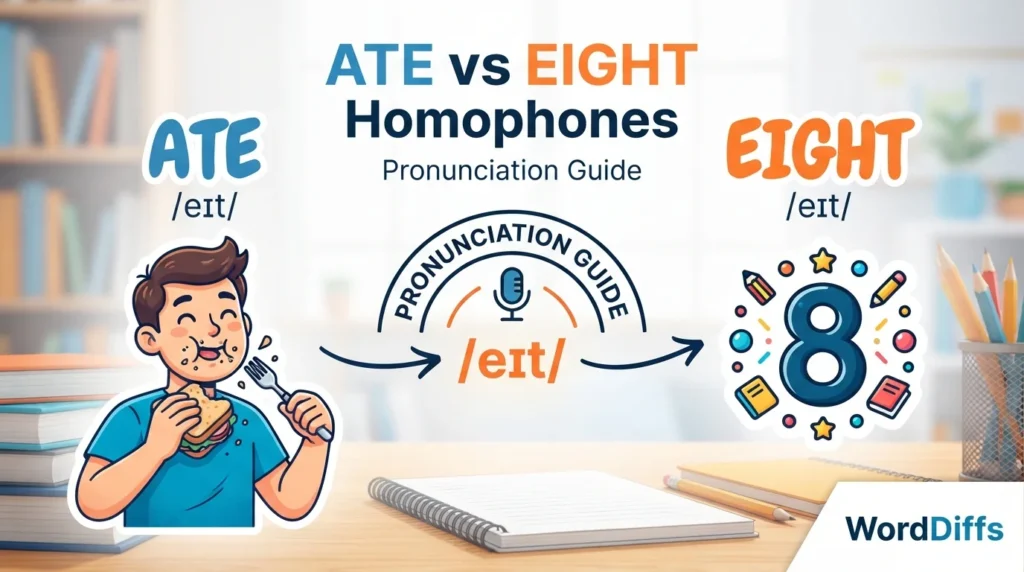
Learning the difference between Ate vs Eight can be confusing because both words are pronounced the same but have completely different meanings and spellings. These words are examples of English homophones, which are words that sound alike but have different definitions, grammar, and uses. Choosing the correct word is important because a simple spelling mistake can change the meaning of a sentence and make your writing unclear.
Pronunciation also plays a major role in spoken English. Since ate and eight sound identical in both British and American English, listeners rely on context to understand which word is being used. This guide explains the pronunciation, meanings, grammar, origins, common uses, collocations, and examples for each word. By the end, you will know exactly when to use ate and when to use eight, helping you write and speak English more accurately and confidently.
Quick Difference Table
| Word | Part of Speech | Meaning | Pronunciation (IPA) | Usage | Example |
| Ate | Verb (past tense of eat) | Consumed food | /eɪt/ | Talking about eating in the past | She ate breakfast early. |
| Eight | Number (cardinal numeral), Noun, Adjective | The number 8 | /eɪt/ | Counting, age, quantity, dates, measurements | There are eight students. |
Ate
Pronunciation
The word ate is pronounced /eɪt/.
Simple pronunciation: Ayt
Audio-style spelling: AYT
Both ate and eight are perfect homophones because they sound exactly the same.
British English (UK): /eɪt/
American English (US): /eɪt/
There is virtually no pronunciation difference between British and American English.
Meaning
Ate is the past tense of the verb eat.
It means someone consumed food or a meal at an earlier time.
It is used whenever you describe something that happened in the past.
Examples of contexts include:
- Meals
- Restaurants
- Family dinners
- School lunches
- Holidays
- Daily conversations
Part of Speech
Ate is a verb.
It functions as the simple past tense of eat.
It describes an action that has already happened.
Example:
They ate dinner together.
Origin
The word ate comes from the Old English verb etan, meaning “to consume food.” Over centuries, the verb evolved into the modern forms:
- Eat (present)
- Ate (past)
- Eaten (past participle)
It has been part of English vocabulary for hundreds of years.
Common Uses
People commonly use ate when talking about:
- Meals
- Food
- Past events
- Dining experiences
- School lunches
- Family gatherings
- Travel stories
- Holidays
- Health discussions
- Everyday conversations
Common Collocations
Some common collocations include:
- ate breakfast
- ate lunch
- ate dinner
- ate quickly
- ate slowly
- ate together
- ate outside
- ate everything
- ate too much
- ate healthy food
- ate dessert
- ate seafood
- ate vegetables
- ate quietly
- ate at home
Example Sentences
- I ate breakfast before leaving home.
- She ate an apple after school.
- We ate dinner at six o’clock.
- They ate together during the holiday.
- My dog ate all the biscuits.
- He ate too quickly and felt sick.
- The children ate fresh fruit at lunch.
- Everyone ate happily after the game.
- Sarah ate homemade soup yesterday.
- I ate my favorite sandwich for lunch.
- They ate seafood during their vacation.
- We ate outside because the weather was pleasant.
- The baby ate slowly with a small spoon.
- He ate every piece of pizza.
- My grandparents ate early every evening.
Eight
Pronunciation
The word eight is pronounced /eɪt/.
Simple pronunciation: Ayt
Audio-style spelling: AYT
It sounds exactly the same as ate.
British English (UK): /eɪt/
American English (US): /eɪt/
There is no meaningful pronunciation difference between the two major accents.
Meaning
Eight is the number that comes after seven and before nine.
It can describe:
- Quantity
- Position
- Age
- Time
- Measurements
- Scores
- Dates
It is one of the basic numbers learned early in English.
Part of Speech
Most commonly, eight functions as a cardinal numeral.
It may also act as:
- A noun
- An adjective
- Part of numerical expressions
Examples:
- Eight books
- Eight people
- Group of eight
Origin
The word eight comes from the Old English eahta, which traces back to ancient Germanic languages and ultimately to Proto-Indo-European roots referring to the number eight.
Its spelling has changed over centuries, but its pronunciation has remained remarkably stable.
Common Uses
People use eight in situations involving:
- Counting
- Mathematics
- Ages
- Time
- Sports scores
- Phone numbers
- Dates
- Measurements
- Addresses
- Quantities
Common Collocations
Common combinations include:
- eight years
- eight people
- eight days
- eight hours
- eight minutes
- eight dollars
- eight students
- eight floors
- eight o’clock
- eight teams
- eight countries
- eight children
- eight questions
- eight miles
- eight pieces
Example Sentences
- Eight students joined the science club.
- The meeting starts at eight o’clock.
- She has eight colorful balloons.
- There are eight slices of pizza.
- My cousin turned eight last week.
- We waited eight minutes for the bus.
- Eight birds landed in the garden.
- He answered all eight questions correctly.
- The race covered eight miles.
- They spent eight days at the beach.
- She bought eight notebooks for school.
- Our team scored eight goals this season.
- Eight guests attended the dinner party.
- We climbed eight flights of stairs.
- The recipe serves eight people.
Pronunciation Comparison
The words ate and eight are perfect homophones. They are pronounced exactly the same as /eɪt/ in both British and American English.
Because they sound identical, listeners cannot distinguish them based on pronunciation alone. Instead, they depend on the surrounding words and the context of the conversation. For example, in the sentence, “I ate at eight,” the first word is the past tense of eat, while the second refers to the time.
Regional English accents may slightly affect the overall vowel quality or speech rhythm, but these changes usually apply to both words equally. As a result, the pronunciation remains effectively identical across English-speaking regions.
This similarity is one of the main reasons English learners often confuse the spellings, especially when writing from dictation or listening to spoken English.
Grammar Differences
| Word | Part of Speech | Meaning | Function | Sentence Position | Verb Forms (If Applicable) | Plural Forms (If Applicable) |
| Ate | Verb | Consumed food in the past | Main verb | Usually follows the subject | Eat, Ate, Eaten, Eating | Not applicable |
| Eight | Cardinal numeral, Noun, Adjective | The number 8 | Shows quantity, order, or amount | Before nouns or used independently | Not applicable | Not applicable |
Side-by-Side Examples
| Ate | Eight |
| I ate breakfast before work. | There are eight apples in the basket. |
| She ate the last cookie. | My son is eight years old. |
| They ate dinner together. | We invited eight friends to the party. |
| He ate too much at lunch. | The meeting begins at eight o’clock. |
| We ate outside because the weather was nice. | The recipe serves eight people. |
| The baby ate mashed potatoes. | She bought eight pencils. |
| I ate a healthy salad yesterday. | Our class has eight new students. |
| They ate seafood during their vacation. | The race lasted eight hours. |
| My dog ate my sandwich. | There are eight chairs around the table. |
| Everyone ate quietly during the movie. | He answered eight questions correctly. |
| She ate dinner before leaving. | The hotel has eight floors. |
| We ate homemade soup. | The bus arrives in eight minutes. |
| He ate slowly after surgery. | She collected eight stamps today. |
| They ate fresh fruit for dessert. | The package weighs eight pounds. |
| I ate with my grandparents. | The concert starts at eight tonight. |
| The children ate sandwiches after school. | We spent eight days on vacation. |
| She ate every vegetable on her plate. | There are eight planets in the Solar System. |
| We ate at a small café downtown. | The spider has eight legs. |
| He ate lunch before the meeting. | The company hired eight interns. |
| They ate ice cream after dinner. | Divide the cake into eight equal pieces. |
Homophones Comparison Table
| Word | Pronunciation | Meaning | Part of Speech | Usage | Example |
| Ate | /eɪt/ | Past tense of eat | Verb | Describes eating in the past | She ate lunch early. |
| Eight | /eɪt/ | The number 8 | Cardinal numeral, noun, adjective | Counting and quantities | Eight students arrived. |
Memory Tricks
Remembering Ate
- Ate comes from eat.
- Both words begin with ea.
- If food is involved, choose ate.
- Think: Eat → Ate → Eaten.
Remembering Eight
- Eight contains the letters igh.
- The spelling is unique because it represents a number.
- Picture the numeral 8 whenever you see eight.
- If you’re counting people, objects, or time, use eight.
Visual Memory Trick
- 🍎 Ate = eating food.
- 8 = Eight = number.
Practical Learning Method
Practice with pairs such as:
- I ate at eight.
- She ate breakfast at eight o’clock.
These sentences help connect pronunciation with meaning.
Common Mistakes
| Incorrect Sentence | Correct Sentence | Explanation |
| I eight lunch. | I ate lunch. | Use ate for eating. |
| She eight an apple. | She ate an apple. | Eight is a number. |
| We eight dinner together. | We ate dinner together. | Wrong word choice. |
| There are ate books. | There are eight books. | Use eight for quantity. |
| He has ate brothers. | He has eight brothers. | Numbers require eight. |
| I woke up at ate. | I woke up at eight. | Refers to time. |
| The class has ate students. | The class has eight students. | Quantity uses eight. |
| They eight breakfast. | They ate breakfast. | Past tense of eat. |
| We invited ate guests. | We invited eight guests. | Number required. |
| She eight all the cake. | She ate all the cake. | Eating action needs ate. |
| He arrived at ate o’clock. | He arrived at eight o’clock. | Clock times use eight. |
| I eight too much yesterday. | I ate too much yesterday. | Past tense verb. |
| The recipe serves ate people. | The recipe serves eight people. | Number required. |
| They have ate children. | They have eight children. | Use the numeral word. |
| She eight pizza last night. | She ate pizza last night. | Correct past tense verb. |
Fill in the Blank Quiz
- I ______ breakfast before school.
- There are ______ players on the team.
- She ______ an orange yesterday.
- We arrived at ______ o’clock.
- They ______ dinner together.
- The classroom has ______ windows.
- He ______ all his vegetables.
- My sister is ______ years old.
- We ______ lunch at noon.
- The spider has ______ legs.
- She ______ too quickly.
- There were ______ questions on the test.
- I ______ a sandwich yesterday.
- We stayed for ______ days.
- The baby ______ some cereal.
- He bought ______ notebooks.
- They ______ at a local restaurant.
- Divide the pizza into ______ slices.
- She ______ breakfast with her family.
- The bus comes at ______.
Answer Key
- ate
- eight
- ate
- eight
- ate
- eight
- ate
- eight
- ate
- eight
- ate
- eight
- ate
- eight
- ate
- eight
- ate
- eight
- ate
- eight
Choose the Correct Word Quiz
1. I ____ lunch at school yesterday.
A. ate ✅
B. eight
C. eat
D. eaten
Answer: A
Explanation: The sentence requires the past tense of eat.
2. There are ____ chairs in the room.
A. ate
B. eight ✅
C. eat
D. eighth
Answer: B
Explanation: The sentence refers to a quantity.
3. She ____ dinner early.
A. ate ✅
B. eight
C. eat
D. eating
Answer: A
Explanation: Past action.
4. The meeting starts at ____ o’clock.
A. ate
B. eight ✅
C. eat
D. eaten
Answer: B
Explanation: Clock time uses the number.
5. He ____ an apple.
A. ate ✅
B. eight
C. eat
D. eats
Answer: A
Explanation: Past tense verb.
6. We invited ____ guests.
A. ate
B. eight ✅
C. eat
D. eighth
Answer: B
Explanation: Refers to quantity.
7. They ____ breakfast together.
A. ate ✅
B. eight
C. eating
D. eats
Answer: A
Explanation: Past tense of eat.
8. She is ____ years old.
A. ate
B. eight ✅
C. eat
D. eighth
Answer: B
Explanation: Indicates age.
9. I ____ too much cake.
A. ate ✅
B. eight
C. eat
D. eating
Answer: A
Explanation: Describes a completed action.
10. There are ____ pages left.
A. ate
B. eight ✅
C. eat
D. eighth
Answer: B
Explanation: A number is needed.
11. The children ____ ice cream.
A. ate ✅
B. eight
C. eated
D. eating
Answer: A
Explanation: Correct past tense.
12. We stayed for ____ days.
A. ate
B. eight ✅
C. eat
D. eighth
Answer: B
Explanation: Indicates duration.
13. My dog ____ my homework.
A. ate ✅
B. eight
C. eating
D. eat
Answer: A
Explanation: Past action.
14. She bought ____ flowers.
A. ate
B. eight ✅
C. eat
D. eighth
Answer: B
Explanation: Refers to quantity.
15. They ____ at the restaurant yesterday.
A. ate ✅
B. eight
C. eat
D. eats
Answer: A
Explanation: Past tense verb.
Common Expressions
Ate
Common Phrases
- ate breakfast
- ate lunch
- ate dinner
- ate too much
- ate out
- ate well
- ate everything
- ate quickly
Examples
- We ate out on Friday night.
- She ate well after recovering from illness.
- They ate breakfast before sunrise.
- He ate everything on his plate.
Eight
Common Phrases
- eight o’clock
- eight years old
- group of eight
- eight times
- eight hours
- eight days
- eight pieces
- eight members
Examples
- The train leaves at eight o’clock.
- My nephew is eight years old.
- We worked for eight hours.
- Cut the pie into eight pieces.
Frequently Asked Questions
What is the difference between ate and eight?
Ate is the past tense of the verb eat, while eight is the number 8. Although they sound identical, they have different meanings, spellings, and grammatical functions. Context determines which word is correct.
Are ate and eight pronounced the same?
Yes. Both are pronounced /eɪt/ in British and American English. They are perfect homophones, meaning their pronunciation is identical even though their meanings differ.
Why do people confuse these homophones?
People confuse them because English spelling does not always match pronunciation. Since both words sound exactly alike, learners often choose the wrong spelling when writing from dictation or memory.
Is ate a regular verb?
No. Eat is an irregular verb. Its forms are eat, ate, and eaten, so the past tense does not follow the regular -ed pattern.
Can eight be used as an adjective?
Yes. It often functions as an adjective before nouns, such as eight books, eight students, or eight cars, where it describes quantity.
How can I remember the difference?
Associate ate with food because it comes from eat. Associate eight with the numeral 8 and counting. Creating sentences like “I ate dinner at eight” helps reinforce the distinction.
Is eight ever a noun?
Yes. It can act as a noun when referring to the numeral itself, as in “Write an eight on the board.”
Can ate describe future actions?
No. Ate always refers to a completed action in the past. For present or future events, use eat or will eat.
Are there regional pronunciation differences?
Only minor accent differences exist. Both British and American speakers pronounce ate and eight the same, making them perfect homophones across most English dialects.
Why is context important?
Since pronunciation cannot distinguish these words, surrounding words reveal the intended meaning. Food-related contexts require ate, while numbers, counting, and time require eight.
Tips to Remember the Difference
- Read short passages containing both words.
- Write ten original sentences using ate.
- Write ten original sentences using eight.
- Read your sentences aloud to connect pronunciation with spelling.
- Practice dictation exercises with homophones.
- Learn irregular verb forms: eat, ate, eaten.
- Review common number vocabulary.
- Label pictures with the correct word.
- Create flashcards for each homophone.
- Use the sentence “I ate dinner at eight.” as a daily memory exercise.
Summary
Understanding the difference between Ate vs Eight is essential because these words are perfect homophones that sound identical but have completely different meanings and grammatical roles. Ate is the past tense of the irregular verb eat and describes the completed action of consuming food. Eight is the cardinal number 8 and is used for counting, measurements, time, ages, and quantities.
Although both words are pronounced /eɪt/ in British and American English, context makes their meanings clear. Learning their parts of speech, common collocations, and typical sentence patterns helps you choose the correct spelling with confidence. Simple memory techniques, such as linking ate with food and eight with the numeral 8, make them easier to remember.
Regular reading, writing, pronunciation practice, and completing quizzes will strengthen your understanding of these homophones. With consistent practice, you will quickly recognize when to use ate and eight, improving both your written and spoken English.

Caitlin Boylan is an experienced content writer, editor, educator, travel writer, and remote worker with more than 10 years of experience in English education and international communication. She is the founder and author of The Country Jumper, a travel blog dedicated to supporting solo travelers, especially women exploring life abroad. She is also the co-founder of Macro Magazine, a global online publication that shares diverse perspectives on worldwide topics that impact communities.