
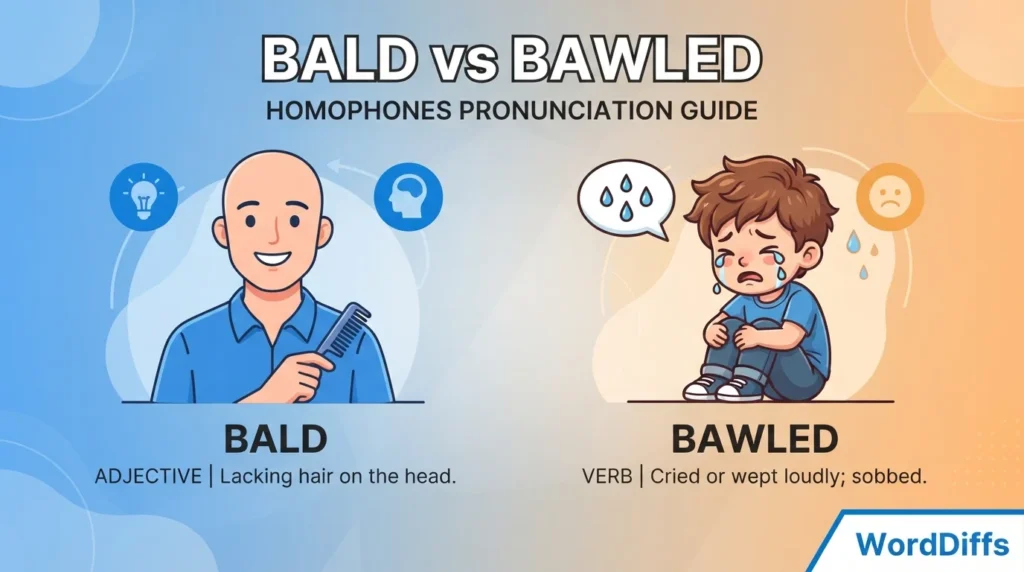
English homophones can be confusing because two or more words may sound exactly alike while having completely different meanings and spellings. Bald and Bawled are a perfect example. Although they are pronounced the same in most English accents, they belong to different parts of speech and are used in entirely different situations. Choosing the wrong spelling can change the meaning of your sentence and create confusion for readers.
Learning the difference between these words improves your vocabulary, spelling, grammar, and overall communication skills. It also helps you write more accurately in school, at work, and in everyday conversations. In this guide, you will learn the pronunciation, meanings, grammar, origins, common uses, collocations, and plenty of real-life examples of Bald and Bawled. By the end, you will be able to recognize these homophones instantly and use each one confidently in both spoken and written English.
Quick Difference Table
| Word | Part of Speech | Meaning | Pronunciation (IPA) | Usage | Example |
| Bald | Adjective | Having little or no hair on the head | /bɔːld/ (UK), /bɔld/ (US) | Describing people, animals, or places without hair or covering | My grandfather is bald. |
| Bawled | Verb (Past Tense of bawl) | Cried loudly or shouted loudly | /bɔːld/ (UK), /bɔld/ (US) | Talking about loud crying or shouting in the past | The child bawled after falling. |
Bald
Pronunciation
IPA
- British English: /bɔːld/
- American English: /bɔld/
Simple pronunciation
Bald sounds like “bawld.”
Audio-style spelling
BAWLD
Does it sound the same as Bawled?
Yes. In standard British and American English, Bald and Bawled are perfect homophones and are pronounced the same.
British pronunciation
The vowel is slightly longer: /bɔːld/.
American pronunciation
The vowel is generally shorter: /bɔld/.
Meaning
Bald describes someone or something with little or no hair. It is most commonly used to describe a person’s head but may also describe animals, hills, tires, or areas without their usual covering.
In everyday English, people often use bald when talking about appearance, aging, or physical characteristics.
Examples of contexts include:
- Hair loss
- Physical descriptions
- Wildlife
- Landscapes
- Tires with worn tread
Part of Speech
Bald is primarily an adjective.
It modifies nouns by describing their appearance or condition.
Examples:
- a bald man
- a bald eagle
- bald tires
Occasionally, it appears in expressions such as bald statement, where it means plain or lacking detail.
Origin
The word bald comes from Old English balde, meaning “white patch” or “without hair.” Over centuries, its meaning broadened to describe anything lacking its usual covering, including heads, animals, landscapes, and objects.
Today, it is widely used in both literal and figurative contexts.
Common Uses
Everyday usage:
- describing hair loss
- describing appearance
- talking about aging
Formal usage:
- medical discussions
- biological descriptions
- technical reports
Informal usage:
- casual conversations
- humorous descriptions
- friendly observations
Academic usage:
- biology
- zoology
- health sciences
- literature
Common Collocations
- bald head
- completely bald
- go bald
- becoming bald
- bald man
- bald woman
- bald eagle
- bald spot
- bald patch
- bald tires
- bald hill
- bald statement
- naturally bald
- nearly bald
- visibly bald
Example Sentences
- My uncle became bald in his thirties.
- The bald man smiled warmly.
- She noticed a small bald spot on her dog’s fur.
- His father is completely bald.
- The mechanic warned that the tires were bald.
- A bald eagle flew above the river.
- The hill looked bald after the trees were removed.
- He joked about going bald someday.
- The baby was almost bald at birth.
- She admired the bald eagle’s sharp eyesight.
- His bald head reflected the sunlight.
- The old carpet had bald patches.
- The actor wore makeup to appear bald.
- The doctor explained that stress can sometimes cause bald patches.
- Their hiking trail crossed a bald mountain ridge.
Bawled
Pronunciation
IPA
- British English: /bɔːld/
- American English: /bɔld/
Simple pronunciation
Bawled sounds like “bawld.”
Audio-style spelling
BAWLD
Does it sound the same as Bald?
Yes. Bawled and Bald are pronounced identically in standard English.
British pronunciation
/bɔːld/
American pronunciation
/bɔld/
Meaning
Bawled is the past tense and past participle of bawl.
It means:
- cried loudly
- shouted loudly
- yelled with great force
The meaning depends on the context.
Examples:
- The baby bawled for hours.
- The coach bawled instructions across the field.
Part of Speech
Bawled is a verb.
It functions as:
- simple past tense
- past participle
Examples:
- She bawled after hearing the news.
- He has bawled loudly before.
Origin
Bawl entered English during the late Middle English period. It likely developed from Scandinavian or Germanic roots meaning “to shout loudly.”
Over time, the word came to describe both loud crying and loud shouting.
Common Uses
Everyday usage:
- babies crying
- children crying
- emotional situations
Formal usage:
- storytelling
- journalism
- novels
Informal usage:
- conversations
- family discussions
Academic usage:
- literature analysis
- language studies
- narrative writing
Common Collocations
- bawled loudly
- bawled uncontrollably
- bawled all night
- bawled with pain
- bawled with laughter
- bawled for help
- bawled at the children
- bawled instructions
- bawled angrily
- bawled into the phone
- bawled his eyes out
- bawled in frustration
- bawled across the room
- bawled after falling
- bawled for attention
Example Sentences
- The baby bawled throughout the night.
- She bawled after losing her favorite toy.
- The coach bawled instructions from the sidelines.
- He bawled in pain after the accident.
- The toddler bawled until his mother arrived.
- The manager bawled at the careless employee.
- They bawled with excitement after winning.
- She bawled into the telephone.
- The child bawled for help.
- He bawled across the crowded street.
- The audience bawled with laughter during the comedy show.
- She bawled because she missed her family.
- The frightened boy bawled uncontrollably.
- His little sister bawled when her balloon burst.
- The actor bawled dramatically during the emotional scene.
Pronunciation Comparison
Are these words perfect homophones?
Yes. Bald and Bawled are considered perfect homophones in standard English because they share the same pronunciation while having different spellings and meanings.
Do they sound identical?
Yes. Most native speakers pronounce both words exactly the same.
British English
- Bald: /bɔːld/
- Bawled: /bɔːld/
The vowel sound is long, and both words are indistinguishable in speech without context.
American English
- Bald: /bɔld/
- Bawled: /bɔld/
Again, they are pronounced identically.
Regional variations
Some regional accents may slightly alter the vowel quality, but both words remain homophones within the same accent.
Why learners confuse these words
Learners often confuse Bald and Bawled because:
- They sound exactly alike.
- Their spellings are very different.
- One is an adjective, while the other is a verb.
- Context is the only reliable clue in spoken English.
Grammar Differences
| Word | Part of Speech | Meaning | Function | Sentence Position | Verb Forms (If Applicable) | Plural Forms (If Applicable) |
| Bald | Adjective | Having little or no hair, or lacking a natural covering | Describes nouns | Before a noun or after a linking verb | Not applicable | Not applicable |
| Bawled | Verb (Past Tense and Past Participle) | Cried or shouted loudly | Expresses an action completed in the past | Usually follows the subject as the main verb or appears with auxiliary verbs | Base: bawl, Present: bawl/bawls, Present Participle: bawling, Past: bawled, Past Participle: bawled |
Side-by-Side Examples
The following examples compare Bald and Bawled in similar contexts so you can clearly see the difference.
| Bald | Bawled |
| The old man is bald. | The little boy bawled after falling down. |
| My grandfather became bald years ago. | She bawled when she heard the sad news. |
| His bald head shone in the sunlight. | The coach bawled across the field. |
| The eagle is famous for its bald white head. | The baby bawled until someone picked him up. |
| The doctor noticed a bald patch on the patient’s scalp. | The teacher bawled at the noisy class. |
| Their dog developed a bald spot on its back. | He bawled in frustration after losing the game. |
| My father isn’t completely bald yet. | She bawled into her pillow all night. |
| Those tires are bald and unsafe. | The child bawled for his mother. |
| The actor wore a bald cap during filming. | They bawled with laughter at the comedian’s joke. |
| The mountain looked bald after the wildfire. | The manager bawled instructions to the workers. |
| A bald eagle landed near the river. | He bawled for help when he got lost. |
| His bald appearance suited the character. | The toddler bawled because he was tired. |
| She gently rubbed his bald head. | The fans bawled their team’s name. |
| The cat has a bald patch near its ear. | The child bawled loudly during the vaccination. |
| Going bald is common with age. | She bawled after reading the emotional letter. |
| His bald scalp required sunscreen. | The singer bawled at the audience to join in. |
| The bald tree stood alone in winter. | He bawled from the opposite side of the street. |
| The barber shaved his head completely bald. | The frightened girl bawled for her parents. |
| A bald hill stretched across the horizon. | They bawled with excitement after the announcement. |
| He accepted becoming bald with confidence. | She bawled until her friend comforted her. |
Homophones Comparison Table
| Word | Pronunciation | Meaning | Part of Speech | Usage | Example |
| Bald | /bɔːld/ (UK), /bɔld/ (US) | Having little or no hair, or lacking a covering | Adjective | Describing appearance, animals, objects, or landscapes | He is completely bald. |
| Bawled | /bɔːld/ (UK), /bɔld/ (US) | Cried loudly or shouted loudly | Verb | Describing loud crying or shouting in the past | The child bawled after falling. |
Memory Tricks
Remembering Bald
- Think of a bald head with no hair.
- The word bald always describes someone’s appearance.
- If you can replace the word with hairless, bald is probably correct.
- Picture a shiny head to help remember the spelling.
Remembering Bawled
- Bawled comes from bawl, which means to cry or shout loudly.
- Notice that bawled contains awl, reminding you of a loud call.
- If someone is making a loud noise, they probably bawled.
- Associate bawled with tears, shouting, or yelling.
Visual Memory Trick
- Bald = Bare head
- Bawled = Big cry
Practical Learning Method
Create two lists:
Bald
- head
- hair
- eagle
- patch
- tires
Bawled
- cried
- shouted
- yelled
- sobbed
- screamed
Grouping related words strengthens memory.
Common Mistakes
| Incorrect Sentence | Correct Sentence | Explanation |
| He bawled because he has no hair. | He is bald because he has no hair. | Hair loss requires bald. |
| My uncle is bawled. | My uncle is bald. | Bawled is a verb, not an adjective. |
| The baby was bald all night. | The baby bawled all night. | Crying uses bawled. |
| She bald loudly. | She bawled loudly. | Loud crying requires the verb bawled. |
| His bawled head looked shiny. | His bald head looked shiny. | Appearance uses bald. |
| The teacher bald at us. | The teacher bawled at us. | Shouting uses bawled. |
| My tires are bawled. | My tires are bald. | Worn tires are bald. |
| The child became bald after losing the toy. | The child bawled after losing the toy. | Emotional crying uses bawled. |
| The eagle is bawled. | The eagle is bald. | The bird’s name includes bald. |
| He bawled patches appeared on his scalp. | Bald patches appeared on his scalp. | Hairless areas are bald patches. |
| They bald across the room. | They bawled across the room. | Loud shouting uses bawled. |
| She became bawled with age. | She became bald with age. | Hair loss uses bald. |
| The coach was bald instructions. | The coach bawled instructions. | Giving loud instructions uses bawled. |
| My grandfather has bawled hair. | My grandfather is bald. | Bawled cannot describe hair. |
| He bald when he hurt himself. | He bawled when he hurt himself. | Loud crying requires bawled. |
Fill in the Blank Quiz
Choose Bald or Bawled.
- My grandfather is completely ________.
- The baby ________ for nearly an hour.
- The mechanic said the tires were ________.
- She ________ after hearing the sad news.
- A ________ eagle flew overhead.
- The toddler ________ loudly in the store.
- His ________ head reflected the light.
- The coach ________ instructions during practice.
- Going ________ is common for some people.
- The little girl ________ because she was scared.
- The cat has a ________ patch behind its ear.
- He ________ across the playground.
- The actor wore a ________ cap.
- The child ________ after dropping the ice cream.
- Those old tires are almost ________.
- She ________ for help.
- The mountain looked ________ without trees.
- He ________ with frustration.
- My father started becoming ________ in his forties.
- The frightened puppy ________ all night.
Answer Key
- Bald
- Bawled
- Bald
- Bawled
- Bald
- Bawled
- Bald
- Bawled
- Bald
- Bawled
- Bald
- Bawled
- Bald
- Bawled
- Bald
- Bawled
- Bald
- Bawled
- Bald
- Bawled
Choose the Correct Word Quiz
1. My uncle is completely _____.
A. Bawled
B. Bald
C. Bawling
D. Bawl
Answer: B. Bald
Explanation: It describes appearance.
2. The baby _____ after waking up.
A. Bald
B. Bawl
C. Bawled
D. Balded
Answer: C. Bawled
Explanation: It describes a past action.
3. The mechanic warned that the tires were _____.
A. Bald
B. Bawled
C. Bawl
D. Bawling
Answer: A. Bald
Explanation: Tires become bald when worn.
4. She _____ in pain.
A. Bald
B. Bawled
C. Balding
D. Balded
Answer: B. Bawled
Explanation: Crying loudly is bawled.
5. A _____ eagle landed nearby.
A. Bawled
B. Bald
C. Bawl
D. Bawling
Answer: B. Bald
Explanation: The species is called the bald eagle.
6. The child _____ all afternoon.
A. Bald
B. Bawled
C. Balded
D. Balding
Answer: B. Bawled
Explanation: It refers to loud crying.
7. His _____ head needed sunscreen.
A. Bawled
B. Bald
C. Bawl
D. Bawling
Answer: B. Bald
Explanation: It describes a hairless head.
8. The manager _____ at everyone.
A. Bald
B. Bawled
C. Balded
D. Balding
Answer: B. Bawled
Explanation: The verb means shouted loudly.
9. The dog developed a _____ spot.
A. Bald
B. Bawled
C. Bawl
D. Bawling
Answer: A. Bald
Explanation: A hairless area is a bald spot.
10. He _____ for help.
A. Bald
B. Bawled
C. Balding
D. Balded
Answer: B. Bawled
Explanation: He shouted loudly.
11. She noticed he was becoming _____.
A. Bawled
B. Bald
C. Bawl
D. Bawling
Answer: B. Bald
Explanation: It refers to hair loss.
12. The frightened child _____ loudly.
A. Bald
B. Bawled
C. Balded
D. Balding
Answer: B. Bawled
Explanation: It means cried loudly.
13. Those _____ tires should be replaced.
A. Bawled
B. Bald
C. Bawl
D. Bawling
Answer: B. Bald
14. He _____ with excitement.
A. Bald
B. Bawled
C. Balded
D. Balding
Answer: B. Bawled
15. The old man remained _____ throughout his life.
A. Bawled
B. Bald
C. Bawl
D. Bawling
Answer: B. Bald
Explanation: It describes appearance.
Common Expressions
Bald
Idioms and Fixed Expressions
Go bald
Meaning: Lose hair.
Example: He started to go bald in his early thirties.
Bald-headed
Meaning: Having no hair.
Example: The bald-headed man greeted everyone warmly.
Bald eagle
Meaning: A large bird of prey native to North America.
Example: We spotted a bald eagle near the lake.
Bald statement
Meaning: A statement made without explanation or supporting details.
Example: The report ended with a bald statement of the facts.
Bawled
Idioms and Fixed Expressions
Bawl one’s eyes out
Meaning: Cry very loudly.
Example: She bawled her eyes out after losing her pet.
Bawl for help
Meaning: Shout loudly for assistance.
Example: The hiker bawled for help when he became trapped.
Bawl at someone
Meaning: Shout angrily at someone.
Example: The coach bawled at the players after the mistake.
Bawl out
Meaning: Scold someone loudly.
Example: The manager bawled out the employee for arriving late.
Frequently Asked Questions
What is the difference between Bald and Bawled?
Bald is an adjective that describes someone or something with little or no hair or natural covering. Bawled is the past tense of bawl, meaning to cry or shout loudly. Although they sound identical, they have completely different meanings and grammatical functions.
Are Bald and Bawled pronounced the same?
Yes. In standard British and American English, both words are pronounced the same, making them perfect homophones. The intended meaning is understood through context rather than pronunciation.
Why do people confuse these homophones?
People confuse them because they have identical pronunciation but different spellings, meanings, and grammatical roles. In speech, listeners rely on context to understand which word is intended.
How can I remember the difference?
Think of bald as relating to a bare head without hair. Remember that bawled comes from bawl, meaning to cry or shout loudly. Associating each word with a clear mental image makes them easier to distinguish.
Is Bald always an adjective?
Almost always. It primarily functions as an adjective describing people, animals, objects, or places that lack hair or another natural covering.
Is Bawled always a verb?
Yes. Bawled is the past tense and past participle of bawl, so it always functions as a verb.
Can Bald describe things besides people?
Yes. It can describe animals, mountains, hills, tires, carpets, and other objects that lack their usual covering.
Can Bawled mean shouted as well as cried?
Yes. Depending on the context, bawled can describe both loud crying and loud shouting.
Which word appears more often in everyday English?
Bald is common when discussing appearance, while bawled often appears in stories, conversations, and descriptions of emotional situations.
Are there other homophones like Bald and Bawled?
Yes. English contains many homophone pairs such as Bear/Bare, Sale/Sail, Pair/Pear, and Hear/Here. Learning them through context is the most effective approach.
Tips to Remember the Difference
- Read sentences containing both words every day.
- Practice spelling each word from memory.
- Say the words aloud while thinking about their meanings.
- Create your own example sentences.
- Learn common collocations instead of isolated words.
- Keep a notebook of frequently confused homophones.
- Read books and articles to see both words in context.
- Ask yourself whether the sentence describes appearance or crying/shouting before choosing the correct spelling.
Summary
Bald and Bawled are classic English homophones because they share the same pronunciation while having entirely different meanings and grammatical roles. Bald is an adjective that describes someone or something without hair or a natural covering, whereas Bawled is the past tense of bawl, meaning to cry or shout loudly. Although they sound identical in both British and American English, context makes their meanings clear. Understanding their pronunciation, origins, grammar, common collocations, and real-world examples helps learners avoid spelling mistakes and communicate more accurately. Memory techniques such as linking bald with a bare head and bawled with loud crying make the distinction easier to remember. Regular reading, writing, speaking, and completing practice exercises will strengthen your confidence. Once you understand the role each word plays in a sentence, choosing between Bald and Bawled becomes natural, improving both your written and spoken English.

Carter is an English language specialist, author, and senior editor with more than 20 years of experience in English grammar, writing, editing, and language education. Throughout his career, he has worked with educational organizations, digital publishers, and content teams to develop accurate, engaging, and learner-focused resources. His expertise includes English grammar, spelling, vocabulary, commonly confused words, proofreading, copy editing, academic writing, and SEO content strategy. Carter is passionate about helping learners and writers improve their communication skills through clear explanations, practical examples, and high-quality educational content.