
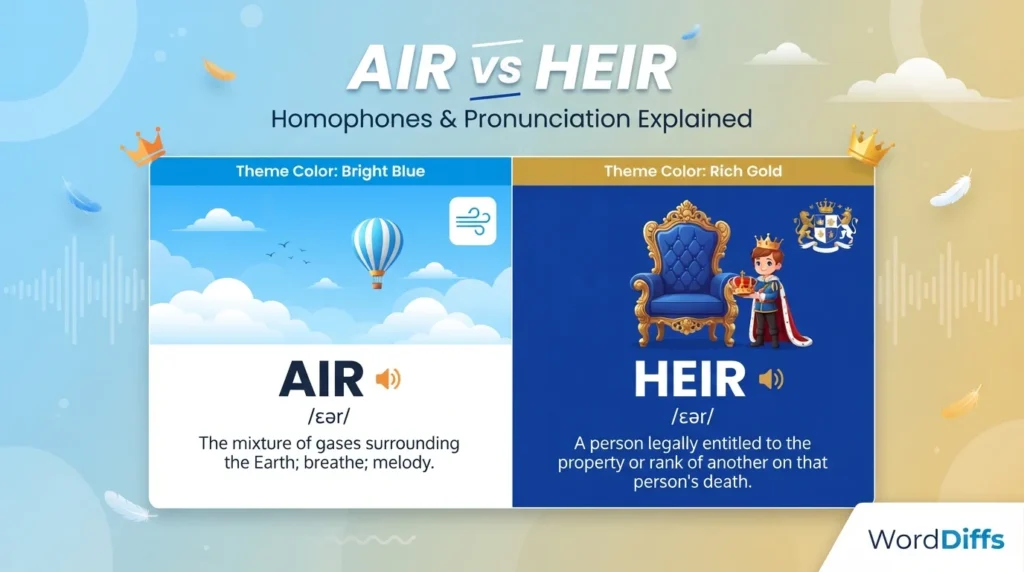
English is full of words that sound exactly alike but have different meanings and spellings. These words are called homophones, and they often confuse learners because pronunciation alone does not reveal which word is correct. Air and heir are excellent examples. Although they share the same pronunciation in most varieties of English, they belong to different parts of speech and are used in completely different contexts.
Choosing the correct spelling is important for clear communication. Writing air when you mean heir, or vice versa, can change the meaning of an entire sentence. Understanding pronunciation, grammar, and context helps you avoid these mistakes with confidence.
In this guide, you will learn the pronunciation, meanings, grammar, origins, common uses, collocations, and examples of air and heir. You will also discover practical memory tricks, comparison tables, quizzes, and tips to help you remember the difference and use both words correctly in everyday English.
Quick Difference Table
| Word | Part of Speech | Meaning | Pronunciation (IPA) | Usage | Example |
| Air | Noun, Verb | The invisible mixture of gases around us; to broadcast or express | /eə(r)/ (BrE), /er/ (AmE) | Nature, science, broadcasting, travel | Fresh air makes me feel better. |
| Heir | Noun | A person who inherits property, money, or a title | /eə(r)/ (BrE), /er/ (AmE) | Law, family, inheritance | She is the heir to the family estate. |
Air
Pronunciation
IPA
- British English: /eə(r)/
- American English: /er/
Simple pronunciation: air
Audio-style spelling: AIR
Does it sound like “heir”?
Yes. In standard British and American English, air and heir are perfect homophones. They are pronounced the same despite having different spellings and meanings.
Meaning
Air usually refers to the invisible gases surrounding the Earth that people and animals breathe.
It can also refer to:
- Wind or atmosphere
- The space above the ground
- A tune or melody (less common)
- A person’s appearance or manner
- A radio or television broadcast
- To broadcast a program or express an opinion (verb)
In everyday English, it most commonly means the air we breathe.
Part of Speech
As a noun
- Refers to the atmosphere or gases around us.
- Can also describe appearance or broadcasting.
As a verb
- Means to broadcast on television or radio.
- Means to express something publicly.
- Means to allow fresh air into a room.
Origin
The word air comes from the Old French air, which originated from the Latin aer, borrowed from Ancient Greek aēr, meaning “the atmosphere” or “mist.” It entered English during the Middle Ages and gradually developed additional meanings related to broadcasting, music, and appearance.
Common Uses
Everyday uses include:
- Talking about weather
- Discussing breathing
- Talking about pollution
- Opening windows
- Flying
- Television programs
- Radio shows
- Public discussions
- Scientific writing
Formal contexts include:
- Environmental reports
- Aviation
- Meteorology
- Broadcasting
Informal contexts include:
- “Let’s get some fresh air.”
- “The show airs tonight.”
Common Collocations
- fresh air
- clean air
- cool air
- warm air
- hot air
- cold air
- air pollution
- air quality
- air pressure
- air conditioner
- air travel
- air traffic
- air force
- air cargo
- air on television
Example Sentences
- Fresh air helps people feel refreshed.
- We opened the windows to let in some air.
- Birds fly through the air with ease.
- The mountain air felt cool and clean.
- Strong winds filled the air with dust.
- The radio station will air the interview tomorrow.
- She enjoys walking outside to breathe fresh air.
- Warm air rises above cold air.
- The balloon floated high into the air.
- Good air quality improves health.
- The documentary will air next Friday evening.
- The child threw the ball into the air.
- Fresh country air is very relaxing.
- Engineers measured the air pressure carefully.
- He spoke with an air of confidence.
Heir
Pronunciation
IPA
- British English: /eə(r)/
- American English: /er/
Simple pronunciation: air
Audio-style spelling: AIR
Does it sound like “air”?
Yes. The initial h is silent, making heir sound exactly like air.
Meaning
An heir is a person who legally receives money, property, land, titles, or responsibilities after someone dies or according to inheritance laws.
The word can also describe someone expected to succeed another person in an important position.
Part of Speech
Noun
An heir is always a noun.
It names a person who inherits or is expected to inherit something valuable.
Origin
The word heir comes from Old French heir, which developed from the Latin word heres, meaning “one who inherits.” The silent h reflects its historical spelling rather than its pronunciation.
Common Uses
Common situations include:
- Family inheritance
- Royal succession
- Legal documents
- Wills
- Property ownership
- Business succession
- Noble titles
Formal usage:
- Court documents
- Estate planning
- Legal writing
Informal usage:
- Talking about family wealth
- Discussing future ownership
Common Collocations
- legal heir
- sole heir
- rightful heir
- direct heir
- only heir
- named heir
- heir to the throne
- heir to the fortune
- heir to the estate
- royal heir
- wealthy heir
- heir apparent
- family heir
- designated heir
- lawful heir
Example Sentences
- She became the heir to her grandfather’s house.
- The prince is the heir to the throne.
- Every heir received part of the estate.
- The lawyer contacted the rightful heir.
- He was named the sole heir in the will.
- The family’s only heir studied abroad.
- The young woman became the legal heir.
- Everyone knew who the future heir would be.
- The wealthy businessman chose his daughter as his heir.
- The court confirmed the lawful heir.
- An heir may inherit property or money.
- The king introduced his heir to the public.
- She accepted her role as the future heir.
- The estate passed to the oldest heir.
- The document clearly identified the heir.
Pronunciation Comparison
Although air and heir have completely different meanings, they are considered perfect homophones in standard English.
| Feature | Air | Heir |
| British pronunciation | /eə(r)/ | /eə(r)/ |
| American pronunciation | /er/ | /er/ |
| Sounds identical? | Yes | Yes |
| Silent letters | No | Yes, the h is silent |
| Common confusion | Meaning and spelling | Meaning and spelling |
In both British and American English, native speakers pronounce these words the same way. Because listeners cannot distinguish them by sound alone, writers must rely on context and spelling.
Regional accents may slightly change the vowel quality, but both words continue to sound identical within the same accent. This similarity is why English learners frequently confuse them when writing.
Grammar Differences
| Word | Part of Speech | Meaning | Function | Sentence Position | Verb Forms (If Applicable) | Plural Forms (If Applicable) |
| Air | Noun, Verb | Atmosphere, gases, broadcast | Subject, object, verb | Flexible | air, airs, aired, airing | airs (noun) |
| Heir | Noun | Person who inherits | Subject or object | Usually before or after verbs | Not applicable | heirs |
Side-by-Side Examples
| Air | Heir |
| The room needs fresh air. | She is the heir to the estate. |
| Warm air filled the balloon. | The prince is the royal heir. |
| We breathed clean air all day. | The lawyer located the legal heir. |
| The program will air tonight. | He became the sole heir. |
| Cold air entered the house. | The heir inherited valuable land. |
| The kite flew through the air. | The family welcomed the young heir. |
| Good air quality matters. | The heir signed the documents. |
| Birds soared in the air. | Every heir received equal shares. |
| Fresh air improves sleep. | She was the rightful heir. |
| The fans watched the show air live. | The court recognized the lawful heir. |
Homophones Comparison Table
| Word | Pronunciation | Meaning | Part of Speech | Usage | Example |
| Air | /eə(r)/ (BrE), /er/ (AmE) | The invisible gases around the Earth; to broadcast | Noun, Verb | Nature, weather, science, travel, broadcasting | We need fresh air after the long meeting. |
| Heir | /eə(r)/ (BrE), /er/ (AmE) | A person who inherits property, money, or a title | Noun | Family, law, inheritance, royalty | The prince is the heir to the throne. |
Memory Tricks
Remembering the difference between air and heir becomes much easier when you associate each word with its spelling and meaning.
- Air contains the letters AI, which can remind you of the atmosphere around you.
- Think of air whenever you breathe, fly, or talk about the weather.
- Heir begins with a silent H. Many learners remember the H as standing for heritage, home, or inheritance.
- If someone receives money, land, or a family title, the correct word is heir.
- Picture fresh blue skies for air.
- Picture a family tree for heir.
- Create your own sentences using both words every day.
- Read books and news articles to see the words in context.
- Practice spelling while saying the words aloud.
- Remember that pronunciation cannot help you choose between them because they sound exactly alike.
Common Mistakes
| Incorrect Sentence | Correct Sentence | Explanation |
| She is the air to the throne. | She is the heir to the throne. | An inheriting person is an heir. |
| The heir outside is fresh. | The air outside is fresh. | Air refers to the atmosphere. |
| We need clean heir. | We need clean air. | Use air when talking about breathing. |
| The air inherited the house. | The heir inherited the house. | Only a person can inherit property. |
| Open the window for some heir. | Open the window for some air. | Air means the gases around us. |
| The prince breathed fresh heir. | The prince breathed fresh air. | Breathing relates to air. |
| The TV station heired the match. | The TV station aired the match. | The verb is aired. |
| Every air received part of the estate. | Every heir received part of the estate. | Heir is the correct noun. |
| Cold heir entered the room. | Cold air entered the room. | Weather uses air. |
| She became the air of the fortune. | She became the heir to the fortune. | Inheritance uses heir. |
| The company will heir the documentary tonight. | The company will air the documentary tonight. | Broadcasting uses the verb air. |
| Fresh heir improves health. | Fresh air improves health. | Use air for the atmosphere. |
| The lawyer found the rightful air. | The lawyer found the rightful heir. | Legal inheritance requires heir. |
| Warm heir rises quickly. | Warm air rises quickly. | Science uses air. |
| He is the legal air of the estate. | He is the legal heir of the estate. | Heir refers to the inheriting person. |
Common Expressions
Air
Idioms and Fixed Expressions
Fresh air
Example: We went outside for some fresh air after lunch.
Air pollution
Example: Air pollution affects millions of people worldwide.
Air quality
Example: The city monitors air quality every day.
Air travel
Example: Air travel has become more affordable.
Air traffic
Example: Heavy air traffic delayed several flights.
Air your opinion
Example: Everyone had a chance to air their opinion.
Air your grievances
Example: Employees aired their grievances during the meeting.
Heir
Idioms and Fixed Expressions
Heir to the throne
Example: The prince is the heir to the throne.
Heir to the fortune
Example: She became the heir to a large fortune.
Heir apparent
Example: Everyone considered him the heir apparent.
Legal heir
Example: The court recognized the legal heir.
Rightful heir
Example: The rightful heir received the estate.
Frequently Asked Questions
What is the difference between air and heir?
Air refers to the invisible gases around us or the act of broadcasting something. Heir refers to a person who inherits property, money, titles, or responsibilities. Although both words sound identical, they have completely different meanings, spellings, and grammatical functions.
Are air and heir pronounced the same?
Yes. In standard British and American English, air and heir are pronounced exactly the same. They are perfect homophones. The only difference is their spelling and meaning. The H in heir is silent.
Why do learners confuse these homophones?
People often confuse them because English pronunciation does not always match spelling. Since air and heir sound identical, learners must rely on context and meaning to choose the correct word in writing.
Is air a noun or a verb?
Air can function as both a noun and a verb. As a noun, it refers to the atmosphere. As a verb, it means to broadcast a program, express an opinion publicly, or allow fresh air into a room.
Is heir always a noun?
Yes. Heir is always a noun. It names a person who legally inherits or is expected to inherit money, property, titles, or responsibilities.
What does “heir apparent” mean?
An heir apparent is someone who has an unquestionable legal right to inherit a title or position and whose claim cannot normally be displaced by another person’s birth.
Can air mean more than the atmosphere?
Yes. Besides the atmosphere, air can refer to a television or radio broadcast, a person’s appearance or manner, or the act of expressing an opinion publicly.
How can I remember the difference?
Associate air with breathing, flying, and weather. Associate heir with inheritance, family, wealth, and royalty. Visual memory and repeated practice make the distinction easier.
Are these words interchangeable?
No. Although they sound the same, they are never interchangeable because their meanings are completely different. Choosing the wrong spelling changes the meaning of the sentence.
Which word is more common?
Air is much more common in everyday English because people frequently discuss weather, breathing, travel, and broadcasting. Heir appears less often and is mainly used in legal, family, and historical contexts.
Tips to Remember the Difference
- Read books and articles containing both words.
- Practice writing sentences using each word correctly.
- Say both words aloud while focusing on their meanings.
- Learn common collocations such as fresh air and legal heir.
- Create flashcards with definitions and example sentences.
- Read inheritance-related texts to reinforce heir.
- Read science or weather articles to reinforce air.
- Keep a vocabulary notebook for confusing homophones.
- Review your writing for homophone mistakes.
- Test yourself regularly with quizzes and sentence creation exercises.
Summary
Understanding the difference between air and heir is essential for accurate English communication. Although these two words are perfect homophones and share the same pronunciation in both British and American English, they have entirely different meanings and grammatical uses. Air usually refers to the atmosphere, weather, breathing, or broadcasting, and it can function as both a noun and a verb. Heir, on the other hand, is always a noun that refers to a person who inherits money, property, titles, or responsibilities.
The easiest way to avoid confusion is to focus on context rather than pronunciation. If the sentence is about breathing, flying, weather, or television, air is almost always correct. If it concerns inheritance, family wealth, legal succession, or royalty, heir is the appropriate choice. Regular reading, writing, pronunciation practice, and memory techniques such as associating air with the atmosphere and heir with heritage will help you master these homophones. With consistent practice, choosing the correct spelling will soon become natural.

Caitlin Boylan is an experienced content writer, editor, educator, travel writer, and remote worker with more than 10 years of experience in English education and international communication. She is the founder and author of The Country Jumper, a travel blog dedicated to supporting solo travelers, especially women exploring life abroad. She is also the co-founder of Macro Magazine, a global online publication that shares diverse perspectives on worldwide topics that impact communities.