
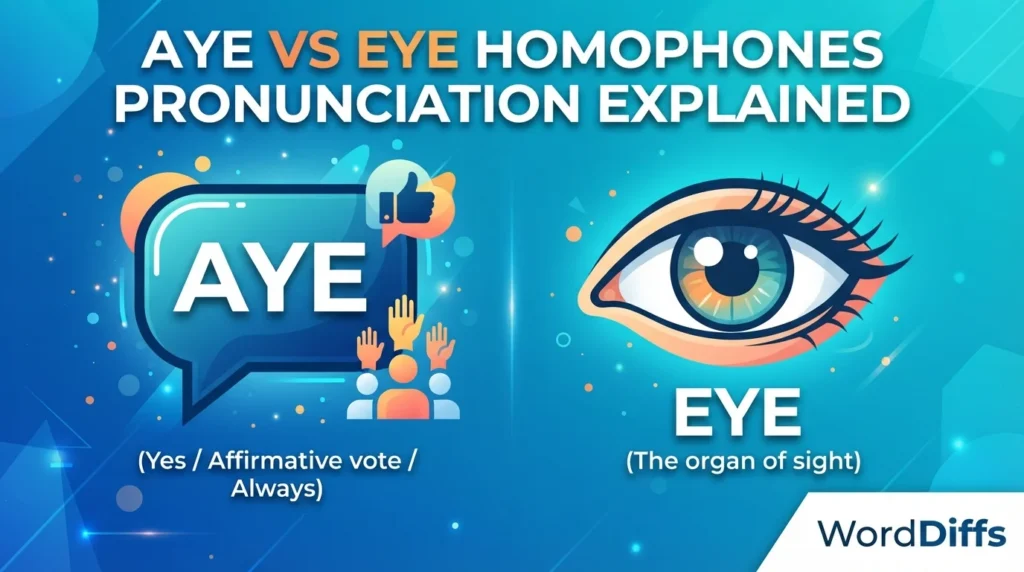
English learners often find Aye vs Eye confusing because these two words have the same pronunciation but completely different meanings, spellings, and uses. Since they sound identical in both everyday speech and many formal situations, choosing the correct spelling depends entirely on understanding the context. A small spelling mistake can change the meaning of a sentence or make your writing appear less accurate.
Correct word choice is especially important in school assignments, business communication, creative writing, and everyday conversations. Although pronunciation helps people recognize spoken words, it cannot always reveal which spelling is intended. That is why learning the meaning, grammar, and typical usage of each homophone is essential.
In this guide, you will learn the pronunciation of Aye and Eye, their meanings, parts of speech, origins, common uses, collocations, and plenty of original example sentences. By the end, you will confidently understand when to use each word correctly in both speaking and writing.
Learning Ant vs Aunt examples and common mistakes provides practical context for using each word correctly.
Quick Difference Table
| Word | Part of Speech | Meaning | Pronunciation (IPA) | Usage | Example |
| Aye | Interjection, Adverb, Noun | Yes; a vote in favor | /aɪ/ | Parliamentary voting, nautical language, agreement | The committee voted aye. |
| Eye | Noun, Verb | The organ of sight; to watch or observe | /aɪ/ | Anatomy, observation, expressions | She has a blue eye. |
Aye
Pronunciation
IPA: /aɪ/
Simple pronunciation: Sounds like the word I.
Audio-style spelling: eye
Homophone status: Aye sounds exactly the same as Eye.
British pronunciation: /aɪ/
American pronunciation: /aɪ/
There is virtually no pronunciation difference between British and American English. The distinction exists only in spelling and meaning.
Meaning
Aye is a word meaning yes or an affirmative vote. It is commonly used in parliamentary procedures, formal voting, and traditional nautical speech.
In everyday conversation, it appears much less frequently than yes, but it remains common in official meetings and legislative settings.
Part of Speech
Aye functions as:
- Interjection when expressing agreement.
- Adverb meaning “yes.”
- Noun referring to an affirmative vote.
Its grammatical role depends on the sentence.
Origin
The word Aye dates back to Middle English and developed from older expressions meaning agreement or affirmation. It has long been associated with official voting procedures in English-speaking legislatures and has also become well known through traditional maritime speech, where sailors respond with “Aye, aye!” to indicate understanding and obedience.
Common Uses
Common situations where Aye is used include:
- Parliamentary voting
- Legislative debates
- Council meetings
- Formal decision-making
- Nautical communication
- Historical literature
- Military traditions
- Ceremonial proceedings
- Traditional Scottish speech
- Expressions of agreement
Common Collocations
- aye vote
- vote aye
- aye and no
- aye or no
- answer aye
- say aye
- those voting aye
- aye majority
- aye response
- aye captain
- aye aye
- unanimous aye
- record the aye
- cast an aye
- parliamentary aye
Example Sentences
- Everyone who supported the proposal answered aye.
- The chairperson requested all members to vote aye or no.
- The council recorded twenty aye votes.
- The sailors replied, “Aye, Captain!“
- She proudly voted aye during the meeting.
- The motion passed after a strong aye majority.
- Every committee member responded with an enthusiastic aye.
- The speaker paused before announcing the aye count.
- The final decision was approved by an overwhelming aye.
- He raised his hand and said aye without hesitation.
- The official carefully recorded each aye vote.
- During the ceremony, every representative answered aye.
- The captain smiled after hearing “Aye, aye!“
- The proposal succeeded because more members voted aye.
- The clerk counted every aye before declaring the result.
Eye
Pronunciation
IPA: /aɪ/
Simple pronunciation: Sounds exactly like I.
Audio-style spelling: eye
Homophone status: Eye is a perfect homophone of Aye.
British pronunciation: /aɪ/
American pronunciation: /aɪ/
The pronunciation remains the same across standard British and American English.
Meaning
An eye is the organ that allows humans and many animals to see. The word also refers to vision, observation, attention, appearance, or something shaped like an eye.
As a verb, eye means to look at someone or something carefully, often with interest, suspicion, or curiosity.
A clear explanation of Color vs Colour meanings in American and British English makes the spelling distinction easier to understand.
Part of Speech
Eye can function as:
- Noun, referring to the organ of sight.
- Verb, meaning to observe or watch closely.
Its meaning changes depending on its grammatical role.
Origin
The word Eye comes from Old English ēage, which traces back to the Germanic language family. It has remained one of the oldest and most fundamental words in the English language because vision is an essential human sense.
Common Uses
Common situations where Eye appears include:
- Talking about vision
- Medical discussions
- Physical descriptions
- Photography
- Art and design
- Sports
- Scientific writing
- Body language
- Observation
- Everyday conversation
Common Collocations
- blue eye
- brown eye
- left eye
- right eye
- sharp eye
- keen eye
- eye contact
- eye movement
- eye exam
- eye doctor
- eye injury
- eye color
- eye protection
- eye witness
- eye for detail
Example Sentences
- She covered one eye during the vision test.
- His left eye was slightly red.
- The artist has an excellent eye for color.
- Keep your eye on the ball.
- The doctor examined my eye carefully.
- I noticed a small mark because I have a sharp eye.
- She made steady eye contact throughout the interview.
- The eagle’s eye spotted its prey from far away.
- He quietly eyed the unopened package.
- The teacher eyed the class before beginning the lesson.
- My eyes became tired after reading for hours.
- Safety glasses protect your eyes from dust.
- She has beautiful green eyes.
- The detective eyed every clue with great attention.
- A careful eye can often notice tiny mistakes.
Pronunciation Comparison
Although Aye and Eye have different meanings and spellings, they are considered perfect homophones in standard English.
Both words are pronounced /aɪ/, which sounds exactly like the pronoun I.
Because there is no pronunciation difference, listeners rely entirely on context to understand which word is intended.
British English
In standard British English, both Aye and Eye are pronounced /aɪ/. Regional accents, especially in Scotland, may use aye more frequently in everyday speech to mean “yes,” but the pronunciation remains essentially the same.
American English
In American English, both words are also pronounced /aɪ/. The pronunciation is identical, although aye is much less common outside formal voting or nautical expressions.
Regional Variations
Some Scottish and Northern English dialects use aye regularly in casual conversation as another way of saying yes. Even in these regions, it still sounds like eye.
Why Learners Confuse These Words
Learners commonly confuse Aye and Eye because:
- They have identical pronunciation.
- They have completely different meanings.
- One appears mainly in formal or historical contexts.
- The other is an everyday vocabulary word.
- Spoken English provides no pronunciation clues about spelling.
Comparing Feet vs Feat differences in spelling and usage makes their distinct meanings easier for English learners to recognize.
Grammar Differences
| Word | Part of Speech | Meaning | Function | Sentence Position | Verb Forms (If Applicable) | Plural Forms (If Applicable) |
| Aye | Interjection, Adverb, Noun | Yes; affirmative vote | Shows agreement or records approval | Usually alone or after a verb | Not applicable | Ayes |
| Eye | Noun, Verb | Organ of sight; observe carefully | Names an object or action | Subject, object, or verb | eye, eyes, eyed, eyeing | Eyes |
Side-by-Side Examples
| Aye | Eye |
| Everyone answered aye during the vote. | My left eye feels itchy today. |
| The committee voted aye unanimously. | She closed one eye to aim carefully. |
| The captain heard a loud “Aye!“ | His eye caught the bright sign. |
| The motion passed with thirty aye votes. | The doctor examined my eye. |
| Every sailor replied, “Aye, Captain!“ | The child rubbed her eye after waking up. |
| The chairman requested an aye or no vote. | Keep an eye on your luggage. |
| Only one member voted aye. | He has a sharp eye for detail. |
| They shouted aye together. | The eagle’s eye is incredibly sharp. |
| The clerk counted every aye carefully. | She wore protective glasses for her eyes. |
| We recorded another aye in favor. | His blue eyes matched his jacket. |
| The council accepted the proposal with an aye majority. | The detective eyed the suspect carefully. |
| The officer answered, “Aye, sir.“ | The artist has an eye for beauty. |
| Every representative said aye. | My eye started watering in the wind. |
| The proposal received another aye vote. | She maintained steady eye contact. |
| The chairman announced the aye count. | An eye exam is scheduled tomorrow. |
| The audience responded with a loud aye. | The photographer has an excellent eye for composition. |
| The members voted aye without delay. | He injured his eye during practice. |
| The sailors repeated “Aye, aye!“ | She eyed the dessert but chose fruit instead. |
| The measure passed because of the strong aye vote. | The cat kept one eye open while resting. |
| The secretary documented every aye. | My right eye is more sensitive to light. |
Homophones Comparison Table
| Word | Pronunciation | Meaning | Part of Speech | Usage | Example |
| Aye | /aɪ/ | Yes; affirmative vote | Interjection, Adverb, Noun | Voting, parliamentary procedures, nautical language | The members voted aye. |
| Eye | /aɪ/ | Organ of sight; observe | Noun, Verb | Vision, observation, medicine, everyday speech | She has a keen eye for art. |
Memory Tricks
- Aye begins with A, which can remind you of Agreement.
- Think of Aye whenever someone votes yes.
- Eye contains the letters EYE, making it easy to connect with seeing.
- Imagine an actual eye whenever you read the word.
- Associate Aye with parliament and Eye with vision.
- Remember that eye contact always relates to seeing.
- Picture sailors saying “Aye, aye!” to remember its meaning.
- Visual flashcards help reinforce the spelling difference.
- Read sentences containing both words aloud.
- Practice writing each word in different contexts.
Common Mistakes
| Incorrect Sentence | Correct Sentence | Explanation |
| I hurt my aye. | I hurt my eye. | Eye is the body part. |
| She has green aye. | She has green eyes. | Eyes are organs of sight. |
| Everyone voted eye. | Everyone voted aye. | Aye means yes in voting. |
| The captain shouted eye, eye. | The captain shouted aye, aye. | Nautical expression uses aye. |
| My aye is sore. | My eye is sore. | Eye refers to vision. |
| They answered eye during the vote. | They answered aye during the vote. | Aye expresses agreement. |
| Keep an aye on the road. | Keep an eye on the road. | Eye means watch carefully. |
| She closed one aye. | She closed one eye. | Eye is the correct noun. |
| The proposal passed by eye votes. | The proposal passed by aye votes. | Aye means affirmative vote. |
| He has a sharp aye. | He has a sharp eye. | Eye refers to observation. |
| The doctor examined my aye. | The doctor examined my eye. | Medical context uses eye. |
| They all shouted eye together. | They all shouted aye together. | Agreement uses aye. |
| Her aye color is blue. | Her eye color is blue. | Eye color is correct. |
| We recorded twenty eye votes. | We recorded twenty aye votes. | Voting uses aye. |
| The detective ayeed the suspect. | The detective eyed the suspect. | Eyed is the verb form of eye. |
Fill in the Blank Quiz
- The committee voted _____ in support of the proposal.
- She covered one _____ during the test.
- The sailors answered, “_____, Captain!”
- Keep your _____ on the road.
- The doctor examined his right _____.
- Everyone present voted _____.
- She has bright blue _____.
- The chairman asked for all those in favor to say _____.
- He _____ the painting with admiration.
- My left _____ feels tired.
- The motion passed because most members voted _____.
- An eagle has excellent _____.
- The officer replied, “_____, sir.”
- The artist has a keen _____ for detail.
- The clerk counted every _____ vote.
- I accidentally rubbed my _____.
- The captain smiled after hearing “_____, aye!”
- She maintained steady _____ contact.
- Another _____ was recorded in favor.
- The child opened one _____ slowly.
Answer Key
- aye
- eye
- Aye
- eye
- eye
- aye
- eyes
- aye
- eyed
- eye
- aye
- eyes
- Aye
- eye
- aye
- eye
- Aye
- eye
- aye
- eye
Choose the Correct Word Quiz
1. The committee voted _____ on the proposal.
A. Eye
B. Aye
C. I
D. Eyes
Correct Answer: B. Aye
Explanation: Aye means yes or an affirmative vote.
2. She has a beautiful blue _____.
A. Aye
B. Eyed
C. Eye
D. Ayes
Correct Answer: C. Eye
Explanation: Eye refers to the organ of sight.
3. The captain heard everyone reply, “_____!”
A. Eye
B. Eyed
C. Aye
D. Eyes
Correct Answer: C. Aye
Explanation: Sailors traditionally answer “Aye!” to show agreement or understanding.
4. Keep an _____ on your backpack.
A. Aye
B. Eye
C. Ayes
D. Eyed
Correct Answer: B. Eye
Explanation: The expression is keep an eye on, meaning watch carefully.
5. Every member voted _____.
A. Eye
B. Eyed
C. Aye
D. Eyes
Correct Answer: C. Aye
Explanation: Voting in favor uses aye.
6. The doctor examined my left _____.
A. Eye
B. Aye
C. Ayes
D. Eyed
Correct Answer: A. Eye
Explanation: The body part is an eye.
7. The detective _____ the suspect carefully.
A. Ayed
B. Eye
C. Eyed
D. Aye
Correct Answer: C. Eyed
Explanation: Eyed is the past tense of the verb eye.
8. The proposal passed because most members said _____.
A. Eye
B. Aye
C. Eyed
D. Eyes
Correct Answer: B. Aye
Explanation: Aye means an affirmative response.
9. She has a keen _____ for fashion.
A. Eye
B. Aye
C. Eyed
D. Ayes
Correct Answer: A. Eye
Explanation: The expression a keen eye means strong observation.
10. The clerk counted every _____ vote.
A. Eye
B. Eyed
C. Aye
D. Eyes
Correct Answer: C. Aye
Explanation: Votes in favor are called aye votes.
11. My right _____ is watering.
A. Aye
B. Eye
C. Eyed
D. Ayes
Correct Answer: B. Eye
Explanation: Eye refers to the organ of vision.
12. The sailors responded, “_____, aye!”
A. Eye
B. Eyed
C. Aye
D. Eyes
Correct Answer: C. Aye
Explanation: “Aye, aye!” is a traditional nautical response.
13. He has an excellent _____ for detail.
A. Eye
B. Aye
C. Ayes
D. Eyed
Correct Answer: A. Eye
Explanation: An eye for detail means the ability to notice small things.
14. The chairman asked those in favor to say _____.
A. Eye
B. Eyed
C. Aye
D. Eyes
Correct Answer: C. Aye
Explanation: Formal voting uses aye.
15. She _____ the antique vase with curiosity.
A. Aye
B. Eye
C. Eyed
D. Ayes
Correct Answer: C. Eyed
Explanation: Eyed means looked at carefully.
Common Expressions
Aye
Common Idioms and Fixed Expressions
Aye, aye!
Meaning: A traditional naval response meaning I understand and will obey.
Example: The crew answered, “Aye, aye, Captain!”
Vote aye
Meaning: To vote in favor of a proposal.
Example: Most members voted aye on the new policy.
The ayes have it
Meaning: More people voted in favor than against.
Example: After counting the votes, the chair announced, “The ayes have it.”
Aye or no
Meaning: A choice between agreement and disagreement.
Example: Every participant had to answer aye or no.
Eye
Common Idioms and Fixed Expressions
Keep an eye on
Meaning: Watch something carefully.
Example: Please keep an eye on my luggage.
Catch someone’s eye
Meaning: Attract someone’s attention.
Example: The colorful painting caught my eye immediately.
Eye to eye
Meaning: Agree completely.
Example: We don’t always see eye to eye, but we respect each other.
An eye for detail
Meaning: The ability to notice small details.
Example: Good editors have an eye for detail.
In the public eye
Meaning: Well known by the public.
Example: The athlete has remained in the public eye for years.
Turn a blind eye
Meaning: Deliberately ignore something.
Example: The manager refused to turn a blind eye to the mistake.
Apple of someone’s eye
Meaning: A person who is deeply loved.
Example: Her youngest son is the apple of her eye.
Eye-opener
Meaning: Something surprising or enlightening.
Example: The documentary was a real eye-opener.
Frequently Asked Questions
What is the difference between Aye and Eye?
Aye means yes or an affirmative vote, especially in formal meetings, parliamentary procedures, and nautical communication. Eye refers to the organ used for seeing or the act of looking carefully. Although they sound identical, their meanings, spellings, and grammatical functions are completely different.
Are Aye and Eye pronounced the same?
Yes. Both words are pronounced /aɪ/ in standard British and American English. They are perfect homophones, so listeners depend on context rather than pronunciation to understand which word is intended.
Why do people confuse these homophones?
People confuse Aye and Eye because they sound exactly alike. Learners often write the more familiar spelling, eye, even when the meaning requires aye, especially during dictation or listening exercises.
When should I use Aye?
Use Aye when expressing agreement in formal voting, parliamentary discussions, council meetings, or traditional nautical speech. It should not be used when referring to vision or the body part.
When should I use Eye?
Use Eye whenever talking about sight, observation, vision, appearance, or looking carefully at something. It is one of the most common nouns in English and can also function as a verb.
Can Eye be used as a verb?
Yes. Eye can be a verb meaning to observe, examine, or look at someone or something carefully. For example, The guard eyed the entrance throughout the event.
Is Aye commonly used in everyday conversation?
Not usually. Most English speakers simply say yes in daily conversation. Aye is mainly found in parliamentary language, formal voting, Scottish English, and traditional maritime communication.
What does “Aye, aye!” mean?
“Aye, aye!” is a traditional naval expression meaning I understand your order and will carry it out. It does not simply mean yes. It confirms both understanding and willingness to obey.
How can I remember the difference?
Remember that Aye starts with A, which can remind you of Agreement or Approval. Eye contains the letters found in the word itself and is easy to associate with seeing and vision.
Are there plural forms of these words?
Yes. The plural of eye is eyes. The noun aye, when referring to votes, can become ayes, as in The ayes outnumbered the noes.
Tips to Remember the Difference
- Associate Aye with Agreement, Approval, and Affirmative.
- Connect Eye with seeing, vision, and observation.
- Read authentic examples from books, newspapers, and official documents.
- Practice writing sentences using both words every day.
- Say each sentence aloud to reinforce the connection between meaning and spelling.
- Create flashcards showing the word on one side and its meaning on the other.
- Learn common expressions such as vote aye and keep an eye on.
- Practice dictation exercises where context determines the correct spelling.
- Build vocabulary by grouping homophones into study lists.
- Review your writing carefully to ensure the correct word matches the intended meaning.
Summary
Understanding Aye vs Eye is an important step toward improving English spelling, vocabulary, and grammar. Although these two words are perfect homophones and share the same pronunciation, /aɪ/, they have entirely different meanings and uses. Aye is primarily used to express agreement or record an affirmative vote in formal settings such as parliamentary procedures, council meetings, and traditional nautical communication. Eye, on the other hand, refers to the organ of sight and also functions as a verb meaning to look at something carefully.
Learning their grammatical roles, common collocations, and typical expressions makes it much easier to choose the correct spelling. Memory tricks such as linking Aye with Agreement and Eye with vision can help reinforce the difference. Regular reading, writing, pronunciation practice, and sentence-building exercises will strengthen your understanding over time. By focusing on context rather than pronunciation alone, you can confidently use Aye and Eye accurately in both spoken and written English.

Josie Palmer is an experienced SEO Content Consultant, content strategist, and founder of JOT SEO, a consultancy focused on helping businesses improve their search visibility through effective SEO and content strategies. With more than 8 years of experience in SEO, content development, and digital marketing, she specializes in creating data-driven content strategies that help businesses grow online.