
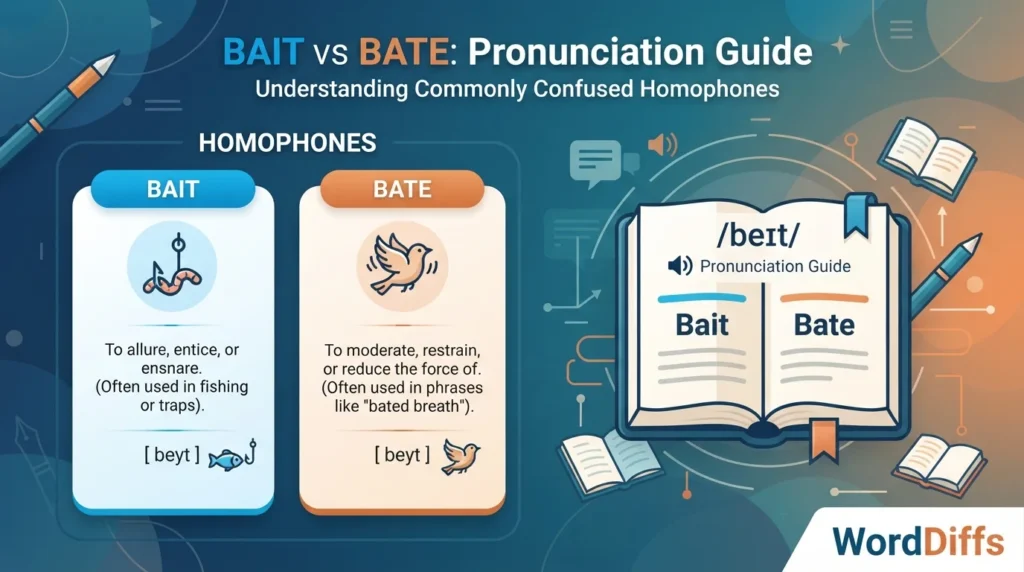
English homophones often confuse learners because two words can sound almost identical while having completely different meanings and spellings. Bait and bate are excellent examples. Although both are pronounced the same in most varieties of English, they belong to different parts of speech, appear in different contexts, and carry distinct meanings. Choosing the wrong spelling can change the meaning of a sentence and make your writing less accurate.
Learning the difference between bait and bate improves your vocabulary, strengthens your grammar, and helps you communicate more clearly in both spoken and written English. Understanding their pronunciation also reduces misunderstandings during conversations. In this guide, you will learn how to pronounce each word, explore their meanings, discover their origins, study common collocations, compare their grammar, and practice using them through examples and exercises. By the end, you will be able to distinguish these homophones confidently and use each one correctly.
Quick Difference Table
| Word | Part of Speech | Meaning | Pronunciation (IPA) | Usage | Example |
| Bait | Noun, Verb | Food or another item used to attract animals or fish; to deliberately provoke someone | /beɪt/ | Fishing, hunting, arguments, online discussions | He used worms as bait. |
| Bate | Verb | To reduce, lessen, restrain, or moderate | /beɪt/ | Formal, literary, historical expressions | She did not bate her enthusiasm. |
Bait
Pronunciation
The word bait is pronounced /beɪt/.
Simple pronunciation: bayt
Audio-style spelling: BAYT
Both bait and bate are pronounced exactly the same in standard English, making them perfect homophones.
British pronunciation: /beɪt/
American pronunciation: /beɪt/
There is virtually no pronunciation difference between British and American English.
Meaning
Bait most commonly refers to food, an object, or another attractive item used to lure fish, animals, or insects into a trap.
It can also be used as a verb meaning to deliberately annoy, provoke, tease, or tempt someone into reacting.
Everyday meanings include:
- Food placed on a fishing hook.
- Something used to attract attention.
- Deliberately provoking another person.
Part of Speech
Noun
As a noun, bait names something used to attract or trap.
Example:
The fisherman prepared fresh bait.
Verb
As a verb, it means to lure, tempt, tease, or provoke.
Example:
The students tried to bait their teacher.
Origin
The word bait comes from Old Norse beita, meaning “to cause to bite” or “to feed.” Over time, English speakers adopted the word for hunting and fishing before expanding its meaning to include provoking or tempting people.
Today, it appears in everyday conversation, outdoor activities, journalism, politics, and internet culture.
Common Uses
Common situations include:
- Fishing with worms or artificial bait.
- Hunting using bait.
- Mouse and insect traps.
- Online clickbait headlines.
- Political debates.
- School teasing.
- Social media arguments.
- Wildlife management.
- Advertising.
- Sports discussions.
Common Collocations
- live bait
- fishing bait
- artificial bait
- fresh bait
- bait hook
- bait shop
- bait bucket
- shark bait
- bait trap
- bait station
- bait someone
- take the bait
- use bait
- bait fish
- clickbait headline
Example Sentences
- The fisherman attached fresh bait to his hook.
- Small fish are often used as bait.
- We bought bait before heading to the lake.
- The mouse ignored the cheese bait.
- The hunter carefully placed bait near the trail.
- Bright colors acted as bait for curious birds.
- Don’t let rude comments bait you into arguing.
- She refused to take the bait during the debate.
- The article’s headline looked like obvious clickbait.
- The children collected worms for fishing bait.
- He changed the bait after catching two fish.
- Online trolls often bait strangers into angry responses.
- Good bait increases your chances of catching fish.
- The clever fox avoided the poisoned bait.
- The coach warned the players not to bait their opponents.
Bate
Pronunciation
The word bate is pronounced /beɪt/.
Simple pronunciation: bayt
Audio-style spelling: BAYT
It sounds exactly the same as bait, making the two words true homophones.
British pronunciation: /beɪt/
American pronunciation: /beɪt/
No significant pronunciation difference exists between the two major accents.
Meaning
Bate is a less common English verb. It means to reduce, lessen, restrain, moderate, or diminish something.
It frequently appears in formal writing, literature, and traditional expressions rather than everyday conversation.
Common meanings include:
- To lessen intensity.
- To reduce speed or force.
- To hold back emotions.
- To moderate expectations.
Part of Speech
Verb
Unlike bait, bate functions almost exclusively as a verb.
Examples:
He would not bate his determination.
Please bate your anger before responding.
Origin
The word bate comes from Old French abattre, meaning “to beat down” or “to reduce.” It entered Middle English as a shortened form of abate, eventually developing its own identity in formal English.
Today it survives mainly in literary works and fixed expressions.
Common Uses
Typical contexts include:
- Literary writing.
- Historical documents.
- Formal speeches.
- Academic discussions.
- Poetry.
- Expressions of restraint.
- Describing reduced intensity.
- Emotional control.
- Legal language.
- Classical literature.
Common Collocations
- bate one’s breath
- bate expectations
- bate enthusiasm
- bate excitement
- bate anger
- bate fear
- bate confidence
- bate hope
- bate impatience
- bate curiosity
- bate emotion
- bate pride
- bate passion
- bate resentment
- bate determination
Example Sentences
- She could not bate her excitement before the ceremony.
- He refused to bate his confidence.
- The judge would not bate his decision.
- They did not bate their determination.
- Please bate your anger during the discussion.
- She never bate her enthusiasm for learning.
- The speaker did not bate his criticism.
- We should bate our expectations until the results arrive.
- The captain refused to bate his courage.
- He struggled to bate his frustration.
- They would not bate their commitment to the project.
- She managed to bate her disappointment.
- The author uses bate in a poetic sense.
- His resolve did not bate despite the challenges.
- You should bate your impatience while waiting.
Pronunciation Comparison
Bait and bate are considered perfect homophones in modern English because they are pronounced identically as /beɪt/.
Both British and American English speakers pronounce them with the same vowel sound and final consonant. Regional accents rarely create any noticeable distinction.
This identical pronunciation explains why English learners often confuse the two words in writing. Since pronunciation provides no clue, learners must rely on spelling and context.
The easiest way to distinguish them is by remembering that bait usually relates to attracting, trapping, tempting, or provoking, while bate refers to reducing, restraining, or lessening something. Mastering their meanings rather than their pronunciation is the key to using these homophones correctly.
Grammar Differences
| Word | Part of Speech | Meaning | Function | Sentence Position | Verb Forms (If Applicable) | Plural Forms (If Applicable) |
| Bait | Noun, Verb | Lure, attract, provoke | Subject, object, or verb | Flexible | bait, baits, baited, baiting | baits |
| Bate | Verb | Reduce, lessen, restrain | Main verb | Predicate | bate, bates, bated, bating | Not applicable |
Side-by-Side Examples
| Bait | Bate |
| He bought fresh bait for fishing. | Please bate your anger before replying. |
| Worms make excellent bait. | She would not bate her enthusiasm. |
| Don’t take the bait online. | We should bate our expectations. |
| The trap contained bait. | He never bate his confidence. |
| They prepared live bait. | She tried to bate her impatience. |
| The fox ignored the bait. | He could not bate his excitement. |
| Bright colors acted as bait. | They did not bate their determination. |
| The fisherman replaced the bait. | Please bate your frustration. |
| She refused to bait her classmates. | The audience would not bate its interest. |
| The article was obvious clickbait. | He bated his expectations. |
Homophones Comparison Table
| Word | Pronunciation | Meaning | Part of Speech | Usage | Example |
| Bait | /beɪt/ | Something used to attract or lure; to provoke someone | Noun, Verb | Fishing, hunting, online discussions, everyday English | He used worms as bait. |
| Bate | /beɪt/ | To reduce, lessen, restrain, or moderate | Verb | Formal writing, literature, historical English | She did not bate her enthusiasm. |
Memory Tricks
Remembering the difference between bait and bate becomes much easier when you associate each spelling with its meaning.
- Bait contains the letters ai, which can remind you of attract. Bait attracts fish, animals, or even people’s attention.
- Think of a fishing hook with bait hanging from it. The image reinforces the meaning of something used to lure.
- Bate is closely related to abate, which means to reduce or lessen. If you know abate, remembering bate becomes simple.
- Visualize someone calming down or reducing their excitement whenever you see bate.
- Practice writing both words in short sentences until the spelling becomes automatic.
- Read authentic examples from books or articles to see how each word is naturally used.
Common Mistakes
| Incorrect Sentence | Correct Sentence | Explanation |
| He bought bate for fishing. | He bought bait for fishing. | Fishing uses bait, not bate. |
| The mouse ignored the bate. | The mouse ignored the bait. | Bait attracts animals. |
| Don’t take the bate online. | Don’t take the bait online. | The expression is “take the bait.” |
| She used worms as bate. | She used worms as bait. | Worms are fishing bait. |
| They prepared fresh bate. | They prepared fresh bait. | Use bait for lures. |
| Please bait your anger. | Please bate your anger. | Bate means reduce or restrain. |
| He would not bait his excitement. | He would not bate his excitement. | Use bate to mean lessen. |
| We should bait our expectations. | We should bate our expectations. | Bate means moderate expectations. |
| She refused to bait her enthusiasm. | She refused to bate her enthusiasm. | The intended meaning is reduce. |
| His confidence never baited. | His confidence never bated. | Past tense of bate is bated. |
| The trap had no bate inside. | The trap had no bait inside. | Traps contain bait. |
| They caught fish without bate. | They caught fish without bait. | Fishing requires bait. |
| The fox smelled the bate. | The fox smelled the bait. | Correct noun is bait. |
| Try not to bait your frustration. | Try not to bate your frustration. | Reduce frustration with bate. |
| The fisherman forgot his bate bucket. | The fisherman forgot his bait bucket. | The correct collocation is bait bucket. |
Fill in the Blank Quiz
Choose bait or bate to complete each sentence.
- The fisherman placed fresh ______ on the hook.
- Please ______ your anger before speaking.
- The fox avoided the poisoned ______.
- She refused to ______ her excitement.
- They bought live ______ for fishing.
- Do not take the ______ during the debate.
- We should ______ our expectations.
- The trap contained cheese as ______.
- He tried to ______ his frustration.
- Good ______ attracts more fish.
- The article was obvious click______.
- Please do not ______ your determination.
- Birds ignored the ______.
- She used insects as ______.
- His enthusiasm never ______.
- The hunter prepared fresh ______.
- Try not to ______ your confidence.
- The mouse never touched the ______.
- The speaker would not ______ his criticism.
- Fresh ______ often works better than artificial options.
Answer Key
- bait
- bate
- bait
- bate
- bait
- bait
- bate
- bait
- bate
- bait
- bait
- bate
- bait
- bait
- bated
- bait
- bate
- bait
- bate
- bait
Choose the Correct Word Quiz
1. The fisherman bought fresh _____.
A. bait
B. bate
C. byte
D. beat
Answer: A
Explanation: Fishing uses bait.
2. Please _____ your excitement.
A. bait
B. bate
C. bite
D. beat
Answer: B
Explanation: Bate means reduce or restrain.
3. The trap contained _____.
A. bate
B. bait
C. beat
D. byte
Answer: B
Explanation: Traps contain bait.
4. We should _____ our expectations.
A. bate
B. bait
C. beat
D. bite
Answer: A
Explanation: Bate means lessen.
5. The mouse ignored the _____.
A. bate
B. bait
C. beat
D. byte
Answer: B
Explanation: Animals ignore or take bait.
6. Don’t take the _____.
A. bate
B. bait
C. beat
D. byte
Answer: B
Explanation: The expression is “take the bait.”
7. She refused to _____ her enthusiasm.
A. bait
B. bate
C. beat
D. bite
Answer: B
Explanation: Bate means reduce.
8. Fresh _____ attracts fish.
A. bait
B. bate
C. beat
D. byte
Answer: A
Explanation: Fishing uses bait.
9. Please _____ your anger.
A. bait
B. bate
C. beat
D. bite
Answer: B
Explanation: The meaning is “reduce.”
10. Worms make excellent _____.
A. bate
B. bait
C. beat
D. byte
Answer: B
Explanation: Worms are commonly used as bait.
11. The headline was obvious click_____.
A. bate
B. bait
C. beat
D. byte
Answer: B
Explanation: The compound word is clickbait.
12. He would not _____ his confidence.
A. bait
B. bate
C. beat
D. bite
Answer: B
Explanation: Bate means lessen.
13. The hunter prepared the _____.
A. bate
B. bait
C. beat
D. byte
Answer: B
Explanation: Hunters may use bait.
14. They bought fishing _____.
A. bate
B. bait
C. beat
D. byte
Answer: B
Explanation: Fishing requires bait.
15. Please don’t _____ your determination.
A. bait
B. bate
C. beat
D. bite
Answer: B
Explanation: Bate means reduce or weaken.
Common Expressions
Bait
Idioms and Fixed Expressions
Take the bait
Meaning: To respond to a provocation.
She refused to take the bait during the argument.
Rise to the bait
Meaning: To react to someone’s attempt to provoke.
He did not rise to the bait.
Clickbait
Meaning: Misleading online content designed to attract clicks.
That headline is pure clickbait.
Bait and switch
Meaning: Advertising one thing but offering another.
Customers complained about the bait and switch tactic.
Bate
Literary and Traditional Expressions
Bated breath
Meaning: Holding one’s breath in excitement or anticipation.
Everyone waited with bated breath for the announcement.
Bate one’s enthusiasm
Meaning: To reduce excitement.
She refused to bate her enthusiasm.
Bate one’s expectations
Meaning: To moderate expectations.
Investors decided to bate their expectations.
Frequently Asked Questions
What is the difference between bait and bate?
Bait refers to something used to attract, lure, tempt, or provoke. It commonly appears in fishing, hunting, and everyday expressions such as take the bait. Bate is a verb meaning to reduce, restrain, or lessen something, such as excitement or anger. Although they sound identical, their meanings and usage are completely different.
Are bait and bate pronounced the same?
Yes. Both words are pronounced /beɪt/ in British and American English. Because they sound identical, they are considered perfect homophones. Context and spelling are the only reliable ways to distinguish them in writing.
Why do people confuse these homophones?
People confuse them because they share the same pronunciation. Since bait is much more common than bate, many learners mistakenly use bait when they actually mean “reduce” or “lessen.”
Is bait a noun or a verb?
Bait functions as both. As a noun, it means something used to lure animals or fish. As a verb, it means to provoke, tempt, or deliberately annoy someone.
Is bate commonly used today?
Not as often as bait. Bate mainly appears in formal writing, literature, historical texts, and the familiar expression bated breath.
What does “bated breath” mean?
It describes waiting with intense excitement, suspense, or anticipation, almost as if holding your breath.
Can bait refer to people?
Yes. As a verb, bait means provoking or teasing someone to trigger a reaction.
Is clickbait related to bait?
Yes. Clickbait uses the original idea of bait by attracting readers with sensational or misleading headlines.
How can I remember the difference?
Associate bait with fishing and attracting. Connect bate with abate, which means reduce. This simple link helps distinguish their meanings.
Which word is more common?
Bait is far more common in modern English. Bate is relatively rare outside formal or literary contexts.
Tips to Remember the Difference
- Read authentic articles containing both words.
- Practice writing five sentences with each word every week.
- Say both words aloud while focusing on their different meanings.
- Memorize the phrase bated breath.
- Associate bait with fishing hooks and lures.
- Link bate with abate to remember “reduce.”
- Create flashcards showing spelling on one side and meaning on the other.
- Complete grammar exercises that require choosing between the two words.
- Build your vocabulary by reading novels and quality news articles.
- Review your writing carefully to ensure you selected the correct homophone.
Summary
Bait and bate are perfect homophones because they share the pronunciation /beɪt/ in both British and American English. Despite sounding identical, they have very different meanings and uses. Bait is commonly used as both a noun and a verb. It refers to something that attracts fish, animals, or people, and it can also describe provoking someone into reacting. In contrast, bate is a much less common verb meaning to reduce, lessen, or restrain. It is mostly found in formal writing, literature, and expressions such as bated breath.
Understanding these differences improves spelling, grammar, vocabulary, and overall communication. Paying attention to context is the most reliable way to choose the correct word because pronunciation offers no clues. Memory techniques, regular reading, writing practice, and completing exercises will help reinforce the distinction. Once you associate bait with attracting and bate with reducing, using these homophones correctly becomes much easier and more natural.

Lauren Kafka is an experienced freelance writer, editor, English tutor, and writing coach with extensive expertise in education, journalism, publishing, and communications. She is the founder of Kafka Consulting LLC, where she provides private English tutoring, writing coaching, and educational consulting services for K-12 students, college students, graduate students, and adults.