
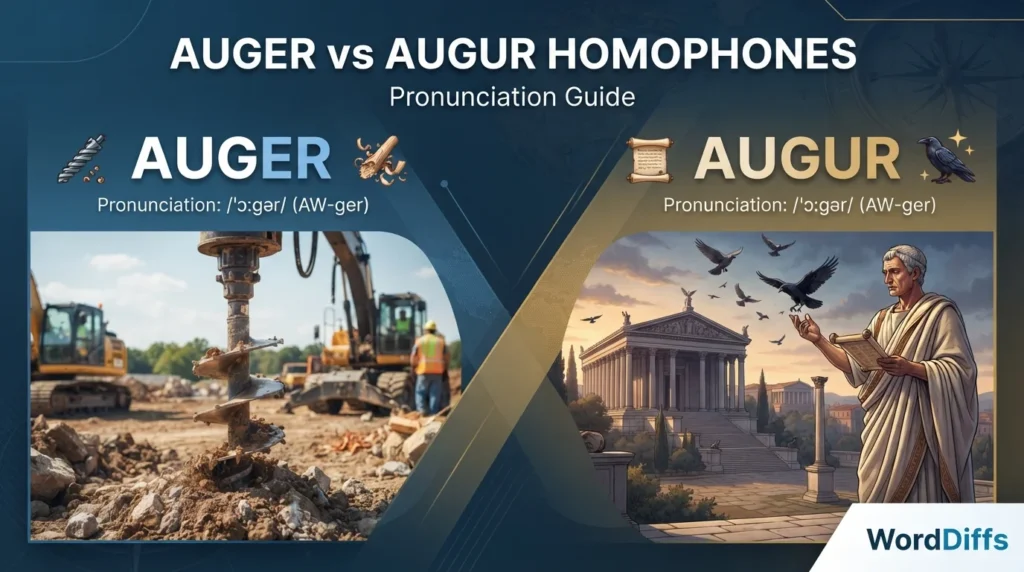
English homophones can be challenging because two words may sound exactly alike while having completely different meanings, spellings, and uses. Auger and Augur are a perfect example. Although they share the same pronunciation in most English accents, they belong to entirely different fields of vocabulary. One refers to a drilling tool, while the other relates to predicting the future or serving as a sign of what is to come.
Choosing the correct spelling is important because confusing these words can change the meaning of a sentence and make your writing appear inaccurate. Understanding their pronunciation, grammar, origins, and common usage helps improve both spoken and written English.
In this comprehensive guide, you will learn how to pronounce Auger and Augur, understand their meanings, recognize their grammatical roles, explore their origins, compare their differences, and practice using them correctly through examples, quizzes, memory tips, and practical exercises.
Quick Difference Table
| Word | Part of Speech | Meaning | Pronunciation (IPA) | Usage | Example |
| Auger | Noun | A tool used for boring or drilling holes | /ˈɔːɡər/ (UK), /ˈɔːɡɚ/ (US) | Carpentry, construction, gardening | The carpenter used an auger to drill a deep hole. |
| Augur | Noun, Verb | A person who foretells events, or to predict or indicate future events | /ˈɔːɡər/ (UK), /ˈɔːɡɚ/ (US) | Literature, history, journalism, formal writing | The dark clouds augur heavy rain. |
Auger
Pronunciation
IPA
- British English: /ˈɔːɡər/
- American English: /ˈɔːɡɚ/
Simple pronunciation
AW-gur
Audio-style spelling
AW-ger
Does it sound like Augur?
Yes. In standard British and American English, Auger and Augur are perfect homophones.
Meaning
An auger is a tool designed for drilling or boring holes into wood, soil, ice, or other materials. Depending on the context, it may be operated by hand or powered by machinery.
In everyday language, it commonly appears in woodworking, gardening, farming, construction, and engineering.
Part of Speech
Noun
An auger functions as a countable noun that names a specific tool.
Examples:
- This auger is very sharp.
- We bought a new auger yesterday.
Origin
The word auger comes from Old English nafogar, referring to a boring tool. Over centuries, pronunciation changed while the meaning remained closely connected to drilling holes.
Common Uses
An auger is commonly used in:
- Carpentry
- Woodworking
- Construction
- Gardening
- Farming
- Ice fishing
- Landscaping
- Utility pole installation
- Engineering projects
- Soil testing
Common Collocations
- hand auger
- earth auger
- power auger
- ice auger
- wood auger
- garden auger
- drill auger
- auger bit
- auger blade
- auger machine
- use an auger
- operate an auger
- sharpen an auger
- heavy-duty auger
- soil auger
Example Sentences
- The carpenter sharpened the auger before starting work.
- We rented an auger to install fence posts.
- The gardener used an auger to plant dozens of trees.
- An auger creates cleaner holes than many ordinary drills.
- The workers carried a heavy earth auger to the construction site.
- My grandfather still owns an old hand auger.
- The ice auger quickly cut through the frozen lake.
- The mechanic repaired the damaged auger.
- A power auger saved hours of digging.
- The farmer selected the correct auger for soil testing.
- Always inspect the auger before using it.
- The machine’s auger became clogged with wet soil.
- They purchased a longer auger for deeper holes.
- The manual explained how to maintain the auger safely.
- Every toolbox in the workshop contains an auger.
Augur
Pronunciation
IPA
- British English: /ˈɔːɡər/
- American English: /ˈɔːɡɚ/
Simple pronunciation
AW-gur
Audio-style spelling
AW-ger
Relationship to Auger
Its pronunciation is identical to Auger in nearly all English dialects.
Meaning
As a noun, an augur is someone who predicts future events.
As a verb, augur means to suggest, predict, or indicate what is likely to happen.
Today, the verb is much more common than the noun.
Part of Speech
Noun
Names a predictor or prophet.
Verb
Describes the act of predicting or signaling future outcomes.
Origin
The word comes from Latin augur, referring to Roman religious officials who interpreted signs from birds to predict future events. The English meaning later broadened to include signs or indications of future events.
Common Uses
Common contexts include:
- News articles
- Academic writing
- Historical texts
- Political analysis
- Literature
- Business reports
- Weather discussions
- Economic forecasts
- Editorial writing
- Formal speeches
Common Collocations
- augur well
- augur badly
- augur success
- augur failure
- augur change
- augur improvement
- augur trouble
- augur prosperity
- augur hope
- augur confidence
- augur future events
- good augur
- bad augur
- ancient augur
- Roman augur
Example Sentences
- The positive results augur future success.
- Dark clouds often augur a storm.
- Experts believe these trends augur economic growth.
- The unexpected silence did not augur well.
- Historians studied the role of the Roman augur.
- Her confident speech seemed to augur victory.
- Falling sales may augur financial problems.
- The early discoveries augur exciting research opportunities.
- Many viewed the eclipse as a bad augur centuries ago.
- His calm leadership augurs stability.
- The favorable weather augured a successful harvest.
- These improvements augur a brighter future.
- Critics said the announcement did not augur well.
- Ancient civilizations respected every augur.
- The excellent teamwork augured continued success.
Pronunciation Comparison
Auger and Augur are considered perfect homophones in standard English. Although they have different spellings, meanings, histories, and grammatical uses, they are pronounced the same.
Do They Sound Identical?
Yes. Most native speakers pronounce both words exactly alike.
| Variety | Auger | Augur | Same Sound? |
| British English | /ˈɔːɡər/ | /ˈɔːɡər/ | Yes |
| American English | /ˈɔːɡɚ/ | /ˈɔːɡɚ/ | Yes |
| Australian English | /ˈɔːɡə/ | /ˈɔːɡə/ | Yes |
| Canadian English | /ˈɔːɡɚ/ | /ˈɔːɡɚ/ | Yes |
Regional Variations
Regional accents may slightly change the vowel quality or the pronunciation of the final r, but both words always remain pronounced the same within each accent.
Why Learners Confuse Them
Learners often confuse these words because:
- They sound identical.
- Both are uncommon words.
- Their spellings differ by only one letter.
- Spell checkers cannot always detect the wrong choice because both are valid English words.
- Their meanings belong to entirely different subject areas.
Grammar Differences
| Word | Part of Speech | Meaning | Function | Sentence Position | Verb Forms (If Applicable) | Plural Forms (If Applicable) |
| Auger | Noun | A drilling or boring tool | Names an object | Subject or object | Not applicable | augers |
| Augur | Noun, Verb | Predictor, or to predict | Names a person or expresses prediction | Subject, object, or predicate | augur, augurs, augured, auguring | augurs (noun) |
Side-by-Side Examples
| Auger | Augur |
| The auger drilled through the wood. | These results augur success. |
| We borrowed an auger from our neighbor. | The signs augur difficult times. |
| The mechanic repaired the auger. | Good weather augurs a strong harvest. |
| An earth auger saves time. | The silence did not augur well. |
| The farmer bought a larger auger. | The agreement augurs peace. |
| She cleaned the auger carefully. | Experts say the figures augur growth. |
| The ice auger cut quickly. | His smile seemed to augur good news. |
| Every worker inspected the auger. | These events augur change. |
| The old auger still works. | The discovery augurs progress. |
| We packed the auger in the truck. | Early success may augur more victories. |
| This auger is lightweight. | Rising demand augurs expansion. |
| He rented a power auger. | The report does not augur well. |
| The auger became stuck in clay. | Their cooperation augurs future success. |
| A new auger costs less than expected. | Better policies augur stability. |
| The engineer selected the proper auger. | The announcement augured improvement. |
| We stored the auger indoors. | Calm negotiations augured peace. |
| The drill includes a strong auger bit. | Their teamwork augurs excellent results. |
| He replaced the broken auger. | The signs augured trouble. |
| The manual explains every auger part. | Investors believe the news augurs profit. |
| She purchased an expensive auger. | The clear skies augured a pleasant day. |
Homophones Comparison Table
| Word | Pronunciation | Meaning | Part of Speech | Usage | Example |
| Auger | /ˈɔːɡər/, /ˈɔːɡɚ/ | Drilling tool | Noun | Construction, woodworking, farming | The auger bored a neat hole. |
| Augur | /ˈɔːɡər/, /ˈɔːɡɚ/ | Predict or foretell | Noun, Verb | Formal writing, history, journalism | The signs augur success. |
Memory Tricks
Easy Remembering Techniques
- Auger contains “er”, reminding you of a worker using a tool.
- Think of an auger as equipment that drills into the Earth.
- Augur contains “ur”, which can remind you of the future.
- If something augurs well, it predicts a positive outcome.
Spelling Associations
- Auger = Gear = Tool
- Augur = Future = Prediction
Visual Memory Tricks
Imagine:
- An auger making a hole in the ground.
- An augur looking into a crystal ball predicting tomorrow.
Practical Learning Methods
- Write both words in separate vocabulary lists.
- Practice using each word in different contexts.
- Read technical articles for auger.
- Read news editorials to see augur used as a verb.
Common Mistakes
| Incorrect Sentence | Correct Sentence | Explanation |
| The clouds auger rain. | The clouds augur rain. | Prediction requires augur. |
| He used an augur to drill. | He used an auger to drill. | Tool requires auger. |
| We rented an augur machine. | We rented an auger machine. | Tool name is auger. |
| The results auger success. | The results augur success. | Prediction uses augur. |
| The farmer sharpened his augur. | The farmer sharpened his auger. | Physical tool is auger. |
| The signs auger well. | The signs augur well. | Expression uses augur. |
| Ancient augers predicted wars. | Ancient augurs predicted wars. | Roman predictors are augurs. |
| The augur bit dug the soil. | The auger bit dug the soil. | Drilling bit comes from auger. |
| This augur drills faster. | This auger drills faster. | Equipment is auger. |
| Better weather augers a drill. | Better weather augurs success. | Wrong meaning. |
| We bought a garden augur. | We bought a garden auger. | Gardening tool is auger. |
| The speech was an auger of peace. | The speech was an augur of peace. | Predictor or sign is augur. |
| He fixed the broken augur blade. | He fixed the broken auger blade. | Blade belongs to an auger. |
| Their victory augered a new hole. | Their victory augured a new era. | Augur predicts, not drills. |
| The carpenter carried an augur bit. | The carpenter carried an auger bit. | Tool spelling is auger. |
Fill in the Blank Quiz
- The carpenter picked up the ______.
- Dark skies ______ heavy rain.
- We rented a power ______.
- These results ______ future success.
- The farmer cleaned the ______.
- The report does not ______ well.
- The old Roman ______ interpreted signs.
- The ice ______ cut quickly.
- Rising profits ______ growth.
- The mechanic repaired the ______.
- Positive feedback may ______ continued improvement.
- She bought a soil ______.
- The warning signs ______ trouble.
- Every worker inspected the ______.
- Ancient people respected each ______.
- The machine’s ______ became dull.
- Better teamwork ______ future success.
- He replaced the damaged ______.
- The evidence seems to ______ change.
- The woodworker sharpened the ______.
Answer Key
- auger
- augur
- auger
- augur
- auger
- augur
- augur
- auger
- augur
- auger
- augur
- auger
- augur
- auger
- augur
- auger
- augur
- auger
- augur
- auger
Choose the Correct Word Quiz
1. The gardener used an _____ to dig holes.
A. augur
B. auger
C. augurs
D. augured
Answer: B
Explanation: A drilling tool is an auger.
2. These signs _____ success.
A. auger
B. augers
C. augur
D. auguring
Answer: C
Explanation: Augur means predict.
3. Which word names a drilling tool?
A. augur
B. augured
C. auger
D. auguring
Answer: C
4. Which word means “predict”?
A. auger
B. augur
C. augers
D. auger bit
Answer: B
5. The mechanic repaired the _____.
A. auger
B. augur
C. augured
D. auguring
Answer: A
6. The results _____ well.
A. auger
B. augur
C. augers
D. auger bit
Answer: B
7. Ancient Romans respected an _____.
A. augur
B. auger
C. auger bit
D. augers
Answer: A
8. We bought a soil _____.
A. augur
B. auger
C. augured
D. auguring
Answer: B
9. The evidence may _____ trouble.
A. augur
B. auger
C. augers
D. augered
Answer: A
10. Which word is primarily used in construction?
A. augur
B. auger
C. auguring
D. augurs
Answer: B
11. Which word is commonly used in journalism?
A. augur
B. auger
C. augers
D. auger bit
Answer: A
12. Which word can be both a noun and a verb?
A. auger
B. augur
C. auger bit
D. neither
Answer: B
13. Which spelling fits a woodworking tool?
A. augur
B. auger
C. augurs
D. augured
Answer: B
14. Which sentence is correct?
A. The augur drilled the hole.
B. The auger drilled the hole.
C. The augured drilled the hole.
D. The auguring drilled the hole.
Answer: B
15. Which sentence is correct?
A. The signs auger success.
B. The signs augur success.
C. The auger success.
D. The augured success.
Answer: B
Common Expressions
Auger
Common Tool-Related Expressions
- auger bit
- earth auger
- hand auger
- power auger
- ice auger
- soil auger
Example: The contractor replaced the worn auger bit before drilling.
Augur
Common Expressions
- augur well
- augur badly
- augur success
- augur trouble
- augur prosperity
- augur change
Example: The encouraging statistics augur well for the company’s future.
Frequently Asked Questions
What is the difference between Auger and Augur?
An auger is a tool used to drill or bore holes in materials such as wood, soil, or ice. Augur refers to predicting future events or indicating what is likely to happen. Although they sound identical, they have completely different meanings, grammatical functions, and areas of use.
Are Auger and Augur pronounced the same?
Yes. In both British and American English, they are pronounced the same, making them perfect homophones. Their identical pronunciation is one of the main reasons learners confuse them in writing.
Why do people confuse these homophones?
People confuse them because they share the same pronunciation but have different spellings and meanings. Since both are valid English words, spelling mistakes may not be detected automatically by writing software.
Is Augur commonly used today?
Yes, especially as a verb in formal writing. Journalists, business analysts, historians, and academics frequently use augur to describe events that predict future outcomes.
Is Auger a common everyday word?
It is common in technical fields such as construction, farming, woodworking, landscaping, and engineering. Outside those fields, it appears less frequently.
Can Augur be both a noun and a verb?
Yes. As a noun, it refers to a predictor in ancient Rome. As a verb, it means to predict or indicate future events. The verb is much more common in modern English.
Does Auger have a verb form?
No. Auger is primarily used as a noun naming a tool. English speakers generally do not use it as a verb.
Which word appears more often in formal writing?
Augur appears more often because newspapers, research papers, and editorials frequently discuss events that predict future outcomes.
How can I remember the difference?
Associate auger with drilling equipment and augur with forecasting the future. Linking each word to a clear image helps strengthen long-term memory.
Are both words accepted in dictionaries?
Yes. Both are standard English words with well-established meanings, spellings, and pronunciations. The important point is choosing the correct one according to the context.
Tips to Remember the Difference
- Read technical articles to become familiar with auger.
- Read editorials and news reports to recognize augur.
- Practice saying both words aloud even though they sound identical.
- Write five sentences using each word every week.
- Create flashcards showing a drill for auger and a crystal ball for augur.
- Review example sentences regularly.
- Learn common collocations rather than isolated words.
- Test yourself by filling in blanks without looking at definitions.
- Read aloud to improve pronunciation confidence.
- Build vocabulary through regular writing exercises.
Summary
Auger and Augur are classic English homophones that demonstrate why pronunciation alone cannot determine correct spelling. Both words are pronounced the same in British and American English, yet they have entirely different meanings and uses. Auger is a noun referring to a tool used for drilling or boring holes, especially in woodworking, farming, construction, and landscaping. Augur, on the other hand, functions as both a noun and a verb. It refers to an ancient Roman predictor or, more commonly today, means to predict or indicate future events.
Understanding their grammatical roles, origins, and common collocations makes it much easier to choose the correct word. Simple memory techniques, such as associating auger with tools and augur with future predictions, can help prevent spelling mistakes. Regular reading, writing, pronunciation practice, and sentence creation will reinforce these distinctions. Mastering Auger vs Augur not only improves vocabulary but also strengthens overall accuracy and confidence in English communication.

Lauren Kafka is an experienced freelance writer, editor, English tutor, and writing coach with extensive expertise in education, journalism, publishing, and communications. She is the founder of Kafka Consulting LLC, where she provides private English tutoring, writing coaching, and educational consulting services for K-12 students, college students, graduate students, and adults.