
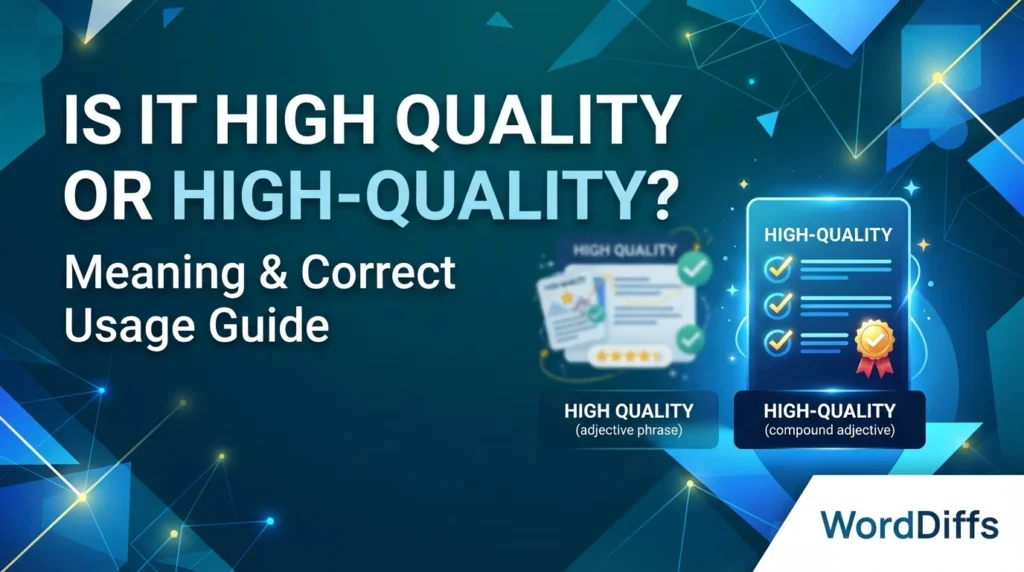
Many English learners and even experienced writers wonder whether they should write High Quality or High-Quality. The confusion comes from the fact that both forms are correct, but they are used in different grammatical situations. Unlike a typical spelling mistake, this is a punctuation and compound adjective issue involving the hyphen. Knowing when to use the hyphen can make your writing clearer and more professional. In this guide, you will learn the meaning of both forms, the grammar rules behind them, pronunciation, common mistakes, memory tricks, origin, and plenty of real-world examples so you can confidently choose the correct form every time.
Quick Facts Table
| Feature | Details |
| Correct Word | High quality and high-quality (both correct in different contexts) |
| Incorrect Word | Neither is inherently incorrect, but using the wrong form for the sentence is a grammar mistake |
| Word Type | Adjective phrase / Compound adjective |
| Meaning | Refers to something of excellent or superior quality |
| Pronunciation | /ˌhaɪ ˈkwɑːləti/ (US), /ˌhaɪ ˈkwɒləti/ (UK) |
| Common Error | Omitting or adding the hyphen in the wrong position |
| Difficulty | Moderate |
What Does High Quality or High-Quality Mean?
Both high quality and high-quality describe something that has excellent standards, superior performance, or exceptional value. The difference is not in meaning, but in how the words function in a sentence.
High-quality is used as a compound adjective before a noun, while high quality is used after a verb or as a noun phrase.
Key Points
- Both forms express excellence.
- The meaning remains the same.
- The hyphen depends on grammatical position.
- The hyphen improves readability before a noun.
Examples
- This is a high-quality camera.
- The camera is high quality.
- They manufacture high-quality furniture.
- Their furniture is consistently high quality.
Is “High Quality” Correct?
Yes. High quality is completely correct when it appears after a linking verb or functions as a noun phrase.
Many writers mistakenly believe the hyphen is always necessary. However, standard English grammar uses the hyphen only when the two words work together before a noun.
When “High Quality” Is Correct
Use high quality:
- after is, are, was, or were
- after other linking verbs such as looks, seems, and becomes
- as part of a noun phrase
Examples
- This laptop is high quality.
- Their customer service remains high quality.
- The materials appear high quality.
- Our goal is to provide high quality.
What Is the Correct Spelling?
The correct choice depends entirely on the sentence structure.
Use high-quality before a noun because the two words work together as one adjective.
Use high quality after the noun or linking verb because the phrase is no longer acting as a compound adjective.
Use high-quality Before a Noun
- high-quality products
- high-quality education
- high-quality images
- high-quality equipment
- high-quality materials
Use high quality After the Noun
- The products are high quality.
- The education is high quality.
- The images look high quality.
- The equipment remains high quality.
- Their service is high quality.
Difference Between the Two Spellings
| Feature | High Quality | High-Quality |
| Correct? | Yes | Yes |
| Hyphen | No | Yes |
| Function | Predicate adjective or noun phrase | Compound adjective |
| Position | Usually after the noun or linking verb | Before the noun |
| Grammar Rule | No hyphen needed | Hyphen joins two words modifying one noun |
| Example | The chair is high quality. | This is a high-quality chair. |
Why This Difference Matters
The hyphen tells readers that high and quality work together to describe the following noun. Without the hyphen before a noun, readers may briefly misread the sentence.
Compare these examples:
- They sell high-quality software.
- Their software is high quality.
Both are correct because each follows standard English grammar.
Meaning of the Correct Word
Whether written as high quality or high-quality, the phrase refers to something that is excellent, reliable, well-made, or superior compared with ordinary alternatives.
It often describes products, services, education, writing, photography, manufacturing, healthcare, technology, and craftsmanship.
Common Uses
- excellent workmanship
- superior materials
- dependable performance
- professional standards
- premium products
- exceptional customer service
- accurate information
Examples
- The company produces high-quality electronics.
- Her research is known for its high quality.
- Customers expect high-quality support.
- The restaurant serves high-quality food.
- This software delivers high quality performance.
Pronunciation
IPA Pronunciation
American English: /ˌhaɪ ˈkwɑːləti/
British English: /ˌhaɪ ˈkwɒləti/
Syllable Breakdown
High: high
Quality: qual • i • ty
Complete phrase:
High | Qual | i | ty
Pronunciation Tips
- Stress the first syllable of quality.
- Pronounce high clearly.
- Do not pause unnaturally between the words.
- The hyphen does not change pronunciation.
- Speak both forms exactly the same way.
Why Do People Make This Spelling Mistake?
Although this is not a spelling error, many writers misuse the hyphen because compound adjective rules are not always obvious.
Common reasons include:
- Confusion about hyphenation rules.
- Assuming every compound adjective always needs a hyphen.
- Copying inconsistent writing from websites.
- Typing quickly without checking grammar.
- Not recognizing whether the phrase comes before or after the noun.
- Influence from informal online writing.
- Unfamiliarity with style guides.
Remember this simple rule:
Before a noun: use the hyphen.
After a noun or linking verb: leave out the hyphen.
Origin and Etymology
The adjective high comes from Old English hēah, meaning elevated, great, or superior.
The noun quality comes from the Latin qualitas, meaning character, nature, or attribute. It entered English through Old French during the Middle English period.
Over time, English speakers combined these words to describe excellence. Modern style guides later adopted the hyphenated form high-quality when the phrase functions as a compound adjective before a noun, making sentences easier to read and less ambiguous.
How to Remember the Correct Spelling
The easiest way to remember the rule is to focus on what comes next.
Memory Tricks
- If a noun follows immediately, add the hyphen.
high-quality laptop - If the sentence ends after “quality,” remove the hyphen.
The laptop is high quality. - Think of the hyphen as a small bridge joining two words before they describe one noun.
- Ask yourself, “Are these two words acting as one adjective?” If yes, use the hyphen.
Quick Spelling Hacks
- Before a noun = high-quality
- After a verb = high quality
- Same meaning, different grammar
- Pronunciation never changes
Examples in Sentences
| Incorrect Sentence | Correct Sentence |
| This is a high quality product. | This is a high-quality product. |
| We sell high quality furniture. | We sell high-quality furniture. |
| She bought a high quality camera. | She bought a high-quality camera. |
| They provide high quality education. | They provide high-quality education. |
| The company makes high quality tools. | The company makes high-quality tools. |
| This phone is high-quality. | This phone is high quality. |
| Their work remains high-quality. | Their work remains high quality. |
| The service looks high-quality. | The service looks high quality. |
| These materials are high-quality. | These materials are high quality. |
| The design seems high-quality. | The design seems high quality. |
| We need high quality images for the website. | We need high-quality images for the website. |
| They manufacture high quality equipment. | They manufacture high-quality equipment. |
| Her writing is high-quality. | Her writing is high quality. |
| The report appears high-quality. | The report appears high quality. |
| Customers appreciate high quality customer support. | Customers appreciate high-quality customer support. |
Common Mistakes to Avoid
Even though both high quality and high-quality are correct, using them in the wrong place is a common grammar mistake. Follow these guidelines to avoid confusion.
- Using “high quality” before a noun
- Incorrect: They sell high quality products.
- Correct: They sell high-quality products.
- Using “high-quality” after a linking verb
- Incorrect: The products are high-quality.
- Correct: The products are high quality.
- Adding a hyphen unnecessarily
- The hyphen is not needed when the phrase follows the noun.
- Removing the hyphen from a compound adjective
- Without the hyphen before a noun, readers may momentarily misunderstand the sentence.
- Being inconsistent
- Use the appropriate form based on sentence structure, not personal preference.
Similar Commonly Misspelled Words
| Word Pair | Correct Usage |
| High quality / High-quality | Depends on sentence position |
| Well known / Well-known | Hyphen before a noun, usually not after a verb |
| Long term / Long-term | Hyphen before a noun |
| Full time / Full-time | Hyphen before a noun |
| Part time / Part-time | Hyphen before a noun |
| Up to date / Up-to-date | Hyphen before a noun |
| Decision making / Decision-making | Hyphen before a noun |
| World class / World-class | Hyphen before a noun |
| User friendly / User-friendly | Hyphen before a noun |
| State of the art / State-of-the-art | Hyphen before a noun |
Related Words
Synonyms
- Excellent
- Superior
- Premium
- First-rate
- Exceptional
- Outstanding
- Top-grade
- Reliable
- Fine
- Well-made
Antonyms
- Poor quality
- Low quality
- Inferior
- Defective
- Substandard
- Cheap
- Mediocre
- Faulty
Related Forms
- Quality
- Qualitative
- Qualify
- Qualified
- Qualifier
- Premium quality
- Superior quality
- High-grade
- Well-crafted
Grammar Tips
Following these grammar rules will help you use the phrase correctly every time.
- Use “high-quality” before a noun.
- They manufacture high-quality furniture.
- Use “high quality” after a linking verb.
- Their furniture is high quality.
- The hyphen connects two words acting as one adjective.
- Do not hyphenate simply because the phrase contains two words.
- Read the sentence aloud. If the phrase directly describes the following noun, a hyphen is usually needed.
Writing Tips
These practical tips can improve your professional and academic writing.
- Check whether the phrase comes before or after the noun.
- Follow a consistent style throughout your document.
- Remember that the meaning does not change, only the grammar.
- Proofread compound adjectives carefully.
- Follow your organization’s preferred style guide when writing professionally.
- Use hyphens to improve readability, not decoration.
- Practice with real examples until the rule becomes automatic.
Quick Spelling Checklist
| Checklist | Yes/No |
| Is the phrase before a noun? Use high-quality | ✓ |
| Is the phrase after a linking verb? Use high quality | ✓ |
| Have you avoided unnecessary hyphens? | ✓ |
| Does the sentence read naturally? | ✓ |
| Have you checked grammar instead of relying on spellcheck? | ✓ |
| Is the usage consistent throughout the document? | ✓ |
| Have you proofread the final version? | ✓ |
Key Takeaways
- Both “high quality” and “high-quality” are correct.
- Use “high-quality” before a noun.
- Use “high quality” after a linking verb or as a noun phrase.
- The hyphen changes grammar, not meaning.
- The pronunciation stays the same in both forms.
- Correct hyphenation makes writing clearer and more professional.
- Learning compound adjective rules helps with many similar expressions.
Conclusion
Understanding the difference between high quality and high-quality is more about grammar than spelling. Both forms express the same idea of excellence, but they serve different grammatical roles. Use high-quality when the phrase comes directly before a noun, such as high-quality materials. Use high quality after a linking verb, as in The materials are high quality. This simple rule will help you write with greater accuracy and confidence in academic, business, and everyday English. With regular practice and careful proofreading, choosing the correct form will soon become second nature, making your writing clearer, more polished, and more professional.
Frequently Asked Questions
Is “high quality” or “high-quality” correct?
Both are correct. Use high-quality before a noun because it functions as a compound adjective. Use high quality after a linking verb or as a noun phrase. The choice depends on grammar rather than spelling.
Why does “high-quality” need a hyphen?
The hyphen joins high and quality into one compound adjective when they describe a noun together. This makes the sentence easier to read and prevents ambiguity.
Can I write “high quality products”?
In formal writing, high-quality products is preferred because the phrase comes before the noun products. Without the hyphen, the sentence does not follow the standard rule for compound adjectives.
Is “the product is high-quality” correct?
Generally, no. After a linking verb such as is, the preferred form is high quality without a hyphen. The phrase is no longer functioning as a compound adjective.
Does the meaning change with the hyphen?
No. Both forms mean that something is of excellent quality. The hyphen changes only the grammatical function and not the meaning or pronunciation.
How do I remember when to use the hyphen?
A simple trick is to look at the next word. If a noun follows immediately, use high-quality. If the phrase comes after a verb like is or seems, use high quality.
Is this rule used in academic writing?
Yes. Academic, business, and professional writing generally follow this rule because it improves clarity and consistency. Many major style guides recommend this approach.
Are there other expressions with the same rule?
Yes. Similar examples include well-known, long-term, full-time, up-to-date, and user-friendly when they appear before nouns. Many compound adjectives follow this pattern.
Is this considered a spelling mistake?
Not exactly. It is usually a hyphenation or grammar mistake, not a spelling error. Both words are spelled correctly, but the punctuation depends on their role in the sentence.
Will using the wrong form affect professional writing?
Yes. Incorrect hyphenation can make writing appear less polished and may distract careful readers. Using the appropriate form demonstrates attention to grammar and editorial standards.
Is “high quality” accepted in exams?
Yes, provided it is used correctly. Examiners typically expect high-quality before a noun and high quality after a linking verb. Following this rule shows a strong understanding of English grammar.
