
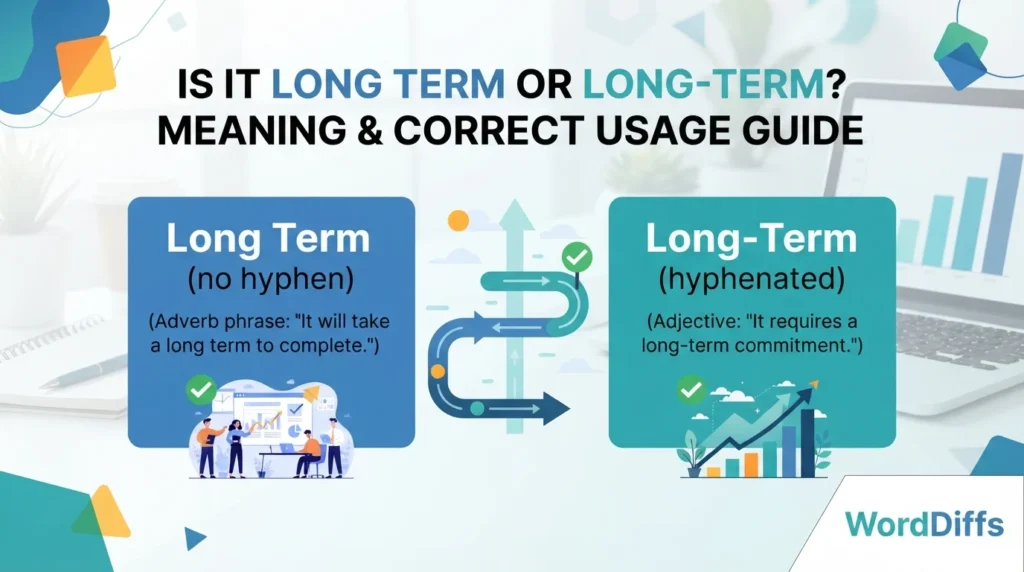
Many writers wonder whether they should write long term or long-term. The confusion comes from the fact that both forms are correct, but they are used in different grammatical situations. Unlike a simple spelling mistake, this is a punctuation and compound modifier issue that often appears in business writing, academic papers, resumes, and everyday English. Knowing when to use a hyphen can make your writing clearer and more professional. In this guide, you will learn the difference between long term and long-term, their meanings, pronunciation, grammar rules, origins, memory tips, and plenty of practical examples to help you use each form with confidence.
Quick Facts Table
| Feature | Details |
| Correct Word | Long term and long-term (both are correct depending on usage) |
| Incorrect Word | Neither is universally incorrect |
| Word Type | Noun phrase and compound adjective |
| Meaning | Referring to an extended period of time |
| Pronunciation | /ˌlɔːŋ ˈtɜːrm/ |
| Common Error | Using or omitting the hyphen incorrectly |
| Difficulty | Easy to Moderate |
What Does Long Term or Long-Term Mean?
Both long term and long-term refer to something that lasts for a considerable period. The difference is not in meaning but in grammar and punctuation.
Long-term is used as a compound adjective before a noun.
Long term is used as a noun phrase or an adverbial expression after a verb or linking verb.
For example:
- We need a long-term strategy.
- Our success depends on the long term.
Key Points
- Both forms share the same meaning.
- The hyphen changes the grammatical role.
- Correct usage depends on sentence structure.
- Professional writing usually follows this distinction.
Examples
- Long-term planning improves business growth.
- She is thinking about the long term.
- We need long-term investments.
- They focused on the long term rather than quick profits.
Is “Long Term” Correct?
Yes. Long term is correct when it is not directly modifying a noun.
It usually appears after verbs, prepositions, or linking verbs.
Examples include:
- We are planning for the long term.
- This solution works well in the long term.
- Think about the long term, not just today.
Why People Think It Is Wrong
Many people assume every compound expression needs a hyphen. However, English grammar only requires the hyphen when the compound acts as an adjective before a noun.
Common Situations
People correctly use long term:
- After a preposition
- As the object of a sentence
- When discussing future outcomes
- In general conversations
Examples
Correct:
- They invested for the long term.
- We should think about the long term.
Incorrect:
- They created a long term plan.
Correct:
- They created a long-term plan.
What Is the Correct Spelling?
The correct form depends entirely on grammar.
Use long-term before a noun.
Use long term when it stands alone as a noun phrase.
Rules
Use “long-term” when it comes before a noun.
Examples:
- a long-term project
- a long-term solution
- a long-term agreement
- a long-term investment
Use “long term” when it is not modifying a noun.
Examples:
- We are thinking long term.
- The company focuses on the long term.
- This policy benefits us in the long term.
- Success comes from planning for the long term.
Difference Between the Two Spellings
| Feature | Long Term | Long-Term |
| Correct? | Yes | Yes |
| Hyphen | No | Yes |
| Grammar Role | Noun phrase or adverbial expression | Compound adjective |
| Used Before a Noun | No | Yes |
| Used After a Verb | Yes | Usually No |
| Meaning | Extended period | Lasting for an extended period |
Explanation
Although the meaning remains the same, the grammatical function changes.
For example:
- We need a long-term plan.
- We must think about the long term.
The first modifies the noun plan. The second functions as a noun phrase.
Meaning of the Correct Word
The expression refers to something involving an extended period rather than immediate or short-lived results.
It is commonly used in:
- Business
- Education
- Finance
- Healthcare
- Personal development
- Government policies
- Career planning
Examples
- A long-term investment usually grows steadily.
- The company adopted a long-term vision.
- We should always consider the long term.
- Good habits create long-term success.
Common Uses
- long-term goals
- long-term care
- long-term planning
- long-term contract
- long-term effects
- long-term relationship
- thinking about the long term
- planning for the long term
Pronunciation
IPA Pronunciation
Long term / Long-term
IPA: /ˌlɔːŋ ˈtɜːrm/
Syllable Breakdown
Long
Term
Two words, each with one syllable.
Pronunciation Tips
- Stress the word term slightly more than long.
- Keep both words clearly separated.
- The hyphen does not change pronunciation.
- Speak naturally without pausing between the two words.
Why Do People Make This Spelling Mistake?
Many writers confuse these forms because the pronunciation is identical.
Common Reasons
- The spoken form gives no clue about the hyphen.
- Many people believe all compound expressions need hyphens.
- Fast typing often leads writers to omit punctuation.
- Some style guides simplify hyphen use, creating inconsistency.
- Memory errors cause people to forget whether the phrase comes before a noun.
- Regional publishing styles may differ slightly, especially between newspapers and digital media.
Understanding the grammatical role is the easiest way to choose the correct form.
Origin and Etymology
The adjective long comes from Old English lang, meaning extended in distance or duration.
The noun term comes from the Latin terminus, meaning boundary, limit, or fixed period.
As English developed, writers combined the two words to describe lengthy periods. The hyphenated form later became standard when the expression was used as a compound adjective before nouns. Modern English style guides continue to recommend this distinction because it improves readability and prevents ambiguity.
How to Remember the Correct Spelling
A simple memory trick is to check the word immediately after the phrase.
If a noun follows, use the hyphen.
If no noun follows, do not use the hyphen.
Memory Tricks
- Hyphen before a noun.
- No noun, no hyphen.
- Read the sentence aloud to identify the modifier.
- Replace it with another compound adjective to test the structure.
Quick Spelling Hacks
- Ask, “Is a noun coming next?”
- If yes, write long-term.
- If no, write long term.
- Proofread headlines carefully because compound adjectives often appear there.
Examples in Sentences
| Incorrect Sentence | Correct Sentence |
| We need a long term strategy. | We need a long-term strategy. |
| She signed a long term contract. | She signed a long-term contract. |
| They launched a long term project. | They launched a long-term project. |
| This is a long term solution. | This is a long-term solution. |
| He wants a long term career. | He wants a long-term career. |
| We should plan for the long-term. | We should plan for the long term. |
| Success depends on the long-term. | Success depends on the long term. |
| Investors think about the long-term. | Investors think about the long term. |
| We must prepare for the long-term. | We must prepare for the long term. |
| Their focus is the long-term. | Their focus is the long term. |
| She developed a long term business model. | She developed a long-term business model. |
| They adopted a long term vision. | They adopted a long-term vision. |
| Our goal is the long-term. | Our goal is the long term. |
| Think about the long-term, not today. | Think about the long term, not today. |
| The company needs a long term financial plan. | The company needs a long-term financial plan. |
Common Mistakes to Avoid
Although both long term and long-term are correct, writers often use them in the wrong grammatical position. Avoid these common mistakes to make your writing more accurate.
- Using “long term” before a noun
- Incorrect: We need a long term solution.
- Correct: We need a long-term solution.
- Using “long-term” after a preposition unnecessarily
- Incorrect: We are planning for the long-term.
- Correct: We are planning for the long term.
- Assuming one form is always correct
- Both forms are correct. The sentence structure determines which one to use.
- Ignoring compound adjective rules
- When two words work together to describe a noun before it appears, they usually take a hyphen.
- Being inconsistent within the same document
- Follow the same grammar rule throughout your writing for consistency.
Similar Commonly Misspelled Words
| Word Pair | Correct Usage |
| Long Term / Long-Term | Depends on grammar and position |
| Short Term / Short-Term | Same hyphen rule applies |
| Well Known / Well-Known | Hyphen before a noun |
| Full Time / Full-Time | Hyphen before a noun |
| Part Time / Part-Time | Hyphen before a noun |
| High Quality / High-Quality | Hyphen before a noun |
| Decision Making / Decision-Making | Hyphen when used as an adjective |
| Up To Date / Up-to-Date | Hyphen before a noun |
| Real Time / Real-Time | Hyphen before a noun |
| Life Long / Lifelong | Lifelong is the standard single-word form |
Related Words
Synonyms
Depending on context, similar expressions include:
- Extended
- Lasting
- Enduring
- Permanent
- Ongoing
- Sustainable
- Future-oriented
- Durable
- Continuing
- Prolonged
Antonyms
- Short-term
- Temporary
- Brief
- Immediate
- Momentary
- Short-lived
- Instant
Related Forms
- Long-term planning
- Long-term goal
- Long-term investment
- Long-term strategy
- Long-term commitment
- Long-term relationship
- Long-term effect
- Long-term care
- Long-term vision
- Long-term success
Grammar Tips
Following these grammar rules will help you use the expression correctly every time.
- Use a hyphen before a noun.
- A long-term project.
- Do not use a hyphen when the phrase stands alone.
- Think about the long term.
- Treat “long-term” as one descriptive unit.
- Proofread titles and headings carefully, since compound adjectives are common there.
- Read the sentence aloud. If the phrase directly describes the following noun, add the hyphen.
- Follow your style guide consistently. Most major English style guides use this rule.
Writing Tips
These practical tips can improve your writing.
- Identify whether the phrase describes a noun.
- Look at the next word before deciding on the hyphen.
- Avoid relying only on spell-checkers because many do not detect hyphenation errors.
- Maintain consistency throughout reports, essays, and articles.
- Review headings separately since punctuation errors often occur there.
- Practice with example sentences until the rule becomes automatic.
Quick Spelling Checklist
| Checklist | Yes/No |
| Is the phrase before a noun? | Use long-term |
| Is it functioning as a noun phrase? | Use long term |
| Does the hyphen improve clarity? | Yes |
| Have you checked the surrounding words? | Yes |
| Is the usage consistent throughout the document? | Yes |
| Does the sentence read naturally? | Yes |
Key Takeaways
- Both “long term” and “long-term” are correct.
- Use “long-term” before a noun.
- Use “long term” after verbs or prepositions.
- The meaning stays the same, but the grammar changes.
- The hyphen helps readers recognize a compound adjective.
- Learning this rule improves professional and academic writing.
- Checking the word that follows is the easiest way to choose the correct form.
Conclusion
Understanding the difference between long term and long-term is more about grammar than spelling. Both forms are accepted in modern English, but each serves a different purpose within a sentence. Use long-term when it functions as a compound adjective before a noun, such as long-term strategy or long-term investment. Use long term when the phrase stands alone as a noun phrase, such as planning for the long term. By remembering this simple rule and reviewing your sentence structure before writing, you can avoid one of the most common punctuation mistakes in English. With regular practice, choosing the correct form will become natural, making your writing clearer, more polished, and more professional.
Frequently Asked Questions
Is “long term” or “long-term” correct?
Both are correct. Use long-term before a noun because it acts as a compound adjective. Use long term when it functions as a noun phrase or follows a verb or preposition. The choice depends entirely on grammar rather than meaning.
Why does “long-term” have a hyphen?
The hyphen joins long and term into a single adjective that modifies the following noun. This punctuation improves clarity and prevents readers from misinterpreting the sentence. Many English compound adjectives follow this same pattern.
When should I write “long term” without a hyphen?
Write long term when the phrase is not directly describing a noun. It commonly appears after verbs, linking verbs, or prepositions. For example, The company is focused on the long term is the correct structure.
Does the hyphen change the meaning?
No. The meaning remains the same in both forms. Both refer to an extended period of time. The only difference is grammatical function and sentence structure, not definition.
Is “long-term plan” correct?
Yes. Long-term plan is correct because long-term modifies the noun plan. The hyphen signals that both words work together as one descriptive adjective before the noun.
Is “thinking long term” correct?
Yes. In this sentence, long term is used without a hyphen because it is not directly modifying a noun. It functions as an adverbial expression describing the way someone is thinking.
Do American and British English use the same rule?
Yes. Both American and British English generally follow the same hyphenation rule for long-term and long term. Some publishers have minor style differences, but the basic grammar remains the same.
Is this considered a spelling mistake?
Not exactly. This is usually a hyphenation and grammar mistake, not a spelling error. Both words are spelled correctly, but the incorrect punctuation can make the sentence grammatically inaccurate.
How can I remember the correct usage?
A simple memory trick is to check the next word. If a noun immediately follows, use long-term. If no noun follows, use long term. This quick check works in almost every situation.
Is the rule important in exams and professional writing?
Yes. Teachers, editors, and employers often expect proper hyphenation in formal writing. Using long-term and long term correctly demonstrates attention to grammar and helps create clear, polished documents.
Can spell-checkers detect this mistake?
Not always. Many spell-checkers recognize both forms as valid words and may not identify incorrect hyphenation. Proofreading your sentence structure is still the best way to ensure correct usage.

Carter is an English language specialist, author, and senior editor with more than 20 years of experience in English grammar, writing, editing, and language education. Throughout his career, he has worked with educational organizations, digital publishers, and content teams to develop accurate, engaging, and learner-focused resources. His expertise includes English grammar, spelling, vocabulary, commonly confused words, proofreading, copy editing, academic writing, and SEO content strategy. Carter is passionate about helping learners and writers improve their communication skills through clear explanations, practical examples, and high-quality educational content.