
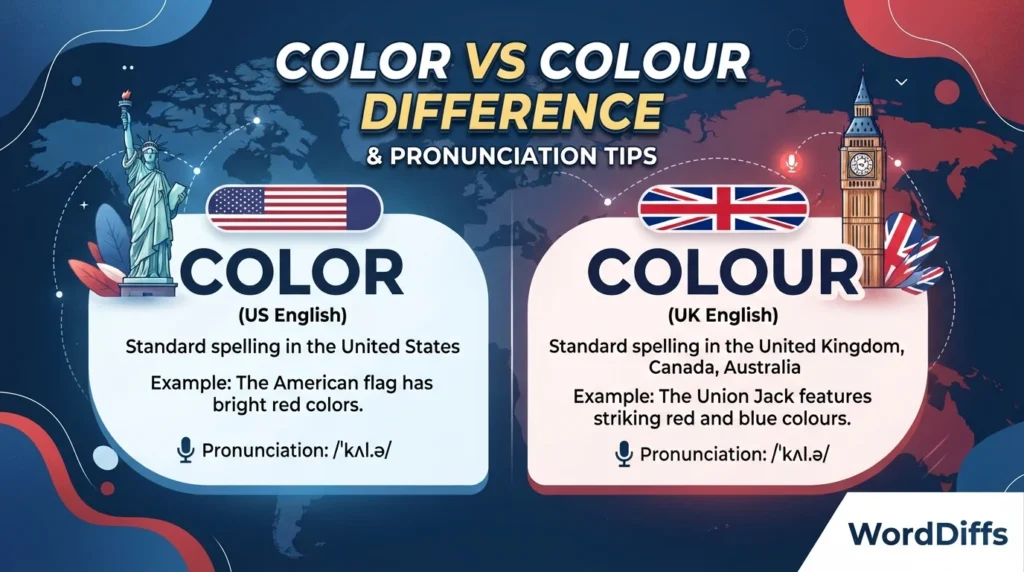
Many English learners wonder whether they should write color or colour. The good news is that both spellings are correct. The difference is not in meaning, pronunciation, grammar, or usage. Instead, the distinction lies in the variety of English you are writing.
Color is the standard spelling in American English (US English), while colour is the standard spelling in British English (UK English). Other countries such as Canada, Australia, New Zealand, Ireland, and South Africa generally follow the British spelling colour, although Canadian English sometimes uses a mixture of British and American spellings depending on the publication or style guide.
Whether you are writing an essay, email, website, business report, or examination answer, it is important to use one spelling consistently. Mixing color and colour in the same document can make your writing look inconsistent.
In this guide, you’ll learn the pronunciation, meanings, grammar, sentence functions, common collocations, UK vs USA spelling differences, related words, and practical examples for color and colour. By the end, you’ll know exactly which spelling to use and when.
Color
Pronunciation
IPA Pronunciation
| Accent | IPA |
| American English (USA) | /ˈkʌlər/ |
| British English (UK) | /ˈkʌlə/ |
Easy Pronunciation Guide
Pronounced as: KUH-lər (American) or KUH-luh (British)
Number of syllables: 2
Word stress: First syllable (KUH)
Beginner Pronunciation Tips
- Say cup without the p sound to begin the first syllable.
- Stress the first syllable.
- Americans pronounce the final r.
- Most British speakers do not pronounce the final r unless another vowel follows.
Meaning
Color is the American English spelling of the word referring to the appearance of something based on the light it reflects or emits.
It may refer to:
- A hue or shade
- A pigment used in art or painting
- The appearance of an object
- Decorative qualities
- Symbolic meanings, such as national colors or team colors
The meaning is identical to colour.
UK vs USA
| Feature | American English (USA) | British English (UK) |
| Preferred spelling | ✅ Color | ❌ Colour |
| Correct in that variety? | Yes | Usually not |
| Pronunciation | Almost identical | Almost identical |
| Meaning | Same | Same |
Countries That Prefer “Color”
The spelling color is standard in:
- United States
- American publications
- Most American textbooks
- US government documents
- American businesses
- American universities
Typical Situations
Use color when talking about:
- Art
- Fashion
- Interior design
- Printing
- Photography
- Science
- Nature
- Marketing
- Computer graphics
- Education
Examples:
- The flower has a beautiful color.
- Red is my favorite color.
- The designer selected a warm color palette.
Part of Speech
| Feature | Description |
| Part of Speech | Noun |
| Also Used As | Verb |
| Sentence Function | Subject, object, complement, or verb |
Grammar and Usage
As a noun, color can be countable or uncountable.
Countable
- The rainbow has many colors.
Uncountable
- Color adds beauty to paintings.
As a verb, color means to make something colorful.
Examples:
- Please color the picture.
- She colored the butterfly.
Common Grammar Patterns
- color of
- favorite color
- color palette
- color scheme
- color wheel
- add color
- lose color
- change color
- full color
- true color
Common Collocations
- favorite color
- bright color
- dark color
- primary color
- secondary color
- natural color
- skin color
- eye color
- hair color
- vivid color
- color correction
- color grading
- color printer
- color palette
- color blindness
Word Forms
| Form | Example |
| Noun | color |
| Verb | color |
| Adjective | colorful |
| Adjective | colorless |
| Noun | coloration |
| Adverb | colorfully |
Grammar Function Table
| Grammar Function | Explanation | Example |
| Subject | Performs the action | Color affects our emotions. |
| Object | Receives the action | I like this color. |
| Modifier | Modifies another noun | Color printer |
Example Sentences
Example 1
Sentence
Blue is my favorite color.
Meaning
Blue is the speaker’s preferred shade.
Grammar Explanation
Color is a noun functioning as a subject complement.
Example 2
Sentence
The leaves changed color in autumn.
Meaning
The leaves became different shades.
Grammar Explanation
Color functions as the object after the verb changed.
Example 3
Sentence
Please color the picture carefully.
Meaning
Fill the picture with colors.
Grammar Explanation
Color is used as an imperative verb.
Example 4
Sentence
The artist mixed several colors.
Meaning
The artist combined different pigments.
Grammar Explanation
Colors is a plural countable noun.
Example 5
Sentence
The company changed its logo color.
Meaning
The logo now has a different shade.
Grammar Explanation
Color modifies the noun logo.
Example 6
Sentence
Bright colors attract children’s attention.
Meaning
Vivid shades easily catch attention.
Grammar Explanation
Colors functions as the subject.
Example 7
Sentence
The room needs more color.
Meaning
The room looks plain and needs brighter shades.
Grammar Explanation
Color is an uncountable noun referring to the general concept.
Related Words
| Related Word | Meaning | Example Sentence |
| colorful | full of colors | The market is colorful. |
| colorless | without color | The liquid is colorless. |
| coloration | arrangement of colors | The bird’s coloration helps it hide. |
| hue | shade of color | Blue is a calming hue. |
| shade | variation of a color | I prefer a darker shade. |
| tint | lighter version of a color | Add white to create a tint. |
| tone | depth of a color | The wall has a warm tone. |
| pigment | coloring substance | Natural pigments are environmentally friendly. |
| palette | collection of colors | The designer chose a pastel palette. |
| spectrum | complete range of colors | A rainbow shows the visible spectrum. |
Colour
Pronunciation
IPA Pronunciation
| Accent | IPA |
| British English (UK) | /ˈkʌlə/ |
| American English (USA) | /ˈkʌlər/ (if encountered) |
Easy Pronunciation Guide
Pronounced as: KUH-luh (British) or KUH-lər (American)
Number of syllables: 2
Word stress: First syllable (KUH)
Beginner Pronunciation Tips
- Begin with the short “u” sound as in cup.
- Stress the first syllable.
- The u in the spelling colour is not pronounced separately.
- British speakers usually do not pronounce the final r, while American speakers do.
Meaning
Colour is the British English spelling of color. It refers to the appearance of something based on the light it reflects or emits. The spelling changes, but the meaning remains exactly the same.
Common meanings include:
- A hue or shade
- A pigment used for painting or printing
- The appearance of an object
- A decorative feature
- A symbolic representation, such as national colours or team colours
There is no difference in definition between color and colour.
UK vs USA
| Feature | British English (UK) | American English (USA) |
| Preferred spelling | ✅ Colour | ❌ Color |
| Correct in that variety? | Yes | Usually not |
| Meaning | Same | Same |
| Pronunciation | Almost identical | Almost identical |
Countries That Prefer “Colour”
The spelling colour is standard in:
- United Kingdom
- Australia
- New Zealand
- Ireland
- South Africa
- Most Commonwealth countries
- Many Canadian publications and educational institutions
Typical Situations
Use colour when writing in British English, especially in:
- UK schools and universities
- British newspapers
- UK government documents
- Academic writing following British style
- Australian and New Zealand publications
- International English contexts that use British spelling
Examples:
- What is your favourite colour?
- The room needs more colour.
- The artist used bright colours in the painting.
Part of Speech
| Feature | Description |
| Part of Speech | Noun |
| Also Used As | Verb |
| Sentence Function | Subject, object, complement, or verb |
Grammar and Usage
The grammar of colour is identical to that of color.
As a noun, it may be countable or uncountable.
Countable
- The painting contains many colours.
Uncountable
- Colour makes the room feel warmer.
As a verb, it means to add colour to something.
Examples:
- Colour the map carefully.
- She coloured the picture beautifully.
Common Grammar Patterns
- colour of
- favourite colour
- colour palette
- colour scheme
- colour wheel
- add colour
- lose colour
- change colour
- full colour
- true colours
Common Collocations
- favourite colour
- bright colour
- dark colour
- primary colour
- secondary colour
- natural colour
- skin colour
- eye colour
- hair colour
- colour palette
- colour scheme
- colour printer
- colour blindness
- colour grading
- colour correction
Word Forms
| Form | Example |
| Noun | colour |
| Verb | colour |
| Adjective | colourful |
| Adjective | colourless |
| Noun | colouration |
| Adverb | colourfully |
Grammar Function Table
| Grammar Function | Explanation | Example |
| Subject | Performs the action | Colour influences emotion. |
| Object | Receives the action | I like this colour. |
| Modifier | Forms compound nouns | Colour printer |
Example Sentences
Example 1
Sentence
Green is my favourite colour.
Meaning
Green is the speaker’s preferred shade.
Grammar Explanation
Colour is a noun used as a subject complement.
Example 2
Sentence
The flowers added colour to the garden.
Meaning
The flowers made the garden look brighter.
Grammar Explanation
Colour is the direct object of the verb added.
Example 3
Sentence
Please colour the picture neatly.
Meaning
Fill the picture using colours.
Grammar Explanation
Colour functions as an imperative verb.
Example 4
Sentence
The artist experimented with warm colours.
Meaning
The artist used shades such as red, orange, and yellow.
Grammar Explanation
Colours is a plural countable noun.
Example 5
Sentence
The leaves lost their colour during winter.
Meaning
The leaves faded as the season changed.
Grammar Explanation
Colour is the object of the possessive phrase their.
Example 6
Sentence
The designer selected a modern colour palette.
Meaning
The designer chose a matching collection of shades.
Grammar Explanation
Colour modifies the noun palette.
Example 7
Sentence
Natural colours make the room feel relaxing.
Meaning
Earthy shades create a calm atmosphere.
Grammar Explanation
Colours functions as the subject of the sentence.
Related Words
| Related Word | Meaning | Example Sentence |
| colourful | full of many colours | The festival was colourful. |
| colourless | without colour | The liquid appeared colourless. |
| colouration | arrangement of colours | The butterfly’s colouration provides camouflage. |
| hue | a particular shade | Purple is a rich hue. |
| shade | variation of a colour | I prefer this lighter shade. |
| tint | lighter version of a colour | Add white to create a tint. |
| tone | depth or intensity of a colour | The tone complements the furniture. |
| pigment | colouring substance | Natural pigments are widely used in art. |
| palette | collection of colours | The artist chose a soft palette. |
| spectrum | full range of visible colours | A prism separates light into its spectrum. |
Comparing Color vs Colour
Quick Comparison Table
| Feature | Color | Colour |
| Meaning | Appearance or hue of something | Same meaning |
| Pronunciation | /ˈkʌlər/ (US) | /ˈkʌlə/ (UK) |
| Part of Speech | Noun, Verb | Noun, Verb |
| Grammar | Same | Same |
| Preferred Region | United States | United Kingdom, Australia, New Zealand, Ireland, most Commonwealth countries |
| Spelling Style | American English | British English |
| Common Examples | favorite color, color palette | favourite colour, colour palette |
| Correct? | Yes, in American English | Yes, in British English |
| Meaning Difference | None | None |
Biggest Differences
The only real difference between color and colour is spelling.
- Color is the standard American English spelling.
- Colour is the standard British English spelling.
- Both words have the same pronunciation, meaning, grammar, and usage.
- Neither spelling is more correct than the other. The appropriate choice depends on the variety of English you are using.
- Maintain one spelling style consistently throughout a document. For example, if you write favorite, use color, not colour. Likewise, if you write favourite, use colour, not color.
Sentence Comparisons
The following examples show how color and colour are used in similar contexts. The meaning stays the same, but the spelling changes according to the variety of English.
Comparison 1
American English: My favorite color is blue.
British English: My favourite colour is blue.
Why is this correct?
The only difference is spelling. American English uses favorite and color, while British English uses favourite and colour.
Grammar Role
In both sentences, color/colour is a noun functioning as a subject complement.
Comparison 2
American English: Please color the picture carefully.
British English: Please colour the picture carefully.
Why is this correct?
Both words function as verbs meaning “to add color.”
Grammar Role
Imperative verb.
Comparison 3
American English: The leaves changed color in autumn.
British English: The leaves changed colour in autumn.
Why is this correct?
The meaning is identical. Only the regional spelling differs.
Grammar Role
Direct object.
Comparison 4
American English: The designer selected a warm color palette.
British English: The designer selected a warm colour palette.
Why is this correct?
The noun phrase changes only in spelling.
Grammar Role
Modifier in a compound noun.
Comparison 5
American English: The printer produces high-quality color images.
British English: The printer produces high-quality colour images.
Why is this correct?
Both refer to images printed in multiple colours rather than black and white.
Grammar Role
Modifier.
Comparison 6
American English: Her eye color is green.
British English: Her eye colour is green.
Why is this correct?
Both describe the appearance of the eyes.
Grammar Role
Subject complement.
Comparison 7
American English: Bright colors make the room feel cheerful.
British English: Bright colours make the room feel cheerful.
Why is this correct?
The plural spelling changes according to the regional standard.
Grammar Role
Subject.
Comparison 8
American English: The company changed its brand color.
British English: The company changed its brand colour.
Why is this correct?
Both refer to the official shade used for branding.
Grammar Role
Object.
Comparison 9
American English: The artist mixed several colors together.
British English: The artist mixed several colours together.
Why is this correct?
Both sentences describe combining pigments.
Grammar Role
Plural object.
Comparison 10
American English: This app lets you adjust the color settings.
British English: This app lets you adjust the colour settings.
Why is this correct?
Software developed for different regions often uses the spelling appropriate for the target audience.
Grammar Role
Modifier.
Common Mistakes
Many English learners understand the meaning of color and colour, but they often make mistakes by mixing spelling styles or using the wrong regional form.
| Incorrect Sentence | Correct Sentence | Explanation |
| My favourite color is blue. | My favourite colour is blue. | British spelling should be consistent. |
| My favorite colour is blue. | My favorite color is blue. | American spelling should be consistent. |
| Please colour this picture. (US English exam) | Please color this picture. | American English prefers color. |
| Please color this picture. (UK English exam) | Please colour this picture. | British English prefers colour. |
| The colour printer is on sale. (US website) | The color printer is on sale. | Match the spelling to American English. |
| The color printer is on sale. (UK brochure) | The colour printer is on sale. | Match the spelling to British English. |
| My favorite colour changed yesterday. | My favorite color changed yesterday. | Do not mix favorite with colour in American English. |
| My favourite color changed yesterday. | My favourite colour changed yesterday. | Do not mix favourite with color in British English. |
Easy Memory Tricks
1. Remember the Country
- Color = USA
- Colour = UK and most Commonwealth countries
Think:
- America drops the “u”.
- Britain keeps the “u”.
2. Match Similar Spellings
American English:
- color
- favorite
- honor
- labor
- neighbor
British English:
- colour
- favourite
- honour
- labour
- neighbour
If one word contains ou, the others usually do too.
3. Look at the Keyboard
When writing for an American audience, simply omit the u.
colour → color
4. Remember the Rule
The meaning never changes.
Only the spelling changes according to the type of English.
5. Think About Your Audience
Ask yourself:
- Is this for an American reader? Use color.
- Is this for a British or Australian reader? Use colour.
6. Keep Your Writing Consistent
Never mix spelling styles in the same document.
✔ American English
- color
- favorite
- center
- organize
✔ British English
- colour
- favourite
- centre
- organise
Consistency makes your writing look natural and professional.
Practice Quiz
Test your understanding of Color vs Colour with these questions. Remember that both spellings are correct, but the choice depends on whether you are using American English or British English.
Question 1: Multiple Choice
Which spelling is preferred in American English?
A) Colour
B) Color
C) Coloure
D) Coler
Correct Answer: B) Color
Explanation:
American English usually removes the letter u from words like color, favorite, and honor.
Question 2: Fill in the Blank
My favourite ______ is green. (British English)
Correct Answer: Colour
Explanation:
British English uses colour with the extra u.
Question 3: Choose the Correct Word
The artist used many bright ______ in the painting.
A) color
B) colour
C) Both color and colour
Correct Answer: C) Both color and colour
Explanation:
Both words are grammatically correct. The choice depends on the spelling system being used.
Question 4: Sentence Correction
Correct this sentence:
My favorite colour is red.
Correct Answer:
My favorite color is red.
Explanation:
The sentence uses favorite, which follows American English spelling. Therefore, color is the matching form.
Question 5: Multiple Choice
Which sentence uses British English correctly?
A) My favorite color is blue.
B) My favourite colour is blue.
C) My favourite color is blue.
D) My favorite colour is blue.
Correct Answer: B) My favourite colour is blue.
Explanation:
British English uses favourite and colour.
Question 6: Fill in the Blank
Please ______ the picture before submitting your homework. (US English)
Correct Answer: Color
Explanation:
In American English, the verb form is spelled color.
Question 7: Choose the Correct Word
The company changed its brand ______ last year.
A) color
B) colour
C) Both are possible
Correct Answer: C) Both are possible
Explanation:
Both spellings are correct. Use color in American English and colour in British English.
Question 8: Sentence Correction
Correct this sentence:
The centre has a new color scheme. (British English)
Correct Answer:
The centre has a new colour scheme.
Explanation:
British English uses colour. The sentence already uses centre, another British spelling.
Question 9: Multiple Choice
What is the main difference between color and colour?
A) Different meanings
B) Different pronunciation
C) Different spelling systems
D) Different parts of speech
Correct Answer: C) Different spelling systems
Explanation:
The words have the same meaning and grammar. The difference is regional spelling.
Question 10: Fill in the Blank
The rainbow has seven ______. (American English)
Correct Answer: Colors
Explanation:
American English uses colors without the extra u.
Frequently Asked Questions
What is the difference between color and colour?
Color and colour have the same meaning. The difference is spelling. Color is American English, while colour is British English.
Is color or colour the correct spelling?
Both are correct. The correct choice depends on the type of English you are using.
Is color American or British?
Color is the American English spelling used in the United States.
Is colour British or American?
Colour is the British English spelling used in the United Kingdom and many Commonwealth countries.
Do color and colour have different pronunciations?
No. They are pronounced almost the same. The main pronunciation difference is that American speakers usually pronounce the final r, while British speakers usually do not.
Are color and colour different words?
No. They are spelling variations of the same word.
Why does colour have a “u”?
The spelling colour comes from French and was traditionally used in British English. American English simplified many words by removing extra letters.
Which spelling should I use in exams?
Use the spelling style required by your school, university, or examination board. Follow American English or British English consistently.
Can I use color in the UK?
People in the UK understand color, but colour is the standard British spelling.
Can I use colour in the USA?
People in the USA understand colour, but color is the standard American spelling.
Does the meaning of color change in British English?
No. The meaning is exactly the same in both varieties.
Is colorful or colourful correct?
Both are correct.
- American English: colorful
- British English: colourful
Should websites use color or colour?
Websites should choose based on their target audience. US audiences usually expect color, while UK audiences usually expect colour.
Which spelling is easier to remember?
Remember:
Color = USA
Colour = UK
The British version keeps the extra u, while American English removes it.
Final Summary
Color and Colour are not different words. They are two spelling forms of the same English word.
The main points to remember are:
- Color is the American English spelling.
- Colour is the British English spelling.
- Both words mean the same thing: a shade, hue, or visual appearance.
- Both can function as nouns and verbs.
- Their pronunciation is almost identical.
- The grammar rules are exactly the same.
- The difference is only regional spelling.
The easiest memory trick is:
USA removes the “u”: color
UK keeps the “u”: colour
For professional writing, always consider your audience. If you are writing for American readers, use color. If you are writing for British, Australian, or many Commonwealth readers, use colour. Most importantly, choose one spelling style and use it consistently throughout your writing.

Carter is an English language specialist, author, and senior editor with more than 20 years of experience in English grammar, writing, editing, and language education. Throughout his career, he has worked with educational organizations, digital publishers, and content teams to develop accurate, engaging, and learner-focused resources. His expertise includes English grammar, spelling, vocabulary, commonly confused words, proofreading, copy editing, academic writing, and SEO content strategy. Carter is passionate about helping learners and writers improve their communication skills through clear explanations, practical examples, and high-quality educational content.