
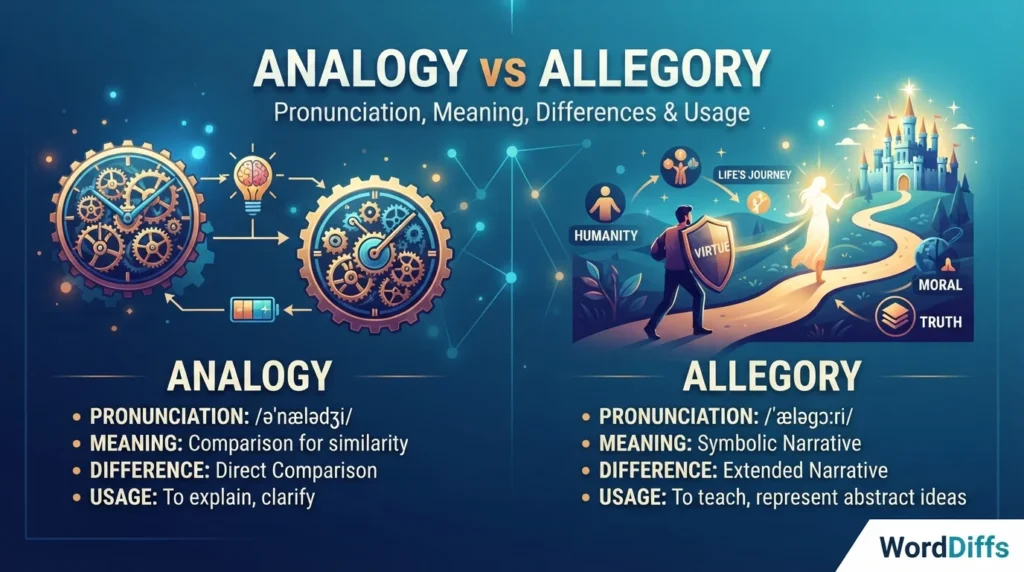
Many English learners confuse analogy vs allegory because both words describe ways of explaining ideas through connections, comparisons, or deeper meanings. They often appear in literature, education, writing, and everyday communication, which makes their meanings seem similar. However, these words serve different purposes.
An analogy is a comparison between two different things to explain an idea more clearly. An allegory is a story, image, or work of art that represents a deeper moral, political, or philosophical meaning. An analogy helps people understand something unfamiliar by comparing it with something familiar, while an allegory hides or expresses a larger message through symbols and characters.
Choosing the correct word matters because using analogy when you mean allegory, or vice versa, can change the meaning of your writing. In this guide, you will learn the pronunciation, meanings, grammar, usage rules, examples, differences, common mistakes, memory tricks, and practical applications of both words.
Analogy
Pronunciation
American IPA: /əˈnælədʒi/
British IPA: /əˈnælədʒi/
Easy Pronunciation Guide:
uh-NAL-uh-jee
Syllables:
a-nal-o-gy (four syllables)
Stress:
The main stress falls on the second syllable: NAL
Pronunciation Tips:
- The first syllable sounds like a relaxed “uh.”
- The middle sound “nal” receives the strongest emphasis.
- The ending “gy” sounds like “jee.”
Example pronunciation:
Analogy → uh + NAL + uh + jee
Many learners incorrectly pronounce it as “an-a-lo-gee” with equal stress on every syllable. English usually gives stronger emphasis to the second syllable.
Meaning
An analogy is a comparison between two different things that share some similarities. It is used to explain, clarify, or make an idea easier to understand.
An analogy does not mean that two things are exactly the same. Instead, it shows that they are similar in a specific way.
For example:
The human brain is like a computer because both process and store information.
A brain and a computer are not the same thing, but comparing them helps explain how the brain works.
Common situations where people use analogies include:
- Teaching difficult concepts
- Explaining scientific ideas
- Making arguments clearer
- Writing essays and speeches
- Giving examples in conversations
Part of Speech
Part of Speech: Noun
Sentence Function:
An analogy usually functions as a noun that names a comparison or relationship between two things.
Examples:
- The teacher used an analogy to explain gravity.
- Her analogy helped students understand the concept.
Grammar and Usage
The word analogy is a countable noun.
Common grammar patterns:
- an analogy
- the analogy
- several analogies
- make an analogy
- use an analogy
- draw an analogy
- create an analogy
- explain something by analogy
Common collocations:
| Collocation | Meaning |
| make an analogy | create a comparison |
| draw an analogy | identify a similarity |
| false analogy | an incorrect comparison |
| useful analogy | a helpful comparison |
| direct analogy | a clear comparison |
Grammar Function
| Grammar Function | Explanation | Example |
| Subject | The analogy performs the action in the sentence. | The analogy explains the concept clearly. |
| Object | The analogy receives the action. | The writer created an analogy. |
| Modifier | Used to describe related ideas or methods. | Analogy-based learning improves understanding. |
Sentence Function
An analogy can appear in different positions:
As a subject:
The analogy between electricity and water helps beginners learn.
Here, “analogy” is the main topic performing the grammatical role of subject.
As an object:
The professor used an analogy to explain physics.
Here, “analogy” receives the action of “used.”
After a preposition:
Students learned through analogy.
Here, it follows the preposition “through.”
Example Sentences
1. The teacher used an analogy to explain how the heart pumps blood.
Meaning:
The teacher compared the heart’s function with something familiar.
Grammar Explanation:
“Analogy” is the object of the verb “used.”
2. His analogy between a company and a machine made the business model easier to understand.
Meaning:
He compared a company’s parts with the parts of a machine.
Grammar Explanation:
“Analogy” is the subject of the phrase “His analogy.”
3. Scientists often use analogy to explain complex theories.
Meaning:
Scientists compare difficult ideas with simpler ones.
Grammar Explanation:
“Analogy” is used after the preposition “use.”
4. The author created an analogy between learning and building a house.
Meaning:
The author compared education with construction.
Grammar Explanation:
“Analogy” is the direct object of “created.”
5. A good analogy can make complicated information easier.
Meaning:
A helpful comparison improves understanding.
Grammar Explanation:
“Analogy” functions as the subject of the sentence.
6. The speaker drew an analogy between teamwork and a sports team.
Meaning:
The speaker identified similarities between two situations.
Grammar Explanation:
“Analogy” is part of the phrase “drew an analogy.”
Related Words
| Related Word | Meaning | Example Sentence |
| Analogous | Similar in certain ways | The two systems are analogous. |
| Analogize | To compare two things | Writers often analogize life to a journey. |
| Analogical | Related to comparison | The article uses analogical reasoning. |
| Analogy-based | Using comparisons for explanation | Analogy-based teaching helps students learn. |
Allegory
Pronunciation
American IPA: /ˈælɪɡɔːri/
British IPA: /ˈælɪɡəri/
Easy Pronunciation Guide:
AL-uh-gor-ee
Syllables:
al-le-go-ry (four syllables)
Stress:
The first syllable receives the strongest stress:
AL: uh-gor-ee
Pronunciation Tips:
- Begin with a strong “AL” sound.
- The middle part sounds like “uh-gor.”
- The ending sounds like “ree.”
Example pronunciation:
Allegory → AL + uh + gor + ree
A common mistake is pronouncing it like “al-le-gory” with stress on the middle syllable. English pronunciation usually emphasizes the first syllable.
Meaning
An allegory is a story, poem, painting, or other creative work in which characters, events, or objects represent deeper meanings.
An allegory often communicates:
- Moral lessons
- Political ideas
- Religious concepts
- Social criticism
- Philosophical messages
The surface story may appear simple, but it represents something more meaningful.
For example:
A story about animals running a farm may actually represent political events and human society.
Common examples of allegory include:
- Fables with hidden lessons
- Symbolic novels
- Political stories
- Religious writings
- Artistic works with deeper meanings
Part of Speech
Part of Speech: Noun
Sentence Function:
An allegory functions as a noun that identifies a symbolic story or artistic representation.
Examples:
- The novel is an allegory about power.
- Many readers interpret the poem as an allegory.
Grammar and Usage
The word allegory is a countable noun.
Common grammar patterns:
- an allegory
- the allegory
- a political allegory
- a religious allegory
- a moral allegory
- a symbolic allegory
Common collocations:
| Collocation | Meaning |
| political allegory | story representing political ideas |
| moral allegory | story teaching a lesson |
| religious allegory | story representing religious ideas |
| symbolic allegory | work using symbols |
| literary allegory | symbolic written work |
Grammar Function
| Grammar Function | Explanation | Example |
| Subject | The allegory performs the action. | The allegory teaches an important lesson. |
| Object | The allegory receives the action. | The writer created an allegory. |
| Modifier | Describes related concepts. | Allegory literature often contains symbols. |
Sentence Function
As a subject:
The allegory reveals hidden social problems.
Here, “allegory” performs the action.
As an object:
The author wrote an allegory about human greed.
Here, “allegory” receives the action.
After a preposition:
The story works as an allegory of corruption.
Here, it follows “as.”
Example Sentences
1. The novel is an allegory about the dangers of uncontrolled power.
Meaning:
The story represents a deeper message about power.
Grammar Explanation:
“Allegory” is a noun following the article “an.”
2. The author used animals as symbols in the allegory.
Meaning:
Animals represent human behaviors or groups.
Grammar Explanation:
“Allegory” is the object of the verb “used.”
3. Many readers consider the book an allegory of social inequality.
Meaning:
The book represents issues related to inequality.
Grammar Explanation:
“Allegory” appears after “an” as a noun complement.
4. The film contains an allegory about human nature.
Meaning:
The film has a hidden symbolic message.
Grammar Explanation:
“Allegory” is the direct object of “contains.”
5. The ancient painting is an allegory representing peace.
Meaning:
The painting uses symbols to communicate an idea.
Grammar Explanation:
“Allegory” functions as a noun after “is.”
6. Writers often create allegories to discuss sensitive topics.
Meaning:
Authors use symbolic stories to discuss difficult subjects.
Grammar Explanation:
“Allegories” is the plural subject of the sentence.
Related Words
| Related Word | Meaning | Example Sentence |
| Allegorical | Containing symbolic meaning | The poem has an allegorical message. |
| Allegorize | To explain something symbolically | Critics allegorize the story differently. |
| Symbolism | Use of symbols to represent ideas | Symbolism is common in literature. |
| Metaphor | A comparison expressing one thing as another | The poem uses metaphor and symbolism. |
Key Differences Between Analogy vs Allegory
Although analogy and allegory are related to explaining ideas, they work in different ways. An analogy is a direct comparison used to make something easier to understand, while an allegory is a complete symbolic work that communicates a hidden or deeper message.
| Feature | Analogy | Allegory |
| Pronunciation | /əˈnælədʒi/ (uh-NAL-uh-jee) | /ˈælɪɡɔːri/ (AL-uh-gor-ee) |
| Meaning | A comparison between two things to explain an idea | A story, artwork, or narrative with a deeper symbolic meaning |
| Part of Speech | Noun | Noun |
| Grammar | Used as a countable noun, often with verbs like make, use, draw | Used as a countable noun, often with verbs like write, create, interpret |
| Typical Usage | Teaching, explaining, reasoning, arguments | Literature, films, art, politics, philosophy |
| Purpose | To clarify or simplify an idea | To represent a deeper message or lesson |
| Structure | Usually a short comparison | Usually a complete story or creative work |
| Time Length | Can be one sentence or a brief explanation | Usually a larger work with characters and events |
| Example | “The brain is like a computer.” | A fictional story representing political events |
| Main Feature | Similarity between two ideas | Symbolic representation of another idea |
Understanding the Biggest Difference Between Analogy and Allegory
The easiest way to separate these words is to remember their purpose.
An analogy explains.
An analogy takes something unfamiliar and compares it with something familiar. It helps someone understand a concept.
Example:
A classroom is like a garden because students grow through learning.
This comparison helps explain education.
An allegory represents.
An allegory uses a story, character, or symbol to communicate a deeper meaning.
Example:
A story about animals controlling a farm may represent human political systems.
The animals and events are not just part of the story. They represent bigger ideas.
A simple rule:
Analogy = comparison for understanding
Allegory = story with symbolic meaning
Analogy vs Allegory: Sentence Comparisons
1. The teacher used an analogy to explain the solar system.
Why analogy is correct:
The teacher made a comparison to help students understand a scientific concept.
Meaning:
A comparison was used as a teaching method.
Grammar Role:
“Analogy” is the object of the verb “used.”
2. The novel is an allegory about the struggle between freedom and control.
Why allegory is correct:
The novel contains a symbolic message represented through a story.
Meaning:
The events represent larger social ideas.
Grammar Role:
“Allegory” is a noun complement after “is.”
3. The speaker created an analogy between a computer and the human brain.
Why analogy is correct:
The speaker compared two things to explain how the brain works.
Meaning:
The comparison improves understanding.
Grammar Role:
“Analogy” is the object of “created.”
4. The movie is an allegory about environmental destruction.
Why allegory is correct:
The movie uses characters and events to represent a larger issue.
Meaning:
The film communicates a hidden message.
Grammar Role:
“Allegory” identifies the type of movie.
5. Scientists often use analogy when explaining complex theories.
Why analogy is correct:
Scientists compare difficult concepts with simpler examples.
Meaning:
Comparison makes information clearer.
Grammar Role:
“Analogy” is the object of “use.”
6. The ancient myth is an allegory about human ambition.
Why allegory is correct:
The myth symbolizes a deeper lesson about human behavior.
Meaning:
The story represents a broader idea.
Grammar Role:
“Allegory” functions as a noun complement.
7. The writer compared the internet to a highway through an analogy.
Why analogy is correct:
The comparison explains how information moves online.
Meaning:
A familiar idea explains an unfamiliar system.
Grammar Role:
“Analogy” follows the preposition “through.”
8. The painting serves as an allegory of hope during difficult times.
Why allegory is correct:
The painting represents an abstract idea through symbols.
Meaning:
The artwork communicates a deeper message.
Grammar Role:
“Allegory” follows “as.”
Common Mistakes When Using Analogy and Allegory
Mistake 1
Incorrect Sentence:
The teacher wrote an analogy about animals that represented human society.
Correct Sentence:
The teacher wrote an allegory about animals that represented human society.
Explanation:
A story using animals as symbols is an allegory, not an analogy.
Mistake 2
Incorrect Sentence:
The professor created an allegory to compare the brain with a computer.
Correct Sentence:
The professor created an analogy to compare the brain with a computer.
Explanation:
A simple comparison used for explanation is an analogy.
Mistake 3
Incorrect Sentence:
This short comparison between a company and a machine is an allegory.
Correct Sentence:
This short comparison between a company and a machine is an analogy.
Explanation:
A comparison does not automatically become an allegory.
Mistake 4
Incorrect Sentence:
The book contains an analogy about political corruption through fictional characters.
Correct Sentence:
The book contains an allegory about political corruption through fictional characters.
Explanation:
Fictional characters representing real ideas create an allegory.
Mistake 5
Incorrect Sentence:
She used an allegory to explain a difficult math formula.
Correct Sentence:
She used an analogy to explain a difficult math formula.
Explanation:
Teaching explanations usually use analogies.
Mistake 6
Incorrect Sentence:
The author made an analogy using a fictional kingdom to criticize society.
Correct Sentence:
The author created an allegory using a fictional kingdom to criticize society.
Explanation:
A fictional world representing real issues is an allegory.
Mistake 7
Incorrect Sentence:
An analogy always contains characters and a plot.
Correct Sentence:
An allegory often contains characters and a plot.
Explanation:
Analogies are usually comparisons, while allegories are often stories.
Mistake 8
Incorrect Sentence:
The story is a simple analogy about justice.
Correct Sentence:
The story is an allegory about justice.
Explanation:
Stories with symbolic meanings are generally allegories.
Easy Memory Tricks
Remember Analogy With “Analyze Similarities”
The word analogy starts with “anal,” which can remind you of analyzing similarities.
Think:
Analogy = Analyze a similarity
Example:
The teacher analyzed similarities between the heart and a pump.
That is an analogy.
Remember Allegory With “A Lesson”
The word allegory begins with “alle,” which can remind you of a lesson.
Think:
Allegory = A lesson hidden in a story
Example:
A fictional story teaches a moral lesson through symbols.
That is an allegory.
Spelling Clue
Analogy contains “logy.”
Many words ending in “-logy” relate to ideas, studies, or explanations.
Example:
- biology
- psychology
- analogy
This can help remember that analogy deals with explaining relationships.
Allegory contains “legory,” which is linked with literary storytelling.
Think:
Allegory → literature → symbols → hidden meaning
Quick Grammar Shortcut
Ask this question:
Is it comparing two things directly?
Yes → Analogy
Example:
Learning is like planting a seed.
Is it a story, artwork, or narrative representing a bigger idea?
Yes → Allegory
Example:
A story about animals representing political groups.
Practice Quiz
1. Choose the correct word:
The teacher used a ______ to explain how electricity flows.
A) Allegory
B) Analogy
Correct Answer: Analogy
Explanation:
The teacher is making a comparison to explain a concept.
2. Fill in the blank:
The novel is an ______ about the dangers of greed.
Correct Answer: Allegory
Explanation:
The novel represents a deeper message through a story.
3. Choose the correct sentence:
A) The scientist created an allegory between the brain and a computer.
B) The scientist created an analogy between the brain and a computer.
Correct Answer: B
Explanation:
A comparison between two things is an analogy.
4. Fill in the blank:
Many writers use ______ to communicate hidden political messages.
Correct Answer: Allegory
Explanation:
Symbolic stories about political ideas are allegories.
5. Correct the sentence:
The professor wrote an allegory to explain a mathematical idea.
Correct Answer:
The professor used an analogy to explain a mathematical idea.
Explanation:
A teaching comparison is an analogy.
6. Choose the correct word:
The painting was an ______ representing peace and unity.
A) Analogy
B) Allegory
Correct Answer: Allegory
Explanation:
Artwork with symbolic meaning is an allegory.
7. Fill in the blank:
The speaker drew an ______ between teamwork and an orchestra.
Correct Answer: Analogy
Explanation:
The speaker compared two concepts.
8. Choose the correct word:
The story about animals fighting for power is a political ______.
A) Analogy
B) Allegory
Correct Answer: Allegory
Explanation:
Characters representing political ideas create an allegory.
9. Correct the sentence:
The author used an analogy with fictional characters to criticize society.
Correct Answer:
The author used an allegory with fictional characters to criticize society.
Explanation:
Fictional characters representing real issues indicate allegory.
10. Choose the correct word:
A comparison used to make difficult information easier is called an ______.
Correct Answer: Analogy
Explanation:
Analogies simplify complex ideas.
Frequently Asked Questions
What is the main difference between analogy and allegory?
An analogy is a comparison used to explain an idea. An allegory is a symbolic story or artwork that represents a deeper meaning.
Are analogy and allegory synonyms?
No. They are related concepts, but they have different meanings and uses.
Is an analogy always a story?
No. An analogy can be a single sentence or short comparison.
Is an allegory always a book?
No. An allegory can be a story, poem, movie, painting, or other creative work.
How do you pronounce analogy?
Analogy is pronounced as uh-NAL-uh-jee.
How do you pronounce allegory?
Allegory is pronounced as AL-uh-gor-ee.
Can a story contain an analogy?
Yes. A story can include an analogy inside it, but the entire story may not be an allegory.
Can an allegory contain comparisons?
Yes. Allegories may contain comparisons, but their main feature is symbolic meaning.
Which word is used in literature more often?
Allegory is more common in literary discussions because it describes symbolic stories.
Which word is useful in teaching?
Analogy is commonly used in teaching because it helps explain difficult concepts.
Is metaphor the same as analogy?
No. A metaphor directly describes one thing as another, while an analogy explains similarities between two things.
Why do people confuse analogy and allegory?
People confuse them because both involve connections between ideas, but their purposes are different.
Final Summary
Analogy and allegory are related words, but they are used in different situations.
An analogy is a comparison that helps explain something clearly. It connects a familiar idea with an unfamiliar one. It is commonly used in education, science, communication, and reasoning.
An allegory is a symbolic story, artwork, or creative work that represents a deeper meaning. It is commonly used in literature, movies, politics, and philosophy.
Pronunciation reminder:
- Analogy: uh-NAL-uh-jee
- Allegory: AL-uh-gor-ee
The easiest way to remember:
Analogy = comparison for explanation
Allegory = story with hidden meaning
When writing or speaking, ask yourself:
“Am I comparing two things to explain an idea?”
Use analogy.
“Am I describing a symbolic story or message?”
Use allegory.
Understanding this difference will help English learners, students, teachers, writers, and exam candidates use these words accurately and confidently.

Caitlin Boylan is an experienced content writer, editor, educator, travel writer, and remote worker with more than 10 years of experience in English education and international communication. She is the founder and author of The Country Jumper, a travel blog dedicated to supporting solo travelers, especially women exploring life abroad. She is also the co-founder of Macro Magazine, a global online publication that shares diverse perspectives on worldwide topics that impact communities.