
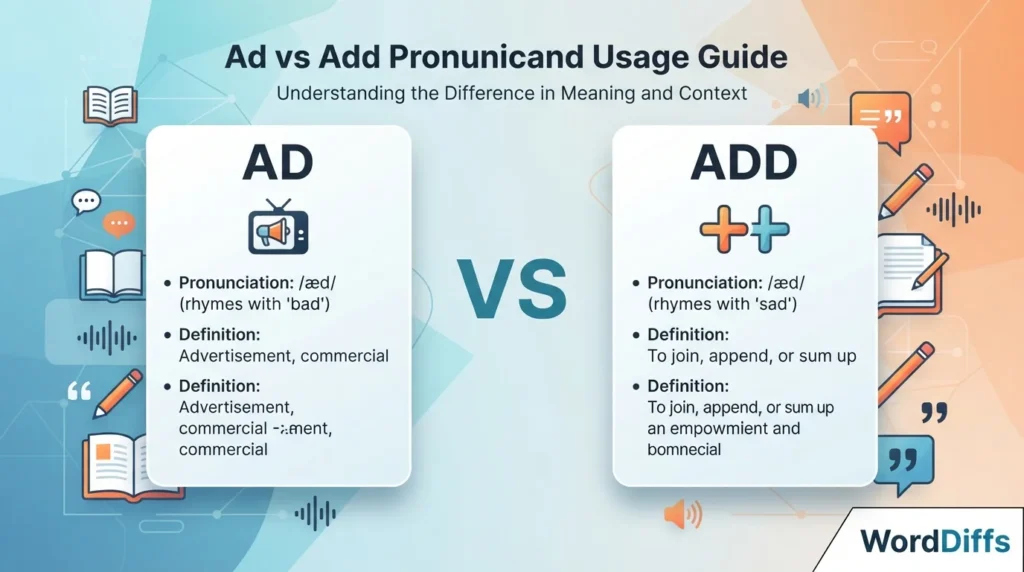
English homophones are among the most confusing parts of the language because two or more words can sound the same while having completely different meanings and spellings. Ad vs Add is a classic example. Although these words are pronounced almost identically in everyday English, they perform different grammatical roles and are used in completely different situations. Choosing the wrong one can change the meaning of a sentence or make your writing appear less accurate.
Correct spelling is especially important in school assignments, business communication, advertising, social media, and professional writing. Understanding pronunciation also helps learners recognize these words when listening to native speakers.
In this guide, you will learn the pronunciation, meaning, grammar, origins, common uses, collocations, and example sentences for both Ad and Add. You will also discover pronunciation differences, grammar comparisons, quizzes, memory tricks, common mistakes, and practical tips that will help you use these homophones confidently.
Quick Difference Table
| Word | Part of Speech | Meaning | Pronunciation (IPA) | Usage | Example |
| Ad | Noun | A short form of advertisement | /æd/ | Marketing, media, business | I watched an ad before the video. |
| Add | Verb | To join, increase, or include something | /æd/ | Mathematics, writing, conversation | Please add your name to the list. |
Ad
Pronunciation
IPA: /æd/
Simple pronunciation: ad
Audio-style spelling: ADD
Homophone status: It sounds exactly like add in most varieties of English.
British English: /æd/
American English: /æd/
There is almost no noticeable pronunciation difference between British and American English for this word.
Meaning
Ad is a shortened form of the word advertisement. It refers to a message created to promote a product, service, event, or idea.
In everyday English, people frequently use ad instead of the longer word advertisement, especially in casual conversation.
Examples of contexts include:
- Television
- YouTube
- Newspapers
- Websites
- Mobile apps
- Billboards
- Social media
Part of Speech
Ad is a noun.
It functions as the subject, object, or complement in a sentence.
Examples:
- The ad was entertaining.
- I skipped the ad.
- That was an interesting ad.
Origin
The word ad originated as a shortened form of advertisement during the nineteenth century.
Advertisement comes from the Latin word advertere, meaning “to turn toward” or “to direct attention.”
Over time, English speakers shortened advertisement to ad because it is quicker and easier to say.
Common Uses
People commonly use ad in:
- Television advertising
- Online marketing
- Newspaper publishing
- Social media campaigns
- Digital marketing
- Business promotions
- Mobile applications
- Video streaming platforms
- Radio broadcasting
- Product launches
Common Collocations
- online ad
- TV ad
- newspaper ad
- digital ad
- banner ad
- classified ad
- video ad
- sponsored ad
- display ad
- social media ad
- ad campaign
- ad agency
- ad revenue
- ad placement
- ad copy
Example Sentences
- I saw an interesting ad during the football match.
- The company launched a new online ad yesterday.
- Every YouTube video begins with an ad.
- She designed an attractive ad for the local bakery.
- The newspaper carried a full-page ad.
- Our school created an ad for the charity event.
- That ad made me laugh.
- The ad encouraged customers to try the new product.
- He clicked on the ad by mistake.
- The television ad became very popular.
- Their latest ad featured famous athletes.
- The travel ad inspired us to book a vacation.
- We removed the ad from the website.
- A colorful ad appeared on my phone.
- The clothing brand released a creative holiday ad.
Add
Pronunciation
IPA: /æd/
Simple pronunciation: add
Audio-style spelling: ADD
Homophone status: It sounds exactly like ad.
British English: /æd/
American English: /æd/
Native speakers generally pronounce both words identically.
Meaning
Add means to put something together with something else, increase an amount, include additional information, or perform mathematical addition.
It is one of the most common verbs in English and appears in both everyday conversation and formal writing.
Part of Speech
Add is primarily a verb.
It can describe actions involving numbers, information, objects, opinions, ingredients, or people.
Examples:
- Add two numbers.
- Add more sugar.
- Add your comments.
- Add another chair.
Origin
The word add comes from the Latin verb addere, meaning “to put to,” “join,” or “attach.”
It entered English through Old French and Middle English before becoming the modern verb used today.
Common Uses
People use add when talking about:
- Mathematics
- Cooking
- Writing
- Editing documents
- Computer software
- Shopping lists
- Conversations
- Instructions
- Scientific calculations
- Business reports
Common Collocations
- add numbers
- add water
- add sugar
- add information
- add details
- add value
- add support
- add comments
- add ingredients
- add someone
- add another
- add up
- add to
- add together
- add color
Example Sentences
- Please add your signature below.
- Add two cups of flour to the bowl.
- The teacher asked us to add the numbers.
- Can you add another chair?
- I forgot to add your email address.
- Add more salt if necessary.
- She wants to add a new chapter.
- Please add your opinion during the discussion.
- The update will add useful features.
- We should add more examples to the lesson.
- Add your expenses carefully.
- The manager asked us to add the missing details.
- I need to add another file.
- You can add decorations later.
- Always add references in academic writing.
Pronunciation Comparison
Both ad and add are considered perfect homophones in standard English.
They are pronounced as /æd/ in both British and American English.
Because the pronunciation is identical, listeners rely entirely on the sentence context to determine which word is intended.
For example:
- I watched an ad before the movie.
- Please add your name to the form.
Although regional accents may slightly change the vowel sound, both words continue to sound alike within the same accent. This identical pronunciation explains why English learners often confuse their spellings while writing.
Grammar Differences
| Word | Part of Speech | Meaning | Function | Sentence Position | Verb Forms (If Applicable) | Plural Forms (If Applicable) |
| Ad | Noun | Advertisement | Names a promotional message | Subject or object | Not applicable | Ads |
| Add | Verb | Join, include, increase | Expresses an action | Predicate | add, adds, added, adding | Not applicable |
Side-by-Side Examples
| Ad | Add |
| I skipped the ad. | Please add your phone number. |
| The ad appeared online. | Add another example. |
| We enjoyed the funny ad. | Add more cheese. |
| That ad became famous. | Add your answer below. |
| The ad promoted a new phone. | Add these numbers carefully. |
| She created an ad. | Add another page. |
| The ad lasted thirty seconds. | Add your comments. |
| I recognized the ad immediately. | Add some fresh herbs. |
| Every app showed an ad. | Add the final paragraph. |
| The ad reached millions of viewers. | Add more practice exercises. |
| His ad attracted customers. | Add another guest. |
| Our favorite ad returned. | Add extra details. |
| The newspaper printed the ad. | Add the ingredients slowly. |
| Their latest ad went viral. | Add one more sentence. |
| The ad looked professional. | Add your initials here. |
| A colorful ad filled the screen. | Add another ticket to the order. |
| I remembered the catchy ad. | Add this file to the folder. |
| The company removed the ad. | Add the prices together. |
| Every student discussed the ad. | Add your ideas to the presentation. |
| The ad increased sales. | Add another bookmark to the page. |
Homophones Comparison Table
| Word | Pronunciation | Meaning | Part of Speech | Usage | Example |
| Ad | /æd/ | Advertisement | Noun | Marketing and promotion | The ad was memorable. |
| Add | /æd/ | Include or increase | Verb | Actions involving addition | Add your name to the form. |
Memory Tricks
Remembering the difference between ad and add becomes much easier when you connect each spelling with its meaning.
- Ad = Advertisement
- “Ad” is simply the shortened form of advertisement.
- If you can replace the word with advertisement, then ad is correct.
- Add = Add More
- The word add has two d letters.
- Think of the extra d as representing adding one more.
Spelling Associations
| Word | Memory Trick |
| Ad | Ad is short for advertisement. |
| Add | Add has an extra d, just like adding something extra. |
Visual Memory Tricks
Imagine a billboard.
- The picture on the billboard is an ad.
- If someone places another poster beside it, they add another advertisement.
Practical Learning Methods
- Read newspapers and identify every ad.
- Practice adding numbers while saying add aloud.
- Write five sentences using ad.
- Write five sentences using add.
- Read your sentences aloud to reinforce spelling and meaning.
Common Mistakes
| Incorrect Sentence | Correct Sentence | Explanation |
| I watched an add on TV. | I watched an ad on TV. | Advertisement uses ad. |
| Please ad your name. | Please add your name. | The verb is add. |
| That add was funny. | That ad was funny. | Promotional message is ad. |
| Adds are everywhere online. | Ads are everywhere online. | Plural noun is ads. |
| The company will ad a new product. | The company will add a new product. | Action verb is add. |
| I skipped every add. | I skipped every ad. | Advertisement is ad. |
| Add campaign was successful. | Ad campaign was successful. | Promotional campaign uses ad. |
| Please ad more sugar. | Please add more sugar. | Use the verb add. |
| We created an add. | We created an ad. | Short form of advertisement. |
| Add revenue increased. | Ad revenue increased. | Revenue from advertisements. |
| He forgot to ad details. | He forgot to add details. | Verb required. |
| Online adds are common. | Online ads are common. | Plural is ads. |
| She liked the newspaper add. | She liked the newspaper ad. | Advertisement is ad. |
| Can you ad another chair? | Can you add another chair? | Action is add. |
| The add appeared first. | The ad appeared first. | Promotional message is ad. |
Fill in the Blank Quiz
- I watched an ______ before the movie.
- Please ______ your name.
- The TV ______ was humorous.
- ______ these numbers together.
- We created a new online ______.
- Please ______ more water.
- Every website displayed an ______.
- Can you ______ another paragraph?
- That newspaper ______ was colorful.
- ______ one more ingredient.
- I skipped the video ______.
- Please ______ your opinion.
- The company released a new ______.
- ______ the prices carefully.
- The funny ______ became popular.
- Could you ______ another example?
- The social media ______ reached thousands.
- Please ______ your phone number.
- We discussed the television ______.
- ______ another page to the report.
Answer Key
- ad
- add
- ad
- Add
- ad
- add
- ad
- add
- ad
- Add
- ad
- add
- ad
- Add
- ad
- add
- ad
- add
- ad
- Add
Choose the Correct Word Quiz
1. I saw an _____ on YouTube.
A. add
B. ad
C. adds
D. added
Correct Answer: B
Explanation: A promotional message is an ad.
2. Please _____ more salt.
A. ad
B. adds
C. add
D. added
Correct Answer: C
Explanation: The action verb is add.
3. The newspaper published an _____.
A. add
B. ad
C. adding
D. adds
Correct Answer: B
Explanation: Advertisement is shortened to ad.
4. _____ your comments below.
A. Ad
B. Add
C. Ads
D. Added
Correct Answer: B
Explanation: This is an instruction using the verb.
5. That television _____ was memorable.
A. add
B. ad
C. added
D. adding
Correct Answer: B
Explanation: It refers to an advertisement.
6. Please _____ another file.
A. add
B. ad
C. ads
D. adding
Correct Answer: A
Explanation: The verb means to include.
7. I skipped every _____.
A. add
B. ad
C. added
D. adding
Correct Answer: B
Explanation: Promotional message.
8. _____ these figures.
A. Ad
B. Add
C. Ads
D. Added
Correct Answer: B
Explanation: Mathematical action.
9. The online _____ attracted customers.
A. ad
B. add
C. added
D. adding
Correct Answer: A
10. Please _____ another guest.
A. add
B. ad
C. ads
D. adding
Correct Answer: A
11. The funny _____ became popular.
A. add
B. ad
C. adds
D. adding
Correct Answer: B
12. _____ another paragraph.
A. Add
B. Ad
C. Ads
D. Added
Correct Answer: A
13. Every video began with an _____.
A. add
B. ad
C. adds
D. adding
Correct Answer: B
14. Can you _____ this information?
A. add
B. ad
C. ads
D. added
Correct Answer: A
15. The company launched a new _____ campaign.
A. add
B. ad
C. adding
D. added
Correct Answer: B
Explanation: “Ad campaign” is the correct collocation.
Common Expressions
Ad
Common Expressions
Ad campaign
- The company launched a successful ad campaign.
Ad agency
- She works for a leading ad agency.
Ad revenue
- The website earns money through ad revenue.
Ad break
- We talked during the ad break.
Classified ad
- He found the job through a classified ad.
Add
Common Expressions
Add up
- Your explanation doesn’t add up.
Add to
- This painting adds to the beauty of the room.
Add on
- We decided to add on another bedroom.
Add in
- Add in the remaining ingredients.
Add value
- Experience can add value to your resume.
Frequently Asked Questions
What is the difference between ad and add?
Ad is a noun meaning a shortened form of advertisement. Add is a verb that means to join, include, increase, or combine something. Although they sound the same, they have different spellings, meanings, and grammatical roles. The correct choice depends entirely on the context of your sentence.
Are ad and add pronounced the same?
Yes. In standard British and American English, both words are pronounced /æd/. They are considered perfect homophones, so listeners rely on context rather than pronunciation to understand which word is intended.
Why do people confuse these homophones?
People confuse them because they are pronounced identically but spelled differently. Beginning English learners often write words according to how they sound, making it easy to replace ad with add, or vice versa.
Is ad always short for advertisement?
Yes. In modern English, ad is the standard abbreviation for advertisement. It is widely used in both informal and professional writing.
Is add only used in mathematics?
No. While add is common in mathematics, it also means to include, attach, increase, or contribute. You can add ingredients, names, comments, ideas, or files.
Can ad be plural?
Yes. The plural form is ads.
Example:
- The website contains many ads.
What are the verb forms of add?
The verb forms are:
- add
- adds
- added
- adding
These forms are used depending on the tense and subject.
Which word appears more often in everyday English?
Both words are common. Add appears more frequently because it is a basic action verb used in many situations, while ad is especially common in discussions about advertising and media.
How can I remember the difference?
Remember that ad is short for advertisement. The extra d in add reminds you that something extra is being added.
Are ad and advertisement interchangeable?
Usually, yes. Ad is simply the shorter and more conversational form of advertisement, while the longer word is often preferred in formal writing.
Tips to Remember the Difference
- Associate ad with advertisement whenever you see marketing or promotion.
- Remember that add contains an extra d, representing something extra being included.
- Read books, magazines, and websites to see both words used naturally.
- Practice writing ten sentences with ad and ten with add.
- Listen to native speakers and identify the correct word from context.
- Build vocabulary by learning common collocations such as ad campaign and add value.
- Create your own flashcards with meanings and example sentences.
- Review your writing carefully for homophone errors.
Summary
The homophones ad and add share the same pronunciation, /æd/, but they have entirely different meanings and grammatical functions. Ad is a noun that refers to an advertisement, commonly used in marketing, television, newspapers, websites, and social media. Add is a verb meaning to join, include, increase, or combine something, making it useful in mathematics, cooking, writing, business, and everyday communication.
Because these words sound identical in both British and American English, writers must rely on spelling and context to choose the correct one. Remember that ad is simply the shortened form of advertisement, while add contains an extra d, reminding you that it means to put something extra into a group or amount.
Regular reading, writing, pronunciation practice, and sentence-building exercises will help reinforce the distinction. By learning their meanings, grammar, collocations, and common expressions, you can confidently use ad and add correctly in both spoken and written English.

Caitlin Boylan is an experienced content writer, editor, educator, travel writer, and remote worker with more than 10 years of experience in English education and international communication. She is the founder and author of The Country Jumper, a travel blog dedicated to supporting solo travelers, especially women exploring life abroad. She is also the co-founder of Macro Magazine, a global online publication that shares diverse perspectives on worldwide topics that impact communities.