
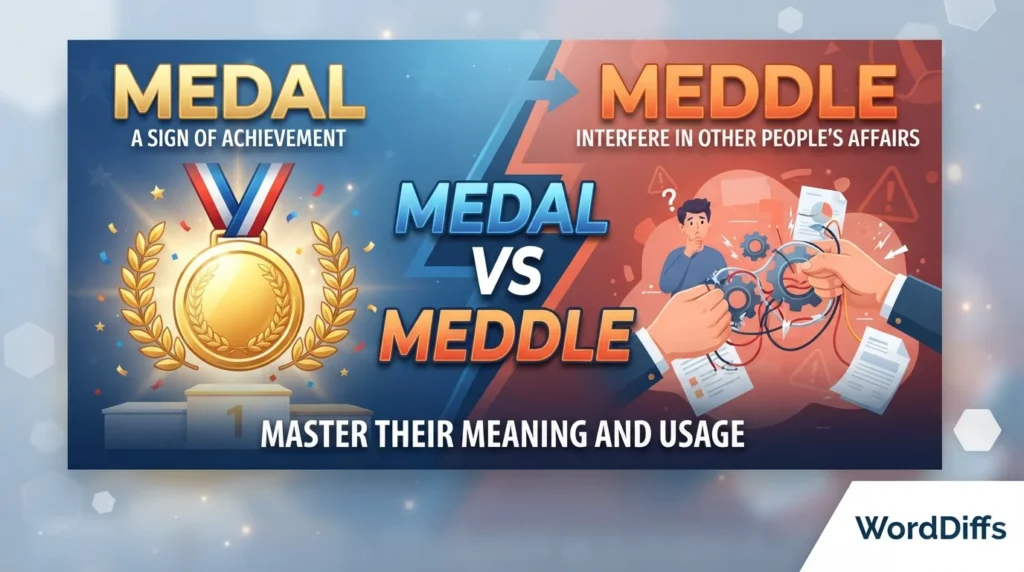
Many English learners confuse Medal and Meddle because they sound somewhat similar but have completely different meanings. A medal is an award given for achievement, bravery, or success, while meddle means to interfere in someone else’s affairs without being asked. Understanding the difference is important because using the wrong word can change the meaning of your sentence. In this guide, you’ll learn the meanings, pronunciation, grammar, common mistakes, and practical examples of both words. By the end, you’ll be able to use Medal and Meddle correctly and confidently in everyday American English.
Quick Difference Table
| Word | Part of Speech | Meaning | Example | Common Usage |
| Medal | Noun | An award for achievement or bravery | She won a gold medal. | Sports, military, competitions, honors |
| Meddle | Verb | To interfere in someone else’s matters | Don’t meddle in their argument. | Advice, personal matters, workplace, relationships |
Meaning of Medal
Meaning
A medal is a piece of metal, usually circular, that is awarded to someone as recognition for excellence, courage, achievement, or service. Medals are commonly presented in sports competitions, military service, academic contests, and community awards.
Unlike trophies, medals are usually worn around the neck or pinned to clothing. The word always refers to a physical award or honor.
Pronunciation
| Feature | Details |
| IPA | /ˈmed.əl/ |
| American Pronunciation | MED-uhl |
| British Pronunciation | MED-uhl |
| Syllables | 2 (med-al) |
| Word Stress | First syllable |
Pronunciation Tips
- Say “MED” clearly and stress it.
- The second syllable sounds like “uhl.”
- Keep the d soft and natural.
- Avoid pronouncing it as “mee-dal.”
- Practice by saying: “gold medal,” “silver medal,” and “bronze medal.”
Function
Part of Speech
Medal is a noun.
Grammar Role
It names a person’s award or honor.
Sentence Function
It usually acts as the subject or object of a sentence.
Common Grammatical Patterns
- win a medal
- earn a medal
- receive a medal
- award someone a medal
- gold medal
- silver medal
- bronze medal
- military medal
- Olympic medal
Example Sentences
- She won a gold medal in the swimming competition.
- The soldier proudly accepted a bravery medal.
- My brother earned a medal for outstanding service.
- Every athlete dreams of winning an Olympic medal.
- The school presented her with a science medal.
- He displayed his marathon medal on the wall.
- The young gymnast received a silver medal after the event.
- Their team celebrated every medal they won.
- The museum displayed an ancient military medal.
- Her greatest achievement was earning a national medal.
When to Use
Use medal whenever you are talking about:
- Awards for sports competitions
- Military honors
- Academic achievements
- Acts of bravery
- Special recognition
- Competitive events
- Ceremonial awards
Examples:
- She received a medal for saving a child’s life.
- Our school won three medals in the tournament.
- The athlete proudly wore her gold medal.
Common Mistakes
1. Confusing “medal” with “meddle.”
❌ He likes to medal in other people’s business.
✅ He likes to meddle in other people’s business.
2. Using “medal” as a verb.
❌ They medaled in our family problems.
✅ They meddled in our family problems.
(Note: “medaled” exists in sports journalism to mean “won a medal,” but beginners should avoid confusing it with meddled.)
3. Forgetting that “medal” is a noun.
❌ She always medal with excellence.
✅ She always wins a medal for excellence.
4. Mixing it with similar-sounding words.
Remember:
- Medal = an award
- Metal = a material like iron or gold
- Meddle = interfere in someone’s affairs
A simple memory trick is:
A medAL is an Award. Both Award and medAL contain the letter A, making it easier to remember that a medal is something you receive for an achievement.
Meaning of Meddle
Meaning
Meddle means to interfere in someone else’s affairs, decisions, or problems without being invited or needed. It often has a negative meaning because the interference is unwanted or unnecessary.
People who meddle usually try to influence situations that do not concern them. The word is commonly used when talking about personal relationships, family matters, workplace issues, or private conversations.
Pronunciation
| Feature | Details |
| IPA | /ˈmed.əl/ |
| American Pronunciation | MED-uhl |
| British Pronunciation | MED-uhl |
| Syllables | 2 (med-dle) |
| Word Stress | First syllable |
Pronunciation Tips
- Stress the first syllable: MED.
- The ending sounds like “uhl.”
- The double d is not pronounced separately.
- Do not pronounce it as “med-dull.”
- Practice with phrases like “don’t meddle,” “stop meddling,” and “meddle in.”
Function
Part of Speech
Meddle is a verb.
Grammar Role
It describes the action of interfering in matters that do not concern you.
Sentence Function
It functions as the main verb in a sentence and often takes the preposition in.
Common Grammatical Patterns
- meddle in someone’s affairs
- meddle in other people’s business
- meddle with something
- stop meddling
- keep out and don’t meddle
- someone meddles in family matters
Example Sentences
- Please don’t meddle in my personal life.
- He always meddles in his neighbors’ arguments.
- She promised not to meddle with the office plans.
- Parents should avoid meddling in every small disagreement.
- The manager warned everyone not to meddle in confidential matters.
- I appreciate your concern, but there’s no need to meddle.
- They often meddle in decisions that belong to others.
- It’s best not to meddle with equipment unless you know how it works.
- My aunt likes to meddle in family discussions.
- Friends should support each other without meddling in private choices.
When to Use
Use meddle when talking about:
- Interfering in someone else’s business
- Giving unwanted advice
- Becoming involved in private matters
- Interrupting decisions that are not yours
- Interfering with objects, equipment, or systems without permission
Examples:
- Don’t meddle in their relationship.
- She tends to meddle in workplace decisions.
- Children should not meddle with electrical wires.
- It’s better to listen than to meddle in someone else’s argument.
Common Mistakes
1. Confusing “meddle” with “medal.”
❌ She won a gold meddle.
✅ She won a gold medal.
2. Forgetting to use the correct preposition.
❌ He meddled into our conversation.
✅ He meddled in our conversation.
3. Using “meddle” for positive involvement.
❌ The coach meddled the team to victory.
✅ The coach helped the team achieve victory.
4. Using “meddle” when you mean “handle.”
❌ She can meddle difficult customers well.
✅ She can handle difficult customers well.
5. Confusing it with “metal.”
Remember:
- Meddle = interfere.
- Medal = an award.
- Metal = a hard material like iron, copper, or gold.
Easy Memory Trick
Think of the double dd in meddle as “double disturbance.” If someone meddles, they are causing unnecessary interference in a situation that does not belong to them.
Side-by-Side Comparison
| Situation | Correct Word | Explanation | Example |
| Winning first place in a race | Medal | A medal is an award for achievement. | She received a gold medal after the race. |
| Interfering in a friend’s argument | Meddle | Meddle means to interfere in someone else’s affairs. | Don’t meddle in their disagreement. |
| Receiving military recognition | Medal | Military honors are often presented as medals. | The captain earned a bravery medal. |
| Giving unwanted advice | Meddle | Unwanted involvement is called meddling. | He likes to meddle in everyone’s decisions. |
| Olympic achievement | Medal | Athletes compete to win medals. | She hopes to win an Olympic medal. |
| Becoming involved in private family matters | Meddle | Meddle describes unwanted interference. | It’s not your place to meddle in family issues. |
| School competition award | Medal | Schools often present medals for excellence. | He received a science medal. |
| Touching equipment without permission | Meddle | Meddle can also mean interfering with objects. | Don’t meddle with the controls. |
| Being honored for bravery | Medal | A medal recognizes courage or achievement. | The firefighter accepted a courage medal. |
| Interrupting someone else’s plans | Meddle | Interfering with plans is meddling. | Please don’t meddle in our project. |
Practice Quiz
Fill in the Blanks
Choose either medal or meddle to complete each sentence.
- The athlete proudly displayed her gold ________.
- Please don’t ________ in matters that don’t concern you.
- The firefighter received a bravery ________.
- My neighbors often ________ in other people’s lives.
- He hopes to win a ________ at the national championship.
- You should never ________ with someone else’s personal belongings.
- She earned a silver ________ for her outstanding performance.
- It’s rude to ________ in private conversations.
- The soldier was awarded a special ________ for his service.
- Children should not ________ in adult disagreements.
Choose the Correct Word
1. Which sentence is correct?
A. She won a gold meddle.
B. She won a gold medal.
C. She won a gold metals.
D. She won a gold meddling.
2. Which word means “to interfere”?
A. Medal
B. Metal
C. Meddle
D. Model
3. Choose the correct sentence.
A. Don’t medal in my business.
B. Don’t meddle in my business.
C. Don’t medals in my business.
D. Don’t meddled my business.
4. Which word refers to an award?
A. Meddle
B. Medal
C. Middle
D. Metal
5. Which sentence uses the word correctly?
A. He received a bravery meddle.
B. He received a bravery medal.
C. He meddled a bravery.
D. He medaled with courage.
6. Which sentence is correct?
A. She likes to medal in family arguments.
B. She likes to meddle in family arguments.
C. She likes meddles family arguments.
D. She likes meddle family arguments.
7. What should you avoid doing in someone else’s private affairs?
A. Winning
B. Medaling
C. Meddling
D. Awarding
8. Which sentence is correct?
A. The swimmer earned a bronze medal.
B. The swimmer earned a bronze meddle.
C. The swimmer meddled a bronze.
D. The swimmer earned bronze meddling.
9. Which word best completes the sentence?
“Please don’t ________ with the computer settings.”
A. medal
B. meddle
C. medals
D. medaled
10. Which sentence is grammatically correct?
A. She proudly wore her gold medal.
B. She proudly wore her gold meddle.
C. She proudly meddled her gold.
D. She proudly medal with honor.
Answer Key
Fill in the Blanks
- medal
A medal is an award given for achievement. - meddle
Meddle means to interfere in someone else’s affairs. - medal
Bravery is often recognized with a medal. - meddle
The sentence describes interfering in other people’s lives. - medal
Athletes compete to win medals in championships. - meddle
“Meddle with” means to interfere with or tamper with something. - medal
A silver medal is a common competition award. - meddle
Interfering in private conversations is called meddling. - medal
Military service can be recognized with a special medal. - meddle
Children should not interfere in adult disagreements.
Multiple-Choice Answers
1. B. She won a gold medal.
A medal is an award given for success in a competition.
2. C. Meddle
Meddle means to interfere in matters that do not concern you.
3. B. Don’t meddle in my business.
The verb “meddle” correctly means to interfere.
4. B. Medal
A medal is an award for achievement, bravery, or excellence.
5. B. He received a bravery medal.
The noun “medal” is the correct choice for an award.
6. B. She likes to meddle in family arguments.
The phrase “meddle in” is the correct grammatical pattern.
7. C. Meddling
Meddling refers to unwanted interference in other people’s affairs.
8. A. The swimmer earned a bronze medal.
Bronze medal is the correct expression for a third-place award.
9. B. meddle
The phrase “meddle with” means to interfere with or tamper with something.
10. A. She proudly wore her gold medal.
The sentence correctly uses “medal” as a noun.
Final Thoughts
Although Medal and Meddle sound similar, their meanings are completely different. A medal is a noun that refers to an award given for achievement, bravery, or excellence. Meddle is a verb that means to interfere in someone else’s affairs without being invited. Remember this simple trick: a medAL is an Award, while meDDle has a double “D” for double disturbance, reminding you that it means unwanted interference. Learning this distinction will help you avoid common writing and speaking mistakes. Whenever you’re unsure, think about whether you’re talking about an award or interfering in someone’s business. With regular practice and attention to context, choosing the correct word will soon become second nature.
Frequently Asked Questions
What is the difference between medal and meddle?
A medal is an award for achievement or bravery, while meddle means to interfere in someone else’s affairs.
Is medal a noun or a verb?
Medal is primarily a noun. It refers to a physical award or decoration.
Is meddle a noun or a verb?
Meddle is a verb. It describes the action of interfering without permission.
How do you pronounce medal?
It is pronounced /ˈmed.əl/, sounding like MED-uhl, with the stress on the first syllable.
How do you pronounce meddle?
It is also pronounced /ˈmed.əl/ in both American and British English.
Why do people confuse medal and meddle?
They are pronounced the same in standard English, making them homophones, but they have different meanings and spellings.
Can meddle have a positive meaning?
Usually, no. Meddle generally has a negative meaning because it refers to unwanted interference.
What are common collocations with medal?
Common expressions include gold medal, silver medal, bronze medal, win a medal, earn a medal, and receive a medal.
What preposition is commonly used with meddle?
The most common pattern is meddle in, as in Don’t meddle in other people’s affairs. The phrase meddle with is also used when referring to interfering with objects or equipment.
Is meddling a real word?
Yes. Meddling is the present participle and gerund form of meddle, meaning interfering in matters that do not concern you.
What is an easy way to remember the difference?
Remember: medAL = Award, and meDDle = Double Disturbance. The spelling itself provides a helpful clue.
Can medal and meddle ever be used interchangeably?
No. They have completely different meanings and grammatical functions, so they should never be substituted for one another.

Caitlin Boylan is an experienced content writer, editor, educator, travel writer, and remote worker with more than 10 years of experience in English education and international communication. She is the founder and author of The Country Jumper, a travel blog dedicated to supporting solo travelers, especially women exploring life abroad. She is also the co-founder of Macro Magazine, a global online publication that shares diverse perspectives on worldwide topics that impact communities.
1 thought on “Medal vs Meddle: Pronunciation, Meaning & Uses”