
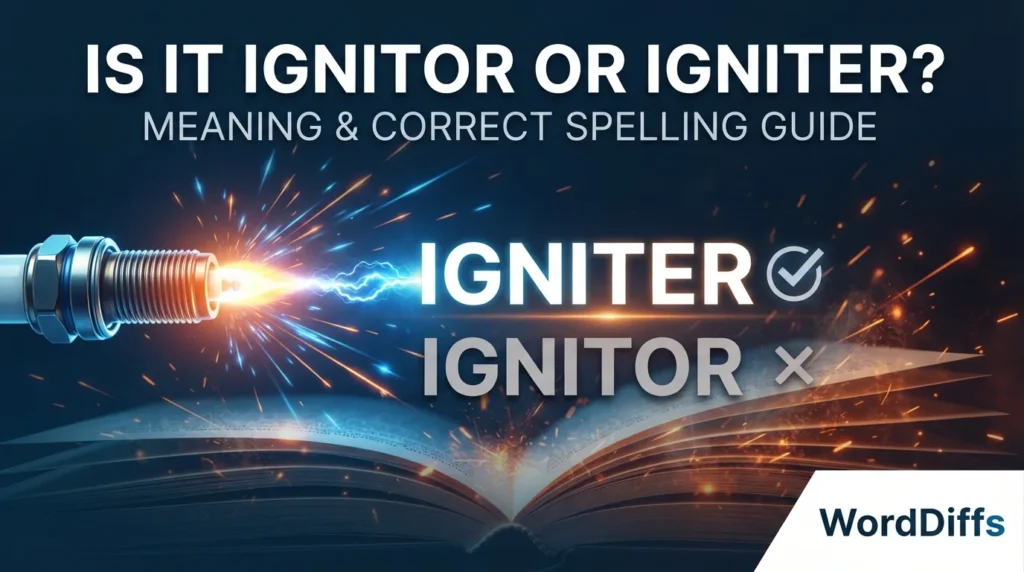
Have you ever wondered whether Ignitor or Igniter is the correct spelling? Many English learners, writers, and even professionals pause when they encounter these two forms because both appear in dictionaries, technical manuals, and online searches. The confusion arises because the words are closely related, and different industries sometimes prefer one spelling over the other. In this guide, you’ll learn which spelling is considered standard, when each form is appropriate, how to pronounce it correctly, why people confuse the two, and practical memory tricks to help you choose the right word confidently in everyday and professional writing.
Quick Facts Table
| Feature | Details |
| Correct Word | Igniter (standard and most widely accepted) |
| Alternative Word | Ignitor (accepted in some technical and industry contexts) |
| Word Type | Noun |
| Meaning | A device or substance that starts combustion or ignition |
| Pronunciation | /ɪɡˈnaɪ.tər/ |
| Common Error | Assuming only one spelling exists in every context |
| Difficulty | Moderate |
What Does Ignitor or Igniter Mean?
Both igniter and ignitor refer to something that starts or triggers ignition. In everyday English, an igniter is a device, component, or material that produces the spark, flame, or heat needed to begin combustion.
Although both spellings exist, igniter is the more common and generally preferred spelling in dictionaries and general English. Ignitor appears more often in engineering, automotive, aerospace, and manufacturer-specific terminology.
An igniter may be used in many situations, including:
- Gas stoves
- Barbecue grills
- Fireplaces
- Jet engines
- Rocket engines
- Industrial burners
- Automotive ignition systems
Examples
- The gas stove’s igniter stopped working.
- Engineers replaced the faulty rocket igniter before launch.
- The technician tested the electronic ignitor used in the combustion chamber.
Is “Ignitor” Correct?
Yes, ignitor is not actually an incorrect spelling. Instead, it is an accepted variant used mainly in technical and industrial fields.
However, in general English writing, dictionaries, educational materials, and everyday communication, igniter is usually preferred.
Many people mistakenly believe ignitor is a misspelling because they encounter igniter much more frequently.
Why Do People Question “Ignitor”?
- Most dictionaries list igniter as the primary spelling.
- School textbooks usually teach igniter.
- Spell checkers often recommend igniter.
- Technical manufacturers sometimes intentionally use ignitor as part of product naming.
Examples
Correct in general English:
- Replace the broken igniter in the oven.
Correct in technical documentation:
- The plasma ignitor initiates combustion inside the turbine.
What Is the Correct Spelling?
For most writing situations, igniter is the preferred spelling.
If you’re writing:
- academic papers
- school assignments
- blogs
- newspapers
- business documents
- general articles
use igniter unless you’re referring to a product or technical specification that officially uses ignitor.
General Rule
Use “igniter” for standard English.
Use ignitor only when:
- quoting technical documentation
- referring to a manufacturer’s product
- following industry terminology
- preserving official naming conventions
Examples
Correct:
- The furnace igniter needs replacement.
- Always inspect the grill igniter before lighting it.
Also acceptable in technical contexts:
- The engine ignitor assembly passed inspection.
Difference Between the Two Spellings
| Feature | Ignitor | Igniter |
| Dictionary Preference | Less common | Preferred |
| Standard English | Less common | Yes |
| Technical Usage | Common | Also common |
| Academic Writing | Rare | Recommended |
| Everyday Writing | Rare | Preferred |
| Product Manuals | Frequently used | Frequently used |
| Meaning | Starts ignition | Starts ignition |
Understanding the Difference
The biggest difference is usage, not meaning.
Both words describe the same object or device. The choice depends largely on style, industry preference, and publication standards.
Meaning of the Correct Word
An igniter is anything that initiates ignition by creating enough heat, spark, or flame to start combustion.
It may be:
- electrical
- mechanical
- chemical
- electronic
The exact design depends on its application.
Examples
- The barbecue igniter produced a strong spark.
- Every modern gas oven includes an electronic igniter.
- Scientists tested a new fuel igniter.
An igniter commonly functions by:
- creating an electric spark
- heating a metal element
- producing a controlled flame
- triggering combustion safely
- starting fuel ignition
Pronunciation
IPA Pronunciation
Igniter: /ɪɡˈnaɪ.tər/
Ignitor: /ɪɡˈnaɪ.tər/
Both spellings are generally pronounced the same way.
Syllable Breakdown
Ig • nite • er
Three syllables:
- Ig
- nite
- er
Pronunciation Tips
- Say ig softly.
- Stress NITE.
- Finish with er.
- Avoid pronouncing the g too strongly.
- Remember that both spellings share the same pronunciation.
Why Do People Make This Spelling Mistake?
Several factors contribute to the confusion between ignitor and igniter.
Pronunciation Confusion
Because both words sound identical, writers often guess the spelling based on what they hear.
Typing Mistakes
Fast typing can lead people to choose whichever ending seems more familiar.
Phonetic Spelling
English contains many words ending in both -er and -or, making it difficult to know which ending is expected.
Examples include:
- actor
- instructor
- creator
- teacher
This mixture encourages uncertainty.
Similar-Looking Words
People compare the word with nouns ending in:
- -or
- -er
Since both endings are common in English, either can appear reasonable.
Memory Errors
Some writers remember seeing ignitor in technical manuals and assume it is always preferred.
Others remember igniter from school and think ignitor must be wrong.
The truth is more nuanced because both forms are accepted, although one is more common.
Regional Influence
Engineering companies, manufacturers, and technical organizations may standardize different spellings in their documentation.
As a result, readers encounter both forms and assume they represent different devices when they usually do not.
Origin and Etymology
The word ultimately comes from the Latin verb ignīre, meaning “to set on fire,” which is related to ignis, meaning “fire.”
The English verb ignite developed from these Latin roots, meaning “to catch fire” or “to cause something to burn.”
From ignite, English later formed nouns referring to devices that begin combustion.
Over time:
- igniter became the standard general-English spelling.
- ignitor emerged as an accepted variant, especially in engineering and manufacturing contexts.
Today, both words share the same meaning, but igniter remains the dominant choice in general usage.
How to Remember the Correct Spelling
Fortunately, remembering the preferred spelling is simple.
Memory Tricks
Think: ignite → igniter
The verb ignite naturally leads to the noun igniter in standard English.
Mnemonics
Remember:
The ignitER starts the firE.
Notice the matching E in both igniter and fire.
Spelling Hacks
- ER is usually safest for everyday writing.
- Choose igniter unless technical documentation specifically uses ignitor.
- If you’re unsure, your dictionary will almost always recommend igniter first.
Quick Tips
- Use igniter in school assignments.
- Use igniter in blogs and articles.
- Use igniter in business writing.
- Keep ignitor only for official technical terminology.
Examples in Sentences
| Incorrect Sentence | Correct Sentence |
| The oven’s ignitor is broken in my school essay. | The oven’s igniter is broken. |
| We replaced the barbecue ignitor. | We replaced the barbecue igniter. |
| The stove ignitor failed yesterday. | The stove igniter failed yesterday. |
| Every gas cooker has an ignitor. | Every gas cooker has an igniter. |
| Buy a new furnace ignitor. | Buy a new furnace igniter. |
| The chef checked the grill ignitor. | The chef checked the grill igniter. |
| My fireplace ignitor clicks loudly. | My fireplace igniter clicks loudly. |
| The technician repaired the oven ignitor. | The technician repaired the oven igniter. |
| A faulty ignitor delayed cooking. | A faulty igniter delayed cooking. |
| The appliance needs a replacement ignitor. | The appliance needs a replacement igniter. |
| Install the gas ignitor carefully. | Install the gas igniter carefully. |
| The electric ignitor created a spark. | The electric igniter created a spark. |
| The old ignitor stopped functioning. | The old igniter stopped functioning. |
| Check whether the ignitor is clean. | Check whether the igniter is clean. |
| Replace the worn-out ignitor before use. | Replace the worn-out igniter before use. |
Note: In technical manuals, product documentation, or manufacturer specifications, ignitor may still be the official spelling and should be retained when referring to that specific product or component.
Common Mistakes to Avoid
Although igniter and ignitor have the same meaning, writers often misuse them because they appear interchangeable. Understanding the preferred context for each spelling will help you write more accurately.
Mistakes to Avoid
- Using ignitor in general writing when igniter is preferred.
- General English style guides and dictionaries usually recommend igniter.
- Assuming ignitor is always incorrect.
- It is an accepted spelling in many engineering and manufacturing fields.
- Changing the spelling in official product names.
- If a manufacturer uses ignitor, keep the original spelling when referring to that product.
- Mixing spellings within the same document.
- Choose one spelling based on your audience and remain consistent.
- Confusing the word with the verb ignite.
- Ignite is the verb.
- Igniter or ignitor is the noun.
Similar Commonly Misspelled Words
| Common Mistake | Correct Spelling | Explanation |
| Recieve | Receive | “I” comes before “E” after “C”. |
| Definately | Definitely | A very common spelling mistake. |
| Occured | Occurred | Double the r before -ed. |
| Seperate | Separate | Remember the middle a. |
| Grammer | Grammar | Ends with -ar, not -er. |
| Untill | Until | Only one l. |
| Begining | Beginning | Double the n. |
| Writting | Writing | Do not double the t. |
| Beleive | Believe | “I before E,” except after C. |
| Goverment | Government | Keep the n after r. |
Related Words
Synonyms
Depending on the context, similar words include:
- Starter
- Spark generator
- Ignition device
- Fire starter
- Ignition source
- Ignition component
- Spark plug (in specific applications)
- Pilot igniter
Antonyms
Since igniter refers to something that starts combustion, there are no exact antonyms. However, opposite concepts include:
- Extinguisher
- Fire suppressant
- Flame arrestor
- Fire inhibitor
Related Forms
| Word | Part of Speech | Meaning |
| Ignite | Verb | To set on fire or start burning |
| Ignition | Noun | The process of starting combustion |
| Ignitable | Adjective | Capable of catching fire |
| Ignitible | Adjective | Alternative spelling of ignitable |
| Ignition system | Noun | Mechanism that starts an engine or burner |
Grammar Tips
Correct spelling is only part of effective writing. Grammar also matters.
Useful Grammar Tips
- Igniter is a countable noun.
- The igniter is faulty.
- The igniters were replaced.
- Use an before igniter because it begins with a vowel sound.
- An igniter was installed.
- Use ignite as the verb.
- The spark ignites the fuel.
- Avoid using igniter as a verb.
- Incorrect: The device ignitered the fuel.
- Correct: The device ignited the fuel.
- Keep verb agreement correct.
- The igniter works properly.
- The igniters work properly.
Writing Tips
Whether you are writing for school, business, or technical audiences, these practices will improve clarity.
- Use igniter in general English unless a technical source specifies otherwise.
- Check manufacturer documentation before changing technical terminology.
- Stay consistent throughout your document.
- Use a reliable dictionary when unsure.
- Proofread carefully because spell-check tools may not always flag ignitor.
- Consider your audience. Technical readers may expect ignitor, while general readers are more familiar with igniter.
- Avoid switching spellings without a reason.
Quick Spelling Checklist
| Checklist | Yes/No |
| Did you use igniter in general writing? | ☐ |
| Are you following the spelling used in official technical documentation? | ☐ |
| Did you keep the spelling consistent throughout the document? | ☐ |
| Did you distinguish between ignite (verb) and igniter (noun)? | ☐ |
| Did you proofread for spelling consistency? | ☐ |
| Did you choose the spelling appropriate for your audience? | ☐ |
Key Takeaways
- Igniter is the preferred spelling in standard English.
- Ignitor is an accepted variant, especially in engineering and technical fields.
- Both words have the same meaning.
- They are pronounced exactly the same.
- Use igniter for school, business, blogs, and everyday writing.
- Preserve ignitor when quoting official manuals or product names.
- Consistency is more important than switching between spellings.
- Remember the phrase: ignite leads to igniter.
Conclusion
The choice between Ignitor or Igniter often depends on context rather than correctness. In standard English, igniter is the preferred spelling and is the safest choice for academic writing, business communication, websites, and everyday use. Meanwhile, ignitor remains an accepted variant that appears in engineering documents, technical manuals, and manufacturer product names. Because both spellings refer to the same device that starts combustion, understanding your audience is the key to choosing the appropriate form. When in doubt, use igniter unless you are following official technical terminology. By remembering the simple connection between ignite and igniter, you can write confidently and avoid one of the most common spelling uncertainties surrounding this word.
Frequently Asked Questions
Is igniter the correct spelling?
Yes. Igniter is the standard spelling in general English and is recommended by most dictionaries and style guides. It is appropriate for school assignments, articles, business documents, and everyday writing. Unless a technical source specifically uses ignitor, igniter is the safest and most widely accepted choice.
Is ignitor a misspelling?
No. Ignitor is not a misspelling. It is a recognized variant used in many engineering, automotive, aerospace, and industrial contexts. Although it is less common in everyday English, it is correct when it matches official technical terminology or product documentation.
Do igniter and ignitor have different meanings?
No. Both words describe a device or component that starts combustion or creates the spark or heat needed for ignition. The difference lies in spelling preference rather than meaning, with igniter being more common in standard English.
Which spelling should I use in academic writing?
Use igniter in essays, research papers, exams, and educational materials. It aligns with standard English usage and is the form most readers and instructors expect. Reserve ignitor for direct references to technical products or manufacturer terminology.
How are igniter and ignitor pronounced?
Both spellings are typically pronounced /ɪɡˈnaɪ.tər/. They sound identical in normal speech, which is one reason people often confuse their spellings. The distinction is visible only in writing.
Why do people confuse these spellings?
People confuse them because they sound exactly the same and both appear in reliable sources. Technical manuals often use ignitor, while dictionaries and general publications usually prefer igniter, leading to uncertainty about which spelling is best.
Is igniter used in professional writing?
Yes. Igniter is widely used in professional communication, including manuals, reports, educational resources, and business writing. It is considered the default spelling unless a company or industry has adopted ignitor as its preferred term.
What is the easiest way to remember the correct spelling?
A simple memory trick is to connect ignite with igniter. Since the verb ignite naturally forms the noun igniter in standard English, this association makes it easier to remember the preferred spelling for everyday writing.
Can I use ignitor in technical documents?
Yes. If a technical standard, engineering specification, or manufacturer uses ignitor, you should keep that spelling for accuracy and consistency. Avoid changing official terminology unless you have a specific editorial reason to do so.
Is one spelling more common in search engines and dictionaries?
Yes. Igniter is generally more common in dictionaries, educational materials, and general web content. However, ignitor also appears frequently in technical documentation, especially in industries involving combustion systems and ignition equipment.
Which spelling is better for professional websites and blogs?
For most websites, blogs, and general audiences, igniter is the better choice because it follows standard English conventions and matches what most readers expect. If your content discusses a branded product named ignitor, preserve the official spelling.

Caitlin Boylan is an experienced content writer, editor, educator, travel writer, and remote worker with more than 10 years of experience in English education and international communication. She is the founder and author of The Country Jumper, a travel blog dedicated to supporting solo travelers, especially women exploring life abroad. She is also the co-founder of Macro Magazine, a global online publication that shares diverse perspectives on worldwide topics that impact communities.