
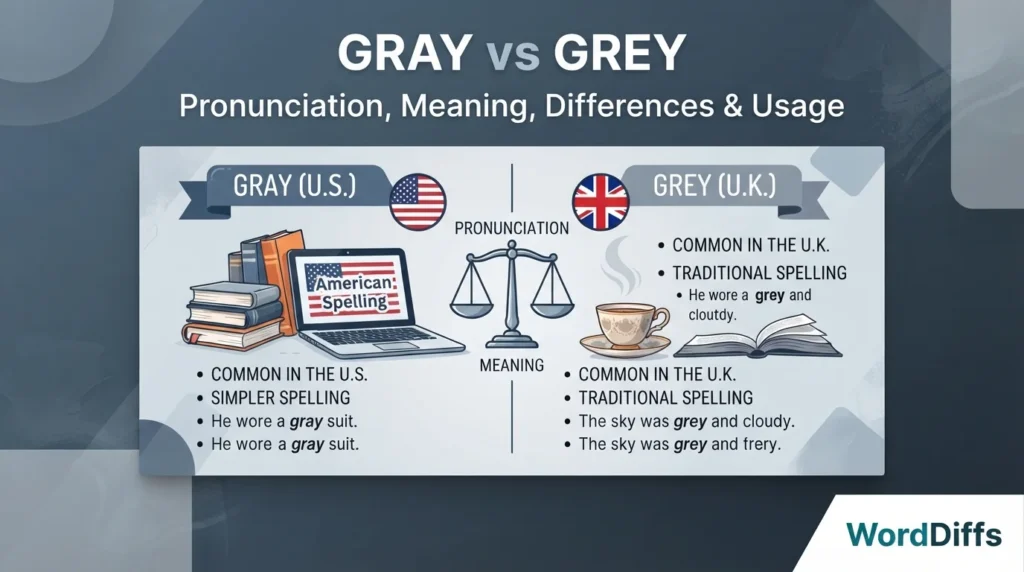
The words gray and grey often confuse English learners because they look almost identical, have the same pronunciation, and refer to the same color. The difference is not about meaning or grammar, but mainly about spelling preference and regional usage. Both words describe a color between black and white, but one spelling is more common in American English, while the other is preferred in British English and many other varieties of English.
Understanding gray vs grey helps writers, students, ESL learners, and professionals choose the correct spelling for their audience. Although both forms are correct, using the preferred spelling for a specific region can make your writing look more natural and polished. In this guide, you will learn their pronunciation, meanings, grammar, usage rules, differences, examples, common mistakes, memory tips, and practical ways to use each form correctly.
Gray
Pronunciation
IPA Pronunciation
American English: /ɡreɪ/
British English: /ɡreɪ/
Easy Pronunciation Guide
Gray is pronounced like “gray” in everyday English.
- It has one syllable.
- The vowel sound is the long A sound, similar to words like day, say, and play.
- The stress falls naturally on the only syllable.
Pronunciation breakdown:
Gray → /ɡ/ + /reɪ/
Beginner pronunciation tips:
- Start with the g sound as in go.
- Follow it with the ray sound.
- Do not pronounce it with a short vowel sound.
- It sounds exactly like grey.
Meaning
Gray is a word that describes a color located between black and white. It can refer to objects, surfaces, clothing, hair, animals, weather, and many other things.
Examples of common meanings:
- A color
Gray is a neutral color that appears between black and white.
Example:
The walls of the room are painted gray. - Gray hair
Gray can describe hair that has lost some of its original color, often because of age.
Example:
My grandfather has gray hair. - Cloudy or dull conditions
Gray can describe skies, moods, or situations that feel dark or unclear.
Example:
The sky looked gray before the storm. - Unclear or complicated situations
The phrase gray area means something without a clear rule or answer.
Example:
The legal issue exists in a gray area.
Part of Speech
Part of Speech: Adjective, noun, verb
Sentence Function
As an adjective:
Gray describes a noun.
Example:
She bought a gray jacket.
Here, gray modifies the noun jacket.
As a noun:
Gray refers to the color itself.
Example:
Gray is a popular color for modern homes.
As a verb:
Gray can mean to become gray.
Example:
His hair began to gray after many years.
Grammar and Usage
Gray follows normal adjective rules in English.
It usually appears:
- Before a noun
- After linking verbs such as be, look, seem, and become
- As a noun when discussing the color itself
- As a verb when describing a change in color
Common grammar patterns:
- gray + noun
Example:
a gray sweater - be + gray
Example:
The building is gray. - turn/go gray
Example:
Her hair turned gray.
Common Collocations
Common word combinations with gray include:
| Collocation | Meaning | Example |
| gray hair | Hair with little or no original color | He has gray hair. |
| gray sky | A cloudy sky | The gray sky suggested rain. |
| gray matter | Brain tissue or intelligence | Education develops gray matter. |
| gray area | Something unclear | The policy has a gray area. |
| gray suit | A suit that is gray in color | He wore a gray suit. |
| gray wolf | A type of wild animal | The gray wolf lives in many regions. |
Grammar Function Table
| Grammar Function | Explanation | Example |
| Subject | Gray can act as the topic when discussing the color | Gray is a neutral color. |
| Object | Gray can be used as the object of a verb when naming a color | She chose gray for the walls. |
| Modifier | Gray describes another noun | He purchased a gray car. |
Example Sentences
1. Sentence:
The cat has soft gray fur.
Meaning:
The cat’s fur is a color between black and white.
Grammar Explanation:
Gray is an adjective modifying the noun fur.
2. Sentence:
She painted her bedroom gray.
Meaning:
She changed the bedroom color to gray.
Grammar Explanation:
Gray works as an adjective after the verb painted to describe the result.
3. Sentence:
Gray is often used in professional designs.
Meaning:
The color gray is common in formal designs.
Grammar Explanation:
Gray is a noun because it refers to the color itself.
4. Sentence:
The old photograph looked gray and faded.
Meaning:
The photograph appeared dull and lacked strong colors.
Grammar Explanation:
Gray is an adjective following the linking verb looked.
5. Sentence:
His beard started to gray with age.
Meaning:
His beard began losing its original color.
Grammar Explanation:
Gray is used as a verb showing a change.
Related Words
| Related Word | Meaning | Example Sentence |
| grayish | Slightly gray in color | The fabric has a grayish tone. |
| graying | Becoming gray | His graying hair was noticeable. |
| grayness | The quality of being gray | The grayness of the sky created a calm mood. |
| grayscale | A range of shades from black to white | The artist created a grayscale image. |
Grey
Pronunciation
IPA Pronunciation
American English: /ɡreɪ/
British English: /ɡreɪ/
Easy Pronunciation Guide
Grey has exactly the same pronunciation as gray.
Pronunciation breakdown:
Grey → /ɡreɪ/
Tips for beginners:
- Pronounce it as one syllable.
- Use the long A sound.
- It rhymes with:
- day
- way
- play
- say
There is no pronunciation difference between gray and grey.
Meaning
Grey has the same meaning as gray. It describes the color between black and white.
The difference is spelling preference, not meaning.
Examples:
- She wore a grey coat.
- The grey clouds covered the sky.
- His grey hair made him look distinguished.
In British English, grey is the standard spelling. It is also widely used in countries influenced by British English, including:
- United Kingdom
- Australia
- New Zealand
- India
- South Africa
Part of Speech
Part of Speech: Adjective, noun, verb
Sentence Function
As an adjective:
Example:
He bought a grey jacket.
Grey describes the noun jacket.
As a noun:
Example:
Grey is one of my favorite colors.
Grey refers to the color.
As a verb:
Example:
The paper began to grey over time.
Grey means to become gray in color.
Grammar and Usage
Grey follows the same grammatical rules as gray.
It can:
- Describe nouns
- Name a color
- Describe aging or color change
Common patterns:
- grey + noun
Example:
a grey dress - be + grey
Example:
The walls are grey. - turn/go grey
Example:
His hair went grey.
Common Collocations
| Collocation | Meaning | Example |
| grey hair | Hair that has lost color | She noticed her first grey hair. |
| grey sky | Cloud-covered sky | The grey sky looked rainy. |
| grey area | An unclear situation | The rule creates a grey area. |
| grey suit | A suit with a grey color | He wore a grey suit to work. |
| grey matter | Brain tissue | The brain contains grey matter. |
| grey wolf | A type of wolf | The grey wolf is a protected animal. |
Grammar Function Table
| Grammar Function | Explanation | Example |
| Subject | Grey can name the color being discussed | Grey is common in interior design. |
| Object | Grey can be selected as a color choice | They painted the room grey. |
| Modifier | Grey describes a noun | She bought a grey scarf. |
Example Sentences
1. Sentence:
The grey dress looked elegant.
Meaning:
The dress had a color between black and white.
Grammar Explanation:
Grey is an adjective modifying dress.
2. Sentence:
The morning was cold and grey.
Meaning:
The morning appeared dull because of clouds or low light.
Grammar Explanation:
Grey follows the linking verb was and describes the subject.
3. Sentence:
She prefers grey furniture in her office.
Meaning:
She likes furniture with a grey color.
Grammar Explanation:
Grey modifies the noun furniture.
4. Sentence:
The artist used different shades of grey.
Meaning:
The artist used multiple gray colors.
Grammar Explanation:
Grey acts as a noun because it identifies a color.
5. Sentence:
The old fence began to grey after years outside.
Meaning:
The fence gradually became grey.
Grammar Explanation:
Grey is a verb showing a change.
Related Words
| Related Word | Meaning | Example Sentence |
| greyish | Slightly grey | The stone has a greyish appearance. |
| greying | Becoming grey | His greying hair showed his age. |
| greyness | The quality of being grey | The greyness of winter days can feel quiet. |
| greyscale | Images using only shades of grey | The photo was converted into greyscale. |
Key Differences Between Gray vs Grey
The main difference between gray and grey is regional spelling preference. Both words have the same pronunciation, meaning, grammar, and usage. They are not different words with separate definitions. They are two accepted spellings of the same word.
Gray is the preferred spelling in American English, while grey is more common in British English and many other English-speaking countries.
Gray vs Grey: Complete Comparison
| Feature | Gray | Grey |
| Pronunciation | /ɡreɪ/ | /ɡreɪ/ |
| Meaning | A color between black and white | A color between black and white |
| Part of Speech | Adjective, noun, verb | Adjective, noun, verb |
| Grammar | Used to describe color, name color, or show color change | Used to describe color, name color, or show color change |
| Typical Usage | Most common in American English | Most common in British English |
| Regional Preference | United States and American publications | United Kingdom, Australia, New Zealand, and many Commonwealth regions |
| Example | She bought a gray sweater. | She bought a grey sweater. |
| Related Forms | grayish, graying, grayscale | greyish, greying, greyscale |
| Correctness | Correct spelling | Correct spelling |
Understanding the Biggest Difference
The biggest difference between gray and grey is not meaning. Both words refer to the same color and function in sentences in the same way.
The difference is based on spelling conventions:
- American English usually prefers gray.
- British English usually prefers grey.
Examples:
American English:
The building has gray walls.
British English:
The building has grey walls.
Both sentences are correct.
A writer should choose the spelling that matches the expected audience.
For example:
- A student writing for an American school should usually use gray.
- A writer publishing for a British audience should usually use grey.
Sentence Comparisons Using Gray vs Grey
1. American and British spelling difference
American English:
The car is painted gray.
British English:
The car is painted grey.
Explanation:
Both sentences have the same meaning. The only difference is regional spelling preference.
2. Describing clothing
She wore a gray coat during the winter.
She wore a grey coat during the winter.
Why both are correct:
Gray and grey are adjectives modifying the noun coat.
3. Talking about hair color
His gray hair made him look older.
His grey hair made him look older.
Explanation:
Both forms describe hair that has lost some natural color. The choice depends on regional spelling style.
4. Discussing design choices
The designer selected gray furniture for the office.
The designer selected grey furniture for the office.
Explanation:
The words function as adjectives describing furniture.
5. Naming the color
Gray is often used in modern architecture.
Grey is often used in modern architecture.
Explanation:
Here, both words act as nouns because they refer to the color itself.
6. Describing weather
The gray sky suggested rain.
The grey sky suggested rain.
Explanation:
Both describe a cloudy or dull sky.
7. Using color change
His hair began to gray with age.
His hair began to grey with age.
Explanation:
Both words can function as verbs meaning “to become gray.”
8. Discussing unclear situations
The situation is a gray area.
The situation is a grey area.
Explanation:
The expression gray area and grey area both mean a situation without a clear answer or rule.
Common Mistakes When Using Gray and Grey
Mistake 1: Thinking Gray and Grey Have Different Meanings
Incorrect idea:
Gray means dark color, but grey means light color.
Correct understanding:
Gray and grey have the same meaning.
Explanation:
The difference is spelling, not color shade.
Mistake 2: Using Both Spellings in the Same Document
Incorrect:
The report describes the grey building and the gray roof.
Correct:
The report describes the grey building and the grey roof.
or
The report describes the gray building and the gray roof.
Explanation:
Mixing spellings can make writing look inconsistent. Choose one style and keep it throughout.
Mistake 3: Using Grey in American Formal Writing Without Reason
Incorrect:
The company’s official American report uses grey throughout.
Better:
The company’s official American report uses gray throughout.
Explanation:
Grey is not wrong, but American publications usually prefer gray.
Mistake 4: Believing Gray and Grey Are Different Pronunciations
Incorrect:
Gray and grey are pronounced differently.
Correct:
Gray and grey are pronounced the same.
Explanation:
Both are pronounced /ɡreɪ/.
Mistake 5: Writing “Grayish” and “Greyish” Incorrectly
Incorrect:
The wall has a grayish color in British writing.
Better:
The wall has a greyish color in British writing.
Explanation:
Related forms usually follow the regional spelling pattern.
Mistake 6: Confusing Gray With Other Similar-Looking Words
Incorrect:
The cloudy day made the sky look grate.
Correct:
The cloudy day made the sky look gray.
Explanation:
Gray refers to color. Words like great, grate, and grey have different meanings.
Mistake 7: Thinking One Spelling Is Always Wrong
Incorrect:
Grey is an incorrect spelling.
Correct:
Grey is a correct spelling mainly used outside American English.
Explanation:
Both forms are accepted in English.
Mistake 8: Forgetting Audience and Location
Incorrect:
A British magazine consistently uses American spelling without a reason.
Better:
A British magazine usually follows British spelling conventions and uses grey.
Explanation:
Good writing considers the audience.
Easy Memory Tricks for Gray vs Grey
Trick 1: Remember the American “A”
Think:
Gray = America
The letter A in gray can remind you of America.
Example:
American English → gray
Trick 2: Remember British English Uses “E”
Think:
Grey = England
The letter E can remind you of England.
Example:
British English → grey
Trick 3: Focus on the Same Sound
Both words rhyme with:
- day
- play
- say
- way
If you know the pronunciation, remember that the difference is only spelling.
Trick 4: Think About Writing Style
Ask yourself:
“Who is reading this?”
- American audience → usually choose gray
- British audience → usually choose grey
Trick 5: Remember There Is No Meaning Difference
Do not spend time deciding which color is darker or lighter.
The simple rule:
Gray and grey = same color, different spelling styles.
Practice Quiz: Gray vs Grey
1. Choose the correct word:
The American newspaper described the sky as ______.
A) grey
B) gray
C) gre
D) graey
Correct Answer: B) gray
Explanation:
American English usually prefers gray.
2. Fill in the blank:
The British writer used the spelling ______ throughout the article.
Correct Answer: grey
Explanation:
British English commonly uses grey.
3. Choose the correct sentence:
A) Her hair started to gray with age.
B) Her hair started to grei with age.
Correct Answer: A
Explanation:
Gray can be used as a verb meaning to become gray.
4. Correct the sentence:
The company painted its office walls grey in an American report.
Correct Answer:
The company painted its office walls gray in an American report.
Explanation:
Gray is the common American spelling.
5. Choose the correct option:
Gray and grey have:
A) Different meanings
B) Different pronunciations
C) The same meaning and pronunciation
D) Opposite meanings
Correct Answer: C
Explanation:
They are spelling variations of the same word.
6. Fill in the blank:
The artist created a ______ scale image.
Correct Answer:
grayscale or greyscale
Explanation:
Both forms exist, depending on spelling preference.
7. Choose the correct sentence:
A) The car is grey.
B) The car is gray.
Correct Answer:
Both A and B
Explanation:
Both sentences are grammatically correct.
8. Which spelling is preferred in American English?
A) Grey
B) Gray
Correct Answer:
B) Gray
Explanation:
American English normally uses gray.
9. Which spelling is preferred in British English?
A) Gray
B) Grey
Correct Answer:
B) Grey
Explanation:
British English usually uses grey.
10. Choose the correct statement:
A) Gray is a noun only.
B) Grey is always incorrect.
C) Gray and grey can both be adjectives, nouns, and verbs.
D) Gray and grey have different pronunciations.
Correct Answer:
C
Explanation:
Both spellings have the same grammatical uses.
Frequently Asked Questions About Gray vs Grey
What is the difference between gray and grey?
Gray and grey have the same meaning. Both describe the color between black and white. The only difference is spelling preference. Gray is more common in American English, while grey is more common in British English.
Are gray and grey pronounced differently?
No. Gray and grey have the same pronunciation: /ɡreɪ/.
They both sound like the word “gray” and rhyme with words such as:
- day
- play
- say
- way
Is gray or grey the correct spelling?
Both spellings are correct. The correct choice depends on the type of English being used.
- Use gray for American English.
- Use grey for British English and many other international varieties.
Which spelling should I use in American English?
In American English, gray is the standard spelling.
Examples:
- The building has gray walls.
- She bought a gray dress.
Which spelling should I use in British English?
In British English, grey is the preferred spelling.
Examples:
- The building has grey walls.
- He wears a grey jacket.
Can gray and grey be used as adjectives?
Yes. Both words commonly function as adjectives to describe nouns.
Examples:
- a gray shirt
- a grey shirt
- gray clouds
- grey clouds
Can gray and grey be used as nouns?
Yes. Both can refer to the color itself.
Examples:
- Gray is a popular color.
- Grey is often used in modern design.
Can gray and grey be used as verbs?
Yes. Both can describe the process of becoming gray in color.
Examples:
- His hair began to gray.
- Her hair began to grey.
This usage is less common than the adjective form.
Why do Americans spell it gray?
The spelling gray became the standard form in American English through historical spelling preferences and dictionary conventions. American English often developed different spelling patterns from British English.
Why do British people spell it grey?
The spelling grey is the traditional British English form. It remains widely used in the United Kingdom and many countries that follow British spelling standards.
Is grey wrong in American English?
No. Grey is not wrong in American English. It is a recognized spelling, but gray is usually preferred in American writing.
Is gray wrong in British English?
No. Gray is also understood in British English, but grey is the more traditional and common choice.
Should I use gray or grey in academic writing?
Choose the spelling style required by your institution, teacher, publisher, or audience.
For example:
- American academic writing → gray
- British academic writing → grey
The most important rule is consistency.
Are gray and grey homophones?
Yes, in modern English they are homophones because they have the same pronunciation but different spellings.
Are gray and grey synonyms?
Yes, they can be considered spelling variants with the same meaning. They are not separate vocabulary words with different definitions.
Final Summary: Gray vs Grey
The words gray and grey are two spellings of the same English word. They describe the color between black and white and can be used as adjectives, nouns, and verbs.
The key differences are:
- Gray is the preferred spelling in American English.
- Grey is the preferred spelling in British English and many other English-speaking regions.
- Both words have the same pronunciation: /ɡreɪ/.
- Both words have the same meaning.
- Both words follow the same grammar rules.
The easiest way to remember the difference is:
Gray = American English
Think of the A in gray as a reminder of America.
Grey = British English
Think of the E in grey as a reminder of England.
For English learners and writers, the most important habit is consistency. Choose one spelling style based on your audience and use it throughout your writing. Whether you write gray or grey, your meaning will remain clear as long as your spelling matches the style you are following.

Caitlin Boylan is an experienced content writer, editor, educator, travel writer, and remote worker with more than 10 years of experience in English education and international communication. She is the founder and author of The Country Jumper, a travel blog dedicated to supporting solo travelers, especially women exploring life abroad. She is also the co-founder of Macro Magazine, a global online publication that shares diverse perspectives on worldwide topics that impact communities.