
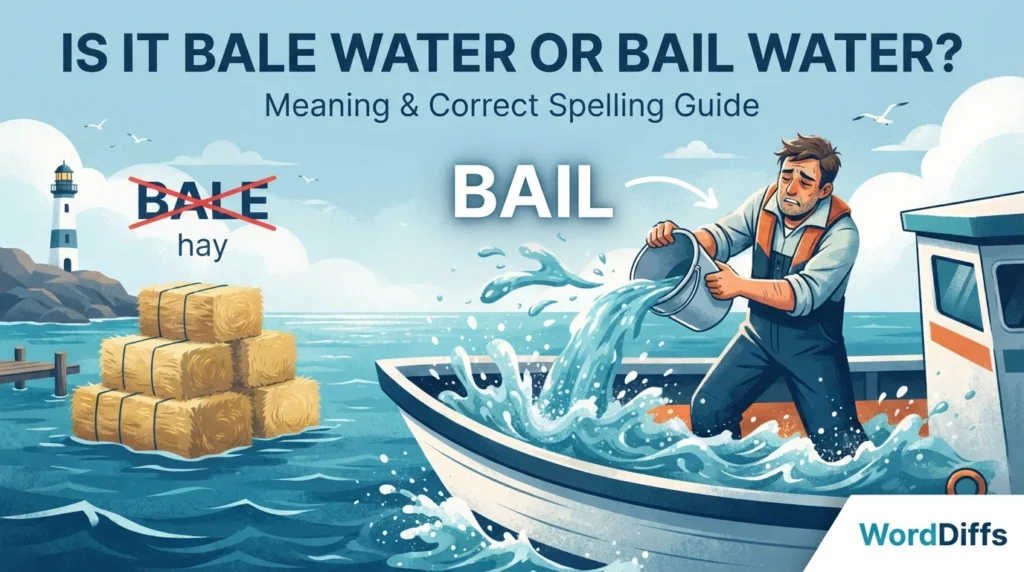
Have you ever wondered whether you should write Bale Water or Bail Water? This confusion is surprisingly common because the words bale and bail sound exactly alike, making them homophones. However, they have different meanings and are used in different contexts. Choosing the wrong spelling can change the meaning of your sentence and create confusion, especially in professional, academic, or maritime writing. In this guide, you’ll learn which spelling is correct, what each word means, how to pronounce them, why people mix them up, and practical techniques to remember the correct usage with confidence.
Quick Facts Table
| Feature | Details |
| Correct Word | Bale Water (when referring to removing water from a boat) |
| Incorrect Word | Bail Water (incorrect in this meaning) |
| Word Type | Verb phrase |
| Meaning | To remove water from a boat or vessel |
| Pronunciation | /beɪl ˈwɔː.tər/ |
| Common Error | Confusing the homophones bale and bail |
| Difficulty | Moderate |
What Does Bale Water or Bail Water Mean?
The phrase bale water means to remove water from a boat, canoe, or other small vessel using a container or similar tool. The verb bale has long been used in nautical English to describe scooping or emptying water from a vessel to keep it afloat.
Many people mistakenly write bail water because the word bail is much more common in everyday English. However, in standard dictionaries and traditional nautical usage, bale water is the accepted spelling for this specific meaning.
Key Points
- Bale water means removing unwanted water from a boat.
- It is commonly found in maritime, boating, and historical writing.
- Bail water is generally considered a spelling mistake when referring to emptying water from a vessel.
- The confusion exists because bale and bail are pronounced the same.
Examples
- The sailors had to bale water throughout the storm.
- We used a bucket to bale water from the canoe.
- Everyone helped bale water until the boat reached shore safely.
Is “Bail Water” Correct?
In the context of removing water from a boat, bail water is not the preferred standard spelling. Although many native English speakers use it informally, dictionaries and style references traditionally recognize bale as the correct verb for this nautical action.
The confusion happens because bail is a much more familiar word. People often associate it with removing something or escaping from a situation, so they mistakenly substitute it for bale.
Why People Write “Bail Water”
- They hear the words rather than see them written.
- Both words are pronounced identically.
- Bail is more common in everyday English.
- Spell checkers may not identify the mistake because bail is also a correctly spelled English word.
Incorrect Examples
- Please bail water from the canoe.
- They spent hours bailing water from the fishing boat.
Correct Versions
- Please bale water from the canoe.
- They spent hours baling water from the fishing boat.
What Is the Correct Spelling?
The correct spelling for the boating action is bale water.
The verb bale specifically means to scoop or throw water out of a boat. It has been used in English for centuries in maritime contexts and continues to appear in dictionaries and boating manuals.
Remember These Rules
- Use “bale” when removing water from a boat.
- Do not replace it with “bail” in nautical writing.
- Use “bailing” only when referring to legal bail or other meanings of the verb bail.
Correct Examples
- The crew quickly baled water after the wave hit.
- She kept baling water until the leak was repaired.
- Everyone took turns baling water from the rowboat.
- They had to bale water before continuing their journey.
Difference Between the Two Spellings
| Feature | Bail Water | Bale Water |
| Standard spelling for removing water from a boat | ❌ No | ✅ Yes |
| Dictionary support for nautical meaning | ❌ Limited | ✅ Yes |
| Traditional maritime usage | ❌ No | ✅ Yes |
| Common mistake | ✅ Yes | ❌ No |
| Suitable for formal writing | ❌ No | ✅ Yes |
Understanding the Difference
Although the spellings differ by only one letter, they represent different words.
Bale is the traditional nautical verb meaning to remove water from a vessel.
Bail most commonly refers to legal release, financial security, or leaving a situation quickly. Because it is much more common, writers often substitute it accidentally.
Meaning of the Correct Word
The verb bale has several meanings, but in this article the relevant meaning is:
To remove accumulated water from a boat or similar vessel by scooping or pouring it out.
This action helps prevent the vessel from becoming too heavy or sinking.
Common Uses
- Small boats
- Canoes
- Kayaks
- Fishing boats
- Rowboats
- Emergency boating situations
Example Sentences
- We had to bale water after crossing rough waves.
- The fisherman calmly baled water while heading toward shore.
- Children learned how to bale water during boating lessons.
- Strong winds forced the crew to bale water continuously.
Pronunciation
IPA Pronunciation
Bale: /beɪl/
Water (American English): /ˈwɑːtər/
Water (British English): /ˈwɔːtə/
Combined:
Bale Water
- American English: /beɪl ˈwɑːtər/
- British English: /beɪl ˈwɔːtə/
Syllable Breakdown
- Bale → bale
- Water → wa • ter
Combined:
bale wa • ter
Pronunciation Tips
- The word bale rhymes with:
- sale
- tail
- Do not let the pronunciation lead you to the spelling bail, since both words sound exactly alike.
- Focus on the meaning rather than the sound when choosing the spelling.
Why Do People Make This Spelling Mistake?
Several factors contribute to the confusion between bale water and bail water.
Pronunciation Confusion
Both words are perfect homophones. Since they sound identical, many people choose the spelling they recognize most often.
Typing Mistakes
Fast typing can easily replace bale with bail, especially because modern keyboards and autocorrect systems do not always detect context.
Phonetic Spelling
Many learners spell words exactly as they hear them. Since pronunciation offers no clue, the incorrect spelling often appears in writing.
Similar-Looking Words
The words differ by only one letter.
- bale
- bail
This tiny visual difference makes proofreading especially important.
Memory Errors
Because bail appears frequently in legal news, conversations, and entertainment, writers naturally remember it more easily than the less common nautical verb bale.
Regional Influence
Some regions and informal publications occasionally use bail water, but careful editing, dictionaries, and traditional maritime usage continue to favor bale water.
Origin and Etymology
The verb bale comes from Middle English and has historical roots connected with the action of scooping or emptying water from a vessel. It became firmly established in nautical vocabulary centuries ago, particularly among sailors and fishermen.
The word bail, however, developed separately. It entered English through legal and administrative traditions, referring to temporary release from custody or a financial guarantee. Over time, bail also gained additional meanings, such as leaving a difficult situation or parachuting from an aircraft.
Although these words now sound identical, their histories are completely different, which explains why they should not be confused in writing.
How to Remember the Correct Spelling
Learning a simple memory trick can help you avoid this common mistake.
Memory Tricks
- Think: “Bale belongs to boats.”
- Both “bale” and “boat” begin with the letter B.
- Remember that sailors bale water to keep a boat afloat.
Mnemonics
- Bale for boats.
- Bale before the boat sinks.
- Boat plus Bale equals the correct spelling.
Quick Spelling Hacks
- Ask yourself if the sentence is about a boat.
- If yes, choose bale.
- If the sentence is about court, prison, or money, choose bail instead.
- Always proofread homophones carefully.
Examples in Sentences
| Incorrect Sentence | Correct Sentence |
| We had to bail water from the canoe. | We had to bale water from the canoe. |
| The crew bailed water all afternoon. | The crew baled water all afternoon. |
| They used buckets to bail water. | They used buckets to bale water. |
| Please bail water before we leave. | Please bale water before we leave. |
| She kept bailing water after the storm. | She kept baling water after the storm. |
| We learned how to bail water safely. | We learned how to bale water safely. |
| Fishermen bailed water during the trip. | Fishermen baled water during the trip. |
| Everyone helped bail water from the rowboat. | Everyone helped bale water from the rowboat. |
| They forgot to bail water after the rain. | They forgot to bale water after the rain. |
| The guide showed us how to bail water. | The guide showed us how to bale water. |
| We spent hours bailing water from the boat. | We spent hours baling water from the boat. |
| The captain ordered everyone to bail water. | The captain ordered everyone to bale water. |
| They continued bailing water until sunrise. | They continued baling water until sunrise. |
| We had no choice but to bail water. | We had no choice but to bale water. |
| Quick action helped us bail water before the boat filled. | Quick action helped us bale water before the boat filled. |
Common Mistakes to Avoid
The confusion between bale and bail usually comes from pronunciation rather than grammar. Understanding the meaning of each word will help you choose the correct spelling.
Mistakes Writers Commonly Make
- Using bail water instead of bale water.
Incorrect: We had to bail water from the canoe.
Correct: We had to bale water from the canoe. - Assuming both spellings are interchangeable.
They are not interchangeable. The standard nautical verb is bale. - Choosing the more familiar word without checking the meaning.
Since bail appears more often in everyday English, many writers mistakenly use it in boating contexts. - Ignoring context while proofreading.
Spell checkers may not flag bail because it is a correctly spelled English word with a different meaning. - Confusing legal and nautical meanings.
Remember that bail relates to courts, money, or leaving a situation, while bale refers to removing water from a boat.
Similar Commonly Misspelled Words
| Incorrect | Correct | Meaning |
| Recieve | Receive | To get something |
| Definately | Definitely | Without doubt |
| Seperate | Separate | To divide |
| Occured | Occurred | Happened |
| Untill | Until | Up to a time |
| Beleive | Believe | To accept as true |
| Goverment | Government | National administration |
| Grammer | Grammar | Rules of language |
| Writting | Writing | The act of composing text |
| Begining | Beginning | The start of something |
Related Words
Synonyms
For bale (nautical sense):
- Empty
- Scoop
- Remove
- Drain
- Pump out
- Clear out
Antonyms
Depending on context:
- Fill
- Flood
- Pour in
- Accumulate
Related Forms
| Word | Part of Speech | Meaning |
| Bale | Verb | To remove water from a boat |
| Baling | Verb (present participle) | Removing water |
| Baled | Verb (past tense) | Removed water |
| Bail | Noun | Temporary legal release |
| Bail | Verb | To secure release or leave a situation |
Grammar Tips
Correct spelling is only part of good writing. Grammar and context are equally important.
- Choose the spelling based on meaning, not pronunciation.
- Use bale as a verb when discussing boats or vessels.
- Use bail only for its own meanings, such as legal release or leaving suddenly.
- Keep verb tense consistent.
- Match singular and plural subjects with the correct verb forms.
- Read your sentence aloud and then verify the spelling separately, since pronunciation will not help with homophones.
Examples
- They baled water for nearly an hour.
- The sailor is baling water now.
- The judge agreed to grant bail.
Writing Tips
These practical habits can help you avoid spelling mistakes.
- Learn the meaning before memorizing the spelling.
- Keep a personal list of commonly confused words.
- Use trusted dictionaries when unsure.
- Proofread slowly, especially for homophones.
- Pay attention to context instead of relying on spell check.
- Read quality books and articles to reinforce correct usage.
- Practice writing new vocabulary in complete sentences.
- Review commonly confused words before exams or professional writing.
Quick Spelling Checklist
| Checklist | Yes/No |
| Is the sentence about removing water from a boat? | □ |
| If yes, did you write bale? | □ |
| Is the sentence about legal release or court? | □ |
| If yes, did you write bail? | □ |
| Did you proofread for homophones? | □ |
| Did you verify the meaning before choosing the spelling? | □ |
| Did you check verb tense? | □ |
| Does the sentence make logical sense? | □ |
Key Takeaways
- Bale water is the standard spelling for removing water from a boat.
- Bail water is a common misspelling in this context.
- The confusion exists because bale and bail are homophones.
- Always choose the spelling according to the meaning.
- Remember the phrase: “Bale belongs to boats.”
- Context is more reliable than pronunciation when selecting the correct spelling.
- Careful proofreading helps catch mistakes that spell check may miss.
Conclusion
Although Bale Water or Bail Water may seem like a small spelling difference, choosing the correct word makes your writing clearer and more accurate. In standard English, bale water is the accepted expression when referring to removing water from a boat or other small vessel. The spelling bail water usually appears because the words sound identical, but it does not represent the traditional nautical term. By understanding the meanings, pronunciation, history, and usage of these homophones, you can avoid a common writing mistake. Whenever you write about boats, remember that bale belongs to boats. With regular reading, careful proofreading, and a simple memory trick, you’ll be able to use the correct spelling confidently in academic, professional, and everyday writing.
Frequently Asked Questions
Is bale water or bail water correct?
Bale water is the correct spelling when referring to removing water from a boat. Although many people mistakenly write bail water, the traditional and standard nautical verb is bale. Choosing the correct spelling improves clarity and accuracy in formal writing.
What does bale water mean?
Bale water means to scoop or remove water from a boat, canoe, or similar vessel using a bucket, container, or another tool. It is commonly used in boating, sailing, and maritime contexts where excess water must be removed to keep the vessel afloat.
Why do people write bail water?
People usually write bail water because bale and bail are pronounced the same. Since bail is a more familiar word in everyday English, many writers choose it automatically without realizing that it has a different meaning.
Is bail ever correct?
Yes. Bail is correct when referring to legal release from custody, money paid for temporary release, or leaving a difficult situation. It should not replace bale when discussing removing water from a boat.
How do you pronounce bale?
Bale is pronounced /beɪl/. It rhymes with words such as sale, mail, and tail. The pronunciation is identical to bail, which is why these words are frequently confused in writing.
Is bale a verb or a noun?
It can be both. As a verb, bale means to remove water from a boat. As a noun, it commonly refers to a tightly packed bundle of materials such as hay, cotton, or paper. Context determines which meaning is intended.
How can I remember the correct spelling?
A useful memory trick is “Bale belongs to boats.” Since both bale and boat begin with the letter B, this association makes it easier to remember the correct spelling whenever you write about removing water from a vessel.
Is bale water used in formal writing?
Yes. Bale water is the preferred spelling in dictionaries, boating manuals, educational materials, and formal writing related to maritime activities. Using this spelling demonstrates accuracy and attention to detail.
Will spell check catch this mistake?
Not always. Because bail is a correctly spelled English word, many spelling tools will not identify it as an error. You should always review the meaning of the sentence instead of relying only on automated spell check.
Is this spelling tested in English exams?
It can be. Homophones and commonly confused spellings often appear in spelling tests, grammar exercises, vocabulary quizzes, and proofreading tasks. Understanding the meanings of both words helps you answer these questions correctly.
Can I use bale water in professional documents?
Absolutely. If your writing involves boating, marine safety, fishing, or historical maritime topics, bale water is the appropriate and professional choice. Using the correct spelling improves precision and credibility.
Meta Description
Learn whether Bale Water or Bail Water is correct, with meanings, examples, pronunciation, spelling tips, and common mistakes.Is It Bale Water or Bail Water? Meaning & Correct Spelling Guide
Introduction
Have you ever wondered whether you should write Bale Water or Bail Water? This confusion is surprisingly common because the words bale and bail sound exactly alike, making them homophones. However, they have different meanings and are used in different contexts. Choosing the wrong spelling can change the meaning of your sentence and create confusion, especially in professional, academic, or maritime writing. In this guide, you’ll learn which spelling is correct, what each word means, how to pronounce them, why people mix them up, and practical techniques to remember the correct usage with confidence.
Quick Facts Table
| Feature | Details |
| Correct Word | Bale Water (when referring to removing water from a boat) |
| Incorrect Word | Bail Water (incorrect in this meaning) |
| Word Type | Verb phrase |
| Meaning | To remove water from a boat or vessel |
| Pronunciation | /beɪl ˈwɔː.tər/ |
| Common Error | Confusing the homophones bale and bail |
| Difficulty | Moderate |
What Does Bale Water or Bail Water Mean?
The phrase bale water means to remove water from a boat, canoe, or other small vessel using a container or similar tool. The verb bale has long been used in nautical English to describe scooping or emptying water from a vessel to keep it afloat.
Many people mistakenly write bail water because the word bail is much more common in everyday English. However, in standard dictionaries and traditional nautical usage, bale water is the accepted spelling for this specific meaning.
Key Points
- Bale water means removing unwanted water from a boat.
- It is commonly found in maritime, boating, and historical writing.
- Bail water is generally considered a spelling mistake when referring to emptying water from a vessel.
- The confusion exists because bale and bail are pronounced the same.
Examples
- The sailors had to bale water throughout the storm.
- We used a bucket to bale water from the canoe.
- Everyone helped bale water until the boat reached shore safely.
Is “Bail Water” Correct?
In the context of removing water from a boat, bail water is not the preferred standard spelling. Although many native English speakers use it informally, dictionaries and style references traditionally recognize bale as the correct verb for this nautical action.
The confusion happens because bail is a much more familiar word. People often associate it with removing something or escaping from a situation, so they mistakenly substitute it for bale.
Why People Write “Bail Water”
- They hear the words rather than see them written.
- Both words are pronounced identically.
- Bail is more common in everyday English.
- Spell checkers may not identify the mistake because bail is also a correctly spelled English word.
Incorrect Examples
- Please bail water from the canoe.
- They spent hours bailing water from the fishing boat.
Correct Versions
- Please bale water from the canoe.
- They spent hours baling water from the fishing boat.
What Is the Correct Spelling?
The correct spelling for the boating action is bale water.
The verb bale specifically means to scoop or throw water out of a boat. It has been used in English for centuries in maritime contexts and continues to appear in dictionaries and boating manuals.
Remember These Rules
- Use “bale” when removing water from a boat.
- Do not replace it with “bail” in nautical writing.
- Use “bailing” only when referring to legal bail or other meanings of the verb bail.
Correct Examples
- The crew quickly baled water after the wave hit.
- She kept baling water until the leak was repaired.
- Everyone took turns baling water from the rowboat.
- They had to bale water before continuing their journey.
Difference Between the Two Spellings
| Feature | Bail Water | Bale Water |
| Standard spelling for removing water from a boat | ❌ No | ✅ Yes |
| Dictionary support for nautical meaning | ❌ Limited | ✅ Yes |
| Traditional maritime usage | ❌ No | ✅ Yes |
| Common mistake | ✅ Yes | ❌ No |
| Suitable for formal writing | ❌ No | ✅ Yes |
Understanding the Difference
Although the spellings differ by only one letter, they represent different words.
Bale is the traditional nautical verb meaning to remove water from a vessel.
Bail most commonly refers to legal release, financial security, or leaving a situation quickly. Because it is much more common, writers often substitute it accidentally.
Meaning of the Correct Word
The verb bale has several meanings, but in this article the relevant meaning is:
To remove accumulated water from a boat or similar vessel by scooping or pouring it out.
This action helps prevent the vessel from becoming too heavy or sinking.
Common Uses
- Small boats
- Canoes
- Kayaks
- Fishing boats
- Rowboats
- Emergency boating situations
Example Sentences
- We had to bale water after crossing rough waves.
- The fisherman calmly baled water while heading toward shore.
- Children learned how to bale water during boating lessons.
- Strong winds forced the crew to bale water continuously.
Pronunciation
IPA Pronunciation
Bale: /beɪl/
Water (American English): /ˈwɑːtər/
Water (British English): /ˈwɔːtə/
Combined:
Bale Water
- American English: /beɪl ˈwɑːtər/
- British English: /beɪl ˈwɔːtə/
Syllable Breakdown
- Bale → bale
- Water → wa • ter
Combined:
bale wa • ter
Pronunciation Tips
- The word bale rhymes with:
- sale
- tail
- Do not let the pronunciation lead you to the spelling bail, since both words sound exactly alike.
- Focus on the meaning rather than the sound when choosing the spelling.
Why Do People Make This Spelling Mistake?
Several factors contribute to the confusion between bale water and bail water.
Pronunciation Confusion
Both words are perfect homophones. Since they sound identical, many people choose the spelling they recognize most often.
Typing Mistakes
Fast typing can easily replace bale with bail, especially because modern keyboards and autocorrect systems do not always detect context.
Phonetic Spelling
Many learners spell words exactly as they hear them. Since pronunciation offers no clue, the incorrect spelling often appears in writing.
Similar-Looking Words
The words differ by only one letter.
- bale
- bail
This tiny visual difference makes proofreading especially important.
Memory Errors
Because bail appears frequently in legal news, conversations, and entertainment, writers naturally remember it more easily than the less common nautical verb bale.
Regional Influence
Some regions and informal publications occasionally use bail water, but careful editing, dictionaries, and traditional maritime usage continue to favor bale water.
Origin and Etymology
The verb bale comes from Middle English and has historical roots connected with the action of scooping or emptying water from a vessel. It became firmly established in nautical vocabulary centuries ago, particularly among sailors and fishermen.
The word bail, however, developed separately. It entered English through legal and administrative traditions, referring to temporary release from custody or a financial guarantee. Over time, bail also gained additional meanings, such as leaving a difficult situation or parachuting from an aircraft.
Although these words now sound identical, their histories are completely different, which explains why they should not be confused in writing.
How to Remember the Correct Spelling
Learning a simple memory trick can help you avoid this common mistake.
Memory Tricks
- Think: “Bale belongs to boats.”
- Both “bale” and “boat” begin with the letter B.
- Remember that sailors bale water to keep a boat afloat.
Mnemonics
- Bale for boats.
- Bale before the boat sinks.
- Boat plus Bale equals the correct spelling.
Quick Spelling Hacks
- Ask yourself if the sentence is about a boat.
- If yes, choose bale.
- If the sentence is about court, prison, or money, choose bail instead.
- Always proofread homophones carefully.
Examples in Sentences
| Incorrect Sentence | Correct Sentence |
| We had to bail water from the canoe. | We had to bale water from the canoe. |
| The crew bailed water all afternoon. | The crew baled water all afternoon. |
| They used buckets to bail water. | They used buckets to bale water. |
| Please bail water before we leave. | Please bale water before we leave. |
| She kept bailing water after the storm. | She kept baling water after the storm. |
| We learned how to bail water safely. | We learned how to bale water safely. |
| Fishermen bailed water during the trip. | Fishermen baled water during the trip. |
| Everyone helped bail water from the rowboat. | Everyone helped bale water from the rowboat. |
| They forgot to bail water after the rain. | They forgot to bale water after the rain. |
| The guide showed us how to bail water. | The guide showed us how to bale water. |
| We spent hours bailing water from the boat. | We spent hours baling water from the boat. |
| The captain ordered everyone to bail water. | The captain ordered everyone to bale water. |
| They continued bailing water until sunrise. | They continued baling water until sunrise. |
| We had no choice but to bail water. | We had no choice but to bale water. |
| Quick action helped us bail water before the boat filled. | Quick action helped us bale water before the boat filled. |
Common Mistakes to Avoid
The confusion between bale and bail usually comes from pronunciation rather than grammar. Understanding the meaning of each word will help you choose the correct spelling.
Mistakes Writers Commonly Make
- Using bail water instead of bale water.
Incorrect: We had to bail water from the canoe.
Correct: We had to bale water from the canoe. - Assuming both spellings are interchangeable.
They are not interchangeable. The standard nautical verb is bale. - Choosing the more familiar word without checking the meaning.
Since bail appears more often in everyday English, many writers mistakenly use it in boating contexts. - Ignoring context while proofreading.
Spell checkers may not flag bail because it is a correctly spelled English word with a different meaning. - Confusing legal and nautical meanings.
Remember that bail relates to courts, money, or leaving a situation, while bale refers to removing water from a boat.
Similar Commonly Misspelled Words
| Incorrect | Correct | Meaning |
| Recieve | Receive | To get something |
| Definately | Definitely | Without doubt |
| Seperate | Separate | To divide |
| Occured | Occurred | Happened |
| Untill | Until | Up to a time |
| Beleive | Believe | To accept as true |
| Goverment | Government | National administration |
| Grammer | Grammar | Rules of language |
| Writting | Writing | The act of composing text |
| Begining | Beginning | The start of something |
Related Words
Synonyms
For bale (nautical sense):
- Empty
- Scoop
- Remove
- Drain
- Pump out
- Clear out
Antonyms
Depending on context:
- Fill
- Flood
- Pour in
- Accumulate
Related Forms
| Word | Part of Speech | Meaning |
| Bale | Verb | To remove water from a boat |
| Baling | Verb (present participle) | Removing water |
| Baled | Verb (past tense) | Removed water |
| Bail | Noun | Temporary legal release |
| Bail | Verb | To secure release or leave a situation |
Grammar Tips
Correct spelling is only part of good writing. Grammar and context are equally important.
- Choose the spelling based on meaning, not pronunciation.
- Use bale as a verb when discussing boats or vessels.
- Use bail only for its own meanings, such as legal release or leaving suddenly.
- Keep verb tense consistent.
- Match singular and plural subjects with the correct verb forms.
- Read your sentence aloud and then verify the spelling separately, since pronunciation will not help with homophones.
Examples
- They baled water for nearly an hour.
- The sailor is baling water now.
- The judge agreed to grant bail.
Writing Tips
These practical habits can help you avoid spelling mistakes.
- Learn the meaning before memorizing the spelling.
- Keep a personal list of commonly confused words.
- Use trusted dictionaries when unsure.
- Proofread slowly, especially for homophones.
- Pay attention to context instead of relying on spell check.
- Read quality books and articles to reinforce correct usage.
- Practice writing new vocabulary in complete sentences.
- Review commonly confused words before exams or professional writing.
Quick Spelling Checklist
| Checklist | Yes/No |
| Is the sentence about removing water from a boat? | □ |
| If yes, did you write bale? | □ |
| Is the sentence about legal release or court? | □ |
| If yes, did you write bail? | □ |
| Did you proofread for homophones? | □ |
| Did you verify the meaning before choosing the spelling? | □ |
| Did you check verb tense? | □ |
| Does the sentence make logical sense? | □ |
Key Takeaways
- Bale water is the standard spelling for removing water from a boat.
- Bail water is a common misspelling in this context.
- The confusion exists because bale and bail are homophones.
- Always choose the spelling according to the meaning.
- Remember the phrase: “Bale belongs to boats.”
- Context is more reliable than pronunciation when selecting the correct spelling.
- Careful proofreading helps catch mistakes that spell check may miss.
Conclusion
Although Bale Water or Bail Water may seem like a small spelling difference, choosing the correct word makes your writing clearer and more accurate. In standard English, bale water is the accepted expression when referring to removing water from a boat or other small vessel. The spelling bail water usually appears because the words sound identical, but it does not represent the traditional nautical term. By understanding the meanings, pronunciation, history, and usage of these homophones, you can avoid a common writing mistake. Whenever you write about boats, remember that bale belongs to boats. With regular reading, careful proofreading, and a simple memory trick, you’ll be able to use the correct spelling confidently in academic, professional, and everyday writing.
Frequently Asked Questions
Is bale water or bail water correct?
Bale water is the correct spelling when referring to removing water from a boat. Although many people mistakenly write bail water, the traditional and standard nautical verb is bale. Choosing the correct spelling improves clarity and accuracy in formal writing.
What does bale water mean?
Bale water means to scoop or remove water from a boat, canoe, or similar vessel using a bucket, container, or another tool. It is commonly used in boating, sailing, and maritime contexts where excess water must be removed to keep the vessel afloat.
Why do people write bail water?
People usually write bail water because bale and bail are pronounced the same. Since bail is a more familiar word in everyday English, many writers choose it automatically without realizing that it has a different meaning.
Is bail ever correct?
Yes. Bail is correct when referring to legal release from custody, money paid for temporary release, or leaving a difficult situation. It should not replace bale when discussing removing water from a boat.
How do you pronounce bale?
Bale is pronounced /beɪl/. It rhymes with words such as sale, mail, and tail. The pronunciation is identical to bail, which is why these words are frequently confused in writing.
Is bale a verb or a noun?
It can be both. As a verb, bale means to remove water from a boat. As a noun, it commonly refers to a tightly packed bundle of materials such as hay, cotton, or paper. Context determines which meaning is intended.
How can I remember the correct spelling?
A useful memory trick is “Bale belongs to boats.” Since both bale and boat begin with the letter B, this association makes it easier to remember the correct spelling whenever you write about removing water from a vessel.
Is bale water used in formal writing?
Yes. Bale water is the preferred spelling in dictionaries, boating manuals, educational materials, and formal writing related to maritime activities. Using this spelling demonstrates accuracy and attention to detail.
Will spell check catch this mistake?
Not always. Because bail is a correctly spelled English word, many spelling tools will not identify it as an error. You should always review the meaning of the sentence instead of relying only on automated spell check.
Is this spelling tested in English exams?
It can be. Homophones and commonly confused spellings often appear in spelling tests, grammar exercises, vocabulary quizzes, and proofreading tasks. Understanding the meanings of both words helps you answer these questions correctly.
Can I use bale water in professional documents?
Absolutely. If your writing involves boating, marine safety, fishing, or historical maritime topics, bale water is the appropriate and professional choice. Using the correct spelling improves precision and credibility.
Meta Description
Learn whether Bale Water or Bail Water is correct, with meanings, examples, pronunciation, spelling tips, and common mistakes.Is It Bale Water or Bail Water? Meaning & Correct Spelling Guide
Introduction
Have you ever wondered whether you should write Bale Water or Bail Water? This confusion is surprisingly common because the words bale and bail sound exactly alike, making them homophones. However, they have different meanings and are used in different contexts. Choosing the wrong spelling can change the meaning of your sentence and create confusion, especially in professional, academic, or maritime writing. In this guide, you’ll learn which spelling is correct, what each word means, how to pronounce them, why people mix them up, and practical techniques to remember the correct usage with confidence.
Quick Facts Table
| Feature | Details |
| Correct Word | Bale Water (when referring to removing water from a boat) |
| Incorrect Word | Bail Water (incorrect in this meaning) |
| Word Type | Verb phrase |
| Meaning | To remove water from a boat or vessel |
| Pronunciation | /beɪl ˈwɔː.tər/ |
| Common Error | Confusing the homophones bale and bail |
| Difficulty | Moderate |
What Does Bale Water or Bail Water Mean?
The phrase bale water means to remove water from a boat, canoe, or other small vessel using a container or similar tool. The verb bale has long been used in nautical English to describe scooping or emptying water from a vessel to keep it afloat.
Many people mistakenly write bail water because the word bail is much more common in everyday English. However, in standard dictionaries and traditional nautical usage, bale water is the accepted spelling for this specific meaning.
Key Points
- Bale water means removing unwanted water from a boat.
- It is commonly found in maritime, boating, and historical writing.
- Bail water is generally considered a spelling mistake when referring to emptying water from a vessel.
- The confusion exists because bale and bail are pronounced the same.
Examples
- The sailors had to bale water throughout the storm.
- We used a bucket to bale water from the canoe.
- Everyone helped bale water until the boat reached shore safely.
Is “Bail Water” Correct?
In the context of removing water from a boat, bail water is not the preferred standard spelling. Although many native English speakers use it informally, dictionaries and style references traditionally recognize bale as the correct verb for this nautical action.
The confusion happens because bail is a much more familiar word. People often associate it with removing something or escaping from a situation, so they mistakenly substitute it for bale.
Why People Write “Bail Water”
- They hear the words rather than see them written.
- Both words are pronounced identically.
- Bail is more common in everyday English.
- Spell checkers may not identify the mistake because bail is also a correctly spelled English word.
Incorrect Examples
- Please bail water from the canoe.
- They spent hours bailing water from the fishing boat.
Correct Versions
- Please bale water from the canoe.
- They spent hours baling water from the fishing boat.
What Is the Correct Spelling?
The correct spelling for the boating action is bale water.
The verb bale specifically means to scoop or throw water out of a boat. It has been used in English for centuries in maritime contexts and continues to appear in dictionaries and boating manuals.
Remember These Rules
- Use “bale” when removing water from a boat.
- Do not replace it with “bail” in nautical writing.
- Use “bailing” only when referring to legal bail or other meanings of the verb bail.
Correct Examples
- The crew quickly baled water after the wave hit.
- She kept baling water until the leak was repaired.
- Everyone took turns baling water from the rowboat.
- They had to bale water before continuing their journey.
Difference Between the Two Spellings
| Feature | Bail Water | Bale Water |
| Standard spelling for removing water from a boat | ❌ No | ✅ Yes |
| Dictionary support for nautical meaning | ❌ Limited | ✅ Yes |
| Traditional maritime usage | ❌ No | ✅ Yes |
| Common mistake | ✅ Yes | ❌ No |
| Suitable for formal writing | ❌ No | ✅ Yes |
Understanding the Difference
Although the spellings differ by only one letter, they represent different words.
Bale is the traditional nautical verb meaning to remove water from a vessel.
Bail most commonly refers to legal release, financial security, or leaving a situation quickly. Because it is much more common, writers often substitute it accidentally.
Meaning of the Correct Word
The verb bale has several meanings, but in this article the relevant meaning is:
To remove accumulated water from a boat or similar vessel by scooping or pouring it out.
This action helps prevent the vessel from becoming too heavy or sinking.
Common Uses
- Small boats
- Canoes
- Kayaks
- Fishing boats
- Rowboats
- Emergency boating situations
Example Sentences
- We had to bale water after crossing rough waves.
- The fisherman calmly baled water while heading toward shore.
- Children learned how to bale water during boating lessons.
- Strong winds forced the crew to bale water continuously.
Pronunciation
IPA Pronunciation
Bale: /beɪl/
Water (American English): /ˈwɑːtər/
Water (British English): /ˈwɔːtə/
Combined:
Bale Water
- American English: /beɪl ˈwɑːtər/
- British English: /beɪl ˈwɔːtə/
Syllable Breakdown
- Bale → bale
- Water → wa • ter
Combined:
bale wa • ter
Pronunciation Tips
- The word bale rhymes with:
- sale
- tail
- Do not let the pronunciation lead you to the spelling bail, since both words sound exactly alike.
- Focus on the meaning rather than the sound when choosing the spelling.
Why Do People Make This Spelling Mistake?
Several factors contribute to the confusion between bale water and bail water.
Pronunciation Confusion
Both words are perfect homophones. Since they sound identical, many people choose the spelling they recognize most often.
Typing Mistakes
Fast typing can easily replace bale with bail, especially because modern keyboards and autocorrect systems do not always detect context.
Phonetic Spelling
Many learners spell words exactly as they hear them. Since pronunciation offers no clue, the incorrect spelling often appears in writing.
Similar-Looking Words
The words differ by only one letter.
- bale
- bail
This tiny visual difference makes proofreading especially important.
Memory Errors
Because bail appears frequently in legal news, conversations, and entertainment, writers naturally remember it more easily than the less common nautical verb bale.
Regional Influence
Some regions and informal publications occasionally use bail water, but careful editing, dictionaries, and traditional maritime usage continue to favor bale water.
Origin and Etymology
The verb bale comes from Middle English and has historical roots connected with the action of scooping or emptying water from a vessel. It became firmly established in nautical vocabulary centuries ago, particularly among sailors and fishermen.
The word bail, however, developed separately. It entered English through legal and administrative traditions, referring to temporary release from custody or a financial guarantee. Over time, bail also gained additional meanings, such as leaving a difficult situation or parachuting from an aircraft.
Although these words now sound identical, their histories are completely different, which explains why they should not be confused in writing.
How to Remember the Correct Spelling
Learning a simple memory trick can help you avoid this common mistake.
Memory Tricks
- Think: “Bale belongs to boats.”
- Both “bale” and “boat” begin with the letter B.
- Remember that sailors bale water to keep a boat afloat.
Mnemonics
- Bale for boats.
- Bale before the boat sinks.
- Boat plus Bale equals the correct spelling.
Quick Spelling Hacks
- Ask yourself if the sentence is about a boat.
- If yes, choose bale.
- If the sentence is about court, prison, or money, choose bail instead.
- Always proofread homophones carefully.
Examples in Sentences
| Incorrect Sentence | Correct Sentence |
| We had to bail water from the canoe. | We had to bale water from the canoe. |
| The crew bailed water all afternoon. | The crew baled water all afternoon. |
| They used buckets to bail water. | They used buckets to bale water. |
| Please bail water before we leave. | Please bale water before we leave. |
| She kept bailing water after the storm. | She kept baling water after the storm. |
| We learned how to bail water safely. | We learned how to bale water safely. |
| Fishermen bailed water during the trip. | Fishermen baled water during the trip. |
| Everyone helped bail water from the rowboat. | Everyone helped bale water from the rowboat. |
| They forgot to bail water after the rain. | They forgot to bale water after the rain. |
| The guide showed us how to bail water. | The guide showed us how to bale water. |
| We spent hours bailing water from the boat. | We spent hours baling water from the boat. |
| The captain ordered everyone to bail water. | The captain ordered everyone to bale water. |
| They continued bailing water until sunrise. | They continued baling water until sunrise. |
| We had no choice but to bail water. | We had no choice but to bale water. |
| Quick action helped us bail water before the boat filled. | Quick action helped us bale water before the boat filled. |
Common Mistakes to Avoid
The confusion between bale and bail usually comes from pronunciation rather than grammar. Understanding the meaning of each word will help you choose the correct spelling.
Mistakes Writers Commonly Make
- Using bail water instead of bale water.
Incorrect: We had to bail water from the canoe.
Correct: We had to bale water from the canoe. - Assuming both spellings are interchangeable.
They are not interchangeable. The standard nautical verb is bale. - Choosing the more familiar word without checking the meaning.
Since bail appears more often in everyday English, many writers mistakenly use it in boating contexts. - Ignoring context while proofreading.
Spell checkers may not flag bail because it is a correctly spelled English word with a different meaning. - Confusing legal and nautical meanings.
Remember that bail relates to courts, money, or leaving a situation, while bale refers to removing water from a boat.
Similar Commonly Misspelled Words
| Incorrect | Correct | Meaning |
| Recieve | Receive | To get something |
| Definately | Definitely | Without doubt |
| Seperate | Separate | To divide |
| Occured | Occurred | Happened |
| Untill | Until | Up to a time |
| Beleive | Believe | To accept as true |
| Goverment | Government | National administration |
| Grammer | Grammar | Rules of language |
| Writting | Writing | The act of composing text |
| Begining | Beginning | The start of something |
Related Words
Synonyms
For bale (nautical sense):
- Empty
- Scoop
- Remove
- Drain
- Pump out
- Clear out
Antonyms
Depending on context:
- Fill
- Flood
- Pour in
- Accumulate
Related Forms
| Word | Part of Speech | Meaning |
| Bale | Verb | To remove water from a boat |
| Baling | Verb (present participle) | Removing water |
| Baled | Verb (past tense) | Removed water |
| Bail | Noun | Temporary legal release |
| Bail | Verb | To secure release or leave a situation |
Grammar Tips
Correct spelling is only part of good writing. Grammar and context are equally important.
- Choose the spelling based on meaning, not pronunciation.
- Use bale as a verb when discussing boats or vessels.
- Use bail only for its own meanings, such as legal release or leaving suddenly.
- Keep verb tense consistent.
- Match singular and plural subjects with the correct verb forms.
- Read your sentence aloud and then verify the spelling separately, since pronunciation will not help with homophones.
Examples
- They baled water for nearly an hour.
- The sailor is baling water now.
- The judge agreed to grant bail.
Writing Tips
These practical habits can help you avoid spelling mistakes.
- Learn the meaning before memorizing the spelling.
- Keep a personal list of commonly confused words.
- Use trusted dictionaries when unsure.
- Proofread slowly, especially for homophones.
- Pay attention to context instead of relying on spell check.
- Read quality books and articles to reinforce correct usage.
- Practice writing new vocabulary in complete sentences.
- Review commonly confused words before exams or professional writing.
Quick Spelling Checklist
| Checklist | Yes/No |
| Is the sentence about removing water from a boat? | □ |
| If yes, did you write bale? | □ |
| Is the sentence about legal release or court? | □ |
| If yes, did you write bail? | □ |
| Did you proofread for homophones? | □ |
| Did you verify the meaning before choosing the spelling? | □ |
| Did you check verb tense? | □ |
| Does the sentence make logical sense? | □ |
Key Takeaways
- Bale water is the standard spelling for removing water from a boat.
- Bail water is a common misspelling in this context.
- The confusion exists because bale and bail are homophones.
- Always choose the spelling according to the meaning.
- Remember the phrase: “Bale belongs to boats.”
- Context is more reliable than pronunciation when selecting the correct spelling.
- Careful proofreading helps catch mistakes that spell check may miss.
Conclusion
Although Bale Water or Bail Water may seem like a small spelling difference, choosing the correct word makes your writing clearer and more accurate. In standard English, bale water is the accepted expression when referring to removing water from a boat or other small vessel. The spelling bail water usually appears because the words sound identical, but it does not represent the traditional nautical term. By understanding the meanings, pronunciation, history, and usage of these homophones, you can avoid a common writing mistake. Whenever you write about boats, remember that bale belongs to boats. With regular reading, careful proofreading, and a simple memory trick, you’ll be able to use the correct spelling confidently in academic, professional, and everyday writing.
Frequently Asked Questions
Is bale water or bail water correct?
Bale water is the correct spelling when referring to removing water from a boat. Although many people mistakenly write bail water, the traditional and standard nautical verb is bale. Choosing the correct spelling improves clarity and accuracy in formal writing.
What does bale water mean?
Bale water means to scoop or remove water from a boat, canoe, or similar vessel using a bucket, container, or another tool. It is commonly used in boating, sailing, and maritime contexts where excess water must be removed to keep the vessel afloat.
Why do people write bail water?
People usually write bail water because bale and bail are pronounced the same. Since bail is a more familiar word in everyday English, many writers choose it automatically without realizing that it has a different meaning.
Is bail ever correct?
Yes. Bail is correct when referring to legal release from custody, money paid for temporary release, or leaving a difficult situation. It should not replace bale when discussing removing water from a boat.
How do you pronounce bale?
Bale is pronounced /beɪl/. It rhymes with words such as sale, mail, and tail. The pronunciation is identical to bail, which is why these words are frequently confused in writing.
Is bale a verb or a noun?
It can be both. As a verb, bale means to remove water from a boat. As a noun, it commonly refers to a tightly packed bundle of materials such as hay, cotton, or paper. Context determines which meaning is intended.
How can I remember the correct spelling?
A useful memory trick is “Bale belongs to boats.” Since both bale and boat begin with the letter B, this association makes it easier to remember the correct spelling whenever you write about removing water from a vessel.
Is bale water used in formal writing?
Yes. Bale water is the preferred spelling in dictionaries, boating manuals, educational materials, and formal writing related to maritime activities. Using this spelling demonstrates accuracy and attention to detail.
Will spell check catch this mistake?
Not always. Because bail is a correctly spelled English word, many spelling tools will not identify it as an error. You should always review the meaning of the sentence instead of relying only on automated spell check.
Is this spelling tested in English exams?
It can be. Homophones and commonly confused spellings often appear in spelling tests, grammar exercises, vocabulary quizzes, and proofreading tasks. Understanding the meanings of both words helps you answer these questions correctly.
Can I use bale water in professional documents?
Absolutely. If your writing involves boating, marine safety, fishing, or historical maritime topics, bale water is the appropriate and professional choice. Using the correct spelling improves precision and credibility.
Meta Description
Learn whether Bale Water or Bail Water is correct, with meanings, examples, pronunciation, spelling tips, and common mistakes.Is It Bale Water or Bail Water? Meaning & Correct Spelling Guide
Introduction
Have you ever wondered whether you should write Bale Water or Bail Water? This confusion is surprisingly common because the words bale and bail sound exactly alike, making them homophones. However, they have different meanings and are used in different contexts. Choosing the wrong spelling can change the meaning of your sentence and create confusion, especially in professional, academic, or maritime writing. In this guide, you’ll learn which spelling is correct, what each word means, how to pronounce them, why people mix them up, and practical techniques to remember the correct usage with confidence.
Quick Facts Table
| Feature | Details |
| Correct Word | Bale Water (when referring to removing water from a boat) |
| Incorrect Word | Bail Water (incorrect in this meaning) |
| Word Type | Verb phrase |
| Meaning | To remove water from a boat or vessel |
| Pronunciation | /beɪl ˈwɔː.tər/ |
| Common Error | Confusing the homophones bale and bail |
| Difficulty | Moderate |
What Does Bale Water or Bail Water Mean?
The phrase bale water means to remove water from a boat, canoe, or other small vessel using a container or similar tool. The verb bale has long been used in nautical English to describe scooping or emptying water from a vessel to keep it afloat.
Many people mistakenly write bail water because the word bail is much more common in everyday English. However, in standard dictionaries and traditional nautical usage, bale water is the accepted spelling for this specific meaning.
Key Points
- Bale water means removing unwanted water from a boat.
- It is commonly found in maritime, boating, and historical writing.
- Bail water is generally considered a spelling mistake when referring to emptying water from a vessel.
- The confusion exists because bale and bail are pronounced the same.
Examples
- The sailors had to bale water throughout the storm.
- We used a bucket to bale water from the canoe.
- Everyone helped bale water until the boat reached shore safely.
Is “Bail Water” Correct?
In the context of removing water from a boat, bail water is not the preferred standard spelling. Although many native English speakers use it informally, dictionaries and style references traditionally recognize bale as the correct verb for this nautical action.
The confusion happens because bail is a much more familiar word. People often associate it with removing something or escaping from a situation, so they mistakenly substitute it for bale.
Why People Write “Bail Water”
- They hear the words rather than see them written.
- Both words are pronounced identically.
- Bail is more common in everyday English.
- Spell checkers may not identify the mistake because bail is also a correctly spelled English word.
Incorrect Examples
- Please bail water from the canoe.
- They spent hours bailing water from the fishing boat.
Correct Versions
- Please bale water from the canoe.
- They spent hours baling water from the fishing boat.
What Is the Correct Spelling?
The correct spelling for the boating action is bale water.
The verb bale specifically means to scoop or throw water out of a boat. It has been used in English for centuries in maritime contexts and continues to appear in dictionaries and boating manuals.
Remember These Rules
- Use “bale” when removing water from a boat.
- Do not replace it with “bail” in nautical writing.
- Use “bailing” only when referring to legal bail or other meanings of the verb bail.
Correct Examples
- The crew quickly baled water after the wave hit.
- She kept baling water until the leak was repaired.
- Everyone took turns baling water from the rowboat.
- They had to bale water before continuing their journey.
Difference Between the Two Spellings
| Feature | Bail Water | Bale Water |
| Standard spelling for removing water from a boat | ❌ No | ✅ Yes |
| Dictionary support for nautical meaning | ❌ Limited | ✅ Yes |
| Traditional maritime usage | ❌ No | ✅ Yes |
| Common mistake | ✅ Yes | ❌ No |
| Suitable for formal writing | ❌ No | ✅ Yes |
Understanding the Difference
Although the spellings differ by only one letter, they represent different words.
Bale is the traditional nautical verb meaning to remove water from a vessel.
Bail most commonly refers to legal release, financial security, or leaving a situation quickly. Because it is much more common, writers often substitute it accidentally.
Meaning of the Correct Word
The verb bale has several meanings, but in this article the relevant meaning is:
To remove accumulated water from a boat or similar vessel by scooping or pouring it out.
This action helps prevent the vessel from becoming too heavy or sinking.
Common Uses
- Small boats
- Canoes
- Kayaks
- Fishing boats
- Rowboats
- Emergency boating situations
Example Sentences
- We had to bale water after crossing rough waves.
- The fisherman calmly baled water while heading toward shore.
- Children learned how to bale water during boating lessons.
- Strong winds forced the crew to bale water continuously.
Pronunciation
IPA Pronunciation
Bale: /beɪl/
Water (American English): /ˈwɑːtər/
Water (British English): /ˈwɔːtə/
Combined:
Bale Water
- American English: /beɪl ˈwɑːtər/
- British English: /beɪl ˈwɔːtə/
Syllable Breakdown
- Bale → bale
- Water → wa • ter
Combined:
bale wa • ter
Pronunciation Tips
- The word bale rhymes with:
- sale
- tail
- Do not let the pronunciation lead you to the spelling bail, since both words sound exactly alike.
- Focus on the meaning rather than the sound when choosing the spelling.
Why Do People Make This Spelling Mistake?
Several factors contribute to the confusion between bale water and bail water.
Pronunciation Confusion
Both words are perfect homophones. Since they sound identical, many people choose the spelling they recognize most often.
Typing Mistakes
Fast typing can easily replace bale with bail, especially because modern keyboards and autocorrect systems do not always detect context.
Phonetic Spelling
Many learners spell words exactly as they hear them. Since pronunciation offers no clue, the incorrect spelling often appears in writing.
Similar-Looking Words
The words differ by only one letter.
- bale
- bail
This tiny visual difference makes proofreading especially important.
Memory Errors
Because bail appears frequently in legal news, conversations, and entertainment, writers naturally remember it more easily than the less common nautical verb bale.
Regional Influence
Some regions and informal publications occasionally use bail water, but careful editing, dictionaries, and traditional maritime usage continue to favor bale water.
Origin and Etymology
The verb bale comes from Middle English and has historical roots connected with the action of scooping or emptying water from a vessel. It became firmly established in nautical vocabulary centuries ago, particularly among sailors and fishermen.
The word bail, however, developed separately. It entered English through legal and administrative traditions, referring to temporary release from custody or a financial guarantee. Over time, bail also gained additional meanings, such as leaving a difficult situation or parachuting from an aircraft.
Although these words now sound identical, their histories are completely different, which explains why they should not be confused in writing.
How to Remember the Correct Spelling
Learning a simple memory trick can help you avoid this common mistake.
Memory Tricks
- Think: “Bale belongs to boats.”
- Both “bale” and “boat” begin with the letter B.
- Remember that sailors bale water to keep a boat afloat.
Mnemonics
- Bale for boats.
- Bale before the boat sinks.
- Boat plus Bale equals the correct spelling.
Quick Spelling Hacks
- Ask yourself if the sentence is about a boat.
- If yes, choose bale.
- If the sentence is about court, prison, or money, choose bail instead.
- Always proofread homophones carefully.
Examples in Sentences
| Incorrect Sentence | Correct Sentence |
| We had to bail water from the canoe. | We had to bale water from the canoe. |
| The crew bailed water all afternoon. | The crew baled water all afternoon. |
| They used buckets to bail water. | They used buckets to bale water. |
| Please bail water before we leave. | Please bale water before we leave. |
| She kept bailing water after the storm. | She kept baling water after the storm. |
| We learned how to bail water safely. | We learned how to bale water safely. |
| Fishermen bailed water during the trip. | Fishermen baled water during the trip. |
| Everyone helped bail water from the rowboat. | Everyone helped bale water from the rowboat. |
| They forgot to bail water after the rain. | They forgot to bale water after the rain. |
| The guide showed us how to bail water. | The guide showed us how to bale water. |
| We spent hours bailing water from the boat. | We spent hours baling water from the boat. |
| The captain ordered everyone to bail water. | The captain ordered everyone to bale water. |
| They continued bailing water until sunrise. | They continued baling water until sunrise. |
| We had no choice but to bail water. | We had no choice but to bale water. |
| Quick action helped us bail water before the boat filled. | Quick action helped us bale water before the boat filled. |
Common Mistakes to Avoid
The confusion between bale and bail usually comes from pronunciation rather than grammar. Understanding the meaning of each word will help you choose the correct spelling.
Mistakes Writers Commonly Make
- Using bail water instead of bale water.
Incorrect: We had to bail water from the canoe.
Correct: We had to bale water from the canoe. - Assuming both spellings are interchangeable.
They are not interchangeable. The standard nautical verb is bale. - Choosing the more familiar word without checking the meaning.
Since bail appears more often in everyday English, many writers mistakenly use it in boating contexts. - Ignoring context while proofreading.
Spell checkers may not flag bail because it is a correctly spelled English word with a different meaning. - Confusing legal and nautical meanings.
Remember that bail relates to courts, money, or leaving a situation, while bale refers to removing water from a boat.
Similar Commonly Misspelled Words
| Incorrect | Correct | Meaning |
| Recieve | Receive | To get something |
| Definately | Definitely | Without doubt |
| Seperate | Separate | To divide |
| Occured | Occurred | Happened |
| Untill | Until | Up to a time |
| Beleive | Believe | To accept as true |
| Goverment | Government | National administration |
| Grammer | Grammar | Rules of language |
| Writting | Writing | The act of composing text |
| Begining | Beginning | The start of something |
Related Words
Synonyms
For bale (nautical sense):
- Empty
- Scoop
- Remove
- Drain
- Pump out
- Clear out
Antonyms
Depending on context:
- Fill
- Flood
- Pour in
- Accumulate
Related Forms
| Word | Part of Speech | Meaning |
| Bale | Verb | To remove water from a boat |
| Baling | Verb (present participle) | Removing water |
| Baled | Verb (past tense) | Removed water |
| Bail | Noun | Temporary legal release |
| Bail | Verb | To secure release or leave a situation |
Grammar Tips
Correct spelling is only part of good writing. Grammar and context are equally important.
- Choose the spelling based on meaning, not pronunciation.
- Use bale as a verb when discussing boats or vessels.
- Use bail only for its own meanings, such as legal release or leaving suddenly.
- Keep verb tense consistent.
- Match singular and plural subjects with the correct verb forms.
- Read your sentence aloud and then verify the spelling separately, since pronunciation will not help with homophones.
Examples
- They baled water for nearly an hour.
- The sailor is baling water now.
- The judge agreed to grant bail.
Writing Tips
These practical habits can help you avoid spelling mistakes.
- Learn the meaning before memorizing the spelling.
- Keep a personal list of commonly confused words.
- Use trusted dictionaries when unsure.
- Proofread slowly, especially for homophones.
- Pay attention to context instead of relying on spell check.
- Read quality books and articles to reinforce correct usage.
- Practice writing new vocabulary in complete sentences.
- Review commonly confused words before exams or professional writing.
Quick Spelling Checklist
| Checklist | Yes/No |
| Is the sentence about removing water from a boat? | □ |
| If yes, did you write bale? | □ |
| Is the sentence about legal release or court? | □ |
| If yes, did you write bail? | □ |
| Did you proofread for homophones? | □ |
| Did you verify the meaning before choosing the spelling? | □ |
| Did you check verb tense? | □ |
| Does the sentence make logical sense? | □ |
Key Takeaways
- Bale water is the standard spelling for removing water from a boat.
- Bail water is a common misspelling in this context.
- The confusion exists because bale and bail are homophones.
- Always choose the spelling according to the meaning.
- Remember the phrase: “Bale belongs to boats.”
- Context is more reliable than pronunciation when selecting the correct spelling.
- Careful proofreading helps catch mistakes that spell check may miss.
Conclusion
Although Bale Water or Bail Water may seem like a small spelling difference, choosing the correct word makes your writing clearer and more accurate. In standard English, bale water is the accepted expression when referring to removing water from a boat or other small vessel. The spelling bail water usually appears because the words sound identical, but it does not represent the traditional nautical term. By understanding the meanings, pronunciation, history, and usage of these homophones, you can avoid a common writing mistake. Whenever you write about boats, remember that bale belongs to boats. With regular reading, careful proofreading, and a simple memory trick, you’ll be able to use the correct spelling confidently in academic, professional, and everyday writing.
Frequently Asked Questions
Is bale water or bail water correct?
Bale water is the correct spelling when referring to removing water from a boat. Although many people mistakenly write bail water, the traditional and standard nautical verb is bale. Choosing the correct spelling improves clarity and accuracy in formal writing.
What does bale water mean?
Bale water means to scoop or remove water from a boat, canoe, or similar vessel using a bucket, container, or another tool. It is commonly used in boating, sailing, and maritime contexts where excess water must be removed to keep the vessel afloat.
Why do people write bail water?
People usually write bail water because bale and bail are pronounced the same. Since bail is a more familiar word in everyday English, many writers choose it automatically without realizing that it has a different meaning.
Is bail ever correct?
Yes. Bail is correct when referring to legal release from custody, money paid for temporary release, or leaving a difficult situation. It should not replace bale when discussing removing water from a boat.
How do you pronounce bale?
Bale is pronounced /beɪl/. It rhymes with words such as sale, mail, and tail. The pronunciation is identical to bail, which is why these words are frequently confused in writing.
Is bale a verb or a noun?
It can be both. As a verb, bale means to remove water from a boat. As a noun, it commonly refers to a tightly packed bundle of materials such as hay, cotton, or paper. Context determines which meaning is intended.
How can I remember the correct spelling?
A useful memory trick is “Bale belongs to boats.” Since both bale and boat begin with the letter B, this association makes it easier to remember the correct spelling whenever you write about removing water from a vessel.
Is bale water used in formal writing?
Yes. Bale water is the preferred spelling in dictionaries, boating manuals, educational materials, and formal writing related to maritime activities. Using this spelling demonstrates accuracy and attention to detail.
Will spell check catch this mistake?
Not always. Because bail is a correctly spelled English word, many spelling tools will not identify it as an error. You should always review the meaning of the sentence instead of relying only on automated spell check.
Is this spelling tested in English exams?
It can be. Homophones and commonly confused spellings often appear in spelling tests, grammar exercises, vocabulary quizzes, and proofreading tasks. Understanding the meanings of both words helps you answer these questions correctly.
Can I use bale water in professional documents?
Absolutely. If your writing involves boating, marine safety, fishing, or historical maritime topics, bale water is the appropriate and professional choice. Using the correct spelling improves precision and credibility.
Meta Description
Learn whether Bale Water or Bail Water is correct, with meanings, examples, pronunciation, spelling tips, and common mistakes.Introduction
Have you ever wondered whether you should write Bale Water or Bail Water? This confusion is surprisingly common because the words bale and bail sound exactly alike, making them homophones. However, they have different meanings and are used in different contexts. Choosing the wrong spelling can change the meaning of your sentence and create confusion, especially in professional, academic, or maritime writing. In this guide, you’ll learn which spelling is correct, what each word means, how to pronounce them, why people mix them up, and practical techniques to remember the correct usage with confidence.
Quick Facts Table
| Feature | Details |
| Correct Word | Bale Water (when referring to removing water from a boat) |
| Incorrect Word | Bail Water (incorrect in this meaning) |
| Word Type | Verb phrase |
| Meaning | To remove water from a boat or vessel |
| Pronunciation | /beɪl ˈwɔː.tər/ |
| Common Error | Confusing the homophones bale and bail |
| Difficulty | Moderate |
What Does Bale Water or Bail Water Mean?
The phrase bale water means to remove water from a boat, canoe, or other small vessel using a container or similar tool. The verb bale has long been used in nautical English to describe scooping or emptying water from a vessel to keep it afloat.
Many people mistakenly write bail water because the word bail is much more common in everyday English. However, in standard dictionaries and traditional nautical usage, bale water is the accepted spelling for this specific meaning.
Key Points
- Bale water means removing unwanted water from a boat.
- It is commonly found in maritime, boating, and historical writing.
- Bail water is generally considered a spelling mistake when referring to emptying water from a vessel.
- The confusion exists because bale and bail are pronounced the same.
Examples
- The sailors had to bale water throughout the storm.
- We used a bucket to bale water from the canoe.
- Everyone helped bale water until the boat reached shore safely.
Is “Bail Water” Correct?
In the context of removing water from a boat, bail water is not the preferred standard spelling. Although many native English speakers use it informally, dictionaries and style references traditionally recognize bale as the correct verb for this nautical action.
The confusion happens because bail is a much more familiar word. People often associate it with removing something or escaping from a situation, so they mistakenly substitute it for bale.
Why People Write “Bail Water”
- They hear the words rather than see them written.
- Both words are pronounced identically.
- Bail is more common in everyday English.
- Spell checkers may not identify the mistake because bail is also a correctly spelled English word.
Incorrect Examples
- Please bail water from the canoe.
- They spent hours bailing water from the fishing boat.
Correct Versions
- Please bale water from the canoe.
- They spent hours baling water from the fishing boat.
What Is the Correct Spelling?
The correct spelling for the boating action is bale water.
The verb bale specifically means to scoop or throw water out of a boat. It has been used in English for centuries in maritime contexts and continues to appear in dictionaries and boating manuals.
Remember These Rules
- Use “bale” when removing water from a boat.
- Do not replace it with “bail” in nautical writing.
- Use “bailing” only when referring to legal bail or other meanings of the verb bail.
Correct Examples
- The crew quickly baled water after the wave hit.
- She kept baling water until the leak was repaired.
- Everyone took turns baling water from the rowboat.
- They had to bale water before continuing their journey.
Difference Between the Two Spellings
| Feature | Bail Water | Bale Water |
| Standard spelling for removing water from a boat | ❌ No | ✅ Yes |
| Dictionary support for nautical meaning | ❌ Limited | ✅ Yes |
| Traditional maritime usage | ❌ No | ✅ Yes |
| Common mistake | ✅ Yes | ❌ No |
| Suitable for formal writing | ❌ No | ✅ Yes |
Understanding the Difference
Although the spellings differ by only one letter, they represent different words.
Bale is the traditional nautical verb meaning to remove water from a vessel.
Bail most commonly refers to legal release, financial security, or leaving a situation quickly. Because it is much more common, writers often substitute it accidentally.
Meaning of the Correct Word
The verb bale has several meanings, but in this article the relevant meaning is:
To remove accumulated water from a boat or similar vessel by scooping or pouring it out.
This action helps prevent the vessel from becoming too heavy or sinking.
Common Uses
- Small boats
- Canoes
- Kayaks
- Fishing boats
- Rowboats
- Emergency boating situations
Example Sentences
- We had to bale water after crossing rough waves.
- The fisherman calmly baled water while heading toward shore.
- Children learned how to bale water during boating lessons.
- Strong winds forced the crew to bale water continuously.
Pronunciation
IPA Pronunciation
Bale: /beɪl/
Water (American English): /ˈwɑːtər/
Water (British English): /ˈwɔːtə/
Combined:
Bale Water
- American English: /beɪl ˈwɑːtər/
- British English: /beɪl ˈwɔːtə/
Syllable Breakdown
- Bale → bale
- Water → wa • ter
Combined:
bale wa • ter
Pronunciation Tips
- The word bale rhymes with:
- sale
- tail
- Do not let the pronunciation lead you to the spelling bail, since both words sound exactly alike.
- Focus on the meaning rather than the sound when choosing the spelling.
Why Do People Make This Spelling Mistake?
Several factors contribute to the confusion between bale water and bail water.
Pronunciation Confusion
Both words are perfect homophones. Since they sound identical, many people choose the spelling they recognize most often.
Typing Mistakes
Fast typing can easily replace bale with bail, especially because modern keyboards and autocorrect systems do not always detect context.
Phonetic Spelling
Many learners spell words exactly as they hear them. Since pronunciation offers no clue, the incorrect spelling often appears in writing.
Similar-Looking Words
The words differ by only one letter.
- bale
- bail
This tiny visual difference makes proofreading especially important.
Memory Errors
Because bail appears frequently in legal news, conversations, and entertainment, writers naturally remember it more easily than the less common nautical verb bale.
Regional Influence
Some regions and informal publications occasionally use bail water, but careful editing, dictionaries, and traditional maritime usage continue to favor bale water.
Origin and Etymology
The verb bale comes from Middle English and has historical roots connected with the action of scooping or emptying water from a vessel. It became firmly established in nautical vocabulary centuries ago, particularly among sailors and fishermen.
The word bail, however, developed separately. It entered English through legal and administrative traditions, referring to temporary release from custody or a financial guarantee. Over time, bail also gained additional meanings, such as leaving a difficult situation or parachuting from an aircraft.
Although these words now sound identical, their histories are completely different, which explains why they should not be confused in writing.
How to Remember the Correct Spelling
Learning a simple memory trick can help you avoid this common mistake.
Memory Tricks
- Think: “Bale belongs to boats.”
- Both “bale” and “boat” begin with the letter B.
- Remember that sailors bale water to keep a boat afloat.
Mnemonics
- Bale for boats.
- Bale before the boat sinks.
- Boat plus Bale equals the correct spelling.
Quick Spelling Hacks
- Ask yourself if the sentence is about a boat.
- If yes, choose bale.
- If the sentence is about court, prison, or money, choose bail instead.
- Always proofread homophones carefully.
Examples in Sentences
| Incorrect Sentence | Correct Sentence |
| We had to bail water from the canoe. | We had to bale water from the canoe. |
| The crew bailed water all afternoon. | The crew baled water all afternoon. |
| They used buckets to bail water. | They used buckets to bale water. |
| Please bail water before we leave. | Please bale water before we leave. |
| She kept bailing water after the storm. | She kept baling water after the storm. |
| We learned how to bail water safely. | We learned how to bale water safely. |
| Fishermen bailed water during the trip. | Fishermen baled water during the trip. |
| Everyone helped bail water from the rowboat. | Everyone helped bale water from the rowboat. |
| They forgot to bail water after the rain. | They forgot to bale water after the rain. |
| The guide showed us how to bail water. | The guide showed us how to bale water. |
| We spent hours bailing water from the boat. | We spent hours baling water from the boat. |
| The captain ordered everyone to bail water. | The captain ordered everyone to bale water. |
| They continued bailing water until sunrise. | They continued baling water until sunrise. |
| We had no choice but to bail water. | We had no choice but to bale water. |
| Quick action helped us bail water before the boat filled. | Quick action helped us bale water before the boat filled. |
Common Mistakes to Avoid
The confusion between bale and bail usually comes from pronunciation rather than grammar. Understanding the meaning of each word will help you choose the correct spelling.
Mistakes Writers Commonly Make
- Using bail water instead of bale water.
Incorrect: We had to bail water from the canoe.
Correct: We had to bale water from the canoe. - Assuming both spellings are interchangeable.
They are not interchangeable. The standard nautical verb is bale. - Choosing the more familiar word without checking the meaning.
Since bail appears more often in everyday English, many writers mistakenly use it in boating contexts. - Ignoring context while proofreading.
Spell checkers may not flag bail because it is a correctly spelled English word with a different meaning. - Confusing legal and nautical meanings.
Remember that bail relates to courts, money, or leaving a situation, while bale refers to removing water from a boat.
Similar Commonly Misspelled Words
| Incorrect | Correct | Meaning |
| Recieve | Receive | To get something |
| Definately | Definitely | Without doubt |
| Seperate | Separate | To divide |
| Occured | Occurred | Happened |
| Untill | Until | Up to a time |
| Beleive | Believe | To accept as true |
| Goverment | Government | National administration |
| Grammer | Grammar | Rules of language |
| Writting | Writing | The act of composing text |
| Begining | Beginning | The start of something |
Related Words
Synonyms
For bale (nautical sense):
- Empty
- Scoop
- Remove
- Drain
- Pump out
- Clear out
Antonyms
Depending on context:
- Fill
- Flood
- Pour in
- Accumulate
Related Forms
| Word | Part of Speech | Meaning |
| Bale | Verb | To remove water from a boat |
| Baling | Verb (present participle) | Removing water |
| Baled | Verb (past tense) | Removed water |
| Bail | Noun | Temporary legal release |
| Bail | Verb | To secure release or leave a situation |
Grammar Tips
Correct spelling is only part of good writing. Grammar and context are equally important.
- Choose the spelling based on meaning, not pronunciation.
- Use bale as a verb when discussing boats or vessels.
- Use bail only for its own meanings, such as legal release or leaving suddenly.
- Keep verb tense consistent.
- Match singular and plural subjects with the correct verb forms.
- Read your sentence aloud and then verify the spelling separately, since pronunciation will not help with homophones.
Examples
- They baled water for nearly an hour.
- The sailor is baling water now.
- The judge agreed to grant bail.
Writing Tips
These practical habits can help you avoid spelling mistakes.
- Learn the meaning before memorizing the spelling.
- Keep a personal list of commonly confused words.
- Use trusted dictionaries when unsure.
- Proofread slowly, especially for homophones.
- Pay attention to context instead of relying on spell check.
- Read quality books and articles to reinforce correct usage.
- Practice writing new vocabulary in complete sentences.
- Review commonly confused words before exams or professional writing.
Quick Spelling Checklist
| Checklist | Yes/No |
| Is the sentence about removing water from a boat? | □ |
| If yes, did you write bale? | □ |
| Is the sentence about legal release or court? | □ |
| If yes, did you write bail? | □ |
| Did you proofread for homophones? | □ |
| Did you verify the meaning before choosing the spelling? | □ |
| Did you check verb tense? | □ |
| Does the sentence make logical sense? | □ |
Key Takeaways
- Bale water is the standard spelling for removing water from a boat.
- Bail water is a common misspelling in this context.
- The confusion exists because bale and bail are homophones.
- Always choose the spelling according to the meaning.
- Remember the phrase: “Bale belongs to boats.”
- Context is more reliable than pronunciation when selecting the correct spelling.
- Careful proofreading helps catch mistakes that spell check may miss.
Conclusion
Although Bale Water or Bail Water may seem like a small spelling difference, choosing the correct word makes your writing clearer and more accurate. In standard English, bale water is the accepted expression when referring to removing water from a boat or other small vessel. The spelling bail water usually appears because the words sound identical, but it does not represent the traditional nautical term. By understanding the meanings, pronunciation, history, and usage of these homophones, you can avoid a common writing mistake. Whenever you write about boats, remember that bale belongs to boats. With regular reading, careful proofreading, and a simple memory trick, you’ll be able to use the correct spelling confidently in academic, professional, and everyday writing.
Frequently Asked Questions
Is bale water or bail water correct?
Bale water is the correct spelling when referring to removing water from a boat. Although many people mistakenly write bail water, the traditional and standard nautical verb is bale. Choosing the correct spelling improves clarity and accuracy in formal writing.
What does bale water mean?
Bale water means to scoop or remove water from a boat, canoe, or similar vessel using a bucket, container, or another tool. It is commonly used in boating, sailing, and maritime contexts where excess water must be removed to keep the vessel afloat.
Why do people write bail water?
People usually write bail water because bale and bail are pronounced the same. Since bail is a more familiar word in everyday English, many writers choose it automatically without realizing that it has a different meaning.
Is bail ever correct?
Yes. Bail is correct when referring to legal release from custody, money paid for temporary release, or leaving a difficult situation. It should not replace bale when discussing removing water from a boat.
How do you pronounce bale?
Bale is pronounced /beɪl/. It rhymes with words such as sale, mail, and tail. The pronunciation is identical to bail, which is why these words are frequently confused in writing.
Is bale a verb or a noun?
It can be both. As a verb, bale means to remove water from a boat. As a noun, it commonly refers to a tightly packed bundle of materials such as hay, cotton, or paper. Context determines which meaning is intended.
How can I remember the correct spelling?
A useful memory trick is “Bale belongs to boats.” Since both bale and boat begin with the letter B, this association makes it easier to remember the correct spelling whenever you write about removing water from a vessel.
Is bale water used in formal writing?
Yes. Bale water is the preferred spelling in dictionaries, boating manuals, educational materials, and formal writing related to maritime activities. Using this spelling demonstrates accuracy and attention to detail.
Will spell check catch this mistake?
Not always. Because bail is a correctly spelled English word, many spelling tools will not identify it as an error. You should always review the meaning of the sentence instead of relying only on automated spell check.
Is this spelling tested in English exams?
It can be. Homophones and commonly confused spellings often appear in spelling tests, grammar exercises, vocabulary quizzes, and proofreading tasks. Understanding the meanings of both words helps you answer these questions correctly.
Can I use bale water in professional documents?
Absolutely. If your writing involves boating, marine safety, fishing, or historical maritime topics, bale water is the appropriate and professional choice. Using the correct spelling improves precision and credibility.

Lauren Kafka is an experienced freelance writer, editor, English tutor, and writing coach with extensive expertise in education, journalism, publishing, and communications. She is the founder of Kafka Consulting LLC, where she provides private English tutoring, writing coaching, and educational consulting services for K-12 students, college students, graduate students, and adults.