
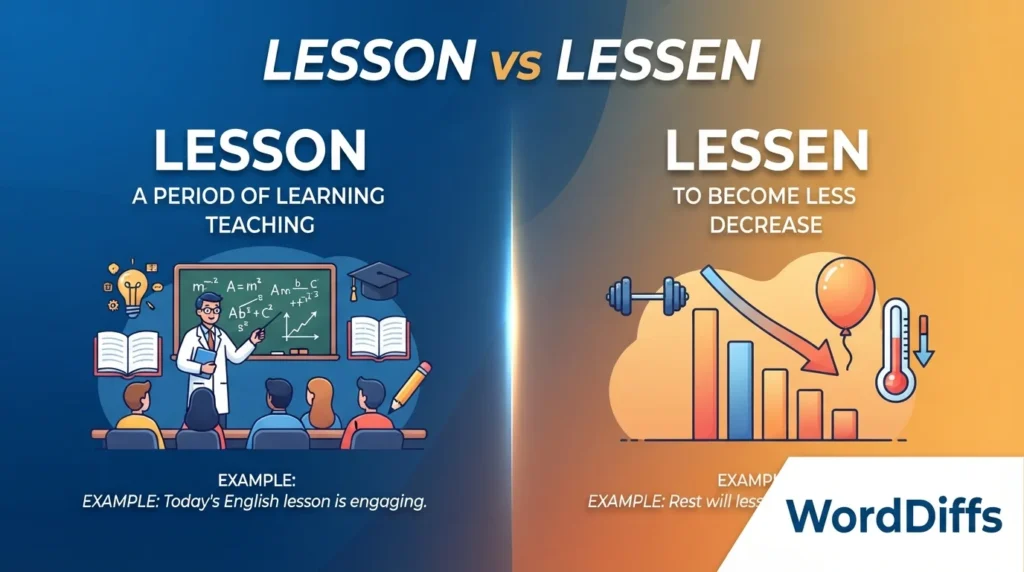
Many English learners confuse Lesson vs Lessen because they look and sound similar, but they have completely different meanings and grammatical roles. A lesson is something you learn, teach, or study, while lessen means to make something smaller, weaker, or reduced. This guide explains the difference between Lesson vs Lessen with simple definitions, pronunciation details, examples, common mistakes, and practice questions to help you use both words correctly.
Quick Difference Table
| Word | Part of Speech | Meaning | Example | Common Usage |
| Lesson | Noun | Something learned or taught | I learned a valuable lesson. | School, advice, experience |
| Lessen | Verb | To reduce or make smaller | Exercise can lessen stress. | Problems, feelings, effects |
Meaning of Lesson
Meaning
Lesson is a noun that refers to information, skills, or knowledge taught or learned. It can describe a classroom session, a personal experience, or advice gained from a situation.
Pronunciation
| Feature | Details |
| IPA | /ˈles.ən/ |
| American Pronunciation | LES-uhn |
| British Pronunciation | LES-uhn |
| Syllables | Two syllables |
| Word Stress | First syllable |
Pronunciation tips:
- Stress the first part: LES: son.
- The second syllable sounds like “uhn.”
- Do not pronounce it like “less-en.”
Function
Lesson functions as a noun.
Common grammar patterns:
- a lesson
- an important lesson
- learn a lesson
- teach a lesson
- take a lesson
It can be the subject or object of a sentence.
Example Sentences
- The teacher prepared a new lesson for the class.
- I learned an important lesson from my mistake.
- She takes a piano lesson every Saturday.
- The book teaches a valuable lesson about kindness.
- My first driving lesson was exciting.
- The accident gave him a lesson about safety.
- We studied a history lesson yesterday.
- The coach explained the lesson clearly.
- Every challenge can become a life lesson.
- The student reviewed the lesson before the test.
When to Use
Use lesson when talking about:
- Something taught by a teacher.
- A skill learned through practice.
- Knowledge gained from experience.
- Advice or a moral message.
Common Mistakes
A common mistake is using lesson when the meaning is “reduce.”
Incorrect: This medicine will lesson pain.
Correct: This medicine will lessen pain.
Remember, lesson is something you learn, not something you reduce.
Meaning of Lessen
Meaning
Lessen is a verb that means to reduce the amount, strength, importance, or effect of something.
Pronunciation
| Feature | Details |
| IPA | /ˈles.ən/ |
| American Pronunciation | LES-uhn |
| British Pronunciation | LES-uhn |
| Syllables | Two syllables |
| Word Stress | First syllable |
Pronunciation tips:
- Lessen sounds almost identical to lesson.
- The difference is meaning, spelling, and grammar.
- Focus on context to identify the correct word.
Function
Lessen functions as a verb.
Common grammar patterns:
- lessen the pain
- lessen the impact
- lessen the risk
- lessen anxiety
- help lessen problems
It shows that something becomes smaller or weaker.
Example Sentences
- Deep breathing can lessen anxiety.
- The new rules may lessen traffic problems.
- This cream helps lessen skin irritation.
- Good planning can lessen stress.
- The medicine helped lessen his headache.
- The repair reduced and lessened the damage.
- Education can lessen misunderstandings.
- Rain may lessen the chance of wildfires.
- She tried to lessen the burden on her family.
- Time can lessen painful memories.
When to Use
Use lessen when describing a reduction in:
- Feelings
- Problems
- Risks
- Effects
- Amounts
- Strength
Common Mistakes
Many learners confuse lessen with lesson because they sound alike.
Incorrect: I learned a lessen today.
Correct: I learned a lesson today.
Incorrect: This will lesson the pressure.
Correct: This will lessen the pressure.
Side-by-Side Comparison
| Situation | Correct Word | Explanation | Example |
| A teacher explains a topic | Lesson | Something taught | Today’s lesson is about grammar. |
| Reducing pain | Lessen | Making something smaller | Medicine can lessen pain. |
| Learning from mistakes | Lesson | Knowledge gained | Failure taught me a lesson. |
| Reducing fear | Lessen | Decreasing intensity | Practice can lessen fear. |
| A classroom activity | Lesson | A teaching session | The lesson starts at nine. |
Practice Quiz
Fill in the Blanks
- The teacher started a new ______ today.
- Exercise can ______ stress.
- I learned a valuable ______ from my experience.
- The treatment may ______ the symptoms.
- We had an English ______ yesterday.
- The advice helped ______ my worries.
- The coach gave us a useful ______.
- Good preparation can ______ mistakes.
- The book contains a powerful ______.
- The new system will ______ the workload.
Choose the Correct Word
- The teacher explained the grammar ______.
A. lessen
B. lesson
C. lessening
D. lessons - Sleep may ______ feelings of stress.
A. lesson
B. lessen
C. lessons
D. learned - Every mistake can teach a ______.
A. lessen
B. lesson
C. less
D. lessenment - The medicine helped ______ the pain.
A. lesson
B. lessen
C. lessons
D. learning - We studied a science ______.
A. lessen
B. lesson
C. lessening
D. lessenly - The program aims to ______ pollution.
A. lesson
B. lessen
C. lessons
D. learned - His failure became a life ______.
A. lessen
B. lesson
C. lessen
D. reducing - The new rules should ______ confusion.
A. lesson
B. lessen
C. lessons
D. learning - She teaches a cooking ______.
A. lesson
B. lessen
C. lessening
D. less - The solution may ______ the problem.
A. lesson
B. lessen
C. lessons
D. taught
Answer Key
- B, because a classroom topic is a lesson.
- B, because lessen means reduce.
- B, because a lesson is something learned.
- B, because pain can be lessened.
- B, because a science class is a lesson.
- B, because pollution can be reduced.
- B, because experience teaches a lesson.
- B, because confusion can become smaller.
- A, because a cooking class is a lesson.
- B, because problems can be lessened.
Final Thoughts
The difference between Lesson vs Lessen is simple once you remember their roles. A lesson is something you learn, teach, or study. Lessen is an action that means to reduce or make something smaller. Although both words have similar pronunciation, they belong to different parts of speech and appear in different situations. A useful memory trick is: a lesson gives knowledge, while lessen lowers something. When writing, always check whether you mean learning or reducing. Choosing the correct word will make your English clearer and more accurate.
Frequently Asked Questions
What is the main difference between lesson and lessen?
Lesson is a noun about learning, while lessen is a verb meaning to reduce.
Are lesson and lessen pronounced the same?
Yes, they usually have the same pronunciation, but their meanings are different.
Is lesson a noun or verb?
Lesson is mainly used as a noun.
Is lessen a noun or verb?
Lessen is a verb.
Can lesson mean reduce?
No. Lesson does not mean reduce.
Can lessen be used for emotions?
Yes. You can lessen fear, stress, sadness, or anxiety.
What is an example of lesson?
The teacher gave us a useful lesson.
What is an example of lessen?
Exercise can lessen stress.
Why do people confuse lesson and lessen?
They look and sound almost identical.
How can I remember the difference?
Remember that a lesson is something you learn, while lessen means something becomes less.
Is lesson related to school only?
No. It can also describe life experiences and personal learning.
Can I use lessen for physical things?
Yes. You can lessen an amount, effect, pressure, or problem.

Caitlin Boylan is an experienced content writer, editor, educator, travel writer, and remote worker with more than 10 years of experience in English education and international communication. She is the founder and author of The Country Jumper, a travel blog dedicated to supporting solo travelers, especially women exploring life abroad. She is also the co-founder of Macro Magazine, a global online publication that shares diverse perspectives on worldwide topics that impact communities.
1 thought on “Lesson vs Lessen: Meaning, Usage and Examples”