
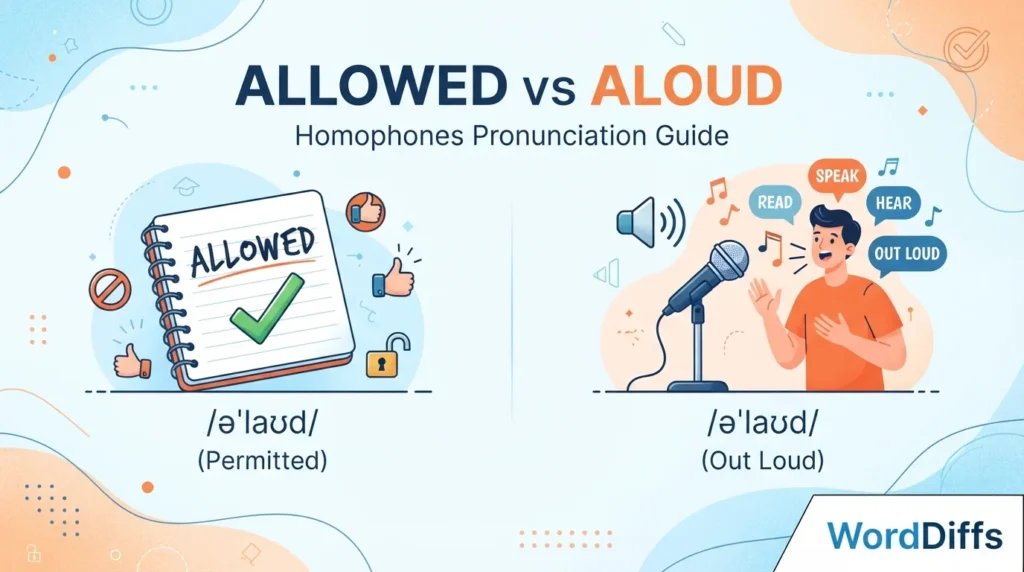
English homophones often confuse learners because they sound the same but have completely different spellings and meanings. Allowed and Aloud are perfect examples of this challenge. Even experienced English learners sometimes use the wrong word in writing because they rely only on pronunciation. While these two words are pronounced almost identically in standard English, they serve very different grammatical purposes and appear in different contexts.
Choosing the correct word is important for clear communication. Writing allowed instead of aloud, or vice versa, can change the meaning of a sentence and make your writing appear less accurate. Understanding the spelling, pronunciation, grammar, and usage of each word helps you speak and write with greater confidence.
In this comprehensive guide, you will learn the meanings of Allowed and Aloud, their pronunciation, grammar, origins, common collocations, practical examples, pronunciation differences, grammar comparisons, memory tricks, common mistakes, quizzes, FAQs, and much more.
Quick Difference Table
| Word | Part of Speech | Meaning | Pronunciation (IPA) | Usage | Example |
| Allowed | Verb (past tense/past participle of allow) | Permitted or gave permission | /əˈlaʊd/ | Permission or approval | We were allowed to enter the museum. |
| Aloud | Adverb | In a voice that can be heard | /əˈlaʊd/ | Speaking audibly | She read the poem aloud. |
Allowed
Pronunciation
IPA (British): /əˈlaʊd/
IPA (American): /əˈlaʊd/
Simple pronunciation: uh-LOUD
Audio-style spelling: uh-LOWD
Does it sound like “aloud”?
Yes. In standard British and American English, allowed and aloud are perfect homophones. They are pronounced the same despite having different spellings and meanings.
Meaning
Allowed means permitted, authorized, or given permission to do something.
It is the past tense and past participle of the verb allow.
People commonly use it when talking about rules, permission, laws, schools, workplaces, families, or organizations.
Examples:
- Students were allowed to leave early.
- Photography is not allowed here.
- Visitors are allowed after noon.
Part of Speech
Allowed is a verb.
More specifically, it is:
- Past tense of allow
- Past participle of allow
It usually follows a subject and often appears with infinitives such as to enter, to speak, or to stay.
Examples:
- They allowed us to participate.
- We were allowed to vote.
- She allowed him to explain.
Origin
The word allow comes from the Old French alouer, meaning “to approve or praise,” which ultimately developed from the Latin allaudare, meaning “to praise.” Over time, the meaning shifted from approval to permission. The form allowed has been used in English for centuries to describe something that has been permitted according to rules, authority, or agreement.
Common Uses
Common situations where allowed is used include:
- School rules
- Workplace policies
- Government regulations
- Family permissions
- Legal contexts
- Sports rules
- Travel requirements
- Public notices
- Safety instructions
- Official permissions
Common Collocations
Some frequent collocations with allowed include:
- allowed to enter
- allowed to leave
- allowed to speak
- allowed to drive
- allowed to vote
- allowed by law
- not allowed
- officially allowed
- legally allowed
- allowed access
- allowed inside
- allowed participation
- allowed visitors
- allowed time
- allowed amount
Example Sentences
- We were allowed to stay after class.
- Only members are allowed inside the building.
- Children are not allowed near the swimming pool alone.
- She was allowed to borrow the library book.
- Pets are not allowed in this restaurant.
- Our teacher allowed us to ask extra questions.
- He was allowed another attempt.
- Employees are allowed flexible working hours.
- Visitors were allowed into the hospital in the afternoon.
- I was finally allowed to explain my side.
- The referee allowed play to continue.
- They allowed extra time for the project.
- No vehicles are allowed beyond this point.
- She allowed her brother to use the laptop.
- We were allowed one carry-on bag.
Aloud
Pronunciation
IPA (British): /əˈlaʊd/
IPA (American): /əˈlaʊd/
Simple pronunciation: uh-LOUD
Audio-style spelling: uh-LOWD
Does it sound like “allowed”?
Yes. Aloud sounds exactly like allowed in standard English pronunciation.
Meaning
Aloud means spoken in a voice that can be heard rather than silently.
It describes the way something is spoken or read.
Common situations include:
- Reading aloud
- Speaking aloud
- Thinking aloud
- Calling aloud
- Laughing aloud
Examples:
- Please read the paragraph aloud.
- She laughed aloud.
- He spoke aloud so everyone could hear.
Part of Speech
Aloud is an adverb.
It modifies verbs by describing how an action is performed.
Examples:
- Read aloud.
- Speak aloud.
- Think aloud.
- Pray aloud.
Origin
The word aloud comes from Middle English and developed from the phrase meaning “out loud.” Historically, it referred to speaking openly or audibly instead of silently. Unlike allowed, it has always related to sound and speech rather than permission.
Common Uses
You commonly see aloud in:
- Reading lessons
- Public speaking
- Storytelling
- Classroom activities
- Presentations
- Drama performances
- Poetry readings
- Speeches
- Language learning
- Audiobooks
Common Collocations
Common collocations include:
- read aloud
- say aloud
- speak aloud
- think aloud
- laugh aloud
- cry aloud
- shout aloud
- call aloud
- pray aloud
- repeat aloud
- answer aloud
- whisper aloud
- read it aloud
- hear aloud
- speak clearly aloud
Example Sentences
- Please read the next paragraph aloud.
- She laughed aloud at the funny joke.
- He answered the question aloud.
- The teacher asked everyone to count aloud.
- I accidentally said my thoughts aloud.
- They read the announcement aloud.
- She practiced her speech aloud.
- The child repeated each word aloud.
- He called aloud for help.
- We read the poem aloud together.
- She prayed aloud before dinner.
- The actor rehearsed his lines aloud.
- I prefer reading difficult passages aloud.
- He spoke aloud so everyone could hear.
- The class read the vocabulary list aloud.
Pronunciation Comparison
Both allowed and aloud are considered perfect homophones in standard English.
| Feature | Allowed | Aloud |
| British IPA | /əˈlaʊd/ | /əˈlaʊd/ |
| American IPA | /əˈlaʊd/ | /əˈlaʊd/ |
| Sounds identical | Yes | Yes |
| Stress | Second syllable | Second syllable |
Although they sound identical, their meanings are completely unrelated.
People confuse them because English spelling often preserves historical forms while pronunciation changes over time. As a result, two different words may eventually sound exactly alike.
Grammar Differences
| Word | Part of Speech | Meaning | Function | Sentence Position | Verb Forms | Plural Forms |
| Allowed | Verb | Permitted | Main verb or passive verb | After subject | Allow, allows, allowed, allowing | Not applicable |
| Aloud | Adverb | In a voice that can be heard | Modifies a verb | Usually after the verb | Not applicable | Not applicable |
Side-by-Side Examples
| Allowed | Aloud |
| We were allowed to enter early. | Please read the instructions aloud. |
| Students are allowed to use calculators. | She laughed aloud during the movie. |
| Visitors were allowed after noon. | He answered aloud. |
| Dogs are not allowed here. | Read every sentence aloud. |
| I was allowed another chance. | She spoke aloud for everyone to hear. |
| We were allowed extra practice time. | The teacher read the story aloud. |
| He was allowed to travel alone. | They counted aloud together. |
| Only members are allowed inside. | The audience repeated the phrase aloud. |
| She was allowed to join the club. | He thought aloud during the meeting. |
| Cameras are allowed in this area. | She called aloud for assistance. |
Homophones Comparison Table
| Word | Pronunciation | Meaning | Part of Speech | Usage | Example |
| Allowed | /əˈlaʊd/ | Permitted or given permission | Verb (past tense/past participle) | Used when talking about permission, rules, or approval | We were allowed to stay longer. |
| Aloud | /əˈlaʊd/ | In a voice that can be heard | Adverb | Used when speaking, reading, or saying something audibly | Please read the paragraph aloud. |
Memory Tricks
Remembering the difference between Allowed and Aloud becomes much easier when you connect each word with its meaning and spelling.
- Allowed contains the word allow, which means to permit. If someone is allowed, they have permission.
- Aloud ends with loud, reminding you of a loud voice. If you speak aloud, people can hear you.
- Think of this sentence:
“If you’re allowed to read, read aloud.” - Associate Allowed with rules, permission, and approval.
- Associate Aloud with voice, speaking, and hearing.
- Create flashcards with one side showing the word and the other showing an example sentence.
- Practice reading example sentences aloud to reinforce both pronunciation and meaning.
Common Mistakes
| Incorrect Sentence | Correct Sentence | Explanation |
| We were aloud to enter. | We were allowed to enter. | Permission requires allowed. |
| She read the story allowed. | She read the story aloud. | Reading audibly requires aloud. |
| Students are aloud to use dictionaries. | Students are allowed to use dictionaries. | Use allowed for permission. |
| Please read it allowed. | Please read it aloud. | Aloud describes speaking audibly. |
| Dogs are not aloud here. | Dogs are not allowed here. | Rules use allowed. |
| He spoke allowed. | He spoke aloud. | Speaking audibly uses aloud. |
| Visitors are aloud after noon. | Visitors are allowed after noon. | Permission is expressed with allowed. |
| Say the answer allowed. | Say the answer aloud. | Audible speech uses aloud. |
| We weren’t aloud to swim. | We weren’t allowed to swim. | Permission is needed here. |
| She laughed allowed. | She laughed aloud. | Aloud modifies the verb. |
| They are aloud inside the museum. | They are allowed inside the museum. | Being permitted requires allowed. |
| Read your essay allowed. | Read your essay aloud. | Reading out loud uses aloud. |
| I wasn’t aloud to drive. | I wasn’t allowed to drive. | Use allowed with permission. |
| He shouted allowed. | He shouted aloud. | Audible speaking uses aloud. |
| Are phones aloud in class? | Are phones allowed in class? | Classroom rules require allowed. |
Fill in the Blank Quiz
Choose allowed or aloud.
- We were ________ to stay late.
- Please read the poem ________.
- Cameras are not ________ here.
- She laughed ________.
- Are visitors ________ today?
- The child counted ________.
- Students were ________ extra time.
- He spoke ________ so everyone could hear.
- Pets are not ________ inside.
- She accidentally said it ________.
- We were ________ to leave early.
- Read each sentence ________.
- They weren’t ________ to park there.
- He thought ________ during the meeting.
- Only members are ________ inside.
- Please answer ________.
- We are ________ one personal item.
- She read the instructions ________.
- Smoking isn’t ________.
- The class repeated the words ________.
Answer Key
- allowed
- aloud
- allowed
- aloud
- allowed
- aloud
- allowed
- aloud
- allowed
- aloud
- allowed
- aloud
- allowed
- aloud
- allowed
- aloud
- allowed
- aloud
- allowed
- aloud
Common Expressions
Allowed
Common Expressions
Be allowed to
Example: Children are allowed to play outside after homework.
Not allowed
Example: Food is not allowed in the laboratory.
Allowed by law
Example: The activity is allowed by law.
Allowed access
Example: Only staff members are allowed access.
Allowed entry
Example: Guests were allowed entry after registration.
Aloud
Common Expressions
Read aloud
Example: Please read aloud for the class.
Think aloud
Example: The teacher encouraged students to think aloud.
Say aloud
Example: Don’t be afraid to say aloud what you believe.
Laugh aloud
Example: Everyone laughed aloud at the joke.
Cry aloud
Example: The child cried aloud for help.
Frequently Asked Questions
What is the difference between Allowed and Aloud?
Allowed means permitted or given permission. It is the past tense and past participle of the verb allow. Aloud means in a voice that can be heard. It is an adverb describing how someone speaks or reads. Although both words are pronounced the same, they have completely different meanings and grammatical functions.
Are Allowed and Aloud pronounced the same?
Yes. In both British and American English, allowed and aloud are pronounced /əˈlaʊd/. They are considered perfect homophones. This identical pronunciation is one of the main reasons learners confuse them in writing.
Why do people confuse these homophones?
People often rely on pronunciation rather than spelling. Since allowed and aloud sound identical, many writers choose the wrong spelling when they are unfamiliar with the meanings or grammatical roles of the words.
Is Allowed a verb?
Yes. Allowed is the past tense and past participle of allow. It describes giving permission or letting someone do something.
Is Aloud an adverb?
Yes. Aloud is an adverb because it modifies verbs such as read, say, speak, laugh, and think, describing that the action is performed audibly.
Can I say “read allowed”?
No. The correct phrase is read aloud because the action is spoken in a voice that others can hear. Allowed refers only to permission.
Can I say “I was aloud to leave”?
No. The correct sentence is I was allowed to leave because permission is being described.
What is the easiest way to remember the difference?
Remember that allowed comes from allow, meaning permission. Aloud contains loud, reminding you of speaking loudly enough to be heard.
Which word is used with rules?
Allowed is used with rules, laws, school policies, workplace regulations, and permissions because it refers to what is permitted.
Which word is used with reading?
Aloud is commonly used with verbs such as read, say, speak, repeat, and think because it describes audible speech.
Tips to Remember the Difference
- Associate Allowed with allow, permission, and rules.
- Associate Aloud with loud, voice, and speaking.
- Read English books and notice how each word is used.
- Write your own sentences using both words every day.
- Practice reading passages aloud to strengthen pronunciation.
- Review grammar patterns involving verbs and adverbs.
- Create vocabulary flashcards with definitions and examples.
- Compare both words side by side during revision.
- Complete quizzes regularly to reinforce learning.
- Listen to native speakers and observe the context in which each word appears.
Summary
Allowed and Aloud are classic English homophones that share the same pronunciation but have entirely different meanings and grammatical roles. Allowed is the past tense and past participle of allow, meaning someone has permission or authorization to do something. In contrast, Aloud is an adverb that describes speaking, reading, or expressing something in a voice that can be heard.
Although both words are pronounced /əˈlaʊd/ in British and American English, understanding their function in a sentence makes choosing the correct spelling much easier. Remember that Allowed relates to permission, while Aloud relates to sound and speech. Practicing common collocations, reading authentic English texts, writing original sentences, and completing quizzes can greatly improve your confidence.
By mastering the difference between Allowed and Aloud, you will write more accurately, communicate more clearly, and avoid one of the most common homophone mistakes in English.

Lauren Kafka is an experienced freelance writer, editor, English tutor, and writing coach with extensive expertise in education, journalism, publishing, and communications. She is the founder of Kafka Consulting LLC, where she provides private English tutoring, writing coaching, and educational consulting services for K-12 students, college students, graduate students, and adults.