
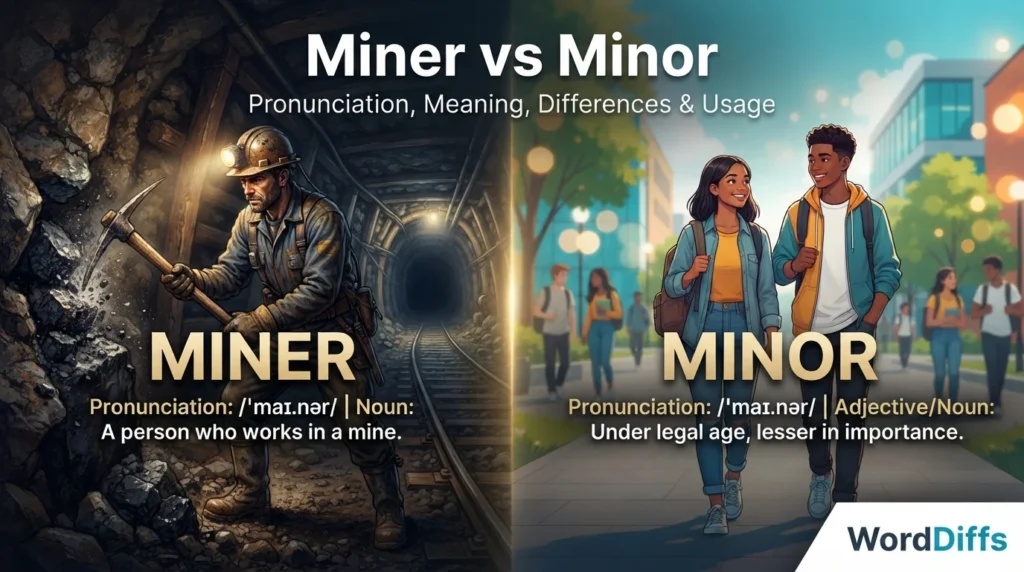
English contains many words that look and sound similar but have completely different meanings. Miner vs Minor is a common confusion because both words differ by only one letter, and their pronunciations are almost identical. However, these words belong to different areas of language and describe completely different ideas.
A miner is connected with people who work underground extracting valuable materials such as coal, gold, or other minerals. A minor usually describes something small, less important, legally underage, or a person who has not reached adulthood. Choosing the correct word matters because using one instead of the other can completely change the meaning of a sentence.
In this guide, you will learn the pronunciation, meanings, grammar rules, sentence functions, common uses, related words, examples, and differences between miner and minor. This comparison will help English learners, students, teachers, writers, and exam candidates use both words accurately.
Miner
Pronunciation
American IPA: /ˈmaɪ.nɚ/
British IPA: /ˈmaɪ.nə/
Easy Pronunciation Guide: MY-ner
The word miner has two syllables:
- Mi: pronounced like “my”
- ner: sounds like “ner” in “nerdy”
The stress falls on the first syllable:
MI-ner
Beginner pronunciation tips:
- Start with the long “i” sound /aɪ/, like in my, buy, and time.
- Do not pronounce it like “mini-er.”
- The ending sound is soft and unstressed.
Meaning
A miner is a person who works in a mine or extracts natural resources from the earth.
Miners remove materials such as:
- Coal
- Gold
- Silver
- Copper
- Diamonds
- Iron ore
- Other valuable minerals
The word usually refers to someone whose job involves mining activities.
Examples of situations where you may use miner:
- A person working underground in a coal mine
- A worker extracting metals from rocks
- A person involved in cryptocurrency mining (in modern technology contexts)
Examples:
- The miner worked deep underground to collect coal.
- The gold miner discovered a valuable deposit.
Part of Speech
Part of Speech: Noun
Sentence Function: A miner usually acts as a person, subject, or object in a sentence.
Examples:
- Subject: The miner entered the tunnel.
- Object: The company hired a miner.
- Description: The miner’s equipment was damaged.
Grammar and Usage
The word miner is a countable noun.
Singular form:
- Miner
Plural form:
- Miners
Possessive forms:
- Miner’s tools
- Miners’ safety equipment
Common grammar patterns:
- a miner for one person
- many miners for multiple workers
- the miner when referring to a specific person
Common collocations:
| Collocation | Meaning |
| coal miner | A person who extracts coal |
| gold miner | A person who searches for or extracts gold |
| underground miner | A worker operating below the surface |
| professional miner | Someone trained in mining work |
| cryptocurrency miner | A person or system that verifies digital transactions |
Grammar Function
| Grammar Function | Explanation | Example |
| Subject | The person performing an action | The miner discovered a new cave. |
| Object | The person receiving an action | The company hired a skilled miner. |
| Modifier | Used to describe something related to mining | The miner helmet protected his head. |
Example Sentences
1. The miner worked for twelve hours inside the coal mine.
Meaning:
A mining worker spent twelve hours doing underground work.
Grammar Explanation:
“Miner” is the subject performing the action “worked.”
2. The rescue team saved the trapped miner.
Meaning:
A team helped a mining worker who was stuck.
Grammar Explanation:
“Miner” is the object receiving the action “saved.”
3. The miner discovered a valuable piece of gold.
Meaning:
The mining worker found gold.
Grammar Explanation:
“Miner” functions as the subject of the sentence.
4. Several miners protested against unsafe working conditions.
Meaning:
Multiple mining workers complained about dangerous conditions.
Grammar Explanation:
“Miners” is the plural form of the noun.
5. The miner’s helmet protected him from falling rocks.
Meaning:
The safety helmet belonging to the miner provided protection.
Grammar Explanation:
“Miner’s” is a possessive noun showing ownership.
6. The cryptocurrency miner verified digital transactions.
Meaning:
A person or computer system processed cryptocurrency transactions.
Grammar Explanation:
“Miner” has a modern technological meaning in addition to its traditional mining meaning.
Related Words
| Related Word | Meaning | Example Sentence |
| Mine | A place where minerals are extracted | The workers entered the mine early. |
| Mining | The activity of extracting resources | Mining is an important industry. |
| Mineral | A natural substance found in the earth | This rock contains valuable minerals. |
| Miner’s | Something belonging to a miner | The miner’s tools were expensive. |
Common Uses of Miner
The word miner appears in several contexts:
Traditional Mining
Example:
- The miner searched for gold underground.
Meaning:
A worker extracting natural resources.
Coal Industry
Example:
- Many miners worked in coal regions.
Meaning:
Workers involved in coal extraction.
Cryptocurrency
Example:
- A Bitcoin miner uses computer power to verify transactions.
Meaning:
A person or computer system involved in blockchain processing.
Common Mistakes With Miner
Many learners confuse miner with minor because they sound almost the same.
Incorrect:
- My brother is a coal minor.
Correct:
- My brother is a coal miner.
Explanation:
A person who works in a mine is a miner. A minor does not describe a mining worker.
Incorrect:
- The company hired several gold minors.
Correct:
- The company hired several gold miners.
Explanation:
The workers extracting gold are miners.
Memory Tip for Miner
Remember:
Miner has “mine” inside it.
A miner works in a mine.
Visual memory:
Imagine a worker wearing a helmet and carrying a tool underground. That person is a miner.
Minor
Pronunciation
American IPA: /ˈmaɪ.nɚ/
British IPA: /ˈmaɪ.nə/
Easy Pronunciation Guide: MY-ner
The pronunciation of minor is the same as miner in most varieties of English.
Both words are homophones because they have identical pronunciation but different spellings and meanings.
The word has two syllables:
- Mi: sounds like “my”
- nor: sounds like “ner”
Stress:
MI-nor
Pronunciation tips:
- Do not pronounce it as “min-or” with two equally strong syllables.
- Keep the second syllable weak.
- Focus on the long “i” sound at the beginning.
Meaning
The word minor has several meanings depending on context.
The most common meanings are:
- A person who is under the legal age of adulthood.
- Something small, less important, or not serious.
- A secondary subject of study in college or university.
- A musical term describing a type of scale or chord.
Because minor has multiple meanings, understanding the context is important.
Meaning 1: A Person Under Legal Age
A minor is someone who has not reached the age considered legally adult.
Examples:
- The law protects minors from certain activities.
- A minor cannot legally sign some contracts.
The exact legal age varies by country, but in many places adulthood begins at age 18.
Meaning 2: Small or Less Important
When used as an adjective, minor describes something not major, serious, or important.
Examples:
- She had a minor injury.
- There was a minor problem with the computer.
In this meaning, minor is the opposite of major.
Meaning 3: Academic Subject
In education, a minor is a secondary field of study.
Example:
- She is majoring in biology and minoring in psychology.
A student’s main subject is called a major, while an additional subject is called a minor.
Meaning 4: Music
In music, minor describes a type of scale or chord that often creates a darker or more emotional sound.
Examples:
- The song is written in a minor key.
- The musician played a minor chord.
Part of Speech
Part of Speech: Noun and Adjective
Sentence functions:
As a noun:
- A young person under legal age
- A secondary academic subject
As an adjective:
- Describing something small or less important
- Describing musical qualities
Grammar and Usage
The grammar of minor depends on its role.
As a noun:
- a minor
- the minor
- minors
Examples:
- The minor needs parental permission.
- Many minors attended the program.
As an adjective:
It comes before the noun it describes.
Examples:
- minor problem
- minor accident
- minor change
- minor injury
Common collocations:
| Collocation | Meaning |
| minor mistake | A small error |
| minor issue | A small problem |
| minor injury | A less serious injury |
| minor child | A person below legal adulthood |
| minor subject | Secondary field of study |
| minor key | Musical scale type |
Grammar Function
| Grammar Function | Explanation | Example |
| Subject | A young person or academic subject performing an action | The minor received permission. |
| Object | A person or thing affected by an action | The teacher helped the minor. |
| Modifier | Describes something small or secondary | She fixed a minor problem. |
Example Sentences
1. The minor needed permission from a parent.
Meaning:
The young person who was not legally an adult needed approval.
Grammar Explanation:
“Minor” is a noun acting as the subject.
2. The doctor treated a minor injury.
Meaning:
The doctor treated a small, not serious injury.
Grammar Explanation:
“Minor” is an adjective modifying “injury.”
3. She chose history as her college minor.
Meaning:
History was her secondary academic subject.
Grammar Explanation:
“Minor” is a noun referring to a field of study.
4. The company made a minor adjustment to the plan.
Meaning:
The company made a small change.
Grammar Explanation:
“Minor” works as an adjective describing “adjustment.”
5. The musician played the song in a minor key.
Meaning:
The song used a musical scale with a particular emotional quality.
Grammar Explanation:
“Minor” is an adjective modifying “key.”
6. The court considered the person a minor.
Meaning:
The court recognized the person as legally underage.
Grammar Explanation:
“Minor” functions as a noun after the verb “considered.”
Related Words
| Related Word | Meaning | Example Sentence |
| Major | Important, large, or main subject | Mathematics is his major. |
| Minimize | To reduce something | We should minimize errors. |
| Minority | A smaller group or part | The minority supported the decision. |
| Minorly | In a small way (less common) | The system was minorly affected. |
Minor (Continued)
Common Uses of Minor
The word minor appears in many areas of everyday English. Its meaning changes depending on the situation.
Legal Context
In law, minor refers to someone who has not reached adulthood.
Examples:
- The minor was required to have a guardian present.
- Minors are protected by special laws.
In legal writing, minor is a formal term and is preferred over informal words like “kid” or “child” when discussing legal rights and responsibilities.
Everyday Problems and Situations
In normal conversation, minor often means something small or not very serious.
Examples:
- I had a minor problem with my internet connection.
- The car only suffered minor damage.
The word suggests that the issue exists but does not require major attention.
Education Context
In colleges and universities, a minor is a secondary area of academic study.
Examples:
- Her major is computer science, and her minor is mathematics.
- He completed a minor in English literature.
A minor usually requires fewer courses than a major.
Music Context
In music theory, minor describes a sound pattern often associated with serious, emotional, or darker moods.
Examples:
- The composer wrote the piece in a minor key.
- This minor chord creates a dramatic feeling.
Common Mistakes With Minor
Because minor sounds exactly like miner, many learners confuse their meanings.
Incorrect:
- The minor worked in a gold mine.
Correct:
- The miner worked in a gold mine.
Explanation:
A person working in a mine is a miner, not a minor.
Incorrect:
- She had a miner injury after the accident.
Correct:
- She had a minor injury after the accident.
Explanation:
A small or less serious injury is a minor injury.
Incorrect:
- He is studying chemistry as his miner.
Correct:
- He is studying chemistry as his minor.
Explanation:
An additional university subject is called a minor.
Incorrect:
- The company solved a miner issue.
Correct:
- The company solved a minor issue.
Explanation:
A small problem is a minor issue.
Memory Tip for Minor
Remember:
Minor means small or less important.
Think:
- Minor problem = small problem
- Minor injury = small injury
- Minor subject = secondary subject
Another memory trick:
Minor starts with “mini.”
A “mini” thing is small, and minor often means something small.
Key Differences Between Miner vs Minor
Although miner and minor sound identical, they have different spellings, meanings, and uses.
| Feature | Miner | Minor |
| Pronunciation | /ˈmaɪ.nɚ/ | /ˈmaɪ.nɚ/ |
| Meaning | A person who extracts resources from a mine | Something small, less important, or a person under legal age |
| Part of Speech | Noun | Noun and adjective |
| Grammar | Refers mainly to a person | Describes people, things, problems, subjects, and music |
| Typical Usage | Mining industry, resource extraction, cryptocurrency | Law, education, everyday descriptions, music |
| Spelling Clue | Contains “mine” | Related to “minimum” and “minority” |
| Opposite | No direct common opposite | Major |
| Example | The miner searched for gold. | She fixed a minor problem. |
The Biggest Difference Between Miner and Minor
The easiest way to separate these words is to focus on meaning:
Miner = a person connected with mining
A miner works in or with mines.
Example:
- The miner collected coal.
Minor = small, secondary, or under legal age
A minor is either a young person or something less important.
Example:
- The accident caused only minor damage.
The pronunciation is the same, but the spelling gives a clue:
- Miner contains mine, which connects to mining.
- Minor connects with ideas of being smaller or less important.
Sentence Comparisons: Miner vs Minor
1. The miner discovered a valuable mineral.
Meaning:
A worker found a valuable substance underground.
Why miner is correct:
The sentence refers to a person whose job involves extracting resources.
Grammar role:
Miner is a noun acting as the subject.
2. The miner discovered a minor problem in the equipment.
Meaning:
A mining worker found a small issue with the equipment.
Why both words are correct:
- Miner = the worker
- Minor = a small problem
Grammar roles:
- Miner = noun
- Minor = adjective
3. The company hired a miner to work underground.
Meaning:
The company employed someone who works in mining.
Why miner is correct:
The sentence refers to an occupation.
4. The company made a minor change to the mining process.
Meaning:
The company made a small adjustment.
Why minor is correct:
It describes the size or importance of the change.
5. The miner wore protective clothing during the job.
Meaning:
A mining worker used safety equipment.
Why miner is correct:
It refers to a person.
6. The student selected music as a minor subject.
Meaning:
The student chose music as a secondary academic field.
Why minor is correct:
It refers to a secondary area of study.
7. The miner helped rescue another worker.
Meaning:
A mining employee helped another person.
Why miner is correct:
The sentence describes a mining professional.
8. The doctor said the injury was minor.
Meaning:
The injury was not serious.
Why minor is correct:
It describes the severity of the injury.
9. The minor needed an adult’s permission.
Meaning:
The young person legally required approval.
Why minor is correct:
It refers to someone below legal adulthood.
10. The miner reported a minor accident.
Meaning:
A mining worker reported a small accident.
Why both words are correct:
- Miner identifies the person.
- Minor describes the accident.
Common Mistakes Between Miner and Minor
Mistake 1
Incorrect:
The coal minor entered the tunnel.
Correct:
The coal miner entered the tunnel.
Explanation:
A worker who extracts coal is a miner because the word comes from mine.
Mistake 2
Incorrect:
The miner problem was fixed quickly.
Correct:
The minor problem was fixed quickly.
Explanation:
A small problem is a minor problem.
Mistake 3
Incorrect:
The company trained new minors for mining work.
Correct:
The company trained new miners for mining work.
Explanation:
People working in mines are miners.
Mistake 4
Incorrect:
She had a miner injury after falling.
Correct:
She had a minor injury after falling.
Explanation:
An injury that is not serious is called a minor injury.
Mistake 5
Incorrect:
He completed a miner in economics.
Correct:
He completed a minor in economics.
Explanation:
A secondary college subject is a minor.
Mistake 6
Incorrect:
The minor searched for gold underground.
Correct:
The miner searched for gold underground.
Explanation:
A person searching for gold is a miner.
Mistake 7
Incorrect:
The doctor said the patient had a miner condition.
Correct:
The doctor said the patient had a minor condition.
Explanation:
A less serious condition is a minor condition.
Mistake 8
Incorrect:
The gold minor found a large deposit.
Correct:
The gold miner found a large deposit.
Explanation:
Gold workers are called gold miners.
Easy Memory Tricks
Trick 1: Look Inside the Word
Miner contains “mine.”
A miner works in a mine.
Example:
- coal miner
- gold miner
- diamond miner
Trick 2: Think “Mini”
Minor sounds similar to “mini.”
Mini means small.
Examples:
- minor mistake = small mistake
- minor injury = small injury
- minor change = small change
Trick 3: Remember the Opposite
The opposite of minor is major.
Examples:
- major problem ↔ minor problem
- major subject ↔ minor subject
There is no common opposite pair for miner because it describes a profession.
Trick 4: Use the Context
Ask:
Is this sentence about:
- Digging?
- Gold?
- Coal?
- Minerals?
- Underground work?
Use:
Miner
Ask:
Is this sentence about:
- Something small?
- A young person?
- A secondary subject?
- Music?
Use:
Minor
Practice Quiz
1. Choose the correct word:
The ______ worked in the diamond mine.
A) Minor
B) Miner
Correct Answer: Miner
Explanation:
A person who works in a mine is a miner.
2. Choose the correct word:
The company made a ______ adjustment.
A) Miner
B) Minor
Correct Answer: Minor
Explanation:
A small adjustment is a minor adjustment.
3. Fill in the blank:
The student chose biology as her college ______.
Correct Answer: Minor
Explanation:
A secondary academic subject is called a minor.
4. Fill in the blank:
The ______ discovered gold underground.
Correct Answer: Miner
Explanation:
A worker who extracts gold is a miner.
5. Choose the correct sentence:
A) The miner injury healed quickly.
B) The minor injury healed quickly.
Correct Answer: B
Explanation:
Minor means not serious or small.
6. Correct the sentence:
The coal minor worked all night.
Correct Answer:
The coal miner worked all night.
Explanation:
The worker is a miner.
7. Choose the correct word:
The court recognized him as a ______.
A) Miner
B) Minor
Correct Answer: Minor
Explanation:
A person below legal adulthood is a minor.
8. Fill in the blank:
The engineer fixed a ______ issue.
Correct Answer: Minor
Explanation:
A small issue is a minor issue.
9. Choose the correct word:
The ______ used special equipment to extract minerals.
A) Miner
B) Minor
Correct Answer: Miner
Explanation:
Mining workers are miners.
10. Choose the correct sentence:
A) She played the song in a minor key.
B) She played the song in a miner key.
Correct Answer: A
Explanation:
Musical scales use the word minor.
Frequently Asked Questions About Miner vs Minor
What is the main difference between miner and minor?
A miner is a person who works in a mine or extracts resources such as coal, gold, or minerals. A minor means something small, less important, a person below legal adulthood, or a secondary subject of study.
Are miner and minor pronounced the same?
Yes. In most English accents, miner and minor are homophones.
Both are pronounced:
American IPA: /ˈmaɪ.nɚ/
British IPA: /ˈmaɪ.nə/
They sound the same but have different spellings and meanings.
Is miner a noun or an adjective?
Miner is a noun.
It refers to a person who works in mining.
Examples:
- The miner entered the cave.
- Several miners worked underground.
It does not function as an adjective in standard English.
Is minor a noun or an adjective?
Minor can be both a noun and an adjective.
As a noun:
- A minor is a person under legal adulthood.
- A minor can also mean a secondary academic subject.
Example:
- The minor needed parental permission.
As an adjective:
- Minor means small or less important.
Example:
- The car had minor damage.
Why do people confuse miner and minor?
People confuse these words because they are homophones, meaning they have the same pronunciation but different meanings and spellings.
The spelling difference gives a useful clue:
- Miner contains “mine,” connecting it to mining.
- Minor relates to being smaller or less important.
Can miner and minor be used interchangeably?
No. They cannot replace each other.
Incorrect:
- The minor worked in a coal mine.
Correct:
- The miner worked in a coal mine.
Incorrect:
- The miner problem was easy to fix.
Correct:
- The minor problem was easy to fix.
The meanings are completely different.
What is the plural form of miner?
The plural form of miner is:
Miners
Example:
- The miners worked safely underground.
The possessive form is:
- Miner’s equipment (one miner)
- Miners’ equipment (multiple miners)
What is the plural form of minor?
The plural form depends on the meaning.
For a young person:
Minors
Example:
- The law protects minors.
For something small:
Usually, the noun being described becomes plural.
Example:
- Minor problems
- Minor injuries
What is the opposite of minor?
The most common opposite of minor is major.
Examples:
- Minor problem ↔ Major problem
- Minor change ↔ Major change
- Minor subject ↔ Major subject
Miner does not have a common opposite because it describes a profession.
Is a miner always a person?
Traditionally, yes. A miner refers to a person who extracts materials from the earth.
However, in technology, especially cryptocurrency, miner can also refer to a computer system or person involved in verifying digital transactions.
Example:
- A Bitcoin miner processes blockchain transactions.
What is a college minor?
A college minor is a secondary field of study that requires fewer courses than a student’s main subject.
Example:
- Her major is engineering, and her minor is psychology.
The major is the primary subject, while the minor is additional specialization.
Does minor always mean something bad?
No. Minor simply means small, less important, or secondary.
It can describe neutral situations.
Examples:
- A minor adjustment
- A minor change
- A minor role
It can also describe something positive, such as a minor improvement.
How can I remember the difference between miner and minor?
Use the spelling clue:
Miner = Mine + worker
A miner works in a mine.
Minor = Mini + smaller
A minor thing is small or less important.
Final Summary: Miner vs Minor
The words miner and minor are often confused because they are pronounced the same, but they have completely different meanings and uses.
Miner
- Pronunciation: /ˈmaɪ.nɚ/
- Part of speech: Noun
- Meaning: A person who works in a mine or extracts natural resources
- Common contexts:
- Coal mining
- Gold mining
- Mineral extraction
- Cryptocurrency
Example:
- The miner discovered a new source of gold.
Minor
- Pronunciation: /ˈmaɪ.nɚ/
- Part of speech: Noun and adjective
- Meanings:
- A person below legal adulthood
- Something small or less important
- A secondary academic subject
- A musical category
Examples:
- The minor needed permission.
- The accident caused minor damage.
- She chose history as her minor.
The easiest way to remember:
Think:
Miner = Mine worker
The word contains mine, which connects it to mining.
Minor = Mini or smaller
The word connects with ideas of being small, secondary, or less important.
When writing or speaking, always consider the context. If you are talking about underground work and resources, choose miner. If you mean something small, secondary, or legally underage, choose minor.
Learning these small spelling differences helps improve vocabulary accuracy, writing quality, and overall English confidence.

Josie Palmer is an experienced SEO Content Consultant, content strategist, and founder of JOT SEO, a consultancy focused on helping businesses improve their search visibility through effective SEO and content strategies. With more than 8 years of experience in SEO, content development, and digital marketing, she specializes in creating data-driven content strategies that help businesses grow online.
2 thoughts on “Miner vs Minor: Meaning, Pronunciation & Differences”