
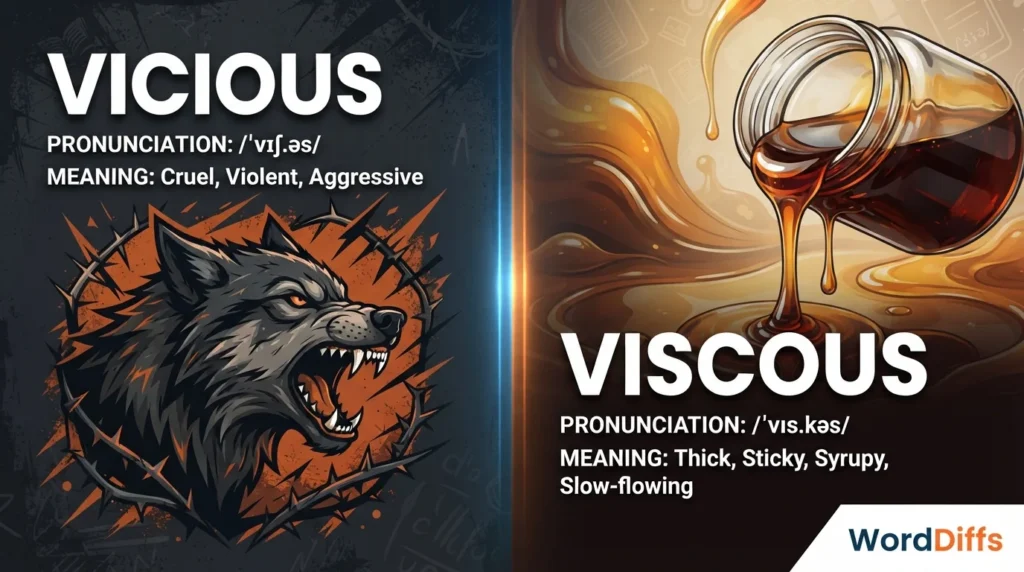
Many English learners confuse vicious vs viscous because the words look almost identical and share a similar spelling pattern. However, they have completely different meanings and are used in very different situations. One describes harmful, cruel, or violent behavior, while the other describes the thickness and flow of liquids. Choosing the wrong word can change the entire meaning of a sentence.
This guide explains the pronunciation, meanings, grammar, usage, examples, common mistakes, and differences between vicious and viscous. It will help students, writers, teachers, ESL learners, and anyone improving their English vocabulary use these words correctly.
Understanding the Miner vs Minor meaning and pronunciation differences can help prevent common English usage mistakes.
Vicious
Pronunciation
American IPA: /ˈvɪʃ.əs/
British IPA: /ˈvɪʃ.əs/
Easy pronunciation guide: VISH-us
The word has two syllables:
- Vish: stressed syllable
- us: unstressed syllable
The middle sound is similar to the “sh” sound in ship. Avoid pronouncing it like “vee-see-us” because the spelling can be misleading.
Meaning
Vicious is an adjective that describes something cruel, violent, aggressive, or morally harmful.
It is commonly used for:
- violent animals
- cruel people
- severe attacks
- harmful criticism
- intense conflicts
- unpleasant situations
The word suggests strong negativity. It often describes actions or behaviors that cause harm intentionally or aggressively.
Examples:
- A vicious dog may attack without warning.
- The politician faced vicious criticism online.
- The storm created vicious waves along the coast.
Part of Speech
Part of Speech: Adjective
Sentence Function: Vicious describes a noun by showing the harmful, cruel, or aggressive quality of that noun.
Examples:
- a vicious attack
- a vicious animal
- a vicious argument
A closer look at Color vs Colour pronunciation and spelling can prevent confusion when writing for international English audiences.
Grammar and Usage
Vicious usually appears before a noun as an adjective.
| Grammar Function | Explanation | Example |
| Subject | Describes the subject of a sentence | The vicious dog frightened everyone. |
| Object | Describes a noun receiving an action | They reported the vicious attack. |
| Modifier | Adds information about a noun | She wrote a vicious review. |
Common Grammar Patterns
Vicious + noun
Examples:
- vicious attack
- vicious rumor
- vicious cycle
- vicious enemy
- vicious crime
Be + vicious
Examples:
- The animal was vicious.
- His comments were vicious.
Common Collocations
Common word combinations include:
- vicious attack
- vicious cycle
- vicious enemy
- vicious animal
- vicious fight
- vicious criticism
- vicious rumor
- vicious behavior
Example Sentences
1. The vicious dog scared the children in the neighborhood.
Meaning: The dog was aggressive and dangerous.
Grammar Explanation: “Vicious” is an adjective modifying the noun “dog.”
2. The team received vicious criticism after losing the match.
Meaning: The criticism was extremely harsh and cruel.
Grammar Explanation: “Vicious” modifies the noun “criticism.”
3. The two groups became involved in a vicious conflict.
Meaning: The conflict was intense and harmful.
Grammar Explanation: “Vicious” functions as a descriptive adjective before “conflict.”
4. The article contained vicious accusations against the company.
Meaning: The accusations were cruel or damaging.
Grammar Explanation: “Vicious” modifies “accusations.”
5. The disease created a vicious cycle of health problems.
Meaning: The problems repeatedly caused more problems.
Grammar Explanation: “Vicious” describes the noun phrase “cycle of health problems.”
6. The attacker used vicious methods.
Meaning: The methods were cruel and violent.
Grammar Explanation: “Vicious” is a modifier for “methods.”
Related Words
| Related Word | Meaning | Example Sentence |
| Viciously | In a cruel or violent way | The animal attacked viciously. |
| Viciousness | The quality of being cruel or violent | The viciousness of the attack shocked people. |
| Vice | Immoral or harmful behavior | Gambling can become a harmful vice. |
Viscous
Pronunciation
American IPA: /ˈvɪs.əs/
British IPA: /ˈvɪs.əs/
Easy pronunciation guide: VIS-us
The word has two syllables:
- Vis: stressed syllable
- ous: unstressed syllable
Unlike “vicious,” the middle sound is a clear “s” sound, not a “sh” sound.
Meaning
Viscous is an adjective that describes a liquid that is thick, sticky, and resistant to flowing easily.
It is used mainly in scientific, medical, engineering, and everyday descriptions of liquids.
Examples:
- Honey is more viscous than water.
- Motor oil becomes more viscous in cold weather.
- The scientist measured the viscous liquid.
A viscous substance flows slowly because it has high resistance to movement.
Part of Speech
Part of Speech: Adjective
Sentence Function: Viscous describes the physical property of a liquid or substance.
Examples:
- viscous oil
- viscous fluid
- viscous material
Grammar and Usage
Viscous usually modifies nouns related to liquids, substances, and materials.
| Grammar Function | Explanation | Example |
| Subject | Describes the condition of a substance | The liquid is viscous. |
| Object | Describes a measured substance | Scientists tested the viscous fluid. |
| Modifier | Gives information about a material | The machine handles viscous oil. |
Common Grammar Patterns
Viscous + noun
Examples:
- viscous liquid
- viscous fluid
- viscous substance
- viscous oil
Be + viscous
Examples:
- The solution is viscous.
- The mixture became viscous.
Common Collocations
Common word combinations include:
- viscous liquid
- viscous fluid
- viscous material
- viscous oil
- viscous substance
- highly viscous
- less viscous
Example Sentences
1. Honey is a viscous liquid that moves slowly.
Meaning: Honey is thick and does not flow quickly.
Grammar Explanation: “Viscous” modifies the noun “liquid.”
2. The engineer tested the viscous oil inside the machine.
Meaning: The oil had a thick consistency.
Grammar Explanation: “Viscous” describes “oil.”
3. The scientist studied the viscous substance in the laboratory.
Meaning: The substance was thick and slow-moving.
Grammar Explanation: “Viscous” functions as an adjective.
4. Cold temperatures can make some fluids more viscous.
Meaning: Some fluids become thicker when cold.
Grammar Explanation: “Viscous” describes the property of “fluids.”
5. The paint became too viscous to spread easily.
Meaning: The paint became too thick.
Grammar Explanation: “Viscous” describes the condition of the paint.
6. Blood is a slightly viscous fluid.
Meaning: Blood has thickness and resistance to flow.
Grammar Explanation: “Viscous” modifies “fluid.”
Related Words
| Related Word | Meaning | Example Sentence |
| Viscosity | Thickness or resistance to flow | The viscosity of oil changes with temperature. |
| Viscously | In a thick, slow-flowing way | The substance moved viscously. |
| Fluid | A liquid or substance that can flow | Water is a low-viscosity fluid. |
Key Differences Between Vicious vs Viscous
| Feature | Vicious | Viscous |
| Pronunciation | /ˈvɪʃ.əs/ | /ˈvɪs.əs/ |
| Meaning | Cruel, violent, harmful | Thick and slow-flowing |
| Part of Speech | Adjective | Adjective |
| Grammar | Describes behavior, actions, situations, or people | Describes liquids and materials |
| Typical Usage | Attacks, criticism, animals, conflicts | Oil, honey, fluids, substances |
| Example | The dog made a vicious attack. | The honey was viscous. |
The biggest difference is that vicious relates to harm and aggression, while viscous relates to thickness and liquid movement.
A simple way to remember:
- Vicious = violence
- Viscous = viscosity
The spelling difference is only one letter, but the meanings are completely unrelated.
Sentence Comparisons
1. The dog was vicious, but the medicine was viscous.
Explanation: The dog was aggressive, while the medicine was thick.
2. The reporter described the attack as vicious.
Explanation: The attack was cruel and violent.
3. The laboratory analyzed the viscous chemical mixture.
Explanation: The mixture had a thick consistency.
4. The criminal received attention because of his vicious actions.
Explanation: The actions were harmful and cruel.
5. The scientist measured the viscosity of the viscous liquid.
Explanation: The liquid was thick and resistant to flow.
6. The movie showed a vicious battle scene.
Explanation: The battle was violent.
7. The factory uses viscous materials in production.
Explanation: The materials have thick physical properties.
8. The internet discussion became vicious after the disagreement.
Explanation: The discussion became cruel and aggressive.
Common Mistakes
Mistake 1
Incorrect: The honey was vicious.
Correct: The honey was viscous.
Explanation: Honey is thick, not cruel.
Mistake 2
Incorrect: The attacker was viscous.
Correct: The attacker was vicious.
Explanation: A person who causes harm is vicious.
Mistake 3
Incorrect: The oil had a vicious texture.
Correct: The oil had a viscous texture.
Explanation: Texture and flow relate to viscosity.
Mistake 4
Incorrect: The animal was viscous.
Correct: The animal was vicious.
Explanation: Animals can be aggressive, so use vicious.
Mistake 5
Incorrect: The scientist studied a vicious liquid.
Correct: The scientist studied a viscous liquid.
Explanation: Scientific liquids are described as viscous.
Mistake 6
Incorrect: The politician faced viscous criticism.
Correct: The politician faced vicious criticism.
Explanation: Harsh criticism is vicious.
Mistake 7
Incorrect: The chemical became vicious after cooling.
Correct: The chemical became viscous after cooling.
Explanation: Cooling can affect thickness, not cruelty.
Mistake 8
Incorrect: The fight was viscous.
Correct: The fight was vicious.
Explanation: A violent fight is vicious.
Easy Memory Tricks
Remember Vicious with Violence
The first three letters of vicious sound like the beginning of violence.
Vicious = violent, cruel, harmful.
Remember Viscous with Viscosity
Viscous contains the idea of viscosity, which measures how easily a liquid flows.
Viscous = thick liquid.
Look at the Middle Sound
- Vicious has a “sh” sound.
- Viscous has an “s” sound.
Use the Context
Ask:
Is the sentence about behavior or liquid?
- Behavior, conflict, attack = vicious
- Liquid, oil, substance = viscous
Practice Quiz
1. The attacker made a _____ move.
A) viscous
B) vicious
Answer: B) vicious
Explanation: The move was harmful or aggressive.
2. Honey is a _____ substance.
Answer: viscous
Explanation: Honey is thick and slow-flowing.
3. Choose the correct sentence.
A) The liquid was vicious.
B) The liquid was viscous.
Answer: B
Explanation: Liquids can have viscosity.
4. Correct the sentence: The dog was viscous.
Answer: The dog was vicious.
Explanation: Dogs can be aggressive, not thick like liquids.
5. The scientist tested a _____ fluid.
Answer: viscous
Explanation: Scientists describe thick fluids as viscous.
6. The article contained _____ criticism.
Answer: vicious
Explanation: Cruel criticism is vicious.
7. Choose the correct word: The oil became more _____ in winter.
Answer: viscous
Explanation: Temperature affects liquid thickness.
8. The two teams had a _____ argument.
Answer: vicious
Explanation: A cruel or aggressive argument is vicious.
9. Choose the correct sentence.
A) The substance is viscous.
B) The substance is vicious.
Answer: A
Explanation: Substances can be thick, not cruel.
10. The animal showed _____ behavior.
Answer: vicious
Explanation: Aggressive behavior is vicious.
Frequently Asked Questions
What is the main difference between vicious and viscous?
Vicious means cruel, violent, or harmful. Viscous means thick and slow-flowing.
Are vicious and viscous pronounced the same?
No. Vicious is pronounced /ˈvɪʃ.əs/, while viscous is pronounced /ˈvɪs.əs/.
Is vicious an adjective?
Yes. Vicious is an adjective used to describe harmful behavior or actions.
Is viscous an adjective?
Yes. Viscous is an adjective used to describe thick liquids or materials.
Can I use viscous for people?
No. Viscous describes physical properties of substances, not personalities.
Can I use vicious for liquids?
No. Vicious describes cruelty or violence, not thickness.
What is a vicious cycle?
A vicious cycle is a repeating situation where one problem creates another problem.
What does viscosity mean?
Viscosity is the measurement of a liquid’s resistance to flowing.
Is honey viscous?
Yes. Honey is a common example of a viscous liquid.
Is oil viscous?
Yes. Many oils are viscous because they flow slowly.
Why do people confuse vicious and viscous?
They look almost identical in spelling and differ by only one sound.
Which word is related to violence?
Vicious is related to violence, cruelty, and harmful behavior.
Which word is related to science?
Viscous is commonly used in science to describe liquids and materials.
Final Summary
Vicious and viscous look similar but have completely different meanings.
- Vicious means cruel, violent, aggressive, or harmful.
- Viscous means thick, sticky, and slow-flowing.
Their pronunciation is also different:
- Vicious: /ˈvɪʃ.əs/
- Viscous: /ˈvɪs.əs/
Remember:
Vicious = violence
Viscous = viscosity
Understanding the context is the easiest way to choose the correct word. If you are describing a person, attack, argument, or harmful action, use vicious. If you are describing honey, oil, chemicals, or another thick liquid, use viscous.

Carter is an English language specialist, author, and senior editor with more than 20 years of experience in English grammar, writing, editing, and language education. Throughout his career, he has worked with educational organizations, digital publishers, and content teams to develop accurate, engaging, and learner-focused resources. His expertise includes English grammar, spelling, vocabulary, commonly confused words, proofreading, copy editing, academic writing, and SEO content strategy. Carter is passionate about helping learners and writers improve their communication skills through clear explanations, practical examples, and high-quality educational content.
1 thought on “Vicious vs Viscous Pronunciation, Meaning, Differences & Usage”