
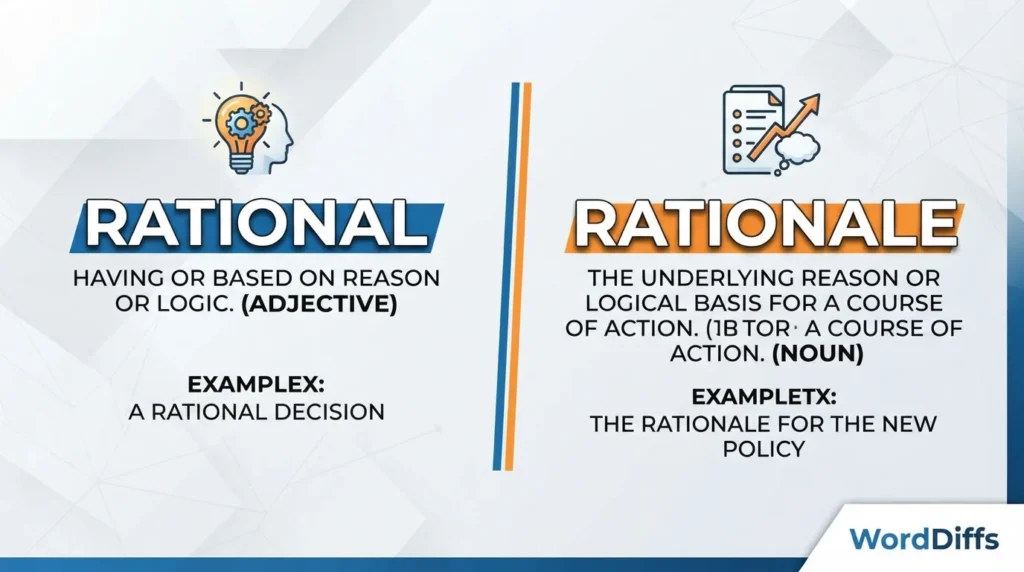
Rational and rationale are both correct English words, but they have different meanings and grammatical roles. This is a genuine point of confusion found in search queries, editing forums, and documented usage errors because the words share the same root and differ by only two letters.
This pair belongs to category (e): grammatical-role split, with an additional semantic distinction. Rational is usually an adjective meaning “based on reason,” while rationale is a noun meaning “the underlying reason or explanation for something.”
Understanding the Difference
| Word | Part of Speech | Meaning | Example |
| Rational | Adjective | Based on logic or reason | She made a rational decision. |
| Rationale | Noun | The reasoning behind a decision or action | The report explains the rationale for the policy. |
Because the spellings are so similar, writers sometimes mistakenly use one in place of the other, especially in business, academic, and government writing.
Why These Words Get Confused
The confusion comes from their shared origin and similar appearance.
People often write phrases such as:
- “Please explain the rational behind this decision.”
- “What is the rational for changing the schedule?”
In both examples, rationale is the correct word because the sentence requires a noun that means “reason” or “justification.”
Likewise, sentences such as:
- “She gave a rationale answer.”
should instead use rational, because the sentence describes the noun answer.
The Grammar Rule
The easiest way to distinguish these words is by their grammatical function.
Use rational when describing something
Ask yourself whether the word is modifying a noun.
Examples:
- The committee reached a rational conclusion.
- Investors tried to remain rational during the market decline.
Here, rational functions as an adjective.
Use rationale when referring to a reason
If the sentence needs something that can be explained, presented, or questioned, rationale is usually the correct choice.
Examples:
- The manager outlined the rationale behind the new procedure.
- Scientists published the rationale for the revised experiment.
Here, rationale is a noun.
The Shared History Behind the Words
Both words ultimately trace back to the Latin word ratio, meaning “reason,” “calculation,” or “reckoning.”
Their paths into English, however, differ.
- Rational developed through Latin rationalis, meaning “relating to reason.”
- Rationale entered English much later through French, where it referred to the fundamental reasoning behind an action or theory.
This explains why the words are related but serve different grammatical purposes.
A Helpful Memory Trick
Think of the endings.
- Rational ends like many adjectives, such as national or traditional. It describes something.
- Rationale ends in -ale, making it a distinct noun that refers to an explanation or justification.
Another simple reminder:
A rationale gives the reason, while a rational person uses reason.
Similar Word Pairs
These pairs involve a similar adjective versus noun distinction.
| Adjective | Noun |
| logical | logic |
| practical | practice (in some contexts) |
| theoretical | theory |
| critical | criticism (different formation but related concept) |
Unlike rational and rationale, these pairs do not share nearly identical spellings, which is why this particular confusion is more common.
Frequently Asked Questions
Is “rational” ever a noun?
No. In modern standard English, rational is primarily an adjective. In mathematics, it may appear in technical expressions such as rational number, but it still functions as an adjective.
Is “rationale” always singular?
No. The plural form is rationales, especially in academic, legal, and policy writing when discussing multiple explanations.
Which word is common in business writing?
Rationale appears frequently in reports, proposals, project documentation, and policy papers because organizations often explain the reasoning behind decisions.
Can a person be described as a rationale person?
No. The correct phrase is a rational person because you are describing the person’s character or behavior.
Summary
Although rational and rationale come from the same linguistic root, they serve different purposes in English. Rational describes thinking or actions based on reason, while rationale refers to the explanation or justification behind a decision. Remembering that one is an adjective and the other is a noun will help you choose the correct word every time.

Caitlin Boylan is an experienced content writer, editor, educator, travel writer, and remote worker with more than 10 years of experience in English education and international communication. She is the founder and author of The Country Jumper, a travel blog dedicated to supporting solo travelers, especially women exploring life abroad. She is also the co-founder of Macro Magazine, a global online publication that shares diverse perspectives on worldwide topics that impact communities.